FameEX Today’s Crypto News Recap | September 23, 2026
2026-09-23 04:14:30

Tokenized stocks enter collateral lending as Canada’s six largest banks explore tokenized deposits and Iran tensions keep oil in focus; today’s BTC is near $86.5K in Greed sentiment. BTC is currently trading at around $86,498, up 0.41% over the past 24 hours. The price remains above $86K after a sharp move higher in the previous session. ETH is trading near $2,762.06, down 0.38% over the same period. Its short-term performance has diverged from BTC to some extent. Among major crypto assets, BTC has remained relatively stronger while ETH has edged lower following its recent rebound. BTC accounts for about 59.0% of the total crypto market capitalization, while ETH represents around 11.5%. Capital therefore remains concentrated in the largest assets. Market breadth also remains uneven, with more tokens declining than advancing. This shows that the broader market has not expanded in step with BTC holding at elevated levels. The Crypto Fear and Greed Index currently stands at 71 in the Greed zone, down from 78 in Extreme Greed the previous day. BTC earlier climbed to around $87,350 and reached a roughly 33-week high before returning to consolidate near $86K. ETH remains above $2,700, although its 24-hour performance continues to lag BTC. Overall, the current market structure is characterized by BTC consolidating at elevated levels, relatively weaker ETH performance, and continued divergence across the broader crypto market.
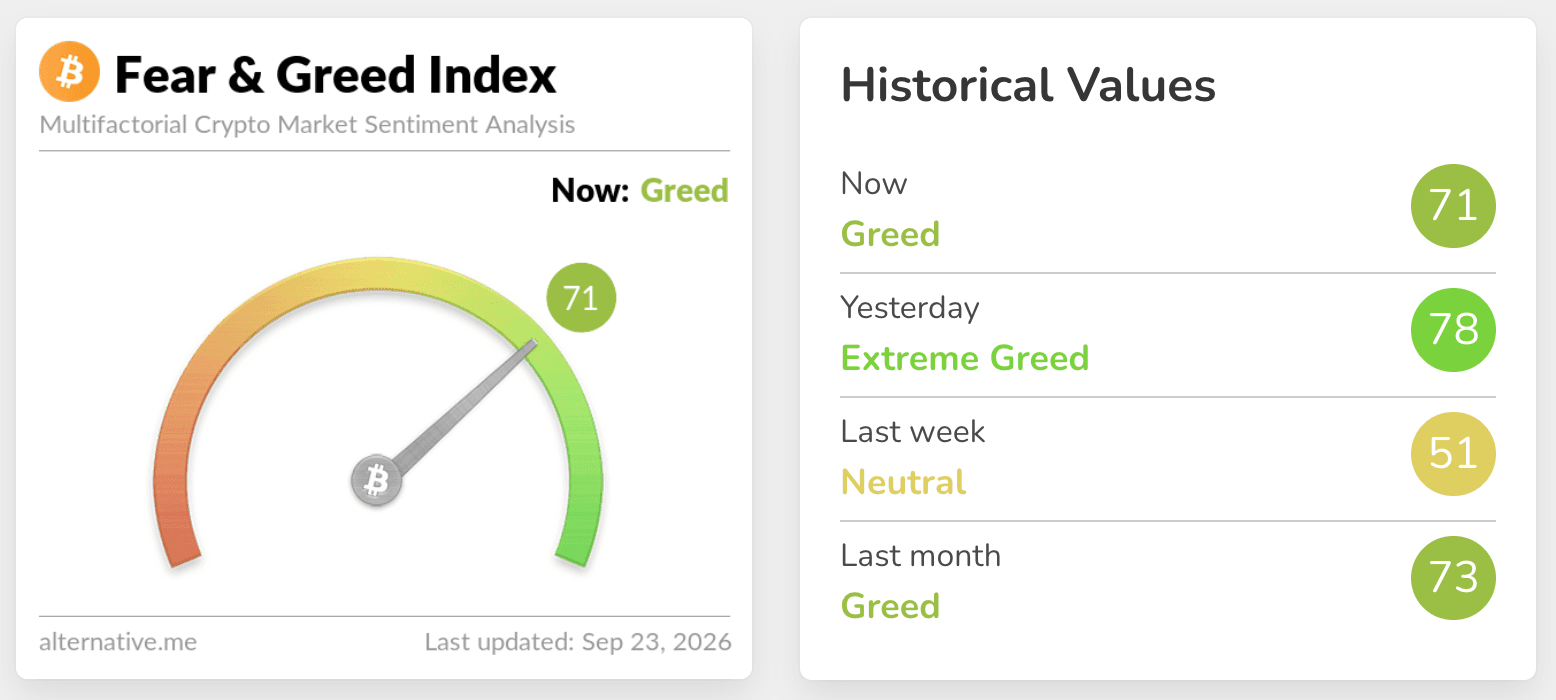
Source: Alternative
Key News Highlights:
RWA Tokenized Stocks Begin Entering Collateralized Lending Markets
Crypto lender Arch Lending plans to expand further into loans backed by tokenized equities by adding on-chain stocks to its collateral portfolio. Arch co-founder and Chief Revenue Officer Himanshu Sahay said the company expects to enter the market soon. The move comes as the rapid growth of tokenized equities begins to create demand for credit backed by these assets. Tokenized stocks have become an increasingly important segment of the on-chain real-world asset market. However, lending products that directly accept them as collateral remain relatively limited. Sahay noted that institutions including Superstate, Robinhood, and Securitize have already introduced tokenized equity products. More lenders could therefore enter the market as demand for this type of collateral grows. Arch has also expanded beyond traditional crypto assets into tokenized real-world assets in recent weeks. It has launched loans backed by Paxos Gold and Tether Gold. BTC still accounts for more than 80% of Arch's overall loan book, which shows that crypto-native assets remain its main source of collateral. The company has also seen growing demand for XRP as collateral, particularly among U.S. borrowers. Meanwhile, some tokenized ETFs have already entered DeFi lending markets. Certain platforms have also started allowing tokenized stocks to support futures and margin-related collateral use cases. According to RWA.xyz, the value of distributed tokenized equities has increased from around USD 630 million a year ago to about USD 3.15 billion. This expansion is gradually extending the use of tokenized equities beyond holding and trading into lending and collateral applications.
Bitcoin Consolidates Near $86K as Oil Prices and Iran Developments Draw Attention
BTC remains near $86K after its sharp rise in the previous session. Market attention is now focused on how the price behaves following the recent breakout. BTC briefly climbed to around $87,350 and reached its highest level in roughly 33 weeks since late January. Volatility then began to ease. At the same time, the crude oil market saw notable intraday swings on September 22. WTI crude fell to around $89.16 before recovering. The price movement came as Saudi Arabia restarted the East-West Pipeline and market participants continued to monitor oil transportation through the Strait of Hormuz. Reuters reported that the pipeline has resumed partial operations. Full capacity may still take six to eight weeks to restore because some facilities were previously damaged. U.S. President Donald Trump also said at the United Nations General Assembly that he believes the United States and Iran could reach an agreement after the U.S. midterm elections on November 3. The statement kept developments between the two countries and global energy supply in focus. On-chain data also drew attention. Glassnode said BTC's Market Value to Realized Value, or MVRV, ratio has moved back above its 365-day moving average. The ratio currently stands at around 1.62, up from about 1.19 on August 16. CryptoQuant also noted that the 30-day moving average of the MVRV ratio has broken above a range that had remained in place for several months. This has brought renewed attention to related on-chain valuation metrics. BTC remains below the previous session's high but continues to hold above $86K. Price action, crude oil volatility, and on-chain data remain among the key developments being watched in the current market environment.
Canada's Six Largest Banks Explore Tokenized Canadian Dollar Deposits
Canada's six largest banks are jointly exploring a tokenized Canadian dollar deposit system. The initiative aims to create infrastructure that would allow digital representations of bank deposits to move between financial institutions. The participating banks are Bank of Montreal, CIBC, National Bank of Canada, Royal Bank of Canada, Scotiabank, and TD Bank Group. The first phase will focus on transferring tokenized deposits between Canadian financial institutions. The banks will later assess the possibility of connecting the system with other digital asset infrastructure. These tokenized deposits represent actual funds held at regulated banks. Their legal status as bank deposits does not change simply because a different underlying technology is used. Canada's Office of the Superintendent of Financial Institutions, or OSFI, clarified this point on September 10. The regulator said tokenized deposits are not legally distinct from traditional deposits because the technology behind a financial product does not determine its legal nature. This also distinguishes tokenized bank deposits from fiat-backed stablecoins issued by non-bank entities and supported by reserve assets. The six banks said the proposed system could improve payment efficiency, shorten processing times, and support programmable payments. It is also expected to operate within existing requirements for security, stability, and regulatory oversight. The initiative may eventually be opened to other deposit-taking institutions rather than remaining limited to the six participating banks. Canada is also developing a broader regulatory framework for digital money. As a result, bank-issued tokenized deposits and non-bank stablecoins are beginning to develop under separate regulatory structures.
Disclaimer: The information provided in this section is for informational purposes only and doesn't represent any investment advice or FameEX's official view.