FameEX Today’s Crypto News Recap | October 7, 2026
2026-10-07 06:23:11

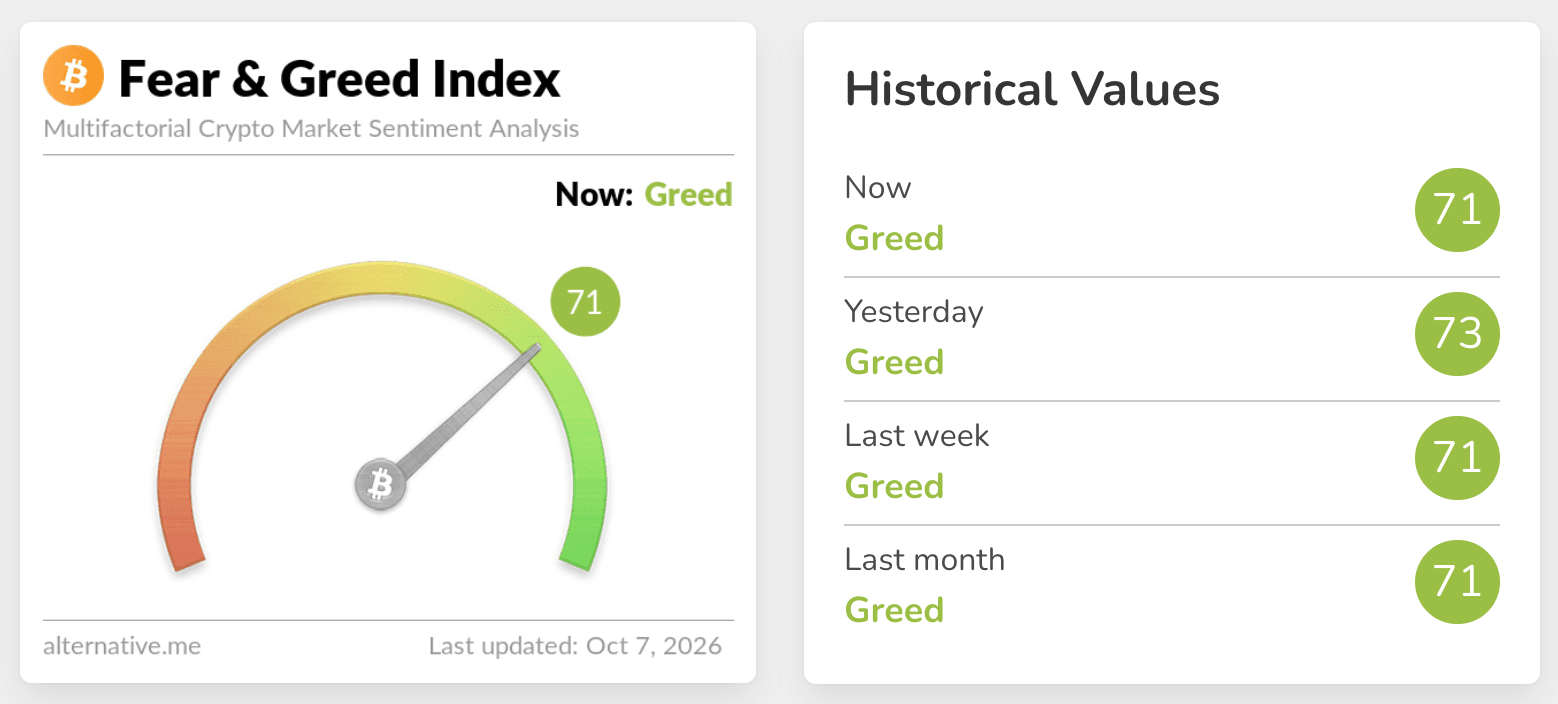
CFTC opens crypto rulemaking as Solana unveils institutional DvP and SAP Pay adds USDC payments; today’s BTC price is near $84.2K in Greed sentiment. Bitcoin is currently near $84,213, down 1.75% over the past 24 hours. Ether is near $2,609.68, down 3.39%. The Fear & Greed Index is at 71, keeping market sentiment in Greed. CoinGlass futures data among different main exchanges shows Bitcoin open interest at about $54.94 billion and Ether open interest at about $34.16 billion. In the derivatives market, Bitcoin’s average 8-hour-equivalent funding rate is around +0.0016%. Ether’s simple average across five trading venues is about +0.0010%, suggesting broadly neutral leverage conditions. Several CEXs recorded about $66.2 million in liquidations over the past 24 hours, with long positions accounting for 78% of the total. Bitcoin liquidations reached about $15.6 million, while Ether liquidations totaled about $12.6 million. ETF flows were mixed. During the latest completed U.S. trading session on October 6, U.S. spot Bitcoin ETFs recorded about $118.8 million in net inflows. Ether ETFs posted about $201.9 million in net outflows.
Source: Alternative
Key News Highlights:
CFTC Opens Consultation on Crypto Asset Trading Rules
The U.S. Commodity Futures Trading Commission (CFTC) issued an Advanced Notice of Proposed Rulemaking (ANPRM) on October 5. It is seeking public feedback on retail commodity transactions involving crypto assets under Section 2(c)(2)(D) of the Commodity Exchange Act. The consultation covers measures to prevent abusive practices in crypto markets, provide more tailored compliance guidance, and potentially create a dedicated “crypto asset market” registration subcategory through future rulemaking. The CFTC will use the feedback to evaluate possible regulatory action. The process remains at an early consultation stage and does not represent an approved or effective final rule. The initiative is based mainly on the CFTC’s existing authority over leveraged, margin, or financed retail commodity transactions. It does not establish a comprehensive new framework for the entire unleveraged spot crypto market. The CFTC said comments must be submitted within 60 days after the ANPRM is published in the Federal Register. If the process advances to a formal proposed rule, venue registration, market-abuse safeguards, disclosures, and customer trading arrangements could become key areas of focus. The most important distinction is that the launch of a rulemaking consultation does not mean new rules are already in force. The next milestones include publication in the Federal Register, the 60-day public comment period, and any more detailed proposal issued after the CFTC reviews the feedback. The potential impact on registration requirements and the broader U.S. crypto market structure will become clearer only as the regulatory process develops.
Solana Foundation Introduces Institutional DvP Standard Ahead of Production Release
The Solana Foundation announced the Solana DvP on October 6. It is an open-source delivery-versus-payment (DvP) escrow program and API designed for financial institutions. Released under the MIT license, the program is designed to settle the asset and payment legs within the same atomic transaction. Both sides complete together or neither is executed. The Foundation says Solana DvP supports SPL Token and Token-2022 and has completed an external security audit. J.P. Morgan provided input on securities settlement practices and requirements. However, the Solana Foundation explicitly stated that J.P. Morgan did not design, develop, operate, approve, or endorse Solana DvP. Delivery-versus-payment is a core settlement principle in traditional securities markets. It ensures that asset delivery and payment occur together, reducing principal risk if one side of a transaction fails to perform after the other side has already settled. Solana DvP aims to turn this model into a reusable standard on public blockchain infrastructure rather than requiring institutions to build custom smart contracts for individual transactions. For tokenized securities and other real-world assets, standardized settlement, atomic execution, asset control, and privacy are all important considerations for integration into institutional workflows.
SAP Pay Brings USDC and Stablecoin Payments Into SAP Cloud ERP
SAP announced on October 6 that it is entering the payments market with SAP Pay, powered by Tereina. The service embeds payment execution and reconciliation directly into SAP Cloud ERP. SAP’s product information shows support for ACH, EFT, wire transfers, checks, and stablecoin payments such as USDC. It also covers 89 global payment corridors. Businesses can use the service to pay suppliers, employees, and affiliates from within SAP software using either traditional currencies or stablecoins. Enterprise resource planning systems have traditionally handled accounts payable, purchase orders, and accounting records. Actual payment execution has usually required banks or third-party payment providers. SAP Pay brings payment execution closer to the ERP workflow and allows traditional fiat rails and digital currency rails to operate within the same product environment. This is different from launching a standalone crypto payment tool because stablecoin functionality is being integrated directly into the financial and reconciliation systems businesses already use. The significance of the launch lies in enterprise software beginning to incorporate stablecoins into existing payment infrastructure. It does not yet prove that businesses are adopting stablecoin payments at scale. SAP and Tereina have not disclosed transaction volumes, the share of payments made with stablecoins, or sufficient customer usage data to measure adoption. For now, SAP Pay is better viewed as an expansion of enterprise payment infrastructure. Future adoption data and stablecoin transaction volumes will provide a clearer measure of actual demand.
Bitcoin Falls Below $84,000 as Higher Oil Prices and Stronger Dollar Pressure Markets
Bitcoin briefly fell to about $83,840 after trading near $86,600 the previous day. The price later recovered to around $84,200 but remained down about 1.5% over 24 hours. Ether dropped roughly 3.5% to $2,610. Other major crypto assets also weakened, including DOGE, HYPE, and XRP. The decline came as broader risk markets turned more cautious. Iran has stepped up attacks on oil tankers in the Strait of Hormuz in recent days. Brent crude rose nearly 1% to around $101.50 per barrel, while the U.S. 10-year Treasury yield climbed to 5.31%. The dollar also strengthened and Asian equities moved lower. Markets are now awaiting the minutes from the Fed’s September meeting for further signals on the direction of interest-rate policy through the rest of the year. FxPro had previously identified $84,000 as an important technical level that could signal stronger seller control if broken. It also highlighted $83,000 as the next key support area. Bitcoin has since moved back above $84,000, but short-term attention remains focused on whether the price can hold that level. Traders are also watching whether macro risks, oil prices, Treasury yields, and interest-rate expectations continue to weigh on broader risk assets.
Disclaimer: The information provided in this section is for informational purposes only and doesn't represent any investment advice or FameEX's official view.