FameEX Today’s Crypto News Recap | October 8, 2026
2026-10-08 06:59:22

Canton CEO urges adoption as Circle and Tereina plan stablecoin payments and Ethereum tests Glamsterdam on Sepolia. Current BTC price is near $82.8K in Greed sentiment.Bitcoin and Ethereum prices remained under pressure as rising oil prices, higher U.S. Treasury yields, and widespread leveraged position liquidations triggered another round of declines across the crypto market. Bitcoin fell below $83K and briefly reached $82.7K before trading near $82.8K. Ethereum also declined to around $2,570 as major cryptocurrencies recorded broad losses. According to CoinGlass, total crypto liquidations reached USD 709 million over the past 24 hours. Long positions accounted for approximately USD 647 million, compared with USD 61.9442 million in short liquidations. This indicates that the latest market decline primarily affected leveraged traders who had positioned for higher prices. Bitcoin recorded approximately USD 172 million in long liquidations, while Ethereum saw around USD 236 million. Both assets experienced substantial adjustments in leveraged positions. Spot ETF flows also remained weak. According to SoSoValue, U.S. spot Bitcoin ETFs recorded approximately USD 487 million in net outflows during the previous trading session. Spot Ethereum ETFs saw approximately USD 161 million in net outflows, marking their seventh consecutive trading day of withdrawals. Market sentiment also weakened as the Crypto Fear and Greed Index fell from 71 yesterday to 64. Although the index remained in the Greed zone, overall risk appetite showed signs of cooling. Meanwhile, geopolitical tensions in the Middle East added pressure to global financial markets. Brent crude briefly climbed above $102 per barrel, while the U.S. 10-year Treasury yield rose to approximately 5.31%. A stronger U.S. dollar also weighed on risk assets. Overall, the crypto market is facing simultaneous pressure from spot capital outflows, leveraged long liquidations, and rising macroeconomic risks. Future price movements will depend partly on changes in spot demand, derivatives positioning, and market liquidity.
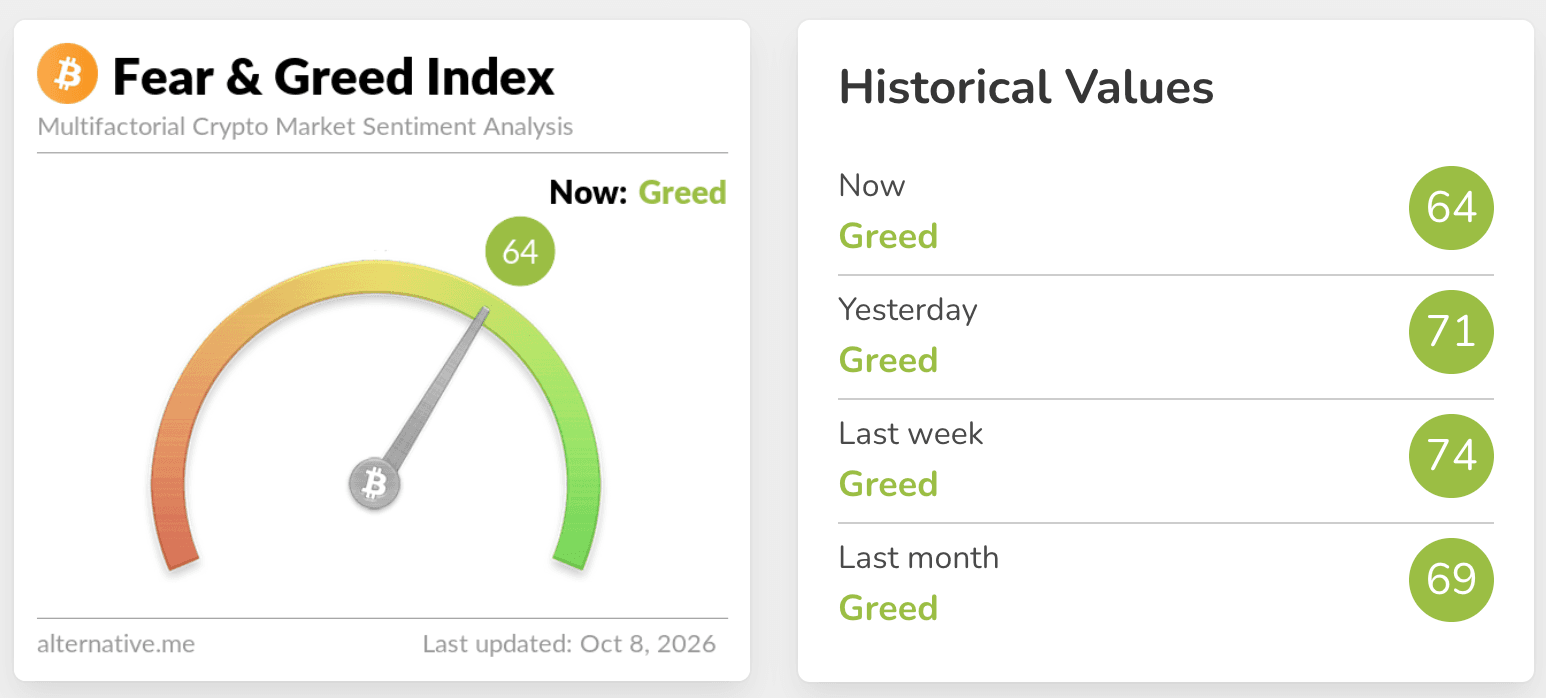
Source: Alternative
Key News Highlights:
Canton CEO Calls for Faster Institutional Blockchain Adoption to Reduce Impact of US Policy Shifts
Digital Asset co-founder and CEO Yuval Rooz, whose company develops technology for Canton Network, urged the crypto industry to take advantage of the current U.S. regulatory environment to accelerate institutional blockchain adoption. Speaking at TOKEN2049 in Singapore, Rooz argued that the industry's long-term development should not depend entirely on the policies of any single administration. Instead, broader real-world adoption could gradually establish blockchain as an integral part of financial services and enterprise operations. Rooz specifically referenced the 2028 U.S. presidential election and warned that future administrations could introduce different regulatory priorities for digital assets. He encouraged the industry to establish a sufficiently mature foundation of practical applications before the policy environment changes. Rooz compared blockchain adoption with the growth of Uber and Airbnb. Both companies became widely used before regulators could fully address their business models. In his view, policymakers must consider established user demand and existing market practices when introducing new rules for technologies that have already achieved widespread adoption. His comments came amid continued uncertainty surrounding U.S. digital asset market structure legislation. The CLARITY Act failed to secure sufficient support during a Senate procedural vote in September, leaving the industry awaiting a clearer federal legislative framework. Richard Teng, co-CEO of a major centralized crypto exchange, said at the same event that passing the legislation would help establish a more stable legal foundation and reduce the possibility of significant regulatory reversals. Franklin Templeton CEO Jenny Johnson also acknowledged the importance of legislative certainty but cautioned against making industry development dependent on the passage of a single bill. She noted that the U.S. Securities and Exchange Commission (SEC) and Commodity Futures Trading Commission (CFTC) were already advancing digital asset regulations under their existing authority. These efforts could continue to support technological innovation and institutional participation. The discussion highlighted concerns about the long-term stability of U.S. crypto regulation and the challenges financial institutions face when expanding blockchain adoption under an evolving legal framework.
Circle Partners With SAP-Backed Tereina to Integrate USDC and EURC Into Enterprise Payments
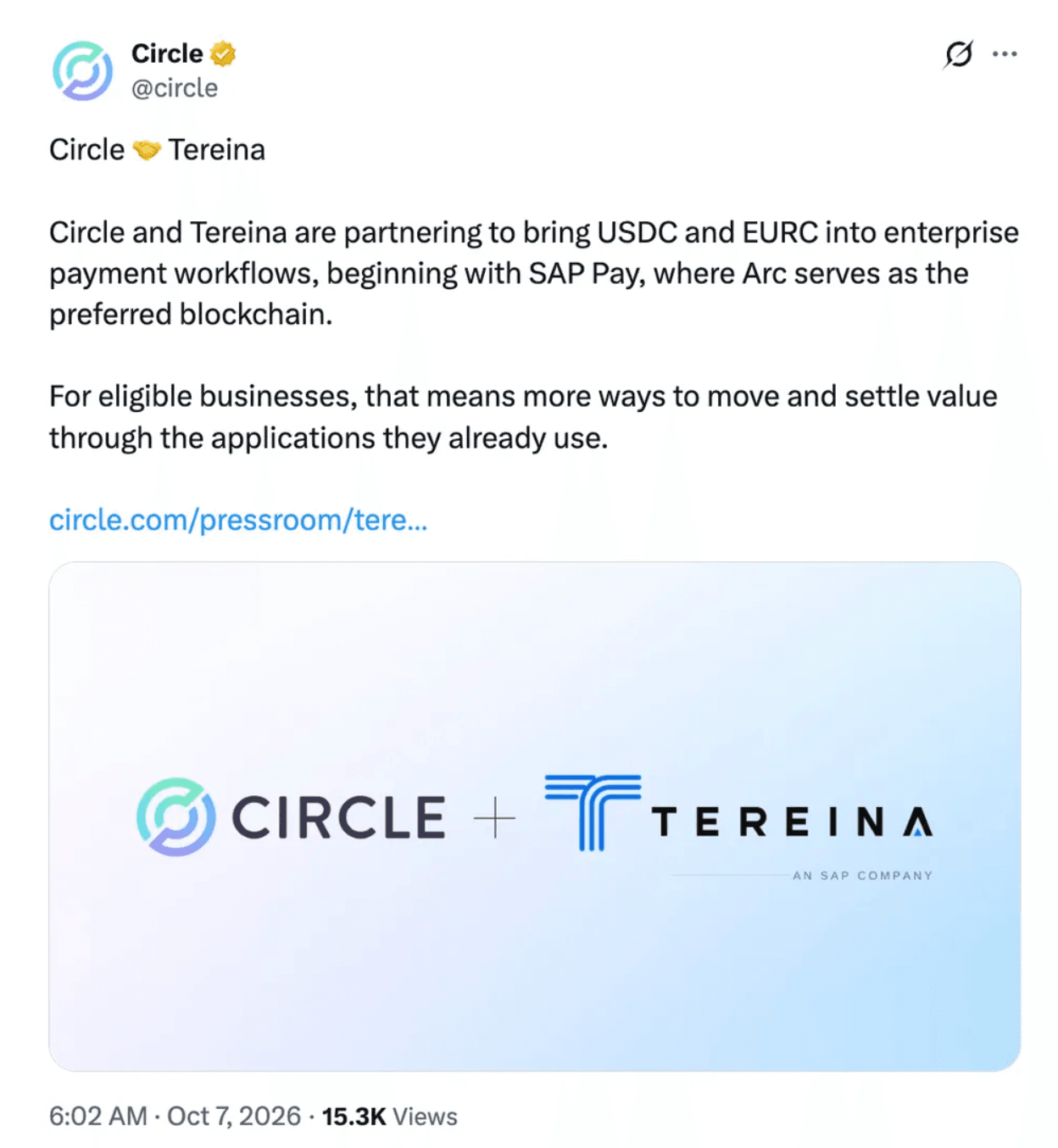
Stablecoin issuer Circle announced a partnership with Tereina, a financial services company backed by German enterprise software provider SAP. The collaboration aims to integrate USDC and EURC into financial management and payment systems already used by businesses. According to the announcement, the integration will initially focus on the SAP Cloud ERP and SAP Pay ecosystem. Eligible businesses will be able to send and receive stablecoin payments directly through their existing enterprise software without switching to a separate digital asset payment platform. USDC will serve as the preferred stablecoin for U.S. dollar-denominated transactions, while EURC will support euro-denominated payments. This arrangement will allow businesses to select digital currencies that correspond to their settlement requirements. Tereina provides payment infrastructure that can be embedded into enterprise applications. Its services combine traditional financial payment channels with digital asset settlement capabilities to support a wider range of fund transfers within existing corporate workflows. Over the coming months, Circle and Tereina plan to work with customers on practical integration tests covering cross-border payments, global treasury operations, and corporate financial management. The process will also include system testing and staff training based on specific business requirements. Circle cited an estimate that SAP's ecosystem supports approximately 84% of global commerce to illustrate the scale of the enterprise software market involved in the partnership. However, this figure does not mean that an equivalent share of global transactions is currently settled using stablecoins. Circle co-founder and CEO Jeremy Allaire said stablecoins are increasingly becoming part of global commercial payment infrastructure. Integrating digital currencies into familiar enterprise applications is one of the company's approaches to expanding business payment services. Tereina CEO Cedric Bru emphasized that the partnership aims to make stablecoin payments available through enterprise software without requiring businesses to make major changes to their existing operations. The collaboration reflects the growing integration of stablecoin payment services into corporate treasury management, cross-border transactions, and traditional financial systems.
Ethereum Glamsterdam Upgrade Goes Live on Sepolia Testnet With Block Gas Limit Near 200 Million
Ethereum's Glamsterdam network upgrade was activated on the Sepolia public testnet on October 6. Developers are now examining transaction processing capacity and node performance under the updated protocol rules through live testnet block activity. The upgrade increased Sepolia's block gas limit from approximately 60 million to nearly 200 million, representing an increase of more than threefold. This change provides additional execution capacity for transactions on the test network. Gas is the unit used to measure the computational resources required to execute transactions and smart contracts on Ethereum. A higher block gas limit allows more computational work to be included in a single block, although it does not necessarily result in a proportional increase in actual transaction throughput. According to CoinDesk's review of more than 25 consecutive test blocks, gas usage ranged from approximately 52 million to 92 million per block. This represented about 26% to 46% of the available limit, and none of the observed blocks approached full capacity. Glamsterdam also introduces protocol-level proposer-builder separation, which changes how transaction blocks are constructed and validated. The mechanism gives validators more time to verify the validity of transactions included in each block. Another major feature is the introduction of block-level access lists. These lists identify the accounts and stored data involved in block transactions so that nodes can retrieve the required information in advance. This approach also enables certain transaction validation tasks to be processed in parallel. The upgrade further adjusts gas pricing for specific computational operations and on-chain data storage. As a result, developers must retest certain smart contracts and applications that rely on fixed gas cost assumptions to confirm compatibility. Under the previously announced testing schedule, the next public testnet upgrade on Hoodi is tentatively planned for October 27. However, the Ethereum Foundation has not yet officially confirmed the activation dates for Hoodi or the Ethereum mainnet. The Sepolia activation remains part of the testing phase before mainnet deployment. Its nearly 200 million block gas limit applies to the test environment and should not be interpreted as an equivalent capacity increase already implemented on Ethereum mainnet.
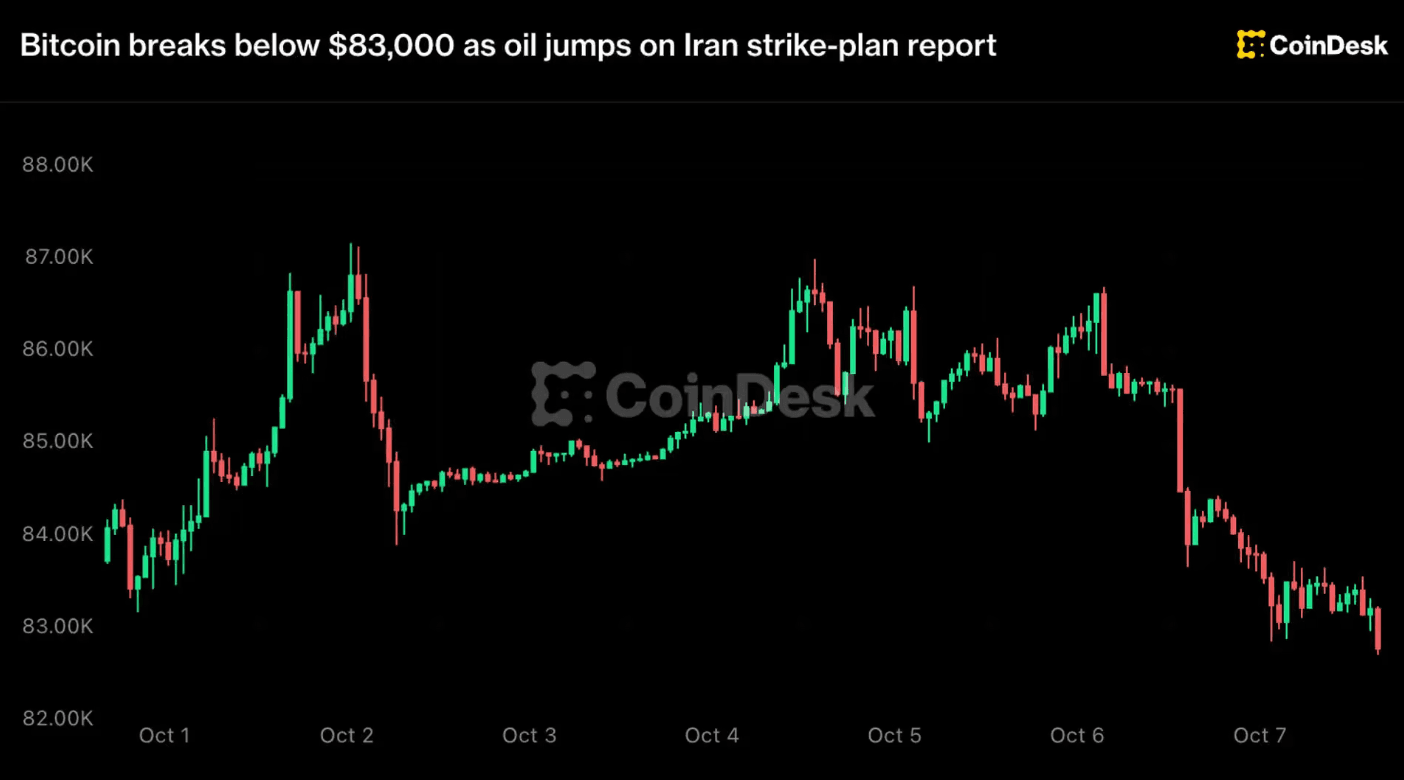
Bitcoin Falls Below $83K to New October Low as Middle East Tensions Push Oil Prices Higher
Crypto markets extended their losses during Asian trading hours on October 8 as geopolitical tensions in the Middle East drove international oil prices and U.S. Treasury yields higher. Bitcoin fell below $83K and reached one of its lowest levels of the month. The cryptocurrency declined approximately 1.6% and briefly traded below $82.8K. Ethereum, XRP, Dogecoin, and Solana also recorded varying degrees of losses. Market attention centered on reports that the White House had requested military strike options against Iran from the Pentagon. Continued uncertainty surrounding Middle East shipping routes and energy supplies added to concerns across global financial markets. At the same time, storms disrupted some oil production activities in the U.S. Gulf of Mexico. Reports of potential regional supply interruptions became another focus for energy traders. Brent crude briefly climbed above $102 per barrel, while the U.S. 10-year Treasury yield rose to approximately 5.31%, approaching its highest levels in decades. These developments highlighted the relationship between energy prices, inflation expectations, and global financing costs. U.S. equities retreated after previously reaching record highs, and major Asian stock markets also came under pressure. The broader decline showed that the volatility extended beyond cryptocurrencies. Among major digital assets, XRP fell nearly 4% to approximately $1.42. Dogecoin declined around 3%, while Ethereum traded near $2,570. Solana and HYPE each recorded losses of more than 2%. The derivatives market also experienced substantial position liquidations. According to CoinGlass, total crypto liquidations reached USD 709 million over the past 24 hours, with long positions accounting for the vast majority. This indicates that some leveraged bullish positions were forcibly closed as prices declined. The latest market developments involved multiple factors, including energy supply risks, rising U.S. Treasury yields, global equity market volatility, and adjustments in leveraged crypto positions. The available data showed that several financial markets were experiencing pressure during the same period.
Disclaimer: The information provided in this section is for informational purposes only and doesn't represent any investment advice or FameEX's official view.