FameEX Today’s Crypto News Recap | October 15, 2026
2026-10-15 06:56:34

Illinois delays its 0.2% crypto tax by six months as U.S. CPI hits 3.7% and ETH leads BTC in $483M liquidations. Today’s BTC price is near $81K amid Greed sentiment. Cryptocurrency markets came under pressure as hotter-than-expected U.S. inflation data coincided with a broad selloff in global risk assets. Bitcoin briefly fell to $80,230 during Asian trading hours before recovering to around $81K after breaking below that level. The cryptocurrency declined approximately 3% over 24 hours. ETH fell below $2,400 and briefly traded under $2,350. Its 24-hour decline exceeded 6%, significantly underperforming Bitcoin. U.S. Consumer Price Index (CPI) inflation rose to 3.7% year over year in September, renewing expectations of a potential Federal Reserve rate hike in October and placing additional valuation and liquidity pressure on risk assets, including equities and cryptocurrencies. Asian stock markets also declined, with South Korea's KOSPI index falling approximately 8% intraday and triggering market circuit breakers. The sharp decline reflected growing sensitivity to changes in global financial conditions. In derivatives markets, rapid price declines triggered widespread liquidations of leveraged long positions. ETH futures accounted for a particularly large share of liquidations, highlighting the pressure on highly leveraged positions during the market correction. Meanwhile, the Crypto Fear & Greed Index rose to 62 from 57 the previous day and remained in Greed territory despite the sharp intraday price declines. U.S. Treasury yields also fell as safe-haven demand increased, reflecting a broader reallocation of capital across traditional financial markets. Overall, inflation expectations, monetary policy uncertainty, and leveraged liquidations are collectively shaping current market conditions. Short-term trading activity continues to reflect heightened volatility and weakening risk appetite.
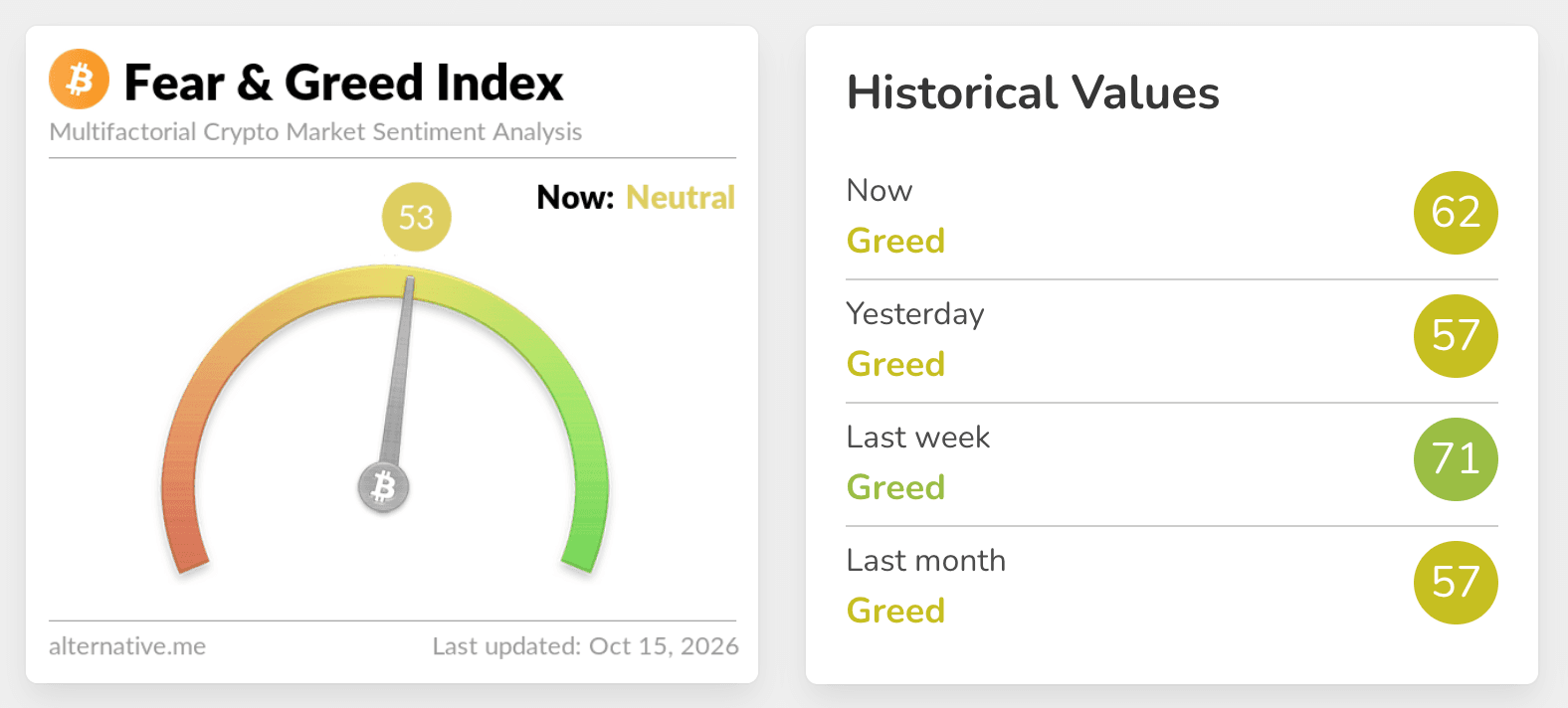
Source: Alternative
Key News Highlights:
Illinois Delays Crypto Asset Tax by Six Months as Industry Groups Seek Expedited Court Ruling
The legal dispute surrounding Illinois' proposed 0.2% tax on digital assets continues as several cryptocurrency industry organizations seek an expedited court ruling on the law's validity. The Crypto Council for Innovation (CCI) and Blockchain Association (BA) have joined legal efforts led by the Digital Chamber and other industry groups to secure a ruling on the merits of Illinois' Digital Asset Tax Act. The organizations filed a motion with the Circuit Court of Sangamon County requesting an expedited summary judgment schedule. The proposed procedure would allow the court to examine the law's validity without proceeding through a full trial. Illinois officials previously agreed to postpone implementation of the 0.2% crypto asset tax for six months, moving its scheduled effective date from January 1, 2027, to July 1, 2027. The delay followed a lawsuit filed by the Digital Chamber. Industry organizations argue that the tax provisions were incorporated into the state's budget process without sufficient public debate or opportunities for public comment. CCI CEO Ji Kim stated that the temporary suspension provides short-term protection for consumers and businesses but emphasized the importance of obtaining a timely judicial determination on the law's validity. Digital Chamber CEO Cody Carbone also confirmed that industry groups would continue pursuing legal action despite the implementation delay. If the court approves the proposed expedited schedule, a ruling on the merits could be issued as early as March 2027. The postponement does not mean the tax has been repealed, and the court has not yet issued a final decision on its legality. The central questions concern the legislative process used to establish the digital asset tax and whether the law should remain in effect.
U.S. Inflation Rises to 3.7% as Rate Hike Expectations Weigh on Asian Stocks and Bitcoin
The U.S. inflation data is higher than expected and has renewed concerns about further Federal Reserve monetary tightening and contributed to simultaneous declines across global equity and cryptocurrency markets. The latest figures showed that headline U.S. Consumer Price Index (CPI) inflation reached 3.7% year over year in September, up from 3.4% in August. Core CPI inflation, which excludes food and energy prices, also increased from 2.4% to 2.6%. These readings indicate that inflationary pressures have yet to fully subside. Following the release, markets quickly reassessed expectations for the Federal Reserve's October interest rate decision. According to CME Group's FedWatch tool, the probability of an October rate hike briefly climbed from approximately 22% to nearly 47% before easing to around 26%. Although expectations for an immediate rate increase subsequently moderated, the inflation report reinforced concerns that interest rates could remain elevated for longer. In cryptocurrency markets, Bitcoin briefly fell below $81K and approached $80K before recovering. Ether, XRP, and SOL also recorded declines of varying degrees. Traditional financial markets faced similar pressure. The Nasdaq Composite declined approximately 1.9% in the previous trading session, while technology and semiconductor stocks led losses across Asian markets. Meanwhile, safe-haven demand for U.S. Treasury securities increased and pushed some Treasury yields lower. This reflected a broader shift in capital allocation across asset classes. Market data cited by media reports also showed that U.S. spot Bitcoin exchange-traded funds (ETFs) recorded net outflows of approximately USD 150.5 million on October 14, reversing net inflows of around USD 175.7 million in the previous trading session. Investors are now awaiting the U.S. Producer Price Index (PPI) release and further comments from Federal Reserve officials for additional insight into inflation trends and the monetary policy outlook.
Crypto Liquidations Surge as ETH Contracts Face Greater Pressure Than Bitcoin
The simultaneous decline in Bitcoin, ETH, and other major cryptocurrencies triggered widespread liquidations of leveraged positions across crypto derivatives markets. ETH futures recorded substantially higher liquidation values than Bitcoin futures during the market downturn. According to media reports citing CoinGlass data, approximately USD 483 million in Bitcoin and ETH futures positions were liquidated over a 24-hour period measured during Asian trading hours. ETH accounted for approximately USD 286 million in liquidations, compared with around USD 197 million for Bitcoin. This indicates that ETH derivatives positions experienced greater liquidation pressure during the selloff. Over the same period, Bitcoin declined approximately 3.2%, while ETH fell around 6.4%. The difference in price performance was broadly consistent with the distribution of liquidations between the two assets. In terms of derivatives market size, ETH futures open interest stood at approximately USD 30 billion, compared with around USD 52 billion for Bitcoin. Despite its smaller outstanding futures market, ETH recorded a higher total liquidation value. Liquidations typically occur when leveraged traders no longer have sufficient margin to maintain their existing positions. Trading systems then automatically close those positions according to established risk management requirements. The reported liquidation values represent the notional value of forcibly closed positions rather than the actual amount of margin lost by individual traders. Liquidation activity also extended beyond BTC and ETH. SOL futures recorded approximately USD 31 million in liquidations, while ZEC futures approached USD 19 million. Corresponding price movements showed SOL declining roughly 5.5% and ZEC falling approximately 13%. These figures demonstrate how volatility spreads across crypto assets of different market sizes. The widespread liquidations also illustrate how price movements associated with macroeconomic developments can transmit additional pressure through leveraged trading and reshape derivatives market positioning.
Kalshi CEO Warns State-Level Regulation Could Force U.S. Prediction Markets Offshore
Kalshi CEO Tarek Mansour warned that prediction market operators could be forced to move their businesses overseas if U.S. courts ultimately support state-level gambling regulation of prediction markets. His comments come amid an ongoing legal dispute over regulatory authority for event contracts in the United States. Speaking at DC Fintech Week near Washington on October 14, Mansour argued that the controversy extends beyond the division of authority between state and federal regulators. He emphasized that the outcome could determine whether prediction market businesses can continue operating within the United States. Several U.S. states have challenged Kalshi and other prediction market platforms in court. State authorities argue that contracts tied to sporting event outcomes constitute gambling activities and should therefore fall under state gambling regulations. Kalshi and the U.S. Commodity Futures Trading Commission (CFTC) have taken a different position. They maintain that these event contracts should be treated as financial products under the federal commodities and derivatives regulatory framework, with oversight assigned to federal authorities. The disputes have reached several federal appellate courts, but the rulings have not established a consistent legal interpretation. One significant decision supported Kalshi's position, while two others favored the states' arguments. In response to the conflicting rulings, New Jersey has asked the U.S. Supreme Court to review the matter. Organizations including the National Football League (NFL) have also submitted their views on the regulatory dispute. Mansour argued that sports-related event contracts can have economic consequences and should not be excluded from financial product classifications solely because they involve sporting events. Meanwhile, the CFTC has continued advancing its regulatory framework for event contracts, including proposals to explicitly bring certain contracts within its oversight of swaps. Mansour also addressed questions surrounding reported Bitcoin and ETH perpetual futures trading volumes on the Kalshi platform. He explained that some recurring fixed-size transactions reflected standardized orders placed by market makers. The related legal proceedings remain ongoing, and the regulatory boundaries between federal and state authorities over U.S. prediction markets have yet to be conclusively determined.
Disclaimer: The information provided in this section is for informational purposes only and doesn't represent any investment advice or FameEX's official view.