FameEX Today’s Crypto News Recap | October 26, 2026
2026-10-26 09:25:03

Elon Musk warns AI clouds may fail as Hong Kong names Solana Company and Electrum patches a wallet flaw. Today’s BTC is near $80.3K amid Neutral sentiment. Cryptocurrency markets extended their recent decline as Bitcoin (BTC) briefly fell below $80K during early Asian trading and touched approximately $79.8K before recovering toward $80K. BTC was later quoted near $80,282, while Ethereum (ETH) dropped to around $2,300 in early trading as major crypto assets continued to face short-term selling pressure. The market downturn came ahead of the Federal Reserve's interest rate meeting on October 27–28. Traders remained focused on the upcoming policy statement and future interest rate decisions. Weakness in Asian technology and artificial intelligence stocks added further pressure to risk assets. The Crypto Fear and Greed Index fell to 50 from 54 the previous day. Market sentiment remained Neutral but had weakened considerably from last week's Greed reading. According to CoinGlass, total cryptocurrency liquidations reached approximately USD 119 million over the past 24 hours. Long liquidations accounted for USD 82.0113 million compared with USD 36.7092 million in short liquidations. This indicated that leveraged long positions absorbed a larger share of losses during the market decline. Bitcoin recorded approximately USD 13.2446 million in long liquidations and USD 5.7066 million in short liquidations. Ethereum saw respectively USD 22.4119 million and USD 9.8136 million in long and short liquidations. ETH's higher liquidation volume indicated more concentrated position adjustments in its derivatives market. Spot market monitoring also showed that BTC buy-side liquidity near the current price remained deeper than sell-side liquidity on certain major centralized exchanges. However, order book imbalances reflect liquidity conditions within specific price ranges and timeframes. They do not necessarily confirm a broader recovery in market demand. CoinGlass liquidation estimates identified concentrated short liquidation exposure above $84,240 for BTC and long liquidation exposure below $76,764. These figures represent estimated liquidation intensity rather than actual liquidated positions. For ETH, substantial potential liquidation exposure was concentrated below $2,239 and above $2,464. Derivatives positioning around these levels remained an important factor to monitor. On-chain monitoring also showed that the Ethereum Foundation exchanged 2,785 ETH for approximately USD 6.42 million in USDS through CoWSwap. The transaction added another notable asset movement to recent on-chain activity, although available information does not establish a direct impact on ETH's market price. Overall, cryptocurrency markets continued to respond to monetary policy expectations, technology stock weakness, derivatives liquidations and on-chain capital movements. Short-term price changes in BTC and ETH therefore remained closely linked to spot liquidity conditions and shifts in leveraged positioning.
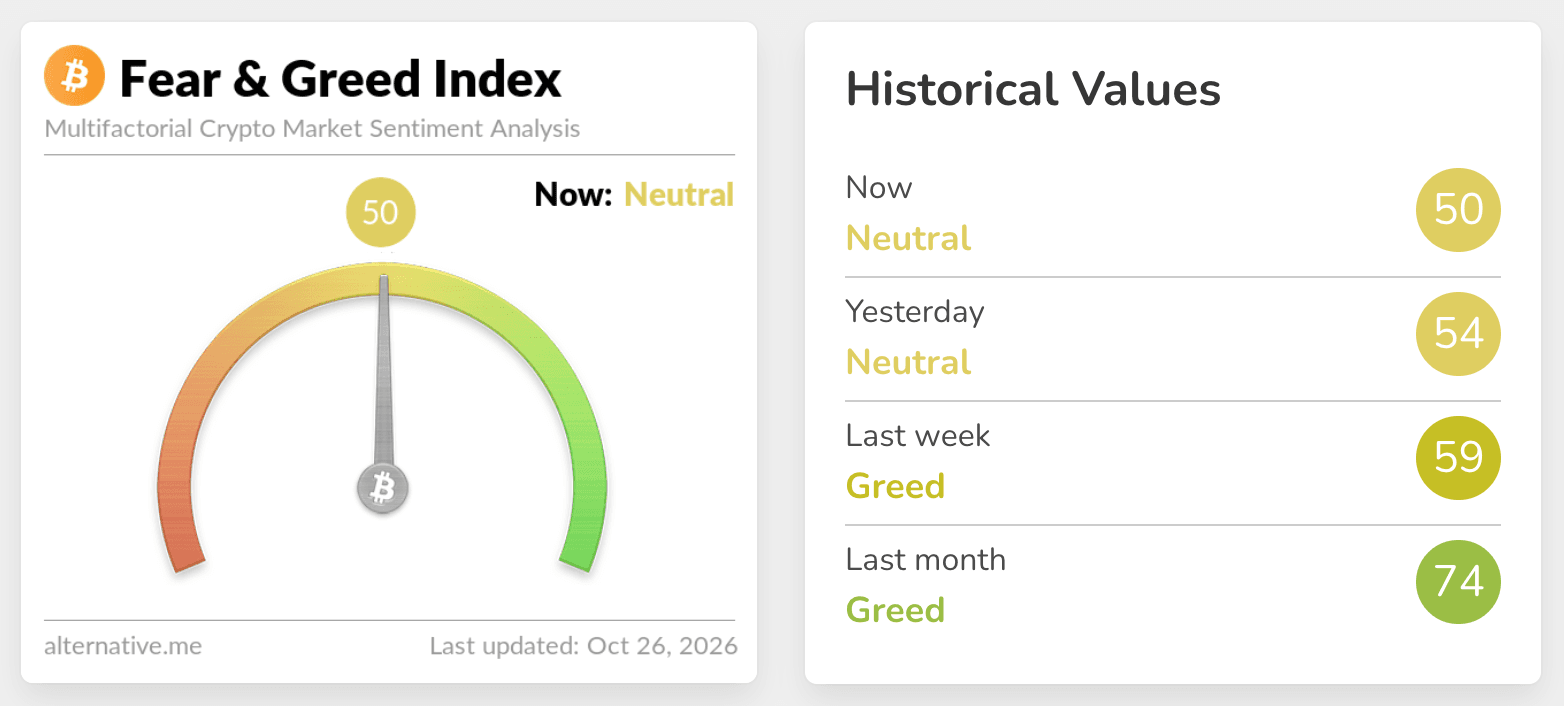
Source: Alternative
Key News Highlights:
Elon Musk Warns Over 200 AI Neocloud Providers Face Failure Or Consolidation As Gartner Forecasts Over 80% Will Lose Independence By 2030
Tesla CEO Elon Musk raised concerns about financing conditions across the AI infrastructure industry. He warned that more than 200 specialized AI cloud providers, commonly known as neoclouds, could face severe funding constraints and industry consolidation. Some may struggle to remain independent. In an October 25 post on X, Musk said lenders had become increasingly reluctant to finance companies without substantial revenue streams beyond AI data centers. This tightening of credit conditions presents particular challenges for businesses that rely heavily on debt to purchase graphics processing units (GPUs) and expand data center capacity. Musk also claimed that SpaceX had secured approximately USD 40 billion in debt financing for GPU infrastructure. He attributed the financing to the company's investment-grade credit profile and diversified revenue from Starlink satellite internet services and rocket operations. However, other media reports presented differing accounts of the financing arrangement and its progress. Neoclouds are specialized cloud infrastructure providers that rent AI computing capacity to enterprise customers through large GPU clusters and dedicated data centers. Their business models generally require substantial upfront investment in computing hardware and supporting infrastructure. Providers then seek to recover these costs through customer contracts and recurring cloud service revenue. Research firm Gartner issued a similar warning in a report published on October 14. It projected that more than 80% of neocloud providers could cease operating independently by 2030 due to rising operating costs, limited business differentiation and pressure to generate adequate returns on invested capital. These outcomes could include mergers and acquisitions rather than outright business failures. Gartner estimated that AI service providers would spend nearly USD 1 trillion on infrastructure in 2026, followed by approximately USD 6 trillion in additional investment between 2027 and 2030. However, projected revenue from enterprise and consumer AI services may not be sufficient to deliver profitable returns across all planned projects. The report also forecasts that spending on AI-optimized infrastructure-as-a-service would increase from USD 66 billion in 2027 to USD 174 billion in 2030. Rapid GPU replacement cycles and hardware depreciation could nevertheless prevent some companies from recovering their infrastructure investments before their equipment becomes outdated. These concerns also extend to Bitcoin mining companies expanding into AI infrastructure. IREN has developed AI cloud computing services, while Core Scientific provides data center hosting for specialized cloud operators. Their operations increasingly span both cryptocurrency mining and high-performance computing infrastructure. Musk's comments and Gartner's research highlighted the financing constraints, infrastructure costs and revenue challenges facing the AI computing industry. The financial structures and business models of specialized cloud providers have consequently become an important topic across the technology and digital asset sectors.
Hong Kong Names Solana Company Strategic Enterprise With Plans For Validator Operations And Asia-Pacific Blockchain Infrastructure
Nasdaq-listed Solana Company (HSDT) announced that it had been selected as a strategic enterprise by Hong Kong's Office for Attracting Strategic Enterprises (OASES). The designation places the company among businesses participating in Hong Kong's initiative to attract international investment and support the development of strategically important industries. Solana Company was the only blockchain infrastructure firm selected by OASES in 2026 and joined the seventh batch of enterprises admitted to the program. The latest group includes companies involved in artificial intelligence, financial technology, advanced manufacturing and other emerging industries. The Hong Kong government also confirmed that 18 additional enterprises had joined the initiative, bringing the total number of participating strategic enterprises to 142. These companies are expected to establish or expand local operations and contribute to investment and industry development across Hong Kong. Solana Company specializes in infrastructure services for the Solana blockchain. Its operations include validator services, staking infrastructure and advisory support for financial institutions exploring blockchain adoption. The company also holds SOL as part of its corporate digital asset treasury strategy. According to its announcement, Hong Kong will serve as its Asia-Pacific headquarters and regional business hub. The company plans to establish Solana validator operations in the city to support transaction validation and blockchain network operations. The planned infrastructure will form part of its Pacific Backbone initiative. This project aims to establish a low-latency blockchain infrastructure network across the Asia-Pacific region and support regional connectivity and validator services. Solana Company stated that its strategic enterprise designation would provide a dedicated channel for coordination with Hong Kong government departments and regulators. The program also offers administrative support for recruiting overseas talent, developing business partnerships and connecting with local institutional partners. Hong Kong has continued to develop its digital asset regulatory framework and financial infrastructure in recent years. Key initiatives include stablecoin regulation, asset tokenization programs and the licensing framework for virtual asset trading platforms. The government's efforts to attract blockchain infrastructure companies have progressed alongside these broader policy developments. Solana Company's selection represents an enterprise development and investment initiative rather than regulatory endorsement of SOL's investment value or any specific digital asset product. Its planned operations in Hong Kong will remain subject to applicable regulations and the company's implementation arrangements.
Bitcoin Briefly Falls Below $80K As Markets Reduce Risk Exposure Ahead Of Fed Meeting
Bitcoin briefly fell below $80K and declined to approximately $79.8K as major cryptocurrencies moved lower across the market. Attention centered on the Federal Reserve's upcoming interest rate meeting and the continued weakness in Asian technology stocks. Other major digital assets also recorded losses. XRP fell to approximately $1.28, while SOL approached $100. DOGE, ZEC, HYPE and BNB each declined by around 1% to 2%. TRX was among the few major cryptocurrencies that maintained a modest gain during the period. The Federal Reserve is scheduled to hold its Federal Open Market Committee (FOMC) meeting on October 27–28. Market participants are closely watching the interest rate decision and accompanying policy statement. They are also awaiting comments from Fed Chair Kevin Warsh on inflation and the future direction of monetary policy. Some analysts expect the Fed to leave interest rates unchanged at the upcoming meeting. However, the possibility of another rate increase in December remains an important consideration for traders. These expectations reflect market assessments rather than confirmed policy decisions. Asian equity markets also faced pressure amid concerns about AI industry valuations and corporate investment returns. Technology-related stocks in South Korea and Japan declined, while Goldman Sachs lowered its 12-month target for South Korea's KOSPI index by 25%. The revision renewed attention on semiconductor manufacturers and AI-related companies. Meanwhile, the MSCI Asia Pacific Index edged lower. The broader decline showed that technology stock weakness extended across several major Asian markets rather than being confined to a single economy. In energy markets, Brent crude fell approximately 2% from recent highs but remained near $114 per barrel. Developments in the Middle East and elevated energy costs continued to feature prominently in discussions of the global macroeconomic outlook. For cryptocurrency markets, Federal Reserve policy, U.S. dollar liquidity, technology stock performance and derivatives positioning remained key developments throughout the week. Bitcoin's brief decline below $80K also became a notable market event as traders assessed the latest changes in risk assets.
Electrum Patches Bitcoin Wallet Transaction Replacement Vulnerability After Malicious Servers Tricked Users Into Signing Fraudulent Payments
Bitcoin software wallet Electrum released version 4.8.3 to address a high-risk security vulnerability involving the verification of unconfirmed transaction data. The flaw could cause users to unknowingly authorize payments to attacker-controlled addresses when attempting to increase transaction fees. Electrum is one of Bitcoin's longest-running lightweight software wallets. Unlike a full Bitcoin node that independently verifies blockchain data, Electrum relies on external servers to retrieve transaction histories, access unconfirmed transaction information and broadcast payments. According to the development team's security advisory, attackers operating malicious servers could exploit the affected versions by intercepting legitimate transactions before they were successfully broadcast to the Bitcoin network. They could then display fraudulent transactions in the wallet's history with the original recipient addresses replaced by attacker-controlled addresses. Earlier versions of Electrum did not perform the necessary signature verification on certain unconfirmed transactions. Therefore, users could see pending payments that appeared legitimate even though their transaction details had been altered. The vulnerability involved Bitcoin's Replace-by-Fee (RBF) mechanism. This feature allows users to replace unconfirmed transactions with new versions carrying higher transaction fees. Attackers exploited the process by inducing users to sign replacement transactions that contained fraudulent payment details. The development team reported that attackers sometimes assigned zero transaction fees to malicious payments. This made the transactions appear stuck and increased the likelihood that users would attempt to accelerate confirmation. Attackers also generated receiving addresses with the same final four characters as the legitimate destination addresses. This technique made the substitutions harder to detect during a quick address check. Electrum received two user reports on October 11 and October 18. The first involved suspicious transaction records in a multisignature wallet, while the second confirmed that a user had lost Bitcoin after increasing the fee on a substituted transaction. The developers did not disclose the amount stolen. Electrum version 4.8.3 introduced signature verification for unconfirmed transactions spending funds from the user's own wallet. The update prevents fraudulent transactions from being treated as valid payments through the affected replacement process. The development team also advised users to update their wallets and carefully verify complete recipient addresses and payment amounts before signing transactions. This recommendation also applies when users are only adjusting the transaction fees of existing payments. According to the developers, users connected exclusively to trusted servers or servers they operated themselves were not exposed to this specific attack. The confirmed vulnerability affected interactions between older Electrum versions and malicious external servers.
Disclaimer: The information provided in this section is for informational purposes only and doesn't represent any investment advice or FameEX's official view.