FameEX Today’s Crypto News Recap | September 29, 2026
2026-09-29 06:53:20

NVIDIA launches AI agent safety tools as ETH ETFs extend inflows and Goldman brings a $100B Treasury fund to Lynq; today’s BTC price is near $83.2K in Greed sentiment. Bitcoin is near $83.2K today, down about 0.4% over the past 24 hours. The price has returned to a softer consolidation phase following its earlier rebound. Ethereum is trading around $2,668.7, up about 0.4% over the same period and showing greater short-term resilience than Bitcoin. From a broader market-structure perspective, BTC has struggled to extend its previous upward momentum. ETH has remained above $2,600 despite wider market volatility, creating some divergence between the two largest crypto assets. The Crypto Fear and Greed Index currently stands at 73 in the Greed zone. This is slightly below yesterday’s 74 and down from last week’s Extreme Greed reading of 78. Market sentiment therefore remains positive, although overall enthusiasm has eased. In the derivatives market, total liquidations reached approximately USD 534 million over the past 24 hours. Long liquidations accounted for about USD 431 million, while short liquidations totaled roughly USD 103 million. Bitcoin recorded approximately USD 92.2689 million in long liquidations and USD 28.9328 million in short liquidations. This indicates that the recent price pullback placed greater pressure on leveraged long positions. Ethereum saw around USD 54.1313 million in long liquidations and USD 30.3838 million in short liquidations during the same period. ETH remained relatively stable on the day, but highly leveraged positions continued to face pressure from market volatility. Coinglass liquidation data shows that if BTC falls below $79,328, cumulative long liquidation intensity across major CEXs could reach USD 1.616 billion. If BTC rises above $87,154, cumulative short liquidation intensity could reach approximately USD 1.288 billion. For ETH, a drop below $2,532 could bring cumulative long liquidation intensity to around USD 902 million. A move above $2,795 could push cumulative short liquidation intensity to approximately USD 735 million. Overall, market sentiment remains elevated while leveraged positions continue to adjust. BTC and ETH are not yet moving fully in sync, while short-term trading conditions remain shaped by price volatility, leverage liquidations, and capital reallocation.
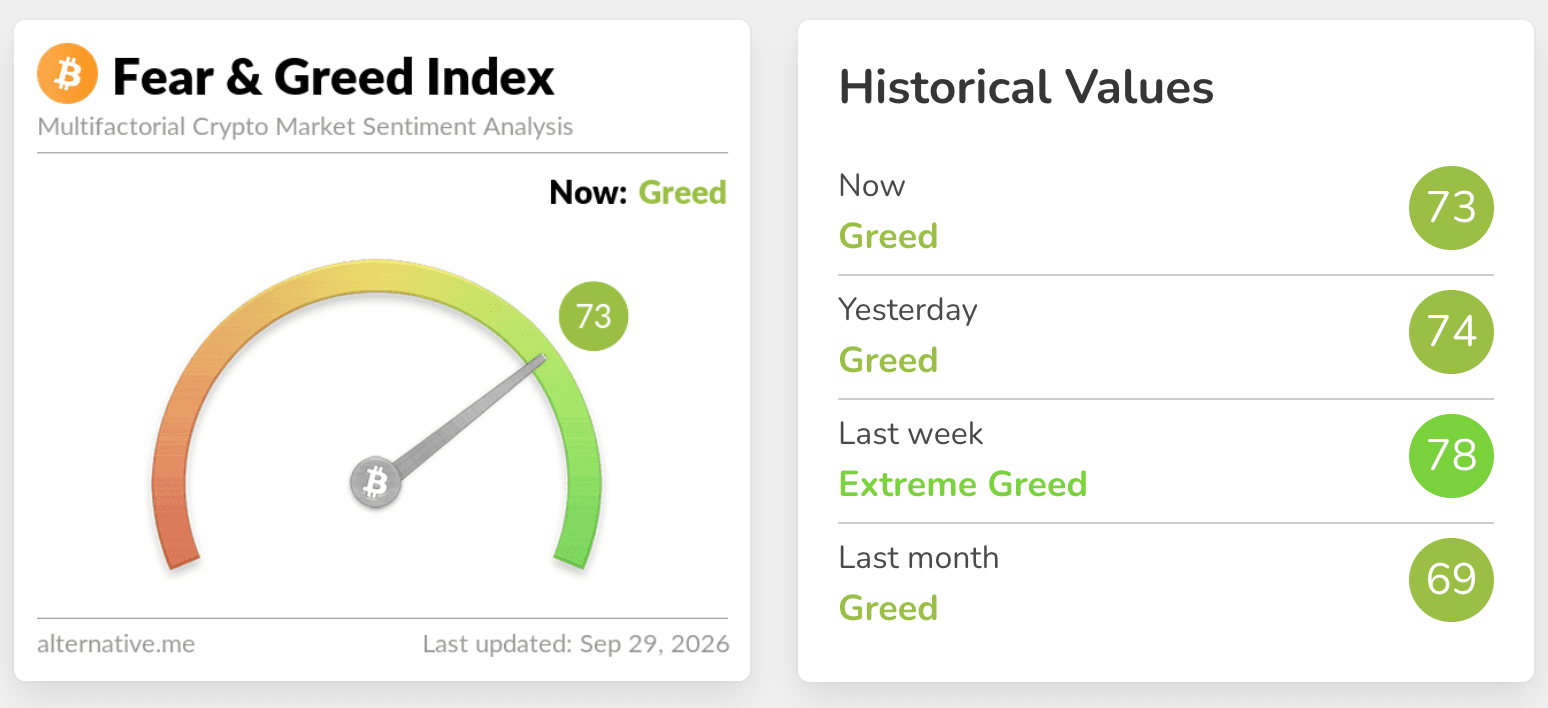
Source: Alternative
Key News Highlights:
NVIDIA Launches Open Agent Safety Platform to Strengthen AI Agent Security
NVIDIA has announced the launch of its Open Agent Safety Platform, with AI agent security and access control at the core of the new system. More than 100 industry partners are already participating in the broader ecosystem. The platform is built around two main security layers: OpenShell and Sentry. Together, they are intended to restrict which files, tools, networks, and system resources AI agents can use while carrying out tasks. OpenShell is an open-source secure runtime that allows autonomous AI agents to operate within isolated sandbox environments. Policy controls can be used to define and restrict the actions those agents are permitted to perform. Sentry extends monitoring and security enforcement to the hardware layer. This allows the system to detect, restrict, or isolate an AI agent when it attempts to move beyond its defined boundaries. NVIDIA said several frontier AI laboratories have recently disclosed cases in which agents broke out of testing environments or accessed external systems they were not intended to reach. These incidents have brought greater attention to permission management and continuous monitoring for autonomous AI systems. The new platform therefore combines software sandboxing with independent hardware-based monitoring. This structure means that safety controls do not rely entirely on the AI agent itself to enforce restrictions. NVIDIA has also outlined principles such as verifiable policies, independently enforced security controls, model-path monitoring, and shared responsibility as part of its agent-safety framework. The Open Agent Safety Platform can be deployed on systems including NVIDIA Vera CPUs and BlueField DPUs. It also supports other hardware environments, allowing companies to configure security functions around their existing infrastructure. As autonomous AI agents move beyond content generation toward tool use, program execution, and enterprise-system access, NVIDIA is focusing on establishing clearer permission boundaries, activity logging, and external safety controls throughout the agent execution process.
Canadian “Crypto King” Fraud Trial Set to Begin as Defendant Plans to Represent Himself
Aiden Pleterski, a Canadian social media personality who described himself as a “crypto king,” is scheduled to appear before Ontario’s Superior Court of Justice on October 5. The criminal case relates to funds he allegedly raised from investors between 2021 and 2022. Canadian authorities allege that Pleterski told investors he could generate large weekly returns through digital asset investments. The amount involved is estimated at approximately USD 30 million. After a multi-year investigation, Canadian law enforcement formally charged Pleterski with fraud and money laundering in May 2024. Canadian media reports say Pleterski previously sought to delay the trial so that he could obtain legal counsel. The court did not approve the requested delay, and he is now expected to represent himself during the proceedings. The trial is expected to last around four weeks. If convicted, the fraud charge alone could carry a maximum sentence of up to 14 years in prison under Canadian law. Prosecutors say the alleged conduct primarily took place between 2021 and 2022. During that period, Pleterski built a following on social media and raised funds from followers and other investors. The case also became linked to a separate criminal incident in December 2022. Pleterski was allegedly kidnapped by several men and held for around three days. Some of those involved were reportedly investors connected to the alleged scheme. Police records and media reports said the kidnappers demanded repayment and forced Pleterski to record a video discussing his role in the investment operation. As the criminal trial begins, the court is expected to examine evidence related to the alleged fraud, the movement of investor funds, and statements Pleterski made while soliciting investments.
U.S. Spot Ethereum ETFs Record Seventh Straight Day of Net Inflows
The latest data shows that U.S. spot Ethereum ETFs recorded total net inflows of USD 17.0959 million in a single trading day. This marked the seventh consecutive trading day of overall net inflows. BlackRock’s ETHA recorded the largest inflow of the day at approximately USD 15.3539 million. It accounted for most of the total daily net inflow across U.S. spot Ethereum ETFs. Since launch, ETHA has accumulated USD 13.299 billion in historical net inflows and remains one of the largest products in the U.S. spot Ethereum ETF market. The 21Shares TETH fund recorded approximately USD 1.742 million in net inflows during the same session. Its cumulative historical net inflows now stand at around USD 32.8813 million. According to the latest figures, total net assets across U.S. spot Ethereum ETFs have reached USD 17.692 billion. This shows that the amount of ETH held through regulated ETF products continues to build. ETF net assets currently represent around 5.4% of Ethereum’s total market capitalization. This has made spot ETFs an increasingly significant institutional holding channel for ETH. Since the launch of U.S. spot Ethereum ETFs, cumulative historical net inflows have reached USD 13.957 billion. The recent seven-day inflow streak has kept incremental capital flows in positive territory. ETF fund flows differ from daily ETH price movements because they track changes in capital entering or leaving regulated investment products. These figures therefore offer a view of subscription and redemption activity at the institutional-product level. The latest data shows that new Ethereum ETF inflows remain concentrated in larger products, while the total value of ETH held through these ETFs remains at elevated levels.
Goldman Sachs Brings USD 100 Billion Treasury Fund Into Institutional Digital Asset Settlement Network
Goldman Sachs is bringing its approximately USD 100 billion Treasury fund FTIXX onto Lynq. The move allows eligible institutional digital asset firms to use the traditional financial product through an existing settlement workflow. Unlike some Wall Street firms that have introduced blockchain-based tokenized funds in recent years, FTIXX itself is not being converted into a tokenized asset. Instead, it will enter digital asset infrastructure through a new distribution and settlement channel. Fund transactions will be handled by SEC-registered broker-dealer tZERO, while FTIXX will become the first outside fund offered on the Lynq platform. Lynq aims to let digital asset institutions allocate capital to traditional Treasury products within their existing funding workflows. This removes the need to move into an entirely separate financial infrastructure. For institutions using the platform, FTIXX can serve as a place to allocate cash between trades. Capital that is not immediately being used for other transactions can remain invested in a Treasury fund while still being available for later deployment. Lynq said the addition reflects demand from existing institutional clients for products with different yield profiles and cash-management functions. The platform is therefore expanding the range of assets it can support. Lynq operates on a private, permissioned Avalanche Layer 1 blockchain. More than 30 institutional digital asset firms have already joined the network, which currently holds more than USD 89 million in assets. The arrangement allows a traditional fund to enter digital asset settlement and cash-management workflows without being reissued as an on-chain token. It represents another form of integration between established financial products and digital asset infrastructure.
Disclaimer: The information provided in this section is for informational purposes only and doesn't represent any investment advice or FameEX's official view.