FameEX Today’s Crypto News Recap | October 27, 2026
2026-10-27 07:10:54
OCC backs bank stablecoin issuance as Injective launches GPU futures and Grayscale reviews Zcash upgrades. Today’s BTC is near $79.8K amid Neutral sentiment. Bitcoin (BTC) is consolidating near $79.8K following its recent decline, while Ethereum (ETH) is fluctuating around $2,315. Both major cryptocurrencies continue to show short-term weakness as the broader market remains in a period of adjustment and cautious trading. BTC has retreated from levels above $84K and has recently fluctuated around the $80K mark. ETH continues to test lower price levels after falling below $2,400. These movements indicate that major cryptocurrencies have yet to establish a consistent recovery pattern. Market sentiment remains Neutral, with the Crypto Fear & Greed Index at 48, down slightly from yesterday's reading of 50. This suggests that risk appetite has moderated in recent sessions. U.S. spot ETF flows have diverged, with Bitcoin spot ETFs recording approximately USD 110.3 million in net inflows while Ethereum spot ETFs posted USD 88.6 million in net outflows. This reflects differing institutional allocation trends between the two assets. In the derivatives market, Coinglass data shows that total crypto liquidations reached approximately USD 175 million over the past 24 hours. Long liquidations accounted for USD 106 million, while short liquidations totaled USD 68.8315 million. These figures indicate that price fluctuations continue to trigger adjustments in leveraged positions. From a market structure perspective, major cryptocurrencies remain influenced by spot capital flows, derivatives positioning, and liquidity distribution. Short-term trading activity continues to concentrate within established price ranges. On the macroeconomic front, the U.S. Federal Reserve is preparing to announce its October interest rate decision. Markets widely expect the benchmark rate to remain unchanged at 3.75%–4.00%, with monetary policy uncertainty continuing to influence capital allocation. Overall, the crypto market has yet to establish a clear directional trend. BTC and ETH price movements reflect an environment shaped by divergent spot demand, derivatives deleveraging, and continued caution ahead of the Federal Reserve's policy decision.
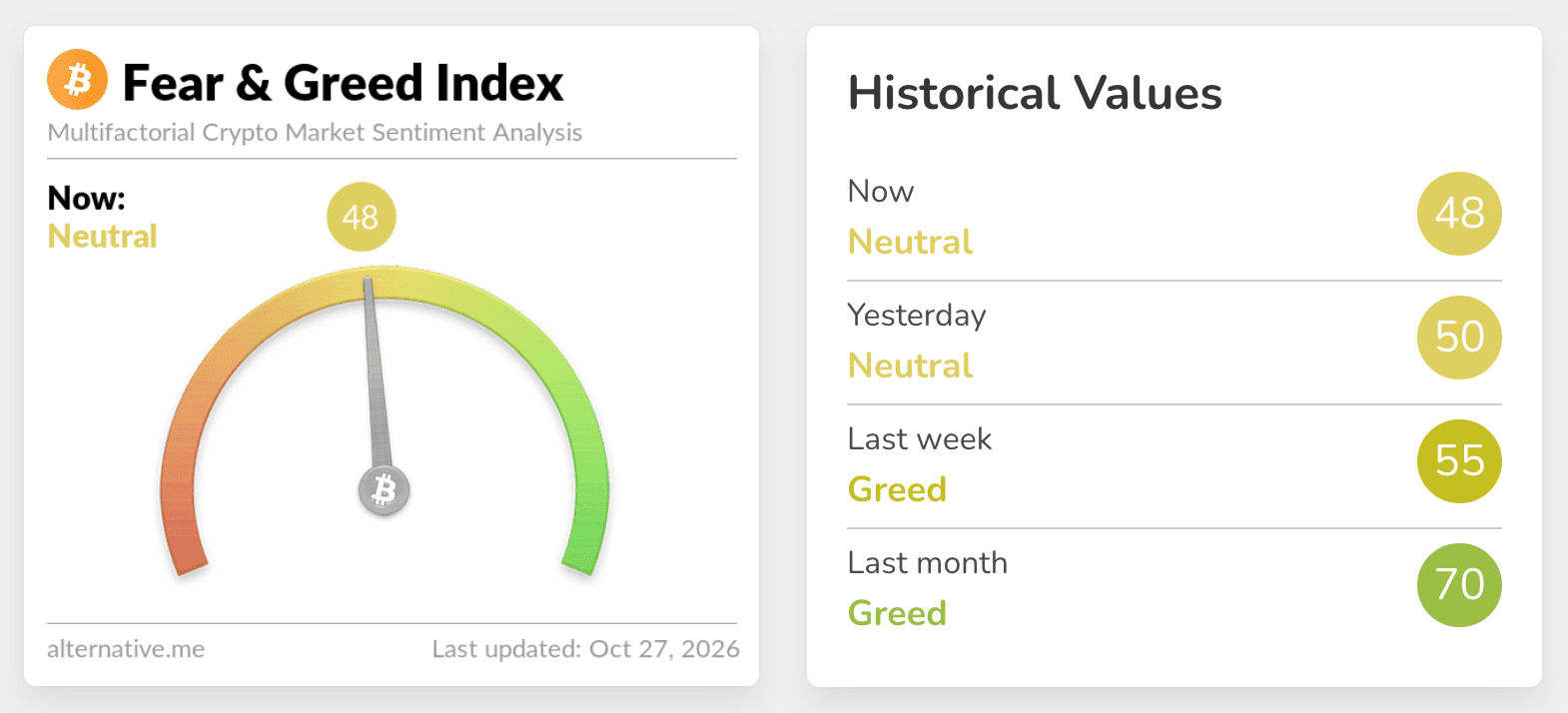
Source: Alternative
Key News Highlights:
U.S. OCC Encourages Community Banks To Issue Payment Stablecoins Ahead Of GENIUS Act Implementation
The U.S. Office of the Comptroller of the Currency (OCC) recently encouraged community banks to participate in the payment stablecoin market. The regulator advised interested banks to consider applying to become permitted payment stablecoin issuers or to pursue issuance through subsidiaries that meet regulatory requirements. This initiative follows the OCC's final implementing rules for the GENIUS Act, released on October 21. The legislation and its related regulatory requirements are expected to take effect on January 18, 2027. The GENIUS Act establishes a federal regulatory framework for payment stablecoins in the United States. It defines which financial institutions and companies may legally issue payment stablecoins and outlines the obligations that authorized issuers must meet. Under the OCC's final rules, payment stablecoin issuers must comply with requirements covering reserve backing, token redemption, risk management, disclosures, audits, and regulatory reporting. These requirements also apply to bank subsidiaries under OCC supervision and eligible nonbank issuers. The OCC clarified that qualified community banks may evaluate the application process based on their business plans. However, the new regulations do not require banks to issue stablecoins or provide related services. Meanwhile, several community banking organizations have raised objections to stablecoin yield arrangements and the regulatory standards applied to different types of issuers. They argue that the existing framework could create differences in regulatory treatment between traditional banks and crypto companies. The Independent Community Bankers of America previously filed a lawsuit challenging the OCC's approval of certain banking charter applications submitted by crypto companies. This dispute has brought further attention to the regulatory treatment of participants in the stablecoin industry. The OCC also indicated that certain requirements involving anti-money laundering, the Bank Secrecy Act, and sanctions compliance will be addressed through separate rulemaking in coordination with the U.S. Treasury Department. As the implementation date approaches, the regulatory framework governing payment stablecoin issuance, banking participation, and compliance obligations in the United States is becoming more clearly defined.
Injective Launches Nvidia GPU Rental Cost Perpetual Futures to Bring AI Computing Prices On-chain
Layer 1 blockchain Injective has launched the Super Intelligence Compute Index (SICI) alongside an on-chain perpetual futures market based on Nvidia GPU rental prices. The new product converts changes in artificial intelligence computing costs into a tradable financial index. SICI tracks rental prices for five Nvidia GPU models, including the H100, B200, H200, A100, and RTX 4090. The underlying data is compiled by London-based market data provider LO: TECH using pricing information from multiple computing rental marketplaces. According to Injective's index methodology, the H100 carries the largest weighting at 40%, followed by the B200 at 25% and the H200 at 15%. The A100 and RTX 4090 each account for 10% of the index. These weightings are designed to reflect rental costs across different GPU models used in AI computing. The index uses a seven-day moving average of rental prices and updates every hour to maintain a connection with pricing data from the GPU rental market. The accompanying perpetual futures contracts use USDC as margin and support leverage of up to 10x. Traders can establish positions based on potential increases or decreases in GPU rental costs. Injective previously introduced an on-chain market tracking Nvidia H100 rental prices in August 2025. The launch of SICI expands that offering from a single GPU model to a broader index covering five chips. Injective explained that companies developing AI models often rent GPU computing capacity from cloud service providers. These rental costs can fluctuate with demand, hardware supply, and market utilization rates. The new product is designed to provide a tool for managing exposure to changes in AI computing costs. GPU infrastructure providers may also use these contracts to manage risks associated with fluctuations in rental revenue. However, the effectiveness of such hedging strategies depends on contract design and market liquidity. By introducing GPU rental prices into on-chain derivatives trading, Injective is expanding the range of real-world industrial cost indicators represented in blockchain-based financial products.
Grayscale Reviews A Decade Of Zcash Development As Block Reward Funding Supports Privacy Upgrades
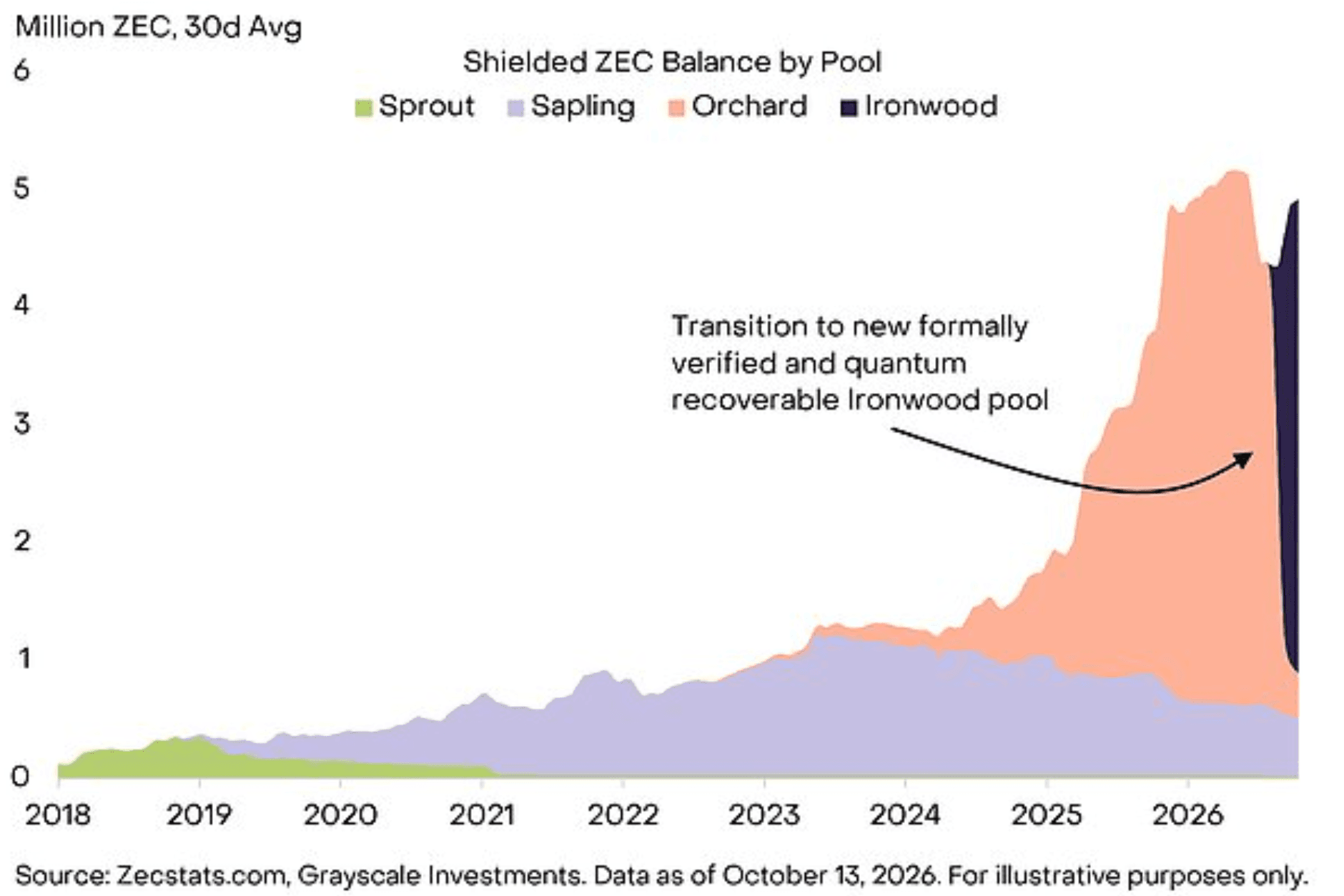
Grayscale's Head of Research, Zach Pandl, published a research article reviewing a decade of technological development at the privacy-focused cryptocurrency Zcash (ZEC). The report identifies the protocol's built-in development funding mechanism as an important foundation for its continued privacy technology upgrades. Zcash will mark the tenth anniversary of its mainnet launch on October 28. The network shares certain monetary characteristics with Bitcoin while incorporating cryptographic technologies such as zero-knowledge proofs to provide privacy features that protect transaction information. According to Grayscale's research, one major difference between Zcash and Bitcoin lies in how block rewards are distributed. Bitcoin miners receive the full block reward, while Zcash allocates 80% of its block rewards to miners and directs the remaining 20% toward protocol development and ecosystem initiatives. This development fund is built directly into the network's protocol. It allows Zcash to maintain financial support for technical research across different market cycles without relying entirely on venture capital or private financing. The evolution of Zcash's privacy technology is particularly evident in the development of its shielded pools. The network initially introduced Sprout before launching Sapling in 2018 and Orchard in 2022. Each upgrade introduced improvements to the underlying architecture used to protect transaction information. On July 28, 2026, Zcash activated the Ironwood network upgrade and introduced a new shielded pool. The upgrade primarily addressed a previously identified vulnerability in the Orchard codebase. It also introduced quantum-resistant recovery addresses and formal verification techniques. Formal verification uses mathematical methods to determine whether software code satisfies specified security properties. This provides an additional layer of security verification for blockchain protocols. Grayscale noted that Zcash continues to face technical challenges involving transaction processing capacity, advances in quantum computing, and cybersecurity threats associated with artificial intelligence. Sustained research funding and effective resource allocation therefore remain important considerations for the network's future development. The report uses Zcash's decade-long history of protocol upgrades to illustrate how allocating a portion of block rewards to a development fund can support the long-term maintenance and advancement of privacy-focused blockchain networks.
NBA Partners With U.S. CFTC To Strengthen Prediction Market Data Sharing And Trading Oversight
The National Basketball Association (NBA) has signed a memorandum of understanding with the U.S. Commodity Futures Trading Commission (CFTC) to establish an information-sharing and regulatory cooperation framework for basketball-related prediction markets. The league also announced commercial partnerships with two major prediction market platforms. According to the NBA's official announcement, these agreements are intended to establish clearer trading standards for markets involving NBA game outcomes. Cooperation among the league, regulators, and platform operators is designed to reduce the risks of insider trading, market manipulation, and other prohibited activities. Prediction markets allow participants to trade contracts based on the outcomes of specific events. A common example involves contracts tied to whether a particular team will win a game, with settlement determined by the final result. The NBA explained that its agreements with partner platforms include restrictions on the types of sports event contracts that may be listed. They also prohibit league and team personnel from trading NBA event contracts and establish procedures for reporting suspicious trading activity and cooperating with investigations. Under the agreements, the platforms will also receive certain rights to use official NBA branding and commercial promotional assets. They will have access to game data provided through the league's official data partner, Sportradar, for authorized market operations and settlement. With this agreement, the NBA joins Major League Baseball (MLB) and the National Hockey League (NHL) as another major U.S. professional sports league to establish a prediction market information-sharing framework with the CFTC. In contrast, the National Football League (NFL) has not entered into a similar arrangement. The NFL has expressed concerns about the strength of existing prediction market oversight, consumer protections, and safeguards for sports integrity. Meanwhile, legal disputes over regulatory authority for sports prediction markets remain unresolved between federal and state authorities in the United States. Several state governments argue that contracts based on sporting event outcomes should fall under state gambling regulations. The CFTC maintains that these event contracts fall within its federal regulatory jurisdiction. The NBA's cooperation with the CFTC represents the latest example of a U.S. professional sports league participating in the development of prediction market oversight. It also reflects ongoing efforts across the industry to establish frameworks for authorized sports data usage, trading compliance, and market integrity.
Disclaimer: The information provided in this section is for informational purposes only and doesn't represent any investment advice or FameEX's official view.