FameEX Today’s Crypto News Recap | February 23, 2026
2026-02-23 06:34:19

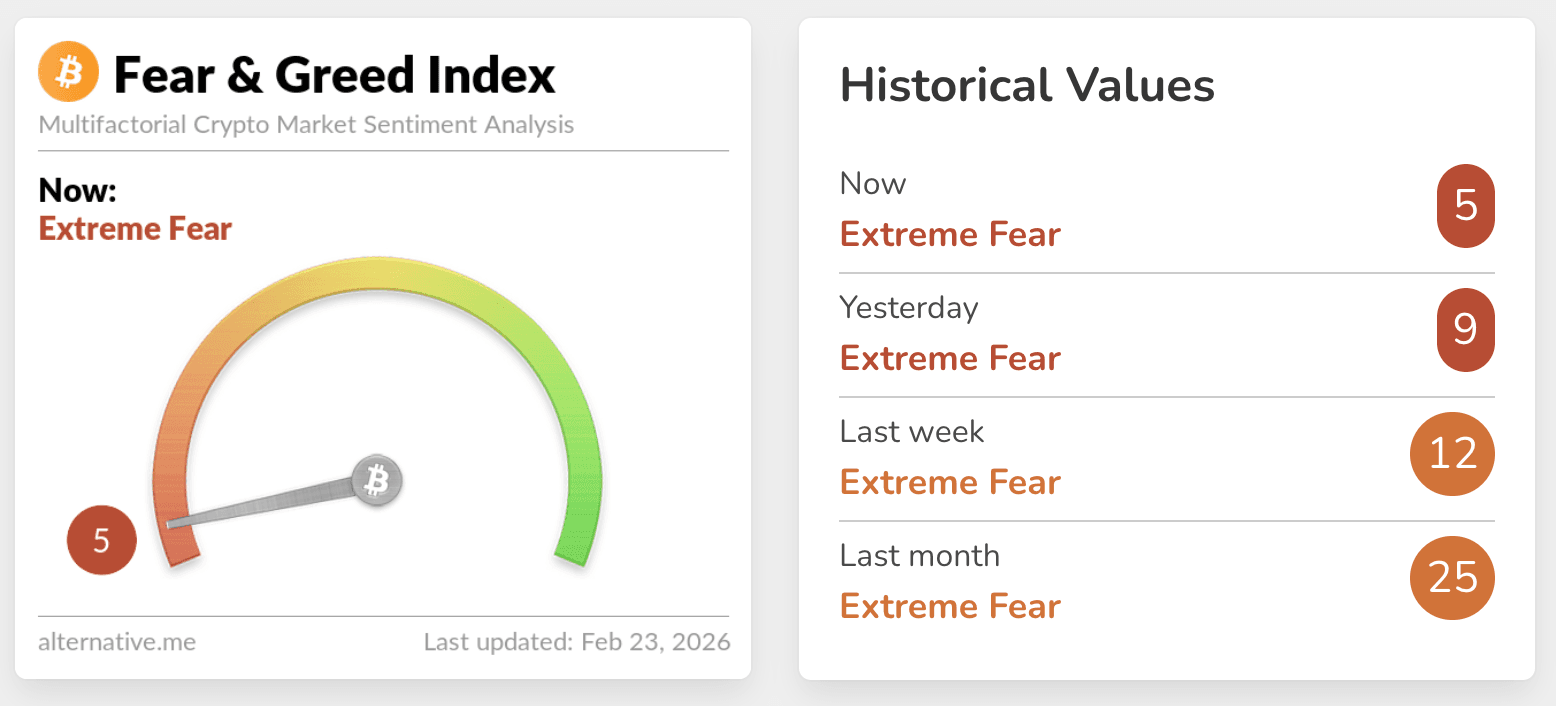
SEC’s stablecoin haircut relief and Curve’s defense of DAO dissent lead the narrative as BTC builds a de-leveraging base above $64K to ease liquidation pressures. The Bitcoin market underwent a massive price correction during early trading today. Within a narrow two-hour window, the price plunged by over $3,000 and completely erased all gains accumulated over the weekend. This sharp decline briefly pushed Bitcoin down to the $64,300 support zone. This sell-off triggered a chain reaction that caused the Crypto Fear & Greed Index to crash to a value of 5. This level represents a state of "Extreme Fear" and marks one of the lowest points for the index since its launch in 2018. Recent data shows that total market liquidations reached USD 459 million over the past 24 hours. Long positions accounted for over 92% of these liquidations. This suggests that high-leverage positions were systematically wiped out as prices retreated rapidly. Although Bitcoin is attempting to stabilize at the $64,500 level, macro pressures like the 1% drop in Nasdaq futures continue to weigh on the market. Investors remain cautious as they watch to see if the current price floor can hold.
Crypto Markets Overview
The Crypto Fear & Greed Index is currently at 5, which places the market in a rare and historical "Extreme Fear" zone. This deep decline reflects a total collapse in participant confidence. Historically, the index has only hit such extreme lows during the August 2019 crash, the June 2022 liquidity crisis, and earlier this month. Based on current market structures, Bitcoin maintains its role as a "market anchor" and remains the primary choice for capital seeking safety. Its performance continues to dictate the risk appetite of the broader crypto ecosystem. However, Bitcoin faces a serious challenge as it breaks below $64,500 and retests the bottom of the price range established after the early February crash. At the same time, Ethereum is struggling under the heavy leverage in the derivatives market. Long positions for ETH have proven extremely fragile, with over USD 106 million in liquidations recorded in the last 24 hours. General liquidity concerns are also rising as the USDT circulating supply dropped by USD 1.5 billion this month. This represents the largest monthly decrease since 2022 and suggests that market risk appetite may take significant time to recover.
Source: Alternative
Mainstream Asset De-leveraging: Bitcoin Retests Support While Ethereum Faces Liquidity Pressure
Bitcoin is currently experiencing intense volatility within the $64,000 to $65,000 price range. This area is a critical battleground where bulls are trying to establish a defensive line against a high volume of potential liquidations. The sharp drop this morning was primarily driven by a lack of buying momentum at higher price levels. Without sufficient spot demand to support the price, a wave of forced liquidations in the futures market pushed Bitcoin lower in search of liquidity. This created a classic "stampede" effect among traders. From a structural perspective, Bitcoin has broken below its previous upward trend and is now attempting to form a second bottom at the lower end of its trading range. Resistance remains heavy near $68,600 due to a large amount of trapped capital at those levels. Ethereum is showing even deeper signs of de-leveraging. Slowing on-chain activity and shifting funding rates have caused ETH to trade weakly. After breaking below key psychological levels, ETH is now searching for a new support floor at lower prices. Both BTC and ETH are currently showing price action defined by forced liquidations rather than a change in fundamental value. The market is effectively in a de-leveraging phase as it searches for a new price equilibrium.
Key News Highlights:
Vitalik Buterin Proposes Transaction Simulations to Enhance On-Chain Security
Ethereum co-founder Vitalik Buterin recently suggested a major change to how users interact with blockchains. He proposed using "transaction simulations" to significantly improve the security of crypto wallets and smart contracts. Buterin argued that security and user experience should not be treated as separate fields. Both focus on ensuring that protocols accurately execute the "true intent" of the user. Under this proposed security model, a system would show a simulation of all on-chain consequences before a user signs a transaction. Users would then click "OK" or "Cancel" only after seeing the simulated results. Buterin also suggested combining this with spending limits and multi-sig approvals to make low-risk actions easier while making dangerous actions harder to execute. While defining human intent is complex, this simulation-based design is seen as one of the most effective ways to stop phishing attacks and smart contract exploits. This approach has the potential to rebuild user trust in decentralized applications from the ground up.
US SEC Allows Broker-Dealers to Apply 2% Risk Haircut on Stablecoin Holdings
The technical division of the US Securities and Exchange Commission (SEC) recently issued a new guidance document for broker-dealers. This document clarifies that the SEC will not object to broker-dealers applying a 2% "haircut" to their stablecoin holdings when calculating net capital requirements. This is a milestone for Wall Street firms. Previously, there was significant uncertainty about whether these dollar-pegged assets required a 100% haircut. Under the old interpretation, holding stablecoins almost never counted toward a firm's required capital ratios. With the new 2% rule, a broker-dealer holding USD 100 million in compliant stablecoins can count USD 98 million toward its net capital. This policy greatly improves capital efficiency for financial institutions. SEC Commissioner Hester Peirce supported the move and stated that the previous 100% haircut was unnecessarily punitive for stablecoins backed by high-quality assets. This change signals that stablecoins are starting to be treated similarly to low-risk money market funds. It will allow Wall Street firms to use stablecoins more flexibly for real-world asset (RWA) tokenization and mainstream financial operations.
Curve Finance Founder Argues Disagreement Within a DAO Is a Sign of Organizational Health
Michael Egorov, the founder of the DeFi giant Curve Finance, recently shared a unique perspective on governance during a media interview. He argued that disagreements and disputes within a Decentralized Autonomous Organization (DAO) are actually signs of a healthy and vibrant ecosystem. Egorov pointed to past debates within the Curve DAO regarding developer grants and recent disputes in the Aave DAO over intellectual property and fee sharing. He noted that if every proposal in a DAO passes instantly without any opposition, it usually signals "governance apathy." This suggests that members either do not care about the protocol or that power has become too centralized. Egorov emphasized that a DAO is a new type of organization that functions differently from a traditional company. It allows different stakeholders to act like political parties to express their views and negotiate. These transparent conflicts ultimately protect the rights of long-term token holders. While DAOs still face legal and banking hurdles in the physical world, Egorov believes this on-chain democratic model will prove more resilient than centralized structures as technology continues to evolve.
Trending Tokens:
- $GGBR (Goldfish)
The Goldfish protocol has recently garnered significant institutional attention as a blockchain-native digital asset backed by physical gold reserves, offering much-needed hard-asset stability within the DeFi ecosystem. Each $GGBR token represents micro-fractional ownership of one-thousandth of a troy ounce of gold, effectively lowering the barrier to entry for investors seeking inflation-resistant stores of value. The current narrative momentum is driven by the project's recent CEX listings and the ongoing rollout of its Social Airdrop Leaderboard, which has already onboarded over 40,000 active users. Market interest is further amplified by upcoming expansions to the Tron and Solana networks, alongside anticipated physical redemption options facilitated through regulated dealers. Investors are closely monitoring the platform following official teasers regarding new multi-chain utility features launching this week for token holders. The synergy between real-world asset tokenization and oracle-verified price stability positions $GGBR as a formidable contender in the emerging RWA sector.
- $BNKR (Bankr)
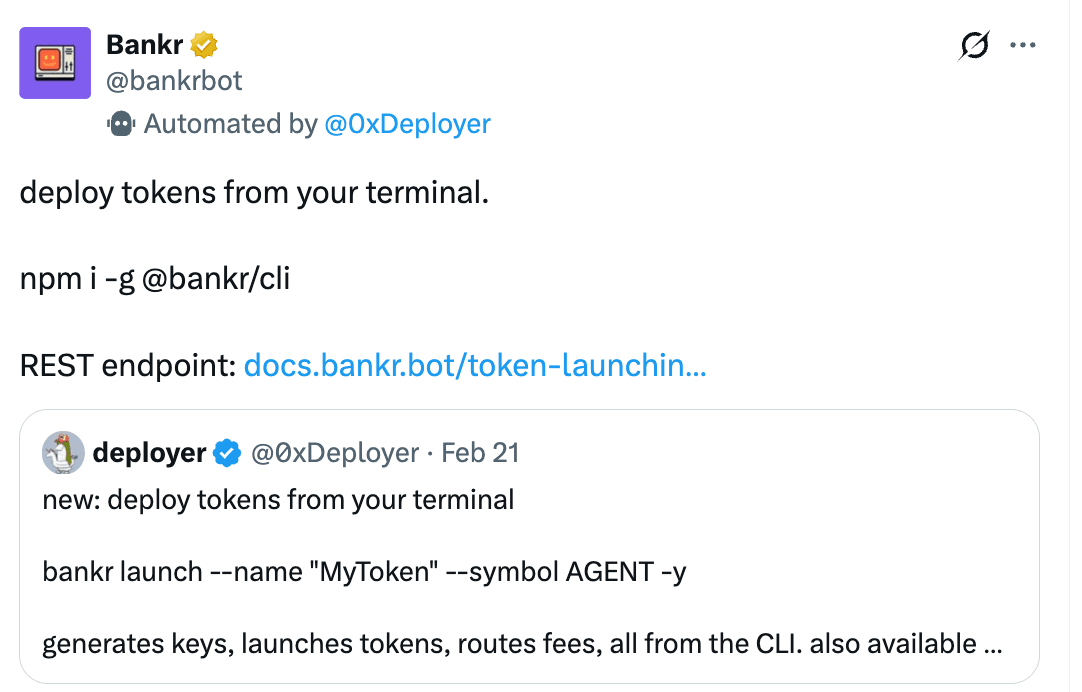
Bankr is currently thriving as a pivotal infrastructure layer in the AI-driven blockchain development space by radically simplifying complex deployment workflows for decentralized applications. The recent release of the @bankr/cli tool allows developers to generate keys and launch tokens directly from a terminal or via a REST endpoint, marking a significant shift toward programmatic deployment standards. This innovation addresses the surging demand for seamless integration between artificial intelligence and on-chain asset management, including automated trading and digital wallet creation. By providing a command-line interface that handles automated fee routing and liquidity management, Bankr significantly reduces the technical friction typically associated with smart contract interactions. The market has reacted positively to the platform's capacity for rapid token issuance, which is increasingly viewed as a core requirement for the burgeoning AI Agent era.
- $AZTEC (Aztec Network)
Aztec Network has reached a defining milestone with the official launch of its native $AZTEC token, catalyzing renewed market interest in privacy-centric Layer 2 solutions. As a ZK-rollup built on Ethereum, the protocol utilizes the industry-standard PLONK proving system to enable private smart contract execution and scalable decentralized applications. The narrative surrounding this launch emphasizes a future where privacy transitions from an optional feature to a default requirement for all on-chain interactions. This event has triggered a surge in community sentiment as the network positions itself as the primary infrastructure for confidential DeFi transactions and enterprise-grade privacy. The project's long-standing history since 2018 provides a level of technical credibility that distinguishes it from newer, unvetted privacy protocols. With the mainnet now live, the market is aggressively repricing the potential for Aztec's privacy-preserving architecture to achieve mass adoption across the broader Ethereum ecosystem.
Disclaimer: The information provided in this section is for informational purposes only and doesn't represent any investment advice or FameEX's official view.