FameEX Today’s Crypto News Recap | May 25, 2026
2026-05-25 07:09:19

Russia advances crypto bill for cross-border trade, an analyst predicts Fed rate-cut cycle, and the US SEC delays RWA stock exemptions, while BTC remains volatile amid macroeconomic policy uncertainty. Cryptocurrency markets have recently remained in a consolidation phase, with investor sentiment staying cautious under the combined influence of macroeconomic data and traditional financial market developments. Recent fund flow data for spot Bitcoin ETFs and spot Ethereum ETFs showed clear net outflows last week, reflecting profit-taking pressure across short-term risk assets and stronger demand for defensive positioning. At the same time, market volatility around key technical levels for Bitcoin and Ethereum continued to affect derivatives positioning on major CEXs. Global financial markets are also entering a critical stage of macroeconomic adjustment. Geopolitical tensions and persistent inflationary pressure have placed the traditional financial system under visible stress. US Treasury yields have continued to rise, with the 30-year Treasury yield breaking above 5.14%. This points to higher long-term funding costs and a more cautious market assessment of the monetary policy outlook. Meanwhile, inflationary pressure has not fully eased. Elevated fuel costs and logistics expenses are gradually feeding into the broader economy, forcing central banks to balance policy easing against monetary stability. Market analysts noted that if inflation fails to improve, some regions may need to maintain restrictive policy settings for a longer period, and future rate hikes cannot be fully ruled out. Investors are closely watching upcoming economic data and policy signals from central bank officials on currency depreciation and liquidity injection, as they assess the core direction of future asset allocation strategies.
Crypto Markets Overview
The cryptocurrency market is currently in a consolidation phase. The Crypto Fear & Greed Index stands at 30, indicating Fear and showing that investor concerns over short-term volatility remain dominant. Bitcoin is hovering near $77K, while Ethereum remains within the $2,100 range. According to market data, if Bitcoin falls below $73,158, cumulative long liquidation intensity on major CEXs could reach USD 991 million. If Bitcoin breaks above $80,529, cumulative short liquidation intensity could reach USD 954 million. For Ethereum, if the price breaks above $2,199, cumulative short liquidation intensity on major CEXs could reach USD 808 million. Conversely, if Ethereum falls below $1,992, cumulative long liquidation intensity could reach USD 552 million. These severe liquidation boundaries indicate that the market is facing strong short-term technical pressure between long and short positions. In addition, spot Bitcoin ETFs recorded USD 1.257 billion in net outflows last week, while spot Ethereum ETFs also saw USD 216 million in net outflows. The withdrawal of institutional capital further limited the market’s rebound momentum, prompting investors to stay on the sidelines while waiting for stronger macro signals to confirm the next phase of the trend.
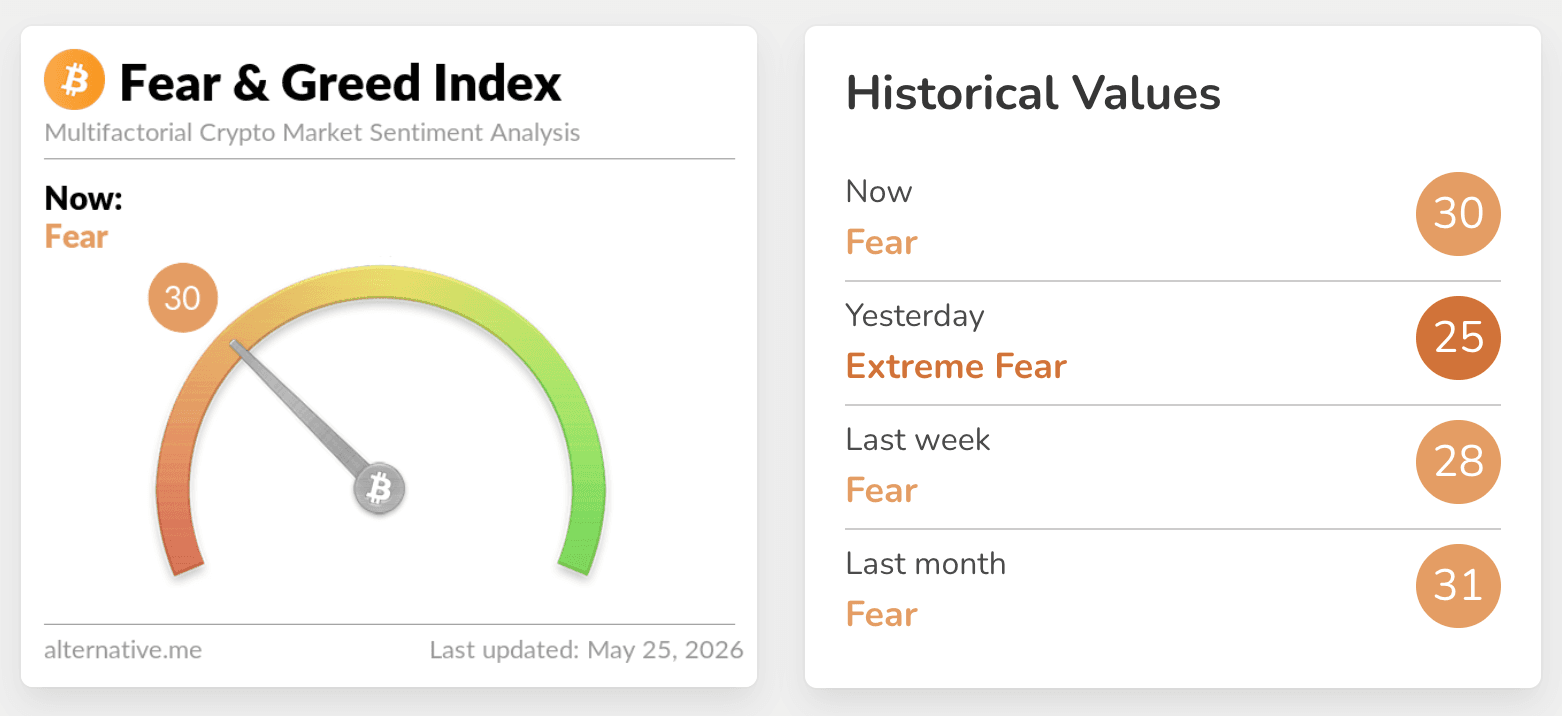
Source: Alternative
Key News Highlights:
Analyst Predicts New Fed Chair Will Start A Rate Cut Cycle
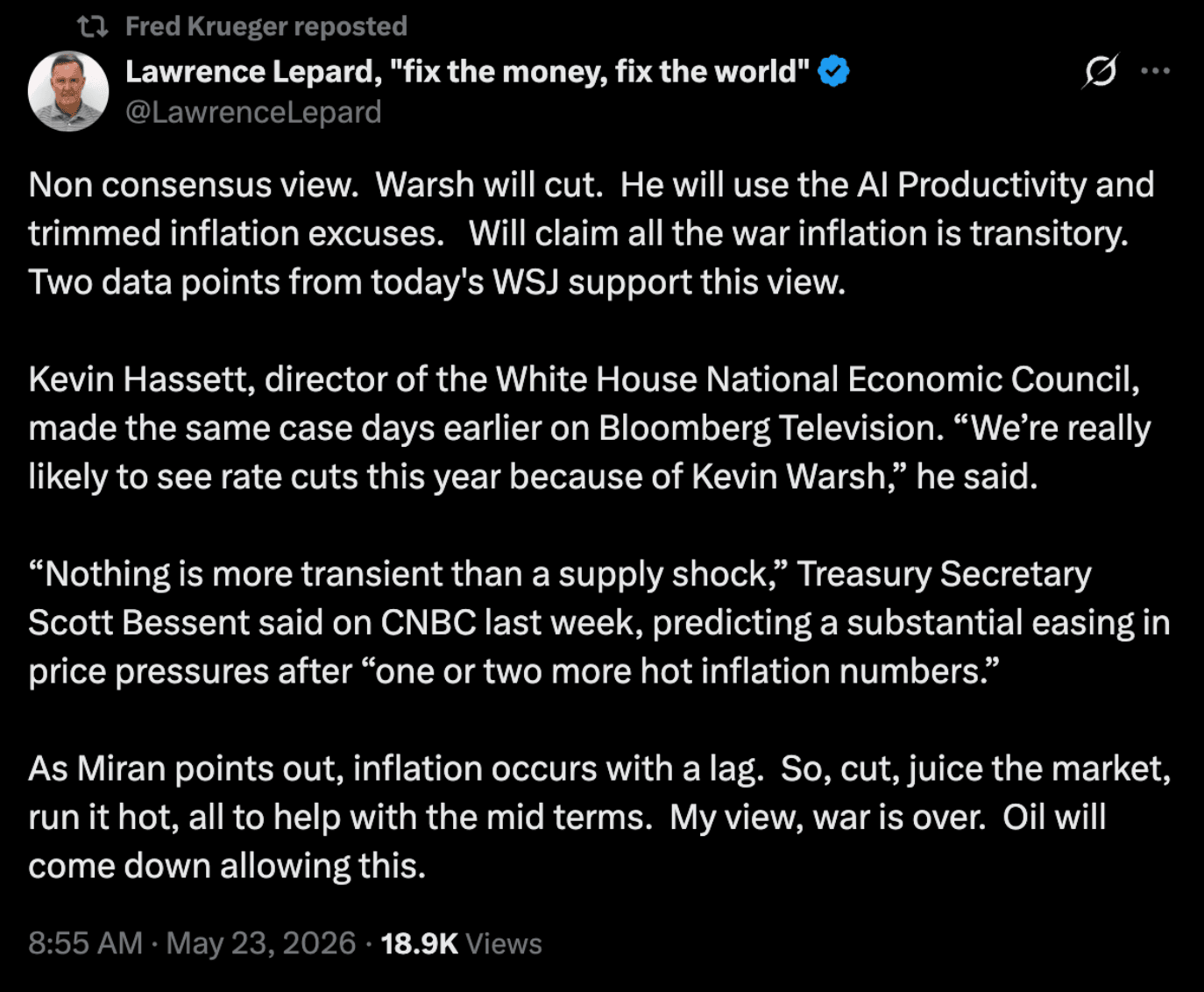
Although the current mainstream view among investors and market participants is that US interest rates will remain unchanged or may still have room to rise, market analyst Lawrence Lepard recently offered a different view on the Federal Reserve’s future policy direction. He predicted that the newly appointed Federal Reserve Chair Kevin Warsh will begin a rate cut cycle. Lepard noted that Warsh may use AI-driven productivity gains and improved inflation data as reasons to adjust monetary policy. He may also describe war-related inflationary pressure as transitory, thereby creating justification for a more accommodative policy stance. Although the current market consensus remains constrained by the high-rate environment, some analysts have observed subtle changes in how Fed officials discuss their response to economic data. This suggests that policy flexibility may be increasing. The forecast also aligns with signals from some cabinet-level officials who have hinted at potential rate cuts, showing that market expectations for a policy shift are gradually rising. If the Fed eventually turns toward rate cuts, the market would likely view it as a positive liquidity signal. Such a move could provide significant support for risk assets because lower borrowing costs and stronger liquidity conditions usually help sustain pricing across risk categories, including digital assets. Investors are now closely monitoring the Fed’s upcoming policy remarks to determine whether this expected policy pivot will materialize.
Russia Plans Crypto Bill To Advance Cross-Border Trade Settlement
Russia’s State Duma has recently made progress on cryptocurrency regulation by passing the first reading of a key bill in April. The bill aims to establish a clear legal framework for digital assets, marking a substantive step in Russia’s effort to integrate cryptocurrency into the international trade system. The core logic of the bill is to position cryptocurrency as a strategic geopolitical tool rather than a domestic currency intended to replace the ruble. The Bank of Russia will oversee licensed operators and monitor cross-border payment transactions to ensure financial compliance. Although authorities continue to strictly prohibit the use of cryptocurrency as a domestic payment instrument, the bill specifically allows companies to use cryptocurrency for compliant cross-border trade settlement when they face restrictions within the traditional financial system. This strategy is designed to provide exporters and importers with an alternative payment channel through a controlled experimental mechanism. At the same time, centralized supervision by the central bank is intended to reduce non-systemic risks and prevent spillover effects on the domestic monetary system. This development highlights Russia’s effort to seek technological alternatives to traditional banking networks under continued Western financial sanctions. The approach still faces scrutiny from Western regulators and potential secondary sanctions risks, but for companies that cannot access mainstream dollar settlement channels, the framework offers an alternative settlement mechanism with a legal basis.
US SEC Delays RWA Tokenized Stock Trading Exemption Plan
The US Securities and Exchange Commission has reportedly delayed its planned “innovation exemption” for RWA tokenized stock trading. The decision came after the agency received substantial feedback from market participants, with many traditional exchange officials and financial institutions raising concerns about implementation details. The proposal was originally designed to provide a compliant operating framework for tokenized stocks. It would require platforms to ensure that investors receive the same rights as traditional shareholders, including dividends and voting rights. However, industry feedback showed that several issues remain unresolved. These include how to verify ownership on semi-pseudonymous blockchains and how to prevent unauthorized third parties from issuing tokens. Although the current US policy environment has been relatively more open to crypto-based financial products, and Wall Street interest in asset tokenization and stablecoins continues to grow, regulators have chosen a more cautious approach this time. The priority is to resolve implementation details and strengthen investor protection. Crypto industry leaders expressed support for the delay, arguing that ensuring the exemption applies to the right asset classes is more important than pushing the plan forward too quickly. This reflects the regulator’s effort to find a balance between advancing the digital transformation of financial markets and maintaining market order, while avoiding systemic problems or legal loopholes caused by rushed rulemaking.
Trending Tokens:
- $GENIUS (Genius)
Genius has rapidly become a focal point within the DeFi ecosystem by positioning itself as a comprehensive on-chain trading terminal for professional users. The platform supports more than ten major blockchain networks, including BNB Chain and Solana, and provides a wide range of functions such as swaps, copy trading, trading, and leveraged trading. After securing USD 6 million in funding from notable institutional investors, including CMCC Global, Flow Traders, and YZi Labs, the project has demonstrated strong institutional backing and market potential. Its long-term vision is to move beyond the limitations of the meme coin era and enable large-scale private trading across blockchains. By removing the need to rely on complex zero-knowledge proofs, Genius aims to significantly simplify the user experience through a unified interface. This architecture directly addresses the fragmentation problem across the current DeFi landscape, allowing traders to execute strategies seamlessly regardless of where they are. As the terminal continues to integrate diverse DeFi environments, market participants are closely watching its ability to deliver on its infrastructure promise.

- $HYPE (Hyperliquid)
Hyperliquid represents a major advancement in high-performance Layer 1 infrastructure, designed to support a fully on-chain financial ecosystem. The platform stands out through its native execution capability, which ensures that every order, cancellation, trade, and liquidation takes place transparently on-chain with block latency below one second. This technical efficiency gives developers a foundation for building permissionless financial applications without compromising the end-user experience. Its flagship application, a fully on-chain order book perpetual exchange, has become the primary driver behind the protocol’s market visibility. By connecting user-built applications with high-performance native components, Hyperliquid establishes a robust foundation for institutional-grade decentralized finance. Investors and developers are increasingly drawn to this architecture because it narrows the gap between traditional exchange speed and decentralized transparency. The project remains at the center of market discussion, especially due to its potential to reshape the landscape of on-chain perpetual trading.
- $BSB (Block Street)
Block Street has carved out a distinct niche within the real-world asset tokenization sector by focusing on the utility of tokenized stocks in decentralized finance. The protocol provides a complete suite of financial services, including decentralized lending, leverage, and yield opportunities for tokenized assets. After receiving USD 11.5 million in funding from prominent institutions, including Hack VC, AI Financial, and Generative Ventures, the project has seen a significant increase in market visibility. By connecting traditional financial instruments with DeFi liquidity pools, Block Street aims to improve capital efficiency for asset holders. Current market interest highlights strong demand for tokenized securities protocols that can operate effectively within the BNB Chain ecosystem. As the integration between traditional financial systems and decentralized systems accelerates, the project is positioning itself as key infrastructure for the future of digital securities. Observers are closely tracking its development and noting its potential to connect traditional market assets with on-chain decentralized protocols.
Disclaimer: The information provided in this section is for informational purposes only and doesn't represent any investment advice or FameEX's official view.