FameEX Today’s Crypto News Recap | May 12, 2026
2026-05-12 07:02:23

Solana ETF inflows surge, MARA reports losses, and Google warns of AI 2FA attacks. Meanwhile, BTC and ETH face profit-taking as sentiment hits neutral as traders monitor the $81K support level. Today’s cryptocurrency market showed a clear corrective phase with notable price volatility. Bitcoin and Ether came under dual pressure from technical profit-taking and weaker macro sentiment after reaching recent highs. Bitcoin (BTC) briefly fell below the key $81,000 psychological level this morning, with an intraday decline of about 0.72%. This indicates that the market has entered a volatile washout phase after extreme overbought conditions, while bullish sentiment has become more restrained. Ether (ETH) showed weaker performance and also briefly dropped below the important $2,300 level, with its intraday decline reaching 1.44%. On the macro front, US and European equity index futures broadly moved lower. S&P 500 futures fell 0.2%, while Nasdaq futures declined 0.4%. This risk-off sentiment spread into crypto assets and limited short-term rebound momentum. Even under selling pressure, the market’s longer-term support logic remained intact. Solana ETFs recorded their strongest weekly inflows since February, while BitMEX founder Arthur Hayes stated that fiat credit expansion and AI capital expenditure could continue to act as core drivers for Bitcoin’s move above $90K.
Crypto Markets Overview
From the perspective of market structure and trading behavior, the crypto market is currently in a key consolidation phase marked by a tug-of-war between long and short positions. Investors have become more cautious after sharp price swings. Today’s Crypto Fear & Greed Index stood at 49 under the Neutral zone and reflects a temporary weakening in chase-buying momentum. Bitcoin is now fluctuating near $81,000. According to Coinglass data, if BTC falls further below $77,311, major CEXs could face up to USD 1.363 billion in long liquidation intensity. Conversely, if BTC breaks above $85,039, around USD 1.163 billion in short positions could face liquidation pressure. For Ether, although supply deflation and stronger staking trends continue to support its fundamentals, the short-term technical structure remains capped by the $2,422 resistance area. A volume-backed breakout above this level could trigger around USD 950 million in short liquidation intensity. Over the past 24 hours, total crypto liquidations reached USD 227 million. Long liquidations stood at USD 118 million, while short liquidations reached USD 108 million. The near-balanced liquidation structure shows that long and short participants remain sharply divided at current price levels. Market participants are closely watching liquidity changes after the US equity market opens, as well as shifts in liquidation heatmap clusters, to assess the next phase of market momentum.
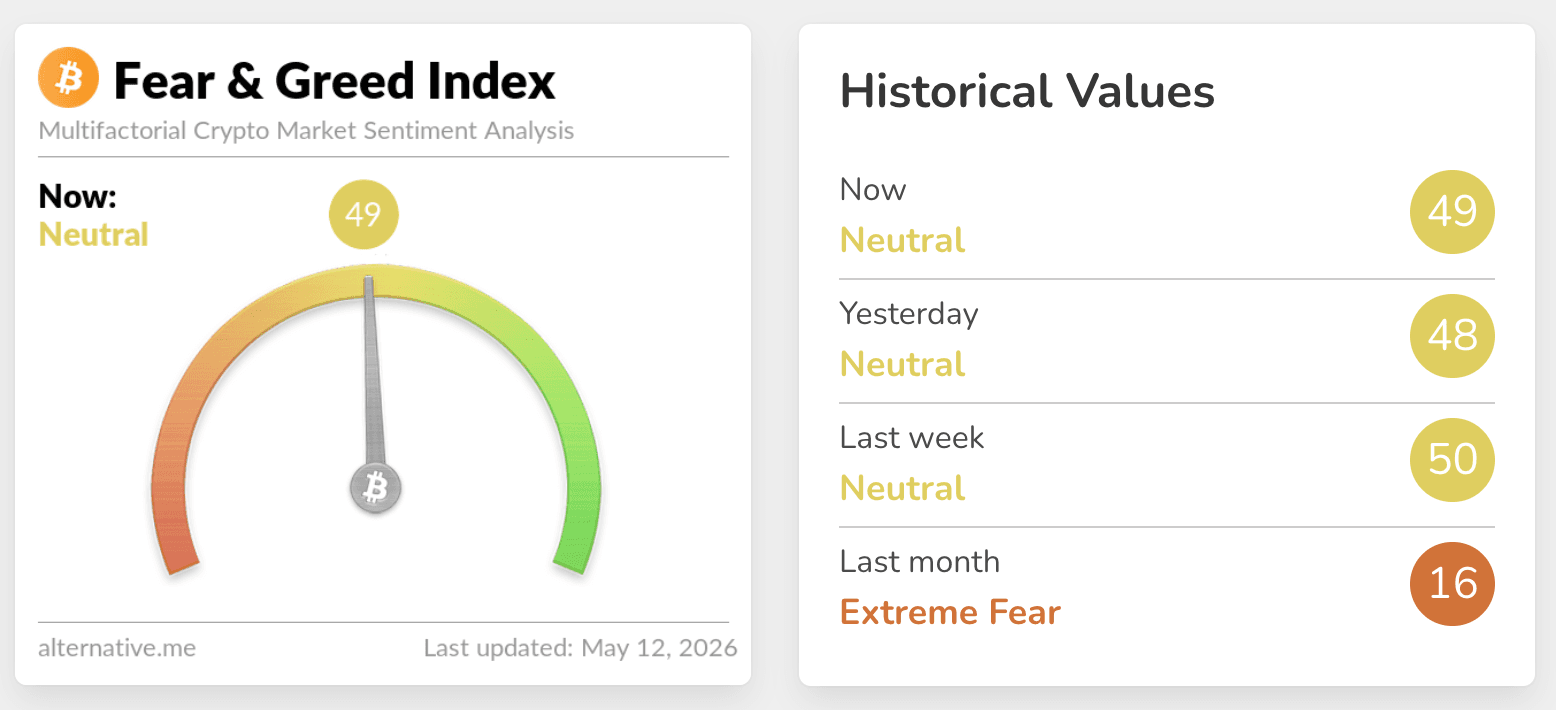
Source: Alternative
Key News Highlights:
Solana ETF Inflows Hit New High as Traders Target $120
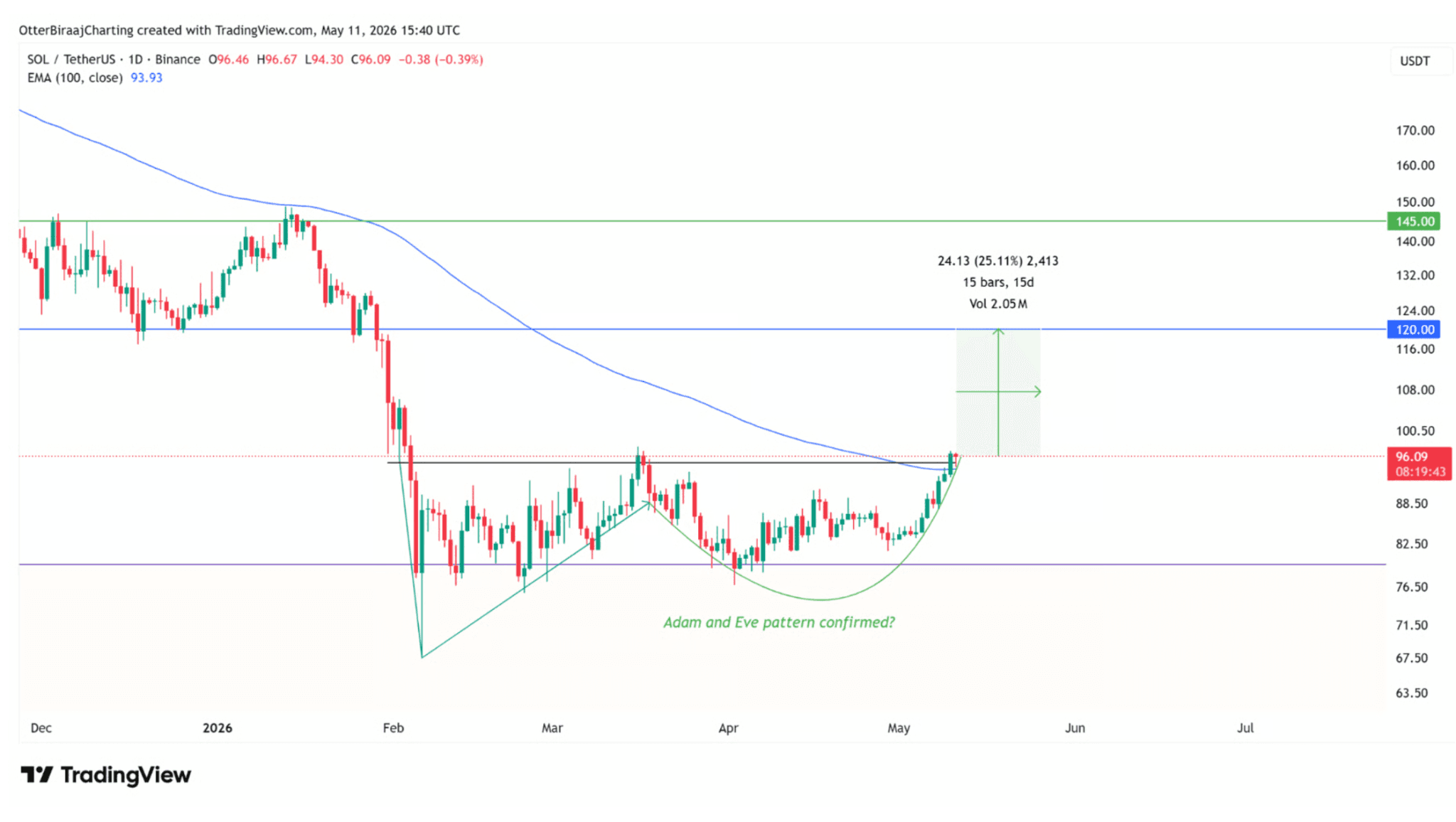
According to the latest combined data from SoSoValue and Coinglass, spot Solana exchange-traded funds (ETFs) recently delivered exceptionally strong performance. They recorded their strongest weekly inflows since February, attracting USD 39.23 million in net inflows for the week. This shows that institutional interest in the asset is recovering significantly. Among these inflows, Bitwise’s BSOL ETF led by a wide margin with USD 36 million in weekly inflows. This brought the product’s cumulative inflows since launch to USD 861 million, accounting for more than 80% of the total USD 1.06 billion inflow pool across all spot Solana ETFs. At the same time, Solana futures open interest rose by nearly 30% in May and has now climbed to USD 6.4 billion. This reflects active positioning by professional traders in the derivatives market. From a technical perspective, SOL is forming a clear Adam and Eve bottom reversal pattern on the daily chart and is now near the key breakout zone at the $95 neckline. Since SOL has broken above its 100-day exponential moving average (EMA) for the first time since October 2025, and the SOL/BTC pair has ended a 231-day downtrend, the market broadly sees $95 as a key support area. If SOL holds above that level, there may be limited major technical resistance between the current range and $120, while the next move could gain further momentum from short covering.
Bitcoin Miner MARA Misses First-Quarter Revenue Estimates and Reports USD 1.3 Billion Loss
US Bitcoin mining giant MARA Holdings recently released its financial results for the first quarter of 2026. Revenue came in at USD 174 million, down 18% from the same period last year and clearly below Wall Street analysts’ estimate of USD 192 million. The company ultimately reported a quarterly loss of USD 1.3 billion, a sharp increase from the USD 533 million loss recorded in the same period last year. The report stated that the large loss mainly came from unrealized losses on the 38,689 Bitcoin held on its balance sheet, as Bitcoin fell 23% during the quarter. To maintain operating capital and cash flow, MARA sold about 15,100 Bitcoin in the final week of March and raised around USD 1.1 billion. Facing a nearly 30% increase in mining difficulty over the past year and lower post-halving rewards, MARA is actively seeking a business transition. Through its acquisition of the Long Ridge Energy & Power power plant, the company plans to convert its existing 600 megawatts of power infrastructure from pure mining use into data centers that support artificial intelligence (AI) and high-performance computing (HPC). Although the company stressed that Bitcoin mining remains its current core business and “operational foundation,” management has made clear that it does not plan to purchase new mining hardware in the future. This marks a shift among large miners toward competition for power resources that overlap heavily with the AI industry, as traditional mining margins continue to face pressure.
Google Warns Hackers Used AI Exploit Script to Bypass Two-Factor Authentication for the First Time
A new investigation from Google’s Threat Intelligence Group shows that cybercriminal groups have carried out what it believes to be the first zero-day exploit developed with the help of artificial intelligence. The attack targeted a vulnerability in a well-known open-source, web-based system administration tool and was designed to bypass common two-factor authentication (2FA) mechanisms. Even with only initial user credentials, hackers were able to use the AI-generated script to move past the second layer of security. This represents a major security warning for cryptocurrency wallets and exchange accounts that rely heavily on 2FA protection. Google experts said the attack script showed clear signs of large language model (LLM) involvement, including specific code formatting and the type of “hallucination” that LLMs sometimes produce. The report further revealed that threat actors linked to North Korea and China are investing heavily in AI-based automated vulnerability discovery. Although current AI-driven attacks have not fully bypassed the core security logic of mainstream models, hackers are using industrialized pipelines to abuse premium AI accounts at scale. These methods include anti-detect browsers and account-sharing services, which are used to generate malicious code or defense evasion instructions. As AI systems become increasingly integrated into enterprise production environments, third-party data connectors and autonomous skills have become primary targets for attackers.
Trending Tokens:
- $MAWARI (Mawari)
Mawari Network has entered a critical transition period toward decentralization as it prepares to move from its initial construction phase into active decentralized infrastructure. As a DePIN platform purpose-built for 3D and XR content delivery, the project aims to address the bottlenecks of real-time rendering and insufficient computing capacity on mobile XR devices. Its recently released multi-phase roadmap has become the main catalyst, outlining the upcoming Decentralized Infrastructure Offering and the planned launch of an L3 chain on Arbitrum Orbit. Market interest has been driven largely by the introduction of Guardian Node Licenses and a three-year incentivization program designed to support network security. By coordinating a global network of GPU-powered nodes, Mawari enables high-fidelity spatial streaming that was previously difficult to achieve on standalone hardware. The upcoming native token and locking program represent important milestones for ecosystem participants seeking exposure to growth in the spatial computing sector. This strategic rollout positions Mawari as a core infrastructure provider for the next generation of immersive digital experiences.
- $NIGHT (Midnight)
Midnight Network has officially reached its mainnet milestone, marking a significant advance in fourth-generation blockchain technology focused on programmable privacy. Developed by Input Output, the network is designed to address the industry’s challenge of balancing data confidentiality with regulatory compliance through a hybrid ledger architecture. The recent launch of the genesis block has generated broad market attention, especially due to the participation of prominent federated node partners such as Google Cloud and MoneyGram. The network uses the NIGHT token for governance and utility while introducing a distinctive dual-component model in which NIGHT generates DUST to cover transaction costs. This recharge-based economic structure is designed to provide cost predictability for institutional users and commercial enterprises. In addition, the integration of the Compact programming language allows developers to implement zero-knowledge proofs with familiar TypeScript-based syntax, lowering the barrier to building privacy-focused applications. As the network advances through its structured multi-phase rollout, it aims to support the digitization of sensitive real-world assets that require selective disclosure capabilities.
- $MEZO (Mezo)
Mezo has officially launched its native token and claim portal, marking a new phase for its Bitcoin economic layer. As a Bitcoin Layer 2 network, Mezo aims to transform Bitcoin from a passive store of value into a productive asset within a circular economy. The recent announcement allowing users to claim tokens and lock them alongside their Bitcoin holdings has led to a notable increase in on-chain activity and social engagement. The project uses a Proof of HODL mechanism that rewards long-term contributors through point multipliers based on the duration of asset deposits. Backed by well-known investors such as Pantera Capital and Hack VC, Mezo uses its technology stack to support a diverse range of decentralized applications without compromising the underlying security of the Bitcoin network. The recent token launch marks the transition from an initial points-based incentive system to a fully functional economic participation model. By lowering the barrier for Bitcoin holders to access DeFi utility, Mezo is positioning itself as a leading project within the emerging Bitcoin-native infrastructure narrative.
Disclaimer: The information provided in this section is for informational purposes only and doesn't represent any investment advice or FameEX's official view.