FameEX Today’s Crypto News Recap | April 29, 2026
2026-04-29 06:49:45

RedStone launches the RWA settlement layer, BTC retreats amid AI weakness, and Canada proposes the crypto ATM ban; the crypto market sees a correction with BTC at $77K as sentiment shifts to Fear. Today’s crypto market showed a pullback as both Bitcoin and Ethereum lost key psychological round-number levels, indicating stronger profit-taking pressure after the market reached recent highs. According to the latest market data, Bitcoin (BTC) fell to around the $77,000 level during today’s session, with a 24-hour decline of about 0.66%, while Ethereum (ETH) also weakened and dropped below the $2,300 mark, down around 0.24%. Overall market sentiment was pressured by weakness in technology stocks and persistent macroeconomic uncertainty. Against this backdrop, total crypto liquidations reached USD 192 million over the past 24 hours, including USD 128 million in long liquidations and about USD 68.28 million in short liquidations. This shows that leveraged long positions faced notable forced unwinding during the short-term pullback. Despite the weak performance of major cryptocurrencies, the AI and GameFi sectors showed relatively strong resilience. Some tokens such as Bittensor (TAO) rose against the market by +4.20%. This suggests that capital still paid attention to sectors with stronger technical fundamentals during a risk-off environment. Meanwhile, the US Treasury’s sanctions targeting Iran’s crypto access channels and former Federal Reserve officials’ expectations for a higher-for-longer rate policy further reinforced the market’s wait-and-see mood.
Crypto Markets Overview
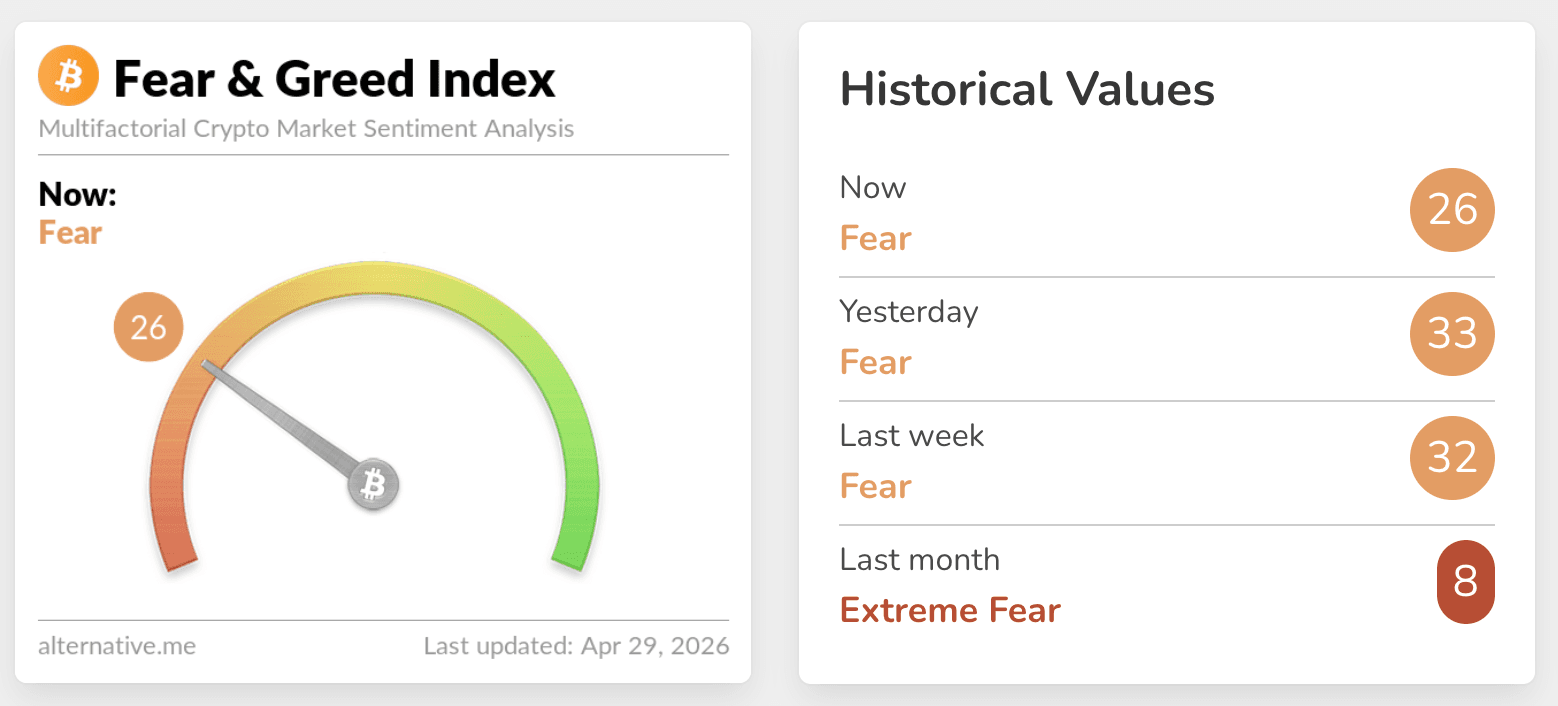
The crypto market overview currently shows that sentiment has shifted meaningfully toward caution. The Crypto Fear & Greed Index fell to 26, remaining in the Fear zone and moving into a deeper cautious range compared with the previous day. This change mainly reflects rising investor concerns over global geopolitical risks and the Federal Reserve’s interest rate path. In terms of trading behavior, Bitcoin’s 8-hour average funding rate across the market fell to 0.0005%, indicating that speculative enthusiasm among leveraged longs is fading. The market is now in a key technical adjustment phase. If BTC moves above $80,059, major exchanges are expected to see up to USD 1.268 billion in short liquidation pressure. If BTC falls below $72,649, about USD 952 million in long positions may face forced liquidation risk. For Ethereum, the funding rate stayed low at 0.0023%, reflecting a cautious view among market participants toward its short-term breakout momentum. Its key liquidation level is concentrated near $2,174. A break below this level could trigger USD 785 million in long liquidations. Overall trading volume has also contracted, while both retail and institutional participants appear to be taking a wait-and-see approach. With the US Dollar Index (DXY) edging higher to 98.639 and the probability of the Federal Reserve keeping rates unchanged priced at 100%, the short-term upside room for risk assets remains clearly constrained.
Source: Alternative
Key News Highlights:
RedStone Launches Settlement Layer To Bridge The Liquidity Gap Between DeFi Lending And RWAs
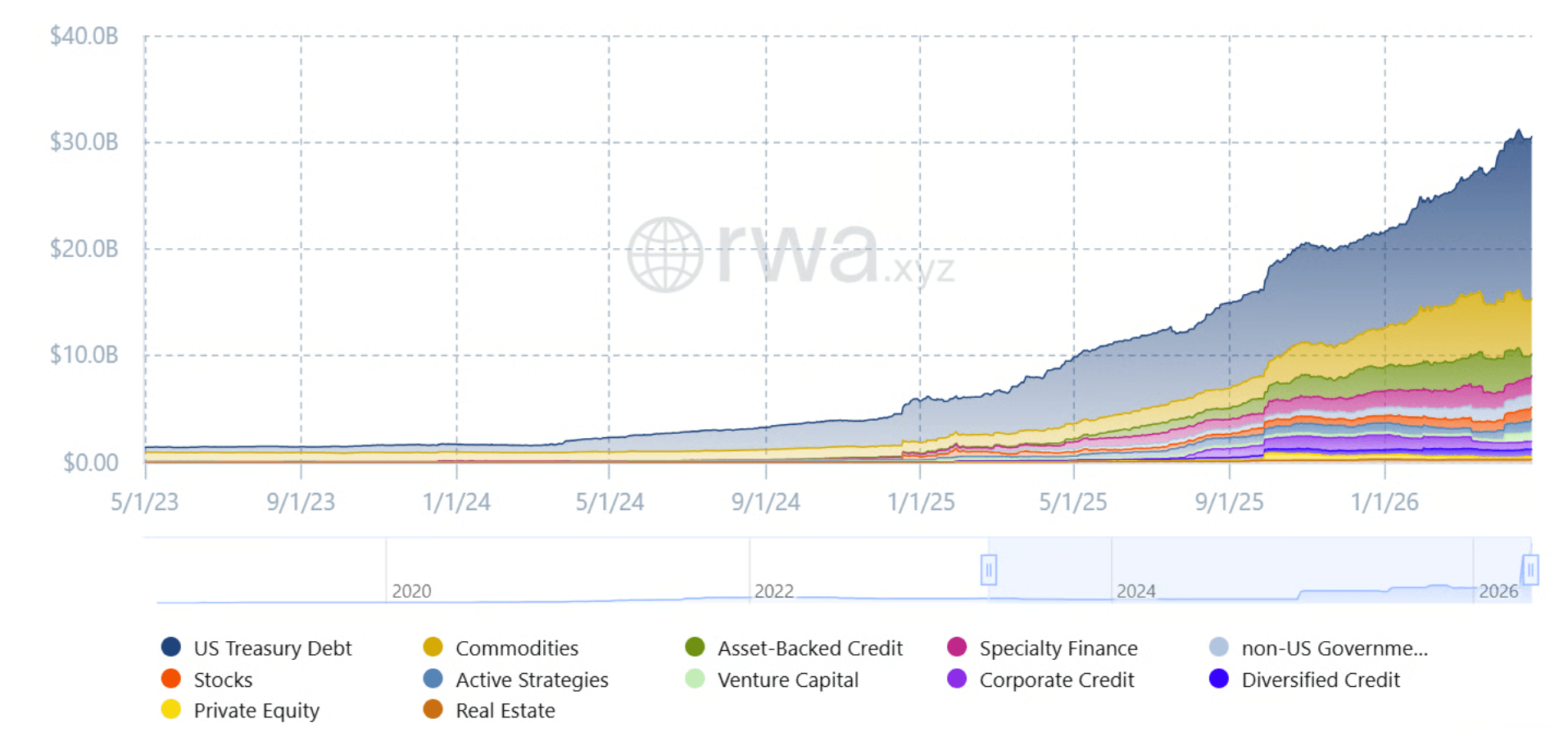
Decentralized oracle provider RedStone has officially launched a new settlement layer called RedStone Settle, which aims to address the structural barriers that prevent tokenized real-world assets (RWAs) from being used more widely as collateral in decentralized finance lending markets. Traditionally, DeFi platforms such as Aave rely on near-instant liquidation mechanisms to manage risk. However, tokenized funds, bonds, and other real-world assets usually have redemption periods ranging from 60 to 180 days. This timing mismatch has limited the broader use of RWAs in lending markets. RedStone Settle introduces an on-chain auction mechanism that allows liquidity providers to immediately step in and take over positions when liquidation events are triggered. These liquidity providers assume the delayed redemption risk at the back end while supplying the immediate liquidity required by lending protocols. According to industry data, the tokenized asset market excluding stablecoins has exceeded USD 30 billion. The launch of this settlement layer is viewed as an important step toward unlocking idle capital and improving asset utilization. It may also help users borrow more efficiently against yield-generating positions.
Bitcoin Falls Below $76,000 As AI Sector Weakness And Regulatory Delays Weigh On Sentiment
Bitcoin pulled back below $76,000 this week, mainly affected by weakness in the tech-heavy Nasdaq 100 Index and negative sentiment linked to OpenAI’s missed revenue growth targets. As leading AI infrastructure stocks such as Nvidia declined, the correlation between the crypto market and the US technology sector became more visible again. Investors chose to take profits ahead of a major technology earnings week, which reduced broader risk appetite. In addition to the spillover effect from technology stocks, disappointment over stalled progress on the CLARITY Act in the Senate Banking Committee also weakened institutional confidence. Although the new administration has taken a more crypto-supportive stance, concrete legislative progress has not yet materialized. Market expectations for the bill’s approval before 2027 have also declined. Combined with the spike in Brent crude prices caused by geopolitical tensions and uncertainty in the real estate markets of both China and the United States, Bitcoin lacked clear upside momentum under multiple macro pressures and continued to trade in a consolidation pattern.
Tokenized RWA market. Source: RWA.xyz
Canadian Federal Government Plans To Ban Crypto ATMs To Fight Fraud Targeting Citizens
The Canadian federal government announced in its latest spring economic update that it plans to ban crypto ATMs across the country, citing concerns that these machines have become a major tool for scammers to mislead citizens and launder funds. According to related investigations, crypto ATMs are easy to use and do not require a bank account, but their lack of human review and relatively private transaction process have made them attractive to criminals seeking to move victims’ cash into virtual wallets around the world. Canada currently has about 4,000 crypto ATMs, giving it the highest per-capita crypto ATM density globally. However, in the absence of industry-specific regulation, financial intelligence agency FINTRAC has repeatedly warned about transaction risks tied to these machines. The government said the proposed ban is intended to better protect citizens from financial crime while still allowing legitimate virtual currency transactions through compliant brick-and-mortar money services businesses (MSBs). Further details are expected to clarify how the measure will restrict illicit fund flows and strengthen the security of the financial system.
Trending Tokens:
- $IRYS (Irys)
Irys has recently drawn strong market attention as a Layer 1 programmable data chain built for AI workloads and large scale data storage. The project evolved from Bundlr and is designed to combine a low cost storage layer with a high performance EVM compatible execution layer known as IrysVM. This architecture enables programmable data across multiple ecosystems, including Ethereum and Polygon, while maintaining efficiency for both developers and autonomous agents. Market interest accelerated after the launch of its new official website and the release of the V1 platform. The update gives the developer community a clearer structure and more complete documentation support. The team has emphasized that these changes are only the first step in a broader communication strategy. That strategy is aimed at strengthening Irys as a preferred foundation for AI driven data applications. Backed by nearly $19 million from investors such as Framework Ventures and CoinFund, the protocol continues to show strong momentum in developer engagement and social attention across the infrastructure sector.
- $TEN (Ten)
Ten represents an important development in the Ethereum Layer 2 landscape by offering a programmable privacy solution that keeps transaction inputs and contract state encrypted. The protocol was originally incubated by enterprise blockchain firm R3 under the name Obscuro. It allows developers to control, at a granular level, which data points remain private and which can be disclosed publicly. Recent updates from the TEN Network Association Board have renewed community interest as the project works to scale its encrypted execution environment for mainstream decentralized applications. As demand grows for protecting sensitive financial and personal data onchain, the narrative around privacy enhanced scalability is gaining stronger market traction. With total funding of $9 million and backing from institutions including Big Brain Holdings, Ten is positioning itself as a notable player in the secure Layer 2 category. The protocol remains focused on balancing Ethereum's transparency with the practical need for private computation. Its current growth trajectory reflects a broader market view that modular privacy will become an important part of next generation blockchain infrastructure.
- $HEMI (Hemi)
Hemi has emerged as a notable modular Layer 2 network by combining Bitcoin security with the broad programmability of the Ethereum Virtual Machine. The project uses its Proof-of-Proof consensus design so that each transaction on the network can inherit Bitcoin's strong security properties. Recent market momentum has been driven by growing attention around the Hemi Virtual Machine and by ecosystem integration with partners such as Spectra Finance. That integration has enabled position management without relying on oracles. By supporting native Bitcoin compliant strategies and cross-chain tunnel technology, Hemi creates a unified environment for institutional custody tools and decentralized finance applications. Its leadership team includes industry veterans such as Jeff Garzik, and the project has raised $30 million from well known backers including Republic and Breyer Capital. Market participants are paying closer attention because Hemi can unlock Bitcoin liquidity while still preserving full EVM compatibility for developers. This dual chain narrative positions Hemi as an important interoperability layer that addresses liquidity fragmentation between the world's two largest blockchain ecosystems.
Disclaimer: The information provided in this section is for informational purposes only and doesn't represent any investment advice or FameEX's official view.