FameEX Today’s Crypto News Recap | April 27, 2026
2026-04-27 06:24:34

Aave seeks Arbitrum aid for Kelp DAO, analysts eye BTC cycle bottoms, and Western Union joins Solana to launch stablecoin; BTC hits $79k as market sentiment recovers to neutral. Today’s cryptocurrency market showed a clear rebound. Bitcoin (BTC) broke above the $79,000 level, while Ethereum (ETH) moved close to $2,400. Overall market sentiment improved notably over the past 24 hours. According to the latest market data, Bitcoin gained about 1.84% in 24 hours. Ethereum performed more strongly with a 3.65% increase, which helped drive broad gains across the decentralized finance (DeFi) and real-world asset (RWA) sectors. Market participants are now focused on the upcoming Federal Reserve interest rate decision. Traders generally expect rates to remain unchanged at this meeting, while the probability of a rate cut by year-end has recovered to around 40%. Geopolitical developments also affected market volatility. Recent comments from Trump on the Middle East situation prompted investors to reassess allocations between safe-haven assets and risk assets. Large-scale short liquidations appeared across the market today. This reflected sharp volatility near lower price ranges and forced a broad unwinding of short positions. Overall open interest also increased, showing that capital is flowing back into the contract market for major cryptocurrencies.
Crypto Markets Overview
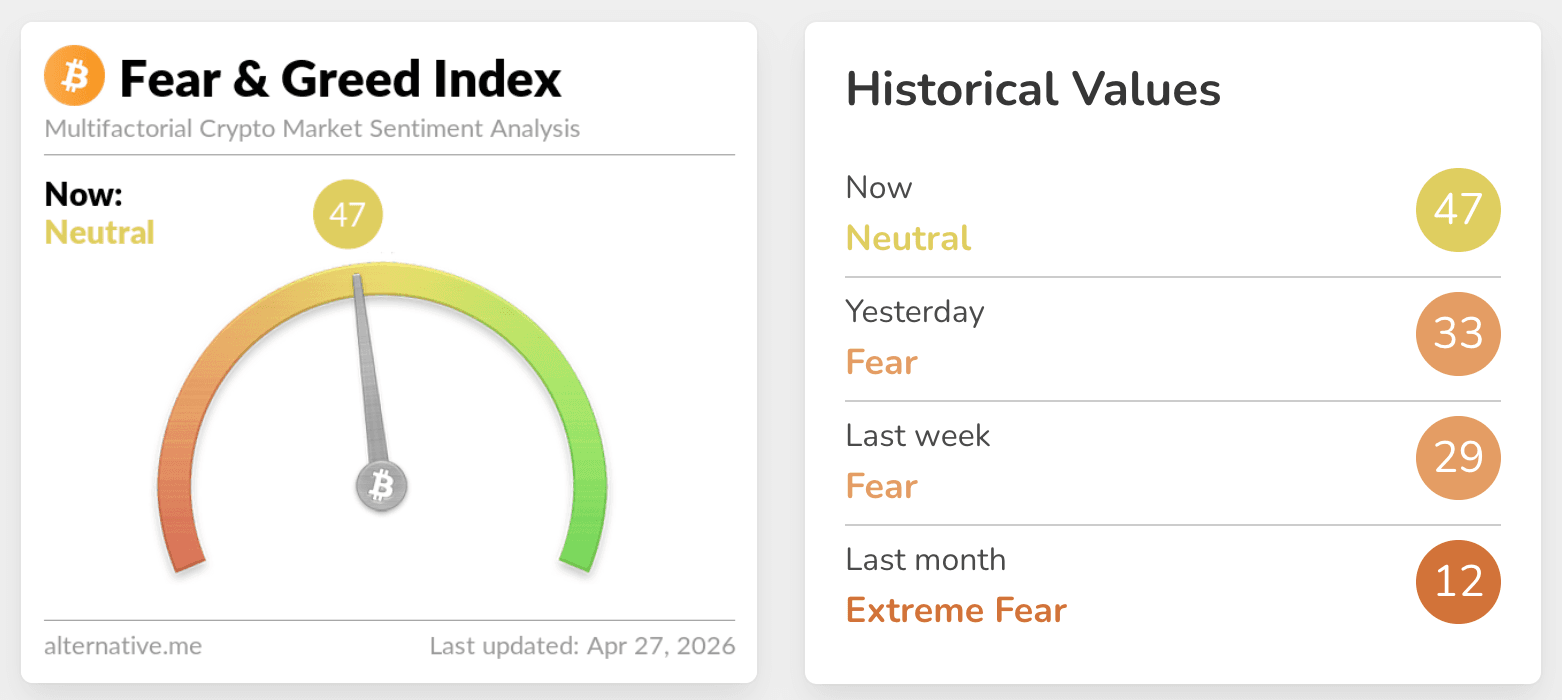
In the current crypto market structure, the Crypto Fear & Greed Index stood at 47. Its number improved from yesterday’s “Fear” level to “Neutral,” suggesting that investor confidence is gradually recovering after the recent market downturn. According to the latest Coinglass data, total liquidations across the crypto market reached USD 213 million over the past 24 hours. Short liquidations accounted for USD 178 million, making up the vast majority of the total, while long liquidations stood at only USD 35.7282 million. This shows that the rebound exceeded the expectations of many short traders. Liquidation pressure increased sharply after Ethereum and Bitcoin broke through key resistance levels. Bitcoin showed relatively strong support near $79,000. However, if it falls below $74,533, cumulative long liquidation intensity across major exchanges could reach USD 1.524 billion. By contrast, if Bitcoin breaks above $82,013, short liquidation pressure could expand further to USD 1.189 billion. For Ethereum, total contract open interest increased by 5.4% over 24 hours and reached USD 32.772 billion. This reflects strong market attention on Ethereum’s potential volatility. Bitcoin’s current 8-hour average funding rate across the market is -0.0031%, while Ethereum’s is -0.0014%. Negative funding rates usually indicate that market sentiment remains somewhat cautious, or that potential reverse squeeze conditions may still exist.
Source: Alternative
Key News Highlights:
Aave Proposes Sending 30,000 ETH From Arbitrum To The DeFi United Relief Fund To Restore Kelp DAO Losses
Aave Labs recently submitted an important proposal to the Arbitrum governance community. The proposal recommends transferring 30,765 ETH currently frozen by the Arbitrum Security Council to a relief fund called “DeFi United.” The funds are worth about USD 73.5 million and are closely tied to the earlier Kelp DAO attack. In that incident, the attacker stole about USD 293 million worth of assets from the Kelp protocol, which created a severe collateral backing gap for the rsETH token. Aave itself was heavily affected by the event. The attacker used the stolen rsETH as collateral on Aave to borrow assets, which led to more than USD 190 million in bad debt and caused the platform’s total value locked to fall by nearly USD 12 billion within one week. The proposal has received support from several affected protocols, including Kelp DAO, LayerZero, Ether.fi, and Compound. Its goal is to restore full collateral backing for rsETH through cross-protocol cooperation and compensate affected holders. The DeFi United fund has already raised more than USD 21 million in direct contributions, including personal support from Aave founder Stani Kulechov. Another USD 215 million in pledged funds is still awaiting governance approval from related protocols. Aave expects the full recovery process to take about 49 days and stressed that even a partial recovery could significantly reduce the current liquidity gap across the DeFi ecosystem.
Analyst Says Bitcoin Could Bottom In The Second Half Of 2026 As The $80,000 Resistance Level Remains In Focus
Prominent Bitcoin investor and analyst Michael Terpin said in a recent market report that Bitcoin may not reach its final bottom until October 2026, even though it has rebounded by more than 29% from its earlier low this year. Based on the historical average of market cycles, he estimated that the bottom could form near $57,000. Terpin said Bitcoin was strongly rejected at the $80,000 level, which remains a key technical resistance zone. In his perspective, the bull market would only fully return after Bitcoin reclaims the $100,000 psychological level. He also noted that Bitcoin often needs to fall below the 200-week moving average, a dynamic support level, before completing a bottoming process. Current market liquidity remains pressured by the high-interest-rate environment and geopolitical tensions. The upcoming Federal Open Market Committee meeting has become especially important, as markets almost fully expect the Fed to keep interest rates unchanged. This has kept investors cautious in the absence of a clear policy pivot signal. Other analysts, including Matthew Hyland, also warned that the current rebound may be a “fake breakout.” They pointed to limited market euphoria and insufficient trading volume support. If Bitcoin fails to hold above $77,500 in the short term, it may still face the risk of pulling back toward $73,000 or even lower levels.
Western Union Plans To Launch Solana-Based Stablecoin USDPT And A Global Stablecoin Payment Card Next Month
Global financial services company Western Union announced a major digital asset initiative during its first-quarter earnings call. CEO Devin McGranahan said the company plans to officially launch USDPT next month, a U.S. dollar-backed stablecoin built on the Solana blockchain. USDPT is not designed as a retail product for ordinary consumers at launch. Instead, it will serve as an alternative to the SWIFT network for onchain settlement between Western Union and its global agents. According to the company, USDPT could significantly improve the settlement speed of cross-border payments and maintain operations during traditional banking holidays. Alongside the stablecoin, Western Union is also launching the Digital Asset Network, known as DAN. The network is designed to connect its existing retail infrastructure with crypto wallets, making it easier for users to convert between local currency and digital assets. The company also plans to launch a Stable Card later this year across dozens of markets. The card is aimed especially at users in high-inflation regions, allowing them to hold dollar-denominated value and use it for daily spending. Although Western Union’s first-quarter adjusted revenue fell 1% to USD 983 million, management expressed confidence in the expansion of its digital asset strategy. The company sees this strategy as a key driver for future business scaling.
Trending Tokens:
- $HYPER (Hyperlane)
Hyperlane has strengthened its position as a leading interoperability provider following the recent launch of Fluent Mainnet, where the protocol’s integration enabled seamless cross-chain communication. The deployment of Nexus has further expanded its utility by supporting native USDT bridging across major networks such as TRON, Arbitrum, Plasma, and BNB Chain. This development is significant because it offers a native asset transfer solution without the common security risks associated with wrapped assets. The protocol’s developer-centric approach, built around on-chain APIs and SDKs, continues to attract builders focused on creating unified cross-chain ecosystems. Market attention remains elevated as Hyperlane expands into high-throughput execution environments and demonstrates its ability to handle core infrastructure messaging. Its integrations with several well-known blockchains highlight its role as a key layer for liquidity and data movement in the modular era. Therefore, the project’s growth metrics are seeing a sharp increase as it captures a larger share of the cross-chain messaging market.
- $KITE (Kite AI)
Kite AI is gaining notable attention for its specialized infrastructure designed to support the development and operation of the agentic internet. The project recently completed a series of high-profile events during its Global Tour in Hong Kong, with a focus on the convergence of AI agents and decentralized networks. By providing a unified identity and payment framework, Kite enables autonomous agents to collaborate and transact without centralized intermediaries. Its protocol-to-protocol token model is designed to align ecosystem incentives by rewarding both the supply and consumption of AI agent services. This structure aims to build a vertically integrated AI environment that delivers verifiable commercial value to users. Investors are paying closer attention to Kite’s potential to support large-scale adoption across AI and Web3 through its scalable Layer 1 solution. The project’s emphasis on AI agent interoperability and governance addresses key challenges in the current autonomous systems landscape.
- $YOM (YOM)
YOM is establishing itself as a pioneer in decentralized physical infrastructure networks by offering a distributed cloud gaming solution. The network uses a global grid of gaming console nodes to deliver high-quality, low-latency gameplay at extremely low operating costs. Recent community initiatives have focused on lowering technical barriers for players, with messaging that prioritizes instant gameplay over complex hardware setup. Node operators are currently incentivized through a deflationary token mechanism that provides attractive returns for contributing computing capacity to the network. This approach effectively uses idle gaming resources to support scalable cloud infrastructure while rewarding participants for their contribution. The project’s presence across the Solana and Avalanche ecosystems highlights its multi-chain strategy and commitment to infrastructure resilience. As decentralized compute remain a major market narrative, YOM’s ability to commercialize distributed resources for the gaming industry has attracted significant market interest.
Disclaimer: The information provided in this section is for informational purposes only and doesn't represent any investment advice or FameEX's official view.