ZIL (Zilliqa) Token Price & Latest Live Chart
2026-02-05 11:21:04
What is ZIL (Zilliqa)?
Zilliqa is a public Layer 1 blockchain that was conceived around a structural premise that early blockchain systems struggled to address in practice: transaction throughput would inevitably become a limiting factor as decentralized applications moved beyond simple transfers and into continuous, high-frequency execution. Instead of treating scalability as an optimization problem to be solved after launch, Zilliqa embedded scalability directly into its base-layer architecture. This decision was shaped by the observation that traditional blockchains require every participating node to process every transaction, creating an execution bottleneck that grows more restrictive as network usage increases. Zilliqa’s design starts from the opposite assumption, that a network can remain secure and decentralized without universal transaction replication, as long as coordination and consensus are handled correctly at the protocol level.
Zilliqa was created to function as a general-purpose execution infrastructure rather than a narrowly scoped application network. The protocol was designed to support smart contracts, decentralized applications, and complex state transitions while maintaining predictable performance characteristics under load. This focus distinguished Zilliqa from many early platforms that prioritized simplicity or rapid experimentation over long-term execution efficiency. By treating computation as a resource that must be distributed intelligently across the network, Zilliqa positioned itself as a system capable of supporting sustained on-chain activity without relying on fee escalation as a congestion control mechanism.
From its inception in 2017, Zilliqa positioned itself as protocol infrastructure rather than narrative-driven software. Its development path emphasized correctness, determinism, and system-level guarantees over rapid feature expansion. This orientation explains why Zilliqa has often been discussed in technical contexts related to scalability research and execution models, rather than being defined by a single consumer-facing use case. The network’s long-term relevance is therefore best understood not through short-term market cycles but through its role as an evolving execution framework designed to address structural constraints in decentralized systems. The ZIL token is an integral component of how this system operates. It serves as the unit through which computation is priced, transactions are prioritized, and network participation is economically coordinated. ZIL is used to pay transaction fees, interact with smart contracts, and participate in security-related mechanisms such as staking and validator incentives, depending on the network phase. Rather than functioning as an abstract financial overlay, the token is embedded directly into the mechanics of execution and resource allocation, ensuring that network usage and economic activity remain tightly coupled.
How does ZIL (Zilliqa) work?
Zilliqa operates on a sharded network architecture, a model that divides the blockchain into multiple smaller groups of nodes known as shards, each responsible for processing a subset of transactions. Unlike traditional blockchains, where transactions are executed sequentially by all nodes, Zilliqa allows these shards to execute transactions in parallel. The results of this parallel execution are then coordinated and aggregated into a single global state. This approach fundamentally alters how throughput scales, because adding more nodes increases the network’s processing capacity rather than merely increasing redundancy. The design assumes that growth in participation should expand capacity, not constrain it.
Security within this parallel execution model is maintained through coordinated consensus and periodic reshuffling of nodes between shards. By rotating node assignments, Zilliqa prevents any fixed group of participants from consistently controlling a specific portion of transaction processing. This mechanism mitigates the risk of shard-level collusion while preserving deterministic finality across the network. The protocol balances local execution within shards with global agreement across the network, ensuring that parallelism does not compromise consistency. The outcome is a system that prioritizes predictable execution and clear settlement guarantees, rather than probabilistic confirmation.
Smart contracts on Zilliqa were originally designed to run using Scilla, a domain-specific programming language created to emphasize safety and formal verification. Scilla enforces a clear separation between contract logic and state transitions, reducing the risk of unintended side effects such as reentrancy vulnerabilities. This design choice reflects a deliberate emphasis on correctness and auditability, particularly important in environments where smart contracts may manage significant economic value. While this approach initially introduced friction for developers accustomed to Ethereum-style tooling, it provided a foundation for contracts that are easier to reason about at scale.
As the ecosystem evolved, Zilliqa expanded its execution environment to include full Ethereum Virtual Machine compatibility as part of its Zilliqa 2.0 roadmap. This addition allows developers to deploy EVM-based smart contracts directly onto the network while continuing to benefit from its underlying sharded architecture. Rather than abandoning its original design principles, Zilliqa layered compatibility on top of its existing infrastructure. This approach enables broader tooling support and lowers developer onboarding friction, while preserving the network’s core execution model. The system thus combines parallelized base-layer execution with widely adopted development standards.
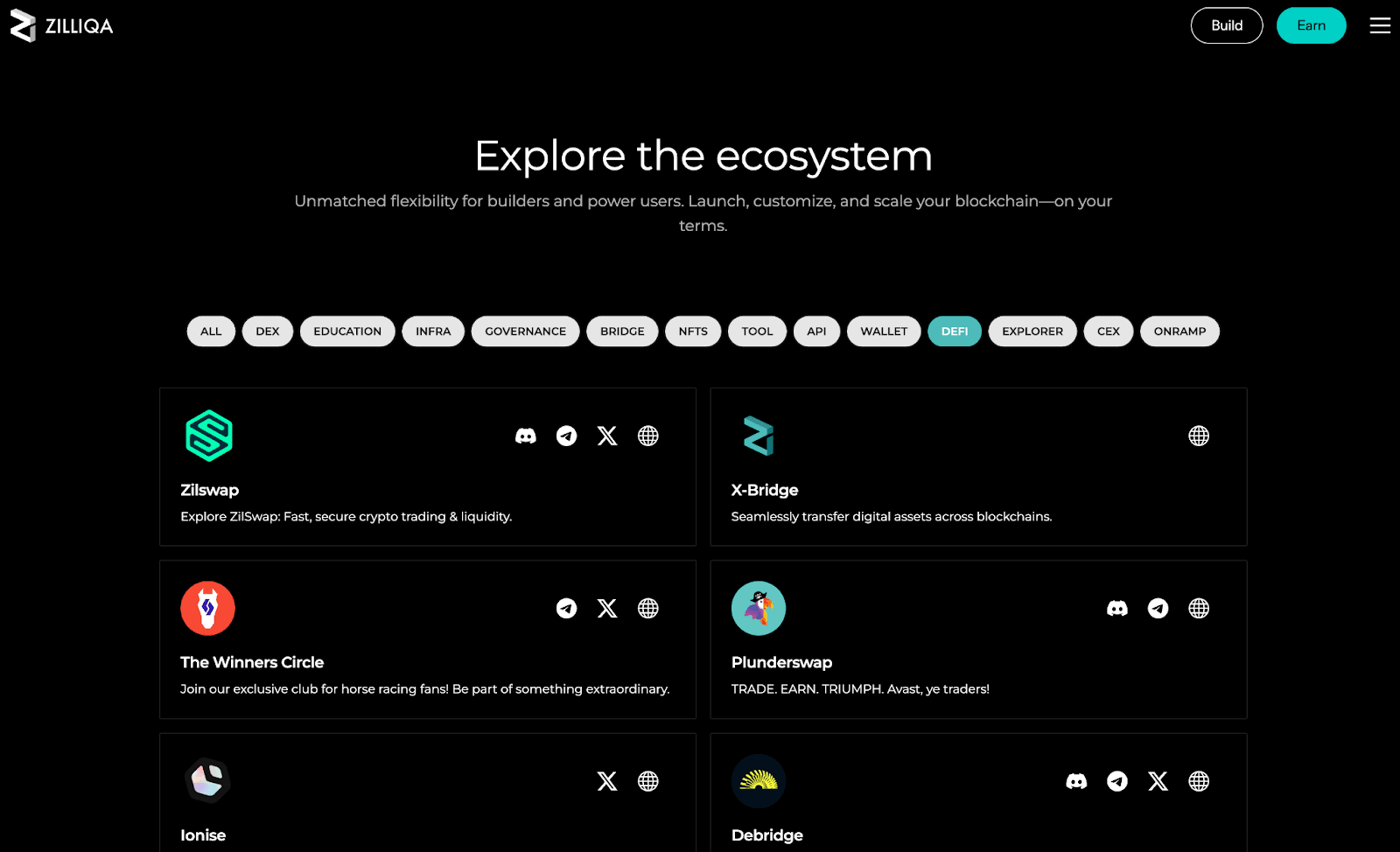
Zilliqa ecosystem, source: Zilliqa
ZIL (Zilliqa) market price & tokenomics
ZIL’s tokenomics must be understood in the context of Zilliqa’s role as execution infrastructure rather than as a purely financial asset. The supply structure and issuance framework were defined during the project’s early lifecycle, with the intention of supporting sustained network operation instead of incentivizing short-term activity through aggressive inflation. Therefore, ZIL’s economic role is closely tied to how computation, transaction prioritization, and security coordination are handled at the protocol level. The token exists primarily as a mechanism for pricing execution resources and aligning participant incentives, rather than as a standalone instrument designed to capture value independently of network usage.
ZIL’s market price has tended to respond to structural milestones rather than continuous narrative momentum. During the 2018 market expansion, ZIL traded alongside other early smart contract platforms, with valuation driven largely by expectations around scalability and throughput potential. In later cycles, particularly around periods of protocol maturation and major upgrade roadmaps, price behavior reflected renewed reassessment of Zilliqa’s relevance as a Layer 1 system rather than speculative interest in application-layer growth.
From a utility perspective, ZIL is consumed through transaction fees and smart contract execution, embedding demand directly into on-chain activity. When applications generate sustained transaction volume or increase computational complexity, demand for execution resources increases accordingly. In phases where staking and validator participation are emphasized, ZIL also functions as the economic bond that ties security provision to resource commitment. This dual role anchors the token’s relevance to actual system operation, making its economic function dependent on network health rather than market sentiment alone.
Why do you invest in ZIL (Zilliqa)?
Zilliqa continues to resurface in market and technical discussions because the problem it was designed to address has not disappeared. As decentralized applications grow in complexity and frequency of execution, the limitations of single-threaded, globally replicated execution models become increasingly visible. Parallel execution architectures regain relevance whenever scalability constraints re-emerge as bottlenecks. In this context, Zilliqa stands out not as a theoretical proposal, but as a network that implemented sharding in production and has operated through multiple market cycles.
Another factor contributing to sustained attention is Zilliqa’s emphasis on execution determinism and contract safety. As smart contracts have come to manage increasingly large pools of economic value, the cost of unexpected behavior or ambiguous execution semantics has become more apparent. Zilliqa’s early focus on formal contract design, particularly through its Scilla language, reflects a philosophy that treats predictability as a core feature rather than an optional enhancement. This approach resonates in discussions about infrastructure reliability, especially for applications that prioritize long-term stability over rapid iteration.
The introduction of full Ethereum Virtual Machine compatibility marked a significant shift in how the network is positioned within the broader ecosystem. By enabling developers to deploy EVM-based contracts without abandoning Zilliqa’s underlying architecture, the protocol reduced barriers to adoption while retaining its core design principles. This change allowed Zilliqa to re-enter competitive comparisons among Layer 1 platforms, not as a closed system with specialized tooling requirements, but as an execution environment that aligns with widely adopted development standards.
Longevity itself also plays a role in sustaining interest. Zilliqa is not a greenfield platform optimized for immediate experimentation, but a system that has had to evolve under the constraints of an existing network. Its upgrade path reflects the challenges of modifying foundational infrastructure while maintaining continuity. For observers concerned with how blockchain systems adapt over time, Zilliqa offers a concrete example of protocol evolution shaped by real operational requirements rather than abstract design alone.
In early February 2026, Zilliqa’s native token ZIL experienced a notable price rise, with market attention centered on confirmed progress in the network’s upgrade cycle. The upgrade included a node version release, a hard fork scheduled for February, and closer alignment with the Ethereum Virtual Machine functionality, materially improving smart contract compatibility, developer tooling support, and node stability while reducing integration friction for applications and infrastructure. During the same upgrade phase, a government-affiliated trust network from Liechtenstein was expected to participate as a validator, adding an institutional layer to network governance and reinforcing the protocol’s decentralization framework.
Is ZIL (Zilliqa) a good investment?
For a Layer 1 blockchain, long-term relevance is determined by whether the network continues to host meaningful activity and whether its native token remains essential to that activity. In Zilliqa’s case, this means assessing whether its execution model continues to offer advantages as application demands evolve, and whether ZIL remains the mechanism through which computation and security are coordinated. From a technical standpoint, Zilliqa’s scalability model is not a finished product but an ongoing process of adaptation. While sharding provides a framework for parallel execution, its effectiveness depends on coordination overhead, tooling maturity, and the ability of applications to take advantage of the underlying architecture. The Zilliqa 2.0 roadmap and the integration of EVM compatibility reflect attempts to address practical constraints that previously limited ecosystem expansion, rather than fundamental changes in design philosophy.
Economically, ZIL’s long-term role depends on whether it continues to function as the required medium for accessing network resources. If on-chain usage remains sustained or grows in complexity, demand for execution and security participation supports the token’s utility. Conversely, if network activity diminishes, the economic relevance of the token weakens regardless of its historical position. This relationship underscores that ZIL’s long-term assessment cannot be separated from the operational health of the network itself.
Find out more about ZIL (Zilliqa):
- Homepage
- Explorer: Bscscan
- Whitepaper
Explore the latest ZIL (Zilliqa) price and live chart, trade ZIL on FameEX, and access real-time market data! Get started now with a seamless trading experience!
Disclaimer: The information provided in this article is intended only for educational and reference purposes and should not be considered investment advice. Conduct your own research and seek advice from a professional financial advisor before making any investment decisions. FameEX is not liable for any direct or indirect losses incurred from the use of or reliance on the information in this article.