FameEX Today’s Crypto News Recap | July 13, 2026
2026-07-13 06:55:03

US spot ETFs end 8-week outflow streak, Thailand tightens stablecoin oversight, and the BIP-110 proposal sparks Bitcoin governance debates. Bitcoin trades at $63K with cautious sentiment. Bitcoin fell back below $63K today, down about 1.83% over the past 24 hours. Its intraday high reached $64,273, while the low fell to $62,580. This shows that the market still lacks sustained upside momentum after the short-term rebound. The Crypto Fear and Greed Index now stands at 28, up from 26 yesterday and 24 last week. It is also significantly higher than last month’s 13, though overall sentiment remains in the Fear zone. On the institutional side, U.S. spot Bitcoin ETFs recorded USD 197 million in net inflows last week, while spot Ethereum ETFs saw USD 84.42 million in net inflows. Both products ended an eight-week streak of weekly net outflows. The latest data shows that some capital has returned to crypto asset ETFs, but the inflow size remains limited compared with the cumulative outflows seen earlier. Therefore, the funding picture has mainly shifted from sustained outflows to a short-term balance. Market sectors did not move in one direction. The NFT sector rose 4.50%, while AI, DeFi, and CeFi posted mild gains. SocialFi, Layer2, Meme, and PayFi recorded different levels of decline. Capital rotation remains concentrated in selected themes and individual tokens.
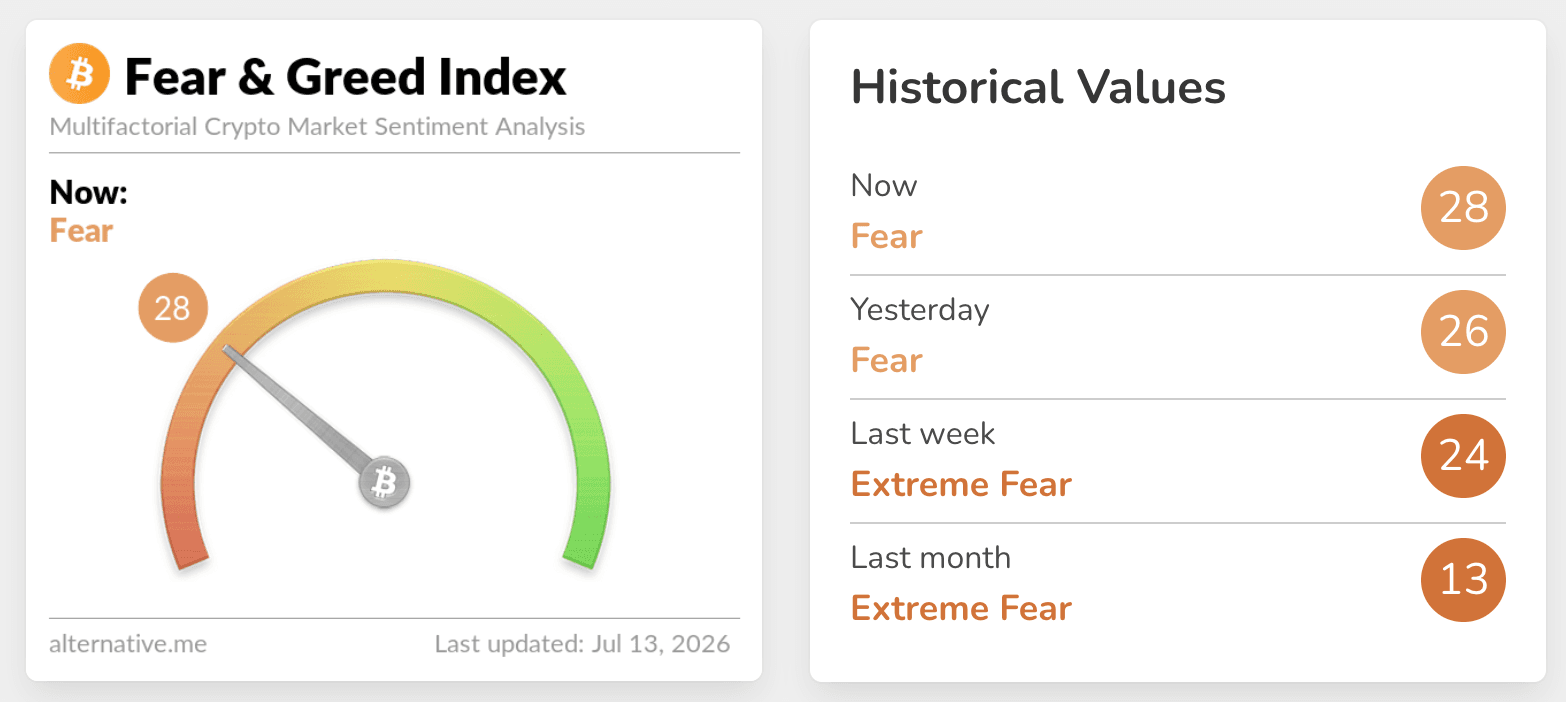
Source: Alternative
Key News Highlights:
Bitcoin and Ethereum Spot ETFs End Eight-Week Outflow Streak
For the week ended July 10, U.S. spot Bitcoin ETFs recorded about USD 197 million in total net inflows, officially ending eight straight weeks of weekly net outflows. BlackRock’s IBIT was the largest inflow product of the week, attracting about USD 292 million in net inflows. Its historical cumulative net inflows rose to USD 60.29 billion. Grayscale Bitcoin Mini Trust BTC recorded about USD 95.084 million in net inflows during the same period, bringing its cumulative net inflows since launch to USD 2.49 billion. On the other hand, Grayscale GBTC saw about USD 108 million in outflows for the week, partially offsetting the positive flows from other products. As of the data snapshot, total net assets across U.S. spot Bitcoin ETFs stood at about USD 77.42 billion. This was equal to around 6.05% of Bitcoin’s total market capitalization. Historical cumulative net inflows stood at about USD 51.28 billion. This marks the first weekly return to net inflows for these ETFs since May, though total withdrawals over the previous eight weeks were about USD 8.26 billion. U.S. spot Ethereum ETFs also recorded USD 84.42 million in net inflows over the same period, ending their own eight-week outflow streak. The main inflows came from BlackRock’s ETHA and Fidelity’s FETH. As of the data snapshot, total net assets across spot Ethereum ETFs stood at about USD 9.59 billion, equal to around 4.44% of Ethereum’s total market capitalization. Historical cumulative net inflows stood at about USD 10.97 billion. Since both ETF categories ended consecutive outflows in the same week, upcoming fund flow data will remain an important reference for understanding changes in institutional product allocation.
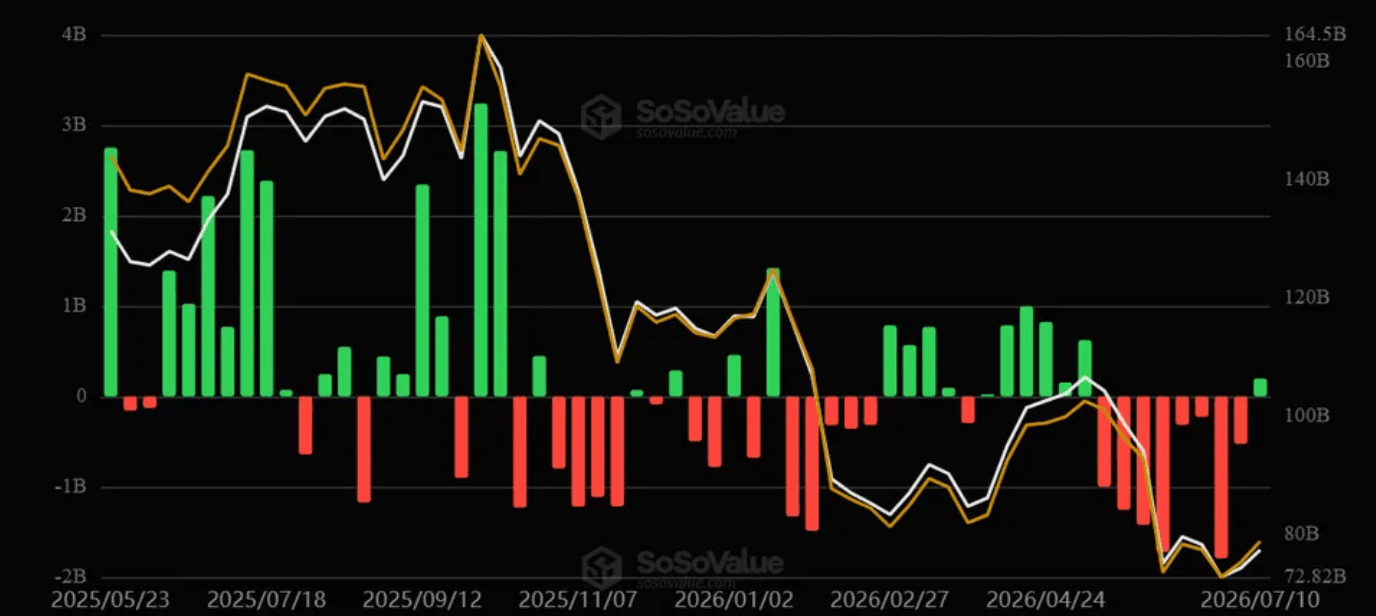
Total Spot Bitcoin ETF Net Inflow. Source: SoSoValue
Thailand Expands Oversight of Stablecoins and Gray Money Flows
The Bank of Thailand is working with the country’s Securities and Exchange Commission to review high-value stablecoin transactions. USDT, large cash transactions, and foreign exchange activity have become key areas of regulatory focus. The measures aim to identify transaction flows that may involve money laundering, illicit finance, cross-border scams, and gray money. The Governor of the Bank of Thailand said that combating illegal funds cannot be achieved through a single or short-term measure. Regulators need to continue using multiple parallel strategies. Thailand’s gray economy usually involves cash with unclear sources, as well as funds generated by scam centers, underground businesses, or other illegal activities. Scam-related losses in Thailand reached about THB 115 billion in 2025. The country also recorded or intercepted about 173 million scam calls and text messages that year. Stablecoins offer fast cross-border transfers, short settlement times, and round-the-clock operation. Because of these features, some illicit financial networks have used them as a tool for large-value transfers. The new rules will require commercial banks to expand their review of cash circulation, foreign exchange, gold trading, and suspicious stablecoin activity. This is intended to prevent regulated institutions from becoming channels for illegal capital flows. Cash deposits above THB 5 million will require full source-of-funds disclosure. Large banknote exchanges without a clear business purpose will also be placed under monitoring. Thailand allows regulated platforms to provide crypto asset trading services, but digital assets and stablecoins are still not allowed as general payment methods.
Bitcoin BIP-110 Sparks Debate Over Transaction Use and Network Governance
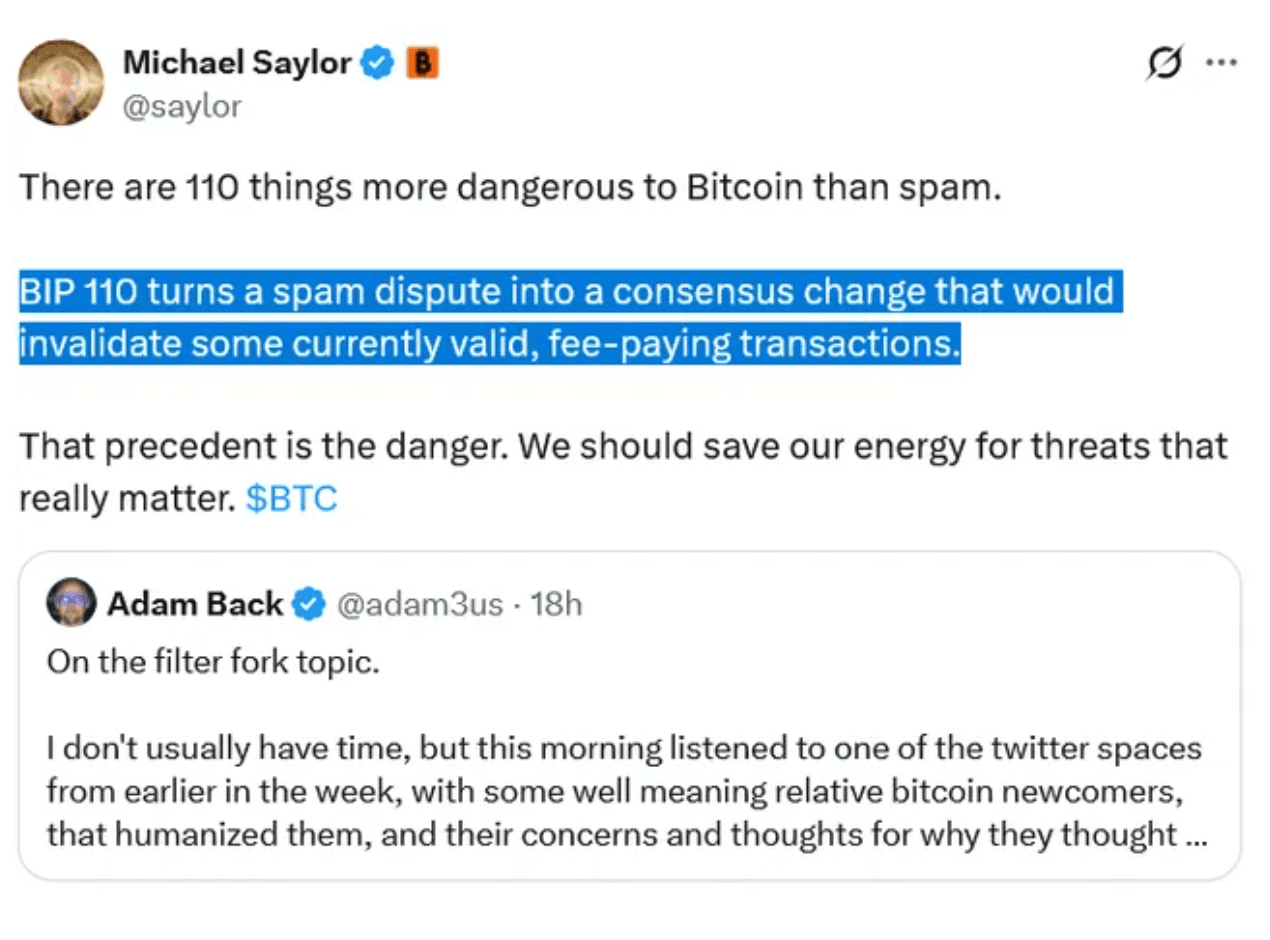
Michael Saylor and Adam Back have publicly opposed BIP-110, a Bitcoin Improvement Proposal that seeks to use a one-year temporary fork to restrict certain non-monetary transactions. BIP-110 was first introduced in December 2025. It mainly targets Ordinals inscriptions and other arbitrary data written onto the Bitcoin blockchain. Supporters of the proposal argue that this type of data may occupy limited block space, increase the burden on the network, and weaken Bitcoin’s core function as a peer-to-peer payment system. Saylor and Back do not fully support how Ordinals are used, but both believe that protocol-level forking and transaction filtering may create risks greater than the data burden itself. Saylor said BIP-110 could prevent some ordinary transactions from being validated. This could affect market trust in the stability of the Bitcoin protocol. Back said that if network participants can use protocol rules to restrict how others use transactions, it may conflict with Bitcoin’s principles of permissionless access, censorship resistance, and open participation. Under the current design, BIP-110 must gain support from at least 55% of blocks in a specified block period before it has a chance to activate. During period 475, the support rate was only about 1%, still far below the required threshold. Daily new Ordinals inscriptions have now fallen below 10,000, down sharply from more than 400,000 per day at the peak in August 2023. Even so, the disagreement over how Bitcoin block space should be used has not disappeared.
Disclaimer: The information provided in this section is for informational purposes only and doesn't represent any investment advice or FameEX's official view.