From DeFi Automation to AgentFi Intelligence: The Next Era of On-Chain Asset Management
2026-04-17 02:48:11
After the explosive DeFi Summer of 2020 and several subsequent years of rotating narratives, the crypto market has had to confront an awkward reality: the few use cases that have clearly demonstrated persistent demand are still clustered around stablecoin payments, basic lending, and relatively simple yield products. There are more protocols than ever, and strategy combinations are increasingly complex, yet the average user experience has not become more user-friendly. For newcomers, the barrier to entry is arguably higher than before. Meanwhile, in the Web2 world, AI has moved rapidly down-market through products like ChatGPT and Copilot. Users are becoming accustomed to expressing intent in natural language and letting models handle retrieval, analysis, and even parts of the decision-making process. AgentFi emerges precisely at the intersection of these two curves. It is a narrative that attempts to wrap complex DeFi strategies and asset management inside AI agents, offloading market noise, rate changes, and protocol risk to the machine, while users only need to define risk preferences and return objectives at a higher level.
Fundamentally, AgentFi is not a single protocol or product. It is an entire class of products and infrastructure layers built around one idea: AI agents actively managing capital on behalf of users. These agents may be powered by large language models, traditional statistical engines, or quantitative strategies, but they share a common behavior pattern that within a clearly defined permission scope, they proactively sense market conditions, generate strategies, and execute transactions. For DeFi power users who are used to manually switching pools and constantly rebalancing positions, this represents a shift from being your own trader and risk manager to designing constraints and objectives, and letting the AI act as executor. For mainstream users who have not yet engaged deeply with on-chain finance, AgentFi has the potential to turn DeFi from a domain that demands heavy learning into an experience closer to set the goal, let the agent handle the rest.
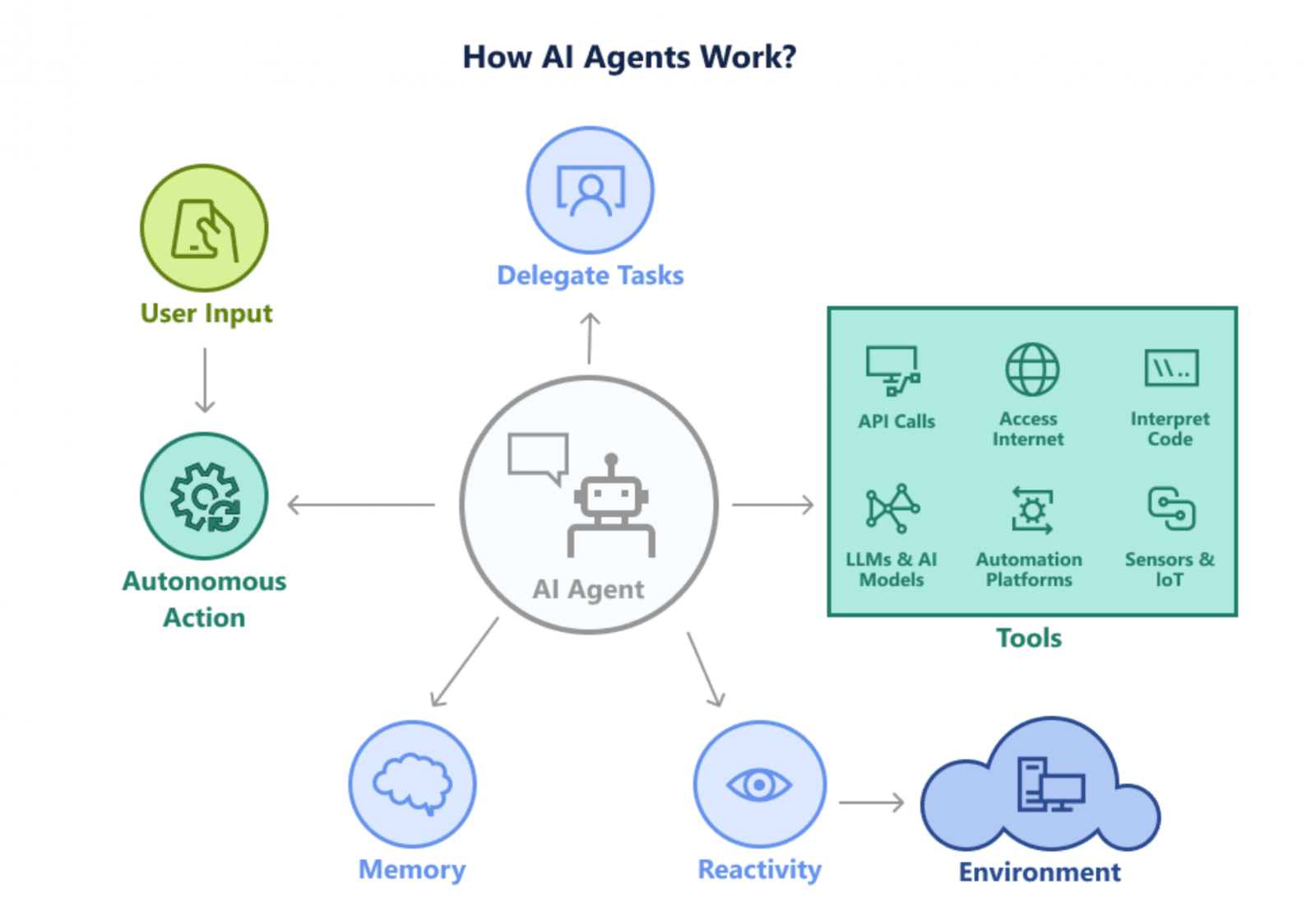
AI agent operating architecture, Source: SUPLARI
From Automation Tools to AI-Native Finance: Positioning AgentFi
To understand why AgentFi is being framed as the next major trend, we need to place it back into the broader history of DeFi’s march toward intelligence. Early smart DeFi primarily stopped at the level of automation tools as strategy platforms built around conditional orders, liquidation protection, dollar-cost averaging (DCA), and automated rebalancing. These systems were essentially enhanced scripts that users defined rules up front, and the system triggered trades when time- or price-based conditions were met. Automation meaningfully reduced manual workload, but the overall loop still looked like humans think, machines execute.
As natural-language models and intent-centric infrastructure matured, a second stage emerged: Copilot-style DeFi assistants. These products allow users to describe what they want in plain language such as allocate 30% of my portfolio into low-risk stablecoin yields, show me the main lending rates on Ethereum today and propose a plan. The system parses that intent, decomposes it into executable steps, and then asks the user to confirm before sending transactions. The improvement here lies in understanding what you want, rather than simply doing what you explicitly instruct, but critical decisions still remain firmly in human hands.
AgentFi is viewed as the third stage and the core of today’s narrative. It is no longer just a tool or assistant, but something closer to an AI agent with an explicit objective function and persistent state. In this design, the user’s role shifts toward defining risk boundaries, return targets, and constraints, then delegating a bounded decision space to the agent. The agent continuously senses markets, generates strategies, adjusts positions, and handles exceptions. Such a system can operate over long periods without human intervention and iteratively refine its own behavior based on realized performance. This is why many researchers consciously use the term “Agentic Finance” rather than “AI trading tools”. The emphasis is not on how many AI buzzwords are involved, but on whether the system truly forms a complete loop of perception → reasoning / strategy generation → on-chain execution → feedback-driven adjustment.
What Actually is AgentFi?
There is no shortage of projects branding themselves as “agents” or “AI DeFi assistants,” but not all of them meet the core characteristics of AgentFi. To avoid treating any chat-based interface as “AI finance,” we can evaluate systems along five practical dimensions to determine whether they genuinely possess AgentFi attributes.
- Proactive Sensing: A genuine AI agent should not simply wait for one-off user instructions. Within its granted scope, it should continuously monitor on-chain interest rates, liquidity, liquidation thresholds, yield curves, and protocol security conditions. In the context of stablecoin yields, for example, a competent agent will not wait for you to tell it when to move pools; it will detect deviations in the rate structure or abnormal risk signals in a protocol and either propose an adjustment or directly initiate a risk procedure.
- Strategy Generation and Composition: Traditional automation tools merely loop through preconfigured strategies. AgentFi, by contrast, must be able to assemble new allocation plans from multiple protocols and instruments based on current market conditions and user preferences. For instance, automatically increasing yield-farming exposure when rates compress, or reducing LP exposure and raising stablecoin weight when volatility expands.
- Autonomous on-chain Execution: If a system still requires the user to manually confirm every step, it is closer to a Copilot than a true agent. The defining feature of AgentFi is that, once the user has explicitly authorized a certain scope, the AI can independently perform swaps, deposits, borrows, staking, unstaking, and rebalancing, while triggering protective mechanisms when necessary.
- PersistentState and Evolution: An agent is not a one-off task runner; it is an entity that lives alongside the account over time. It records historical performance, risk events, and user preferences, and incorporates this information into subsequent decisions.
- Agent-native Architecture: This includes a dedicated execution environment for agents, session-key-based permission control, multi-agent coordination frameworks, and developer-facing agent SDKs. Wrapping a legacy strategy behind a chat interface or a simple API does not, by itself, qualify as AgentFi.
The AgentFi Tech Stack: Data, Strategy, Execution, and Risk
From an engineering standpoint, any AgentFi system that aims to be safe and usable must at least integrate four critical layers: the data and observability layer, the strategy and decision layer, the execution and account layer, and the risk and governance layer. Weakness in any layer will surface directly in user experience and risk exposure.
The data and observability layer is the agent’s sensory system. In DeFi, this goes far beyond pulling a few price feeds or TVL numbers. It is a full web of on-chain and off-chain information like lending rate curves, liquidity profiles across pools, stablecoin pegs, liquidation threshold distributions, protocol governance changes, oracle sources, bridge security incidents, CEX derivatives funding rates and basis levels, macro rates, and risk-asset performance. The broader and cleaner the data coverage, the closer an agent can get to a professional trader’s situational awareness. At the same time, this introduces challenges around data processing and latency: if updates are stale or sources conflict, the AI may act aggressively on false signals and amplify losses.
The strategy and decision layer is the agent’s brain. In practice, very few teams are willing to hand full decision authority to a monolithic black-box model. Most adopt a multi-layered design. The outermost layer is a clear rule framework that defines hard risk boundaries such as single-pool max exposure, maximum daily drawdown, leverage caps, and so on. Within those bounds, quantitative models or ML components search for relatively optimal allocation schemes given current conditions. Large language models are more often applied at the explanation layer, translating strategy changes, risk states, and performance shifts into natural-language narratives that users can understand. This approach preserves AI’s strengths in pattern recognition and multi-dimensional trade-offs, while rules and verification mechanisms prevent completely opaque decision-making.
The execution and account layer functions as the agent’s hands and nervous system. To operate without taking custody of user funds, AgentFi typically relies on smart accounts and fine-grained session-key permissions. Users do not hand assets to a centralized manager. Instead, they authorize a specialized contract or abstract account to act within strict limits. Session keys define which protocols the agent can call, per-transaction value caps, and the classes of operations allowed. For example, only deposit and withdraw to whitelisted protocols, no perpetuals, and no transfers to arbitrary external addresses. This layer directly affects both execution efficiency and the maximum loss that can occur under adverse conditions.
The risk and governance layer is the system’s immune and supervisory function. Once you allow software to control your capital for extended periods, the critical question is not how much does it make on average, but what happens under the worst-case scenario? AgentFi protocols therefore tend to implement multiple lines of defense. Predefined hard-stop conditions such as automatic shutdown when NAV falls beyond a certain daily threshold; distinct capital caps for different risk tiers to prevent high-risk strategies from absorbing excessive capital; governance-level multi-sig or emergency pause capabilities to quickly disable compromised or misbehaving agents; and transparent performance and risk reporting to support external audits and community oversight. In other words, a mature AgentFi product should be designed under the assumption that models will fail, not under the illusion that AI is always more accurate than humans.
Core Use Case 1: Stablecoin Yield Routing and Asset Management
Among all potential AgentFi scenarios, stablecoin yield management is widely regarded as the most natural and near-term addressable market. Stablecoins exhibit low price volatility and have a clear valuation anchor. Their yields stem primarily from lending rates, protocol incentives, and interest-bearing structures which lend themselves to quantitative modeling. At the same time, rate differentials across lending and yield protocols are persistent and driven by sentiment, liquidity, and capital flows, providing agents with a constant stream of rebalancing opportunities.
For everyday users, the pain points of stablecoin yield management are highly concrete. There are too many protocols, rates change frequently, and it is unrealistic to monitor them daily, let alone withdraw from old pools and deposit into new ones each time. Protocol risk is hard to assess, governance proposals are difficult to parse, and users often find themselves thinking, “I know there are higher yields out there, but I’m not sure they’re worth the extra risk.” Stablecoin agents step in with a transparent risk framework and routing logic to take over these high-frequency yet critical decisions. At onboarding, users can define the maximum risk tier they are willing to accept. For instance, only protocols with long safety track records and multiple audits, no experimental pools, and no ultra-high APY vaults controlled by anonymous single teams. The agent then monitors rates and risk metrics within that framework and dynamically adjusts allocations.
To make this more tangible, we can break down the stablecoin agent system into several key phases. These are not standalone strategies, but snapshots of how an AI agent operates within its constraints:
- Continuous monitoring phase: The agent scans all whitelisted protocols for the latest rates, TVL shifts, and risk events, flags pools with sharp yield drops or sudden outflows, and evaluates based on preset thresholds whether reallocation should be triggered.
- Event-triggered phase: The agent continuously tracks lending markets and stablecoin pegs. If it detects excessive volatility in collateral assets, concentrated liquidation risk, or oracle anomalies in a protocol, it proactively reduces exposure and temporarily rotates part of the capital back into large, high-liquidity lending platforms.
- Periodic evaluation phase: At fixed intervals (for example, every 4 or 8 hours, or as configured by the user), the agent reviews realized yield and any risk incidents, and updates the allocation plan. For instance, raising cash weight when market sentiment turns defensively skewed, or increasing allocation to shorter-duration yield pools when the rate curve steepens.
- Long-horizon recalibration: Every few days or weeks, the agent re-calibrates strategy parameters based on longer-term performance data, such as adjusting per-protocol max exposure, refining stop-loss logic, or adding new risk indicators so that its behavior evolves with market structure.
From the user’s perspective, this entire process is ultimately abstracted into a small number of parameters that target yield band, maximum acceptable drawdown, whether to allow incentive-driven pools, and preference for short-term liquidity versus lockups. All the heavy lifting like rate monitoring, protocol evaluation, gas-cost trade-offs, and actual execution is handled by the agent in the background. Under this design, stablecoins cease to be passively parked in a single lending protocol and instead become part of a dynamic asset-management portfolio continuously adjusted by AI.
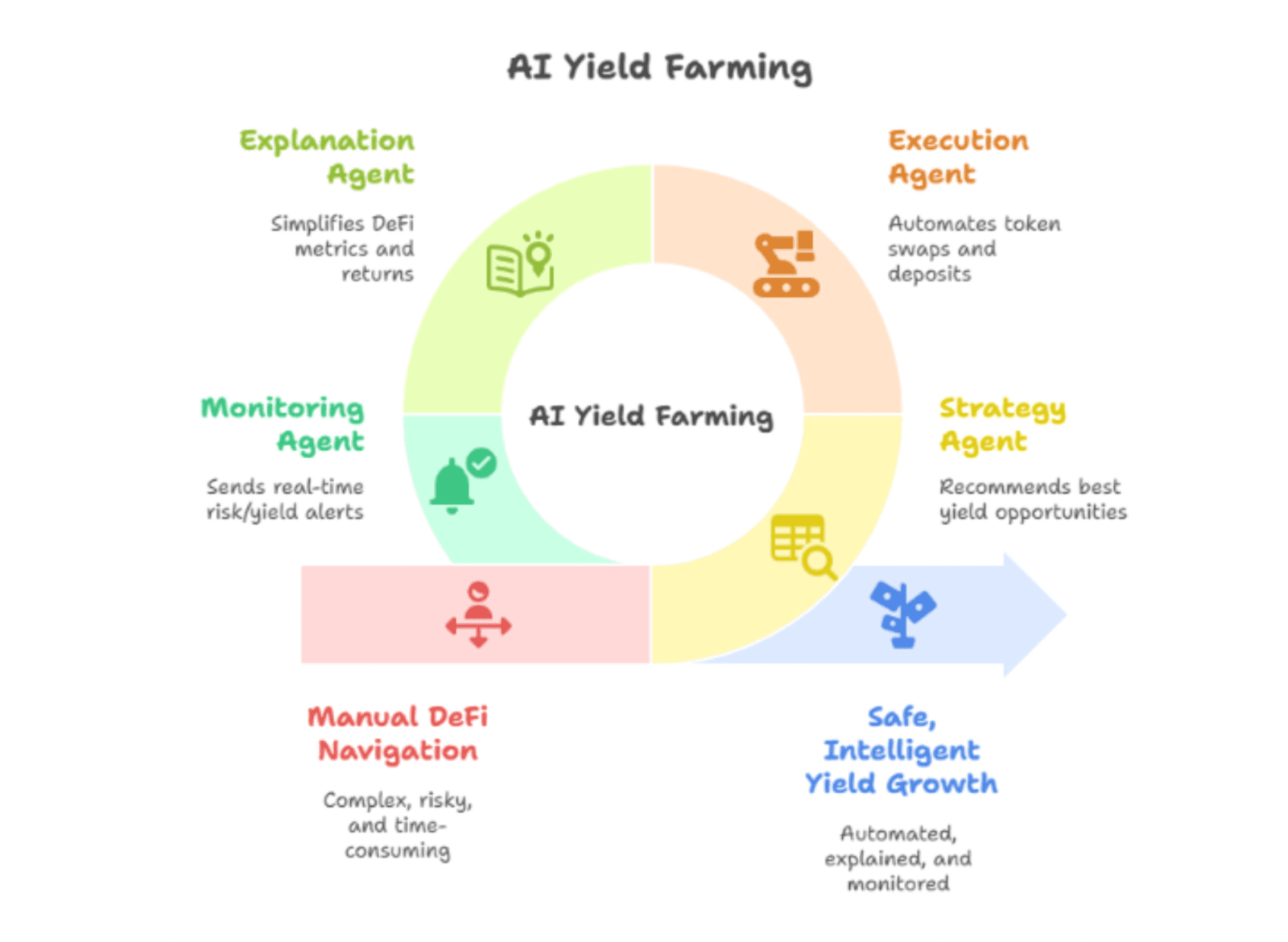
AI agents in stablecoin yield management, source: goML
Core Use Case 2: AI-Driven Liquidity Mining and LP Strategies
Compared with stablecoin yields, AMM liquidity provision presents an even steeper challenge for individual users. Whether under the classic constant-product model or newer concentrated-liquidity designs, LPs are constantly trading off fee income against impermanent loss. Simply throwing funds into the pool and forgetting about it often yields significantly worse outcomes than just holding the underlying assets, especially under directional trends or high-volatility regimes. In practice, robust LP strategies depend on continuous monitoring of short-term price swings, liquidity distribution, and volume patterns. Something that is nearly impossible for most individual traders to maintain over long periods.
Here, AgentFi can act as an automated LP strategy manager. A liquidity-focused agent monitors the price range of underlying assets, volatility levels, fee accrual, and the distribution of liquidity within the pool. Based on the user’s tolerance for impermanent loss and target annualized return, it dynamically narrows or widens the active range or exits fully back into stablecoins. When markets trend strongly in one direction, the agent can scale down LP exposure to avoid bearing the brunt of extreme moves. When volatility compresses and flows stabilize, it can narrow ranges to improve capital efficiency and boost fee income. If humans had to make all of these adjustments manually, the process would be time-consuming and emotionally taxing, and errors would be frequent.
More advanced liquidity agents can integrate LP strategies with borrowing, hedging, and yield-tokenization. For example, they can construct offsetting spot or derivatives positions alongside LP exposure to bring the overall portfolio closer to market-neutral; they can use protocols like Pendle to split fee expectations into tradable yield tokens and hand those off to other strategy agents; and they can shift liquidity across different AMMs to track which venue offers more attractive fee structures and lower MEV risk for a given asset. These composite strategies are far beyond what a typical retail user can manage manually, but for AI agents that excel at high-dimensional data and sequential decision-making, they are a natural fit.
Core Use Case 3: Human–Machine Co-Governance in Trading and Prediction
Trading has always been both the most attractive and the most destructive use case in crypto. The gap between retail and professional traders stems from differences in information access, modeling capability, and execution discipline. With AgentFi entering the trading arena, the game is less about “who reads charts better” and more about restructuring the entire pipeline of information such as aggregation → view formation → strategy implementation → risk convergence.
In conservative designs, trading agents begin as analysis and decision-support tools. They continuously track on-chain capital flows, whale addresses, social sentiment, derivatives leverage structures, and macro events. These signals are compressed into directional bias and risk prompts for specific assets, which traders can use as additional input. Many existing on-chain analytics terminals and research dashboards already embed elements of this behavior, even if they do not explicitly brand themselves as AgentFi. The real turning point comes when such analysis no longer ends as a static report but directly drives position adjustments and capital allocation. At that moment, the agent transitions from an analytical companion to a trading entity with material influence.
In more aggressive designs, autonomous trading agents operate within user-defined constraints that accept leverage bands, whitelisted instruments, and maximum drawdowns while building, closing, and resizing positions across spot and derivatives markets. Some may focus on short-term volatility in a single asset, while others manage structured portfolios, such as using stablecoins as collateral, holding core spot positions in major assets, and layering futures or perpetuals for hedging and yield enhancement. A fully opaque black-box agent in this context would be extremely dangerous, so more teams are baking explainability and behavioral transparency into their products. Each trade is accompanied by a concise rationale and a description of its impact on overall risk, allowing users to maintain a meaningful understanding of how their capital is being deployed.
Risk Challenges for Models, Contracts, Black Boxes, and Regulatory Boundaries
Despite the narrative and technical potential, AgentFi cannot escape the fundamental risk landscape that DeFi has always faced. In some respects, it may even amplify those risks.
The first is model risk. Whether a system relies on traditional statistical models, machine-learning engines, or hybrid architectures that incorporate LLMs, all models are built on assumptions that roughly stable volatility regimes, correlations that do not reverse instantaneously, and liquidity that does not vanish in seconds. Crypto markets have repeatedly shown that these assumptions can break violently under black-swan conditions. If an AgentFi system leans too heavily on historical relationships without designing explicit extreme scenario safeguards, it is likely to suffer collective failure when rare events occur.
The second is smart-contract and execution risk. AgentFi does not eliminate classic DeFi risks such as protocol exploits, oracle manipulation, or bridge compromises. In fact, automation can magnify the damage. Under manual operation, even active traders seldom rebalance every minute with full size. An AI agent with no throttling or exposure caps, by contrast, might react to a transient oracle glitch or short-lived protocol anomaly by executing a flurry of harmful transactions, causing losses to snowball in a very short timeframe. Practical system design therefore needs to include hard limits on action frequency, per-adjustment size, and maximum consecutive moves.
The third, often under-discussed issue is opacity and trust. AgentFi’s original promise is to help users handle complex decisions. If users cannot see any of the internal logic and can only judge performance from a single PnL curve, the model is effectively just a black-box fund on-chain. To mitigate this, more projects are emphasizing transparent strategy frameworks, visible risk parameters, and traceable behavior. Some even build “trade log” interfaces where users can inspect the rationale and alternatives for a given decision. Not everyone will read the fine print, but the existence of such artifacts creates the possibility of external scrutiny and moves AgentFi from faith-based trust toward verifiable trust.
Finally, there is regulation and responsibility. When a self-directed agent is deployed on-chain, allowed to execute strategies autonomously, and opened to third-party deposits, the structure begins to resemble a decentralized asset-management platform. Different jurisdictions may interpret this through the lenses of securities law, fund regulations, or investment-advisory rules, potentially assigning responsibility to the core team. There may also be grey zones where the code made the decision, not any specific person, complicating accountability. Even purely on-chain, these issues cycle back to tokenholders and core developers via governance. When a risky strategy is passed through governance and leads to severe losses, the question of who is responsible becomes a test of institutional design, not just technical architecture.
From Single AI Agents to Multi-Agent Financial Networks
If we treat most current AgentFi products as first-generation on-chain AI agents, their common trait is a focus on a single, clearly scoped task like stablecoin yield routing, lending rebalancing, LP management, yield-token rotation, or trading strategy execution. These specialized agents encode strategies that historically required significant professional maintenance and make them accessible to a broader base of users. The truly disruptive shift, however, is likely to emerge from multi-agent collaboration and multi-layered financial networks.
Imagine a future where users do not simply subscribe to a high-yield pool or a particular vault, but instead hold portfolios managed collectively by multiple agents. At the base, a stablecoin agent handles cash management and short-term yield routing. In the middle, LP and yield-token agents manage medium-risk strategies. At the top, an asset-allocation agent adjusts weights across strategies based on the user’s risk profile, time horizon, and market conditions. A risk-control agent spans the entire portfolio, monitoring aggregate exposure, simulating stress scenarios, and issuing warnings. These agents communicate through standardized intent and message formats and can coordinate autonomously, for example, by simultaneously cutting leverage and raising cash when macro risk spikes.
Reaching this state will require far more than a single protocol or team. It calls for a comprehensive stack of AgentFi-centric infrastructure and standards which include financial intelligence layers that provide real-time, verifiable on-chain data; execution networks that orchestrate across chains and protocols; issuance platforms and marketplaces for agent developers; and middleware layers that address privacy, compliance, and verification. From this perspective, AgentFi is less a short-term speculative meme and more a long-term program to decompose, modularize, and reopen asset management as a programmable surface. For those willing to invest the time to understand the structure, what is on offer is not merely upside in one token, but a live laboratory for redesigning who makes decisions for whom, under what constraints, and with what forms of verification.
Conclusion
AgentFi is not the product of a single breakthrough, nor is it merely the latest narrative craze. It is the natural result of multiple underlying trends converging. DeFi architectures are becoming more complex, but users are not finding it easier to participate. AI’s reasoning capabilities are advancing quickly, but users are no longer satisfied with passive automation scripts. On-chain finance requires finer-grained risk and decision frameworks, yet traditional manual human operation can no longer keep pace with market speed and density. AgentFi fills this structural gap with long-running, explainable, risk-framed agents that can genuinely assume decision-making responsibility.
From yield routing and LP management to strategy execution and risk surveillance, AI agents are progressively taking over tasks that are high-frequency, granular, and attention-intensive. This allows professional know-how to be standardized, modularized, and exposed to a broader user base. Humans are not displaced; the roles in asset management are simply reallocated. Humans define objectives and risk boundaries, while agents optimize decisions, execution, and adjustments within that framework. The most meaningful structural change will not come from a single super agent, but from financial networks composed of many specialized agents, each serving a distinct function and coordinating through standardized messaging and risk layers.
This trajectory clarifies AgentFi’s true significance. It is not merely about making DeFi more automated; it is about making on-chain finance behave more like a programmable, verifiable, and governable financial system. For those who dig deeper into its architecture, AgentFi is less an investment slogan and more a new framework for how decisions are made, audited, and constrained. Once that framework matures, it may fundamentally reshape how we think about asset management and become a core building block of the next stage of on-chain financial infrastructure.
FAQ
Q1: What is the fundamental difference between AgentFi and traditional automated trading bots?
Conventional trading bots are largely execution amplifiers. Human traders or quant teams design the core strategy ex-ante, and the bot simply repeats orders according to fixed rules without altering the underlying logic. AgentFi aims to push this model one step further. Within clearly defined risk constraints, AI agents proactively sense markets, shift weight across multiple strategies, and, when necessary, pause operations and re-evaluate allocations. They resemble on-chain asset managers with embedded investment logic and risk frameworks, rather than scripts that mechanically follow prewritten instructions.
Q2: How much of a retail investor’s portfolio should be delegated to agents today?
At the current stage, a conservative view is that AgentFi should be treated as part of an innovative risk allocation bucket, not as a replacement for core holdings. For users with higher risk tolerance, it may make sense to start with a very small portion of capital that does not require immediate liquidity, focusing first on relatively controlled scenarios such as stablecoin yield routing or audited lending strategies. After observing real-world performance and risk controls over time, users can decide whether to scale up exposure. Regardless of how intelligent a system appears, basic diversification and explicit risk limits should never be abandoned, and AgentFi should not be regarded as a guaranteed-profit black box.
Q3: Will AgentFi eventually replace human traders and asset managers?
AgentFi is more likely to reshape professional roles than to eliminate them. For highly repetitive, 24/7 tasks with clear rule sets such as rate monitoring, LP range adjustments, and routine yield rotation, AI agents are indeed better suited to handle front-line execution. But when it comes to narrative judgment, regulatory and structural risk assessment, macro context, and the design of risk frameworks, humans still retain advantages that are difficult to encode fully in models. A more realistic division of labor is that professional investors and asset managers design objectives, constraints, and strategy frameworks and then manage the agents, rather than manually pushing every transaction themselves. Those who can effectively combine strategic thinking with AgentFi tooling are likely to gain structural advantages in the next phase of the market.
Disclaimer: The information provided in this article is intended only for educational and reference purposes and should not be considered investment advice. For more information, please refer to here. Conduct your own research and seek advice from a professional financial advisor before making any investment decisions. FameEX is not liable for any direct or indirect losses incurred from the use of or reliance on the information in this article.