How Base MCP Turns AI Agents into Web3 Asset Assistants
2026-06-01 11:34:23
Introduction: A Paradigm Shift from Clicking to Conversation
Over the past decade, decentralized finance (DeFi) has relied on a familiar user journey. Users open a website, connect a wallet, search through complex dashboards, choose the right function, and confirm a wallet signature request. This manual process has helped DeFi grow, but it also creates clear friction. New users face a steep learning curve, while experienced users still need to move between many interfaces, compare different protocol pages, and review each transaction with care. At the same time, phishing websites, fake front ends, and confusing wallet prompts continue to create security risks across Web3.
The rise of the Agentic Economy may change this interaction model. As large language models become more capable, AI agents are no longer limited to content generation or simple information retrieval. They can understand user intent, plan a sequence of actions, call external tools, and help users complete practical tasks. For AI agents to become useful in Web3, they need more than market data or protocol documentation. They need a secure way to interact with onchain accounts and applications without taking control away from the user.
Base MCP was created for this purpose. It provides a structured gateway between AI agents, Base Account, and applications across the Base ecosystem. It allows users to ask an agent to check balances, send funds, swap tokens, review transaction history, or interact with supported DeFi protocols through a chat interface. More importantly, it does this without giving the agent direct access to private keys. Base MCP is not just a connector. It represents a new interaction standard for the AI era, where users express intent through conversation and approve final execution through a secure account flow.

What Is Base MCP?
Base MCP, or Model Context Protocol, is a bridge that seamlessly connects a user’s Base Account, the account used in Base App, with the AI interface of their choice, such as Claude, ChatGPT, Cursor, and other supported environments. Traditionally, allowing AI to control a wallet creates significant security risks because it often requires granting the agent excessive permissions. Base MCP addresses this problem by giving AI agents the ability to access onchain information and prepare transaction suggestions, while ensuring that the “final decision-making authority” always remains in human hands.
Its Core Value:
- Seamless Conversational Execution: Users can complete transfers, swaps, balance checks, and other actions without leaving the chat window.
- Ecosystem Integration: Through a plugin-based design, agents can directly interact with major DeFi protocols such as Uniswap and Morpho.
- Security First: A Human-in-the-Loop review mechanism prevents unauthorized onchain operations.
Operating Architecture: OAuth 2.1 and Security Mechanisms
The strength of Base MCP lies in its thoughtful architecture. It combines industrial-grade authentication standards with an innovative transaction handling mechanism.
Secure Authentication Based on OAuth 2.1
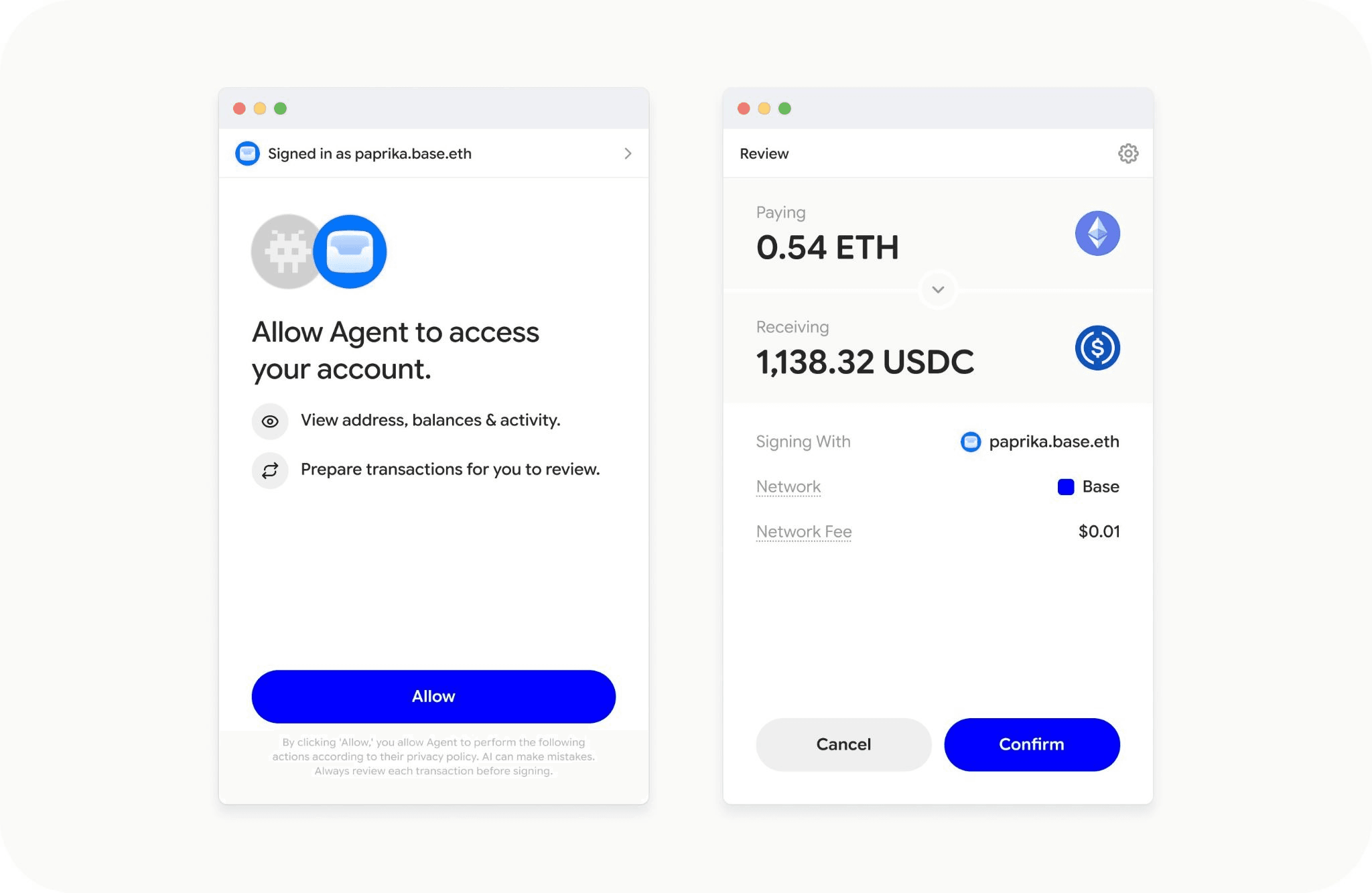
Base MCP does not use a traditional private key custody model for authentication. Instead, it uses the OAuth 2.1 standard. This is similar to the familiar “Sign in with Google” experience used by mainstream internet products. When users connect Base Account to an AI environment, they authorize the agent to perform actions on their behalf. They do not transfer account control to the agent. This design ensures that the agent can never directly access the user’s private keys.
Stored Requests Mechanism
This is the most technically important part of Base MCP. Traditional malicious websites often use fake front ends to trick users into signing incorrect transactions. Base MCP avoids this type of attack through the following process:
- Request Construction: The agent builds the transaction parameters locally.
- Request Storage: The transaction parameters are sent to the Base MCP server, marked as a Pending Request, and assigned a unique Request ID.
- Secure Redirect: The MCP server provides the user with a link. After the user clicks it, a trusted Base Account window opens.
- Transparent Review: Before signing, the user can clearly review a preview of the expected asset changes.
By decoupling “transaction initiation” from “transaction execution,” Base MCP helps defend against phishing attacks and domain hijacking risks at the structural level.
Ecosystem and Skill Plugins
Base MCP is not designed only for transfers. It also serves as an “expandable digital steward.” Through skill plugins, agents can execute complex tasks across multiple DeFi protocols.
Overview of Initial Ecosystem Plugins
With Base MCP, user instructions to AI can evolve from “help me buy some tokens” into “analyze lending rates on Morpho and select the highest-yielding pool for asset supply.” This is not just automation. It is intelligent asset allocation.
Opportunities for Developers: Building Plugins
Base MCP’s architecture is not only user-friendly. It is also highly inclusive for developers. If a protocol developer wants their protocol to become one of an agent’s “skills,” the process is relatively simple. Developers only need to write a short Markdown specification. This specification tells the agent how to communicate with the protocol’s API or MCP server to retrieve unsigned transaction details. These details are then passed into the Base MCP framework, where the user completes the final confirmation and signature process on the client side. This standardized approach allows new protocols to enter the agent skill library quickly without complicated system integration.
Conclusion: Moving Toward the Future of Autonomous Finance
The emergence of Base MCP marks a shift in blockchain UX from a “webpage-centered” model to an “intent-centered” model. For new users, it reduces the cognitive burden of technical execution, price impact, gas fees, and authorization flows. For experienced users, it provides a more efficient and scalable operating environment. The Base ecosystem is expanding rapidly, and Base MCP may become one of the strongest core infrastructures behind the Agentic Finance revolution.
***
>> Original Article: Base MCP Official Website、Base X Post
***
Disclaimer: The information provided in this article is intended only for educational and reference purposes and should not be considered investment advice. Conduct your own research and seek advice from a professional financial advisor before making any investment decisions. FameEX is not liable for any direct or indirect losses incurred from the use of or reliance on the information in this article.