BILL (Billions Network) Token Price & Latest Live Chart
2026-05-14 06:00:04
What is BILL (Billions Network)?
Billions Network is a human and AI Agent verification network built for the AI era. Its core mission is not to create another single sign-on tool, but to add a verifiable trust infrastructure layer to the internet. As generative AI, bots, automated scripts, and synthetic identities continue to enter social platforms, onchain applications, transaction workflows, and content distribution environments at scale, users and applications are no longer only asking whether an address is valid. They also need to know whether the counterparty is a real human, a unique identity, a compliant participant, or an AI Agent that can be traced and constrained. Through decentralized identifiers, verifiable credentials, and verifiable proofs, Billions Network allows humans, organizations, and AI Agents to prove certain identity attributes without repeatedly exposing raw personal data to every application. The project defines itself as The Human and AI Network to enable any person or agent to prove what is true about themselves without revealing more information than necessary.
The project’s uniqueness lies in its ability to address both real user verification and AI Agent identity within a unified decentralized identity system. For users, it provides a mechanism to defend against Sybil attacks, helping ensure that airdrop rewards or voting rights reach real individual users with greater precision. By returning control over identity data to individuals, the project breaks the traditional monopoly that centralized institutions hold over personal privacy. It also uses the immutability of blockchain infrastructure to record reputation signals. When users interact across different platforms, they no longer need to repeatedly submit sensitive legal documents. Instead, they can complete verification through cryptographic proofs generated by the network. This model significantly improves the operating efficiency of the digital economy. The project’s long-term vision is to become a universal trust layer, allowing every digital transaction and interaction to take place based on transparent and verifiable identity.
For AI Agents, Billions Network introduces a framework called KYA, or Know Your Agent. This framework gives automated programs traceable origins and defined capability boundaries. It allows developers and users to identify trusted agent entities, reducing the risks created by fraud and malicious automation. Most traditional identity systems assume that the interacting party is either a human or a corporate account. Yet as autonomous agents become capable of executing transactions, initiating requests, calling smart contracts, managing assets, and acting on behalf of organizations, verifying only real users is no longer enough to support the next generation of internet collaboration. Billions Network uses DeepTrust and KYA as its AI Agent verification framework. It brings an agent’s origin, control policies, capability limits, reputation signals, and accountability relationships into the same verifiable model. Therefore, AI Agents are no longer just anonymous API traffic or untraceable automated addresses. They become digital actors with verifiable identities, policy constraints, and reputation records. As of May 2026, the protocol has been deployed across multiple major blockchain ecosystems and has become an important infrastructure project in the decentralized identity and verifiable AI sectors.
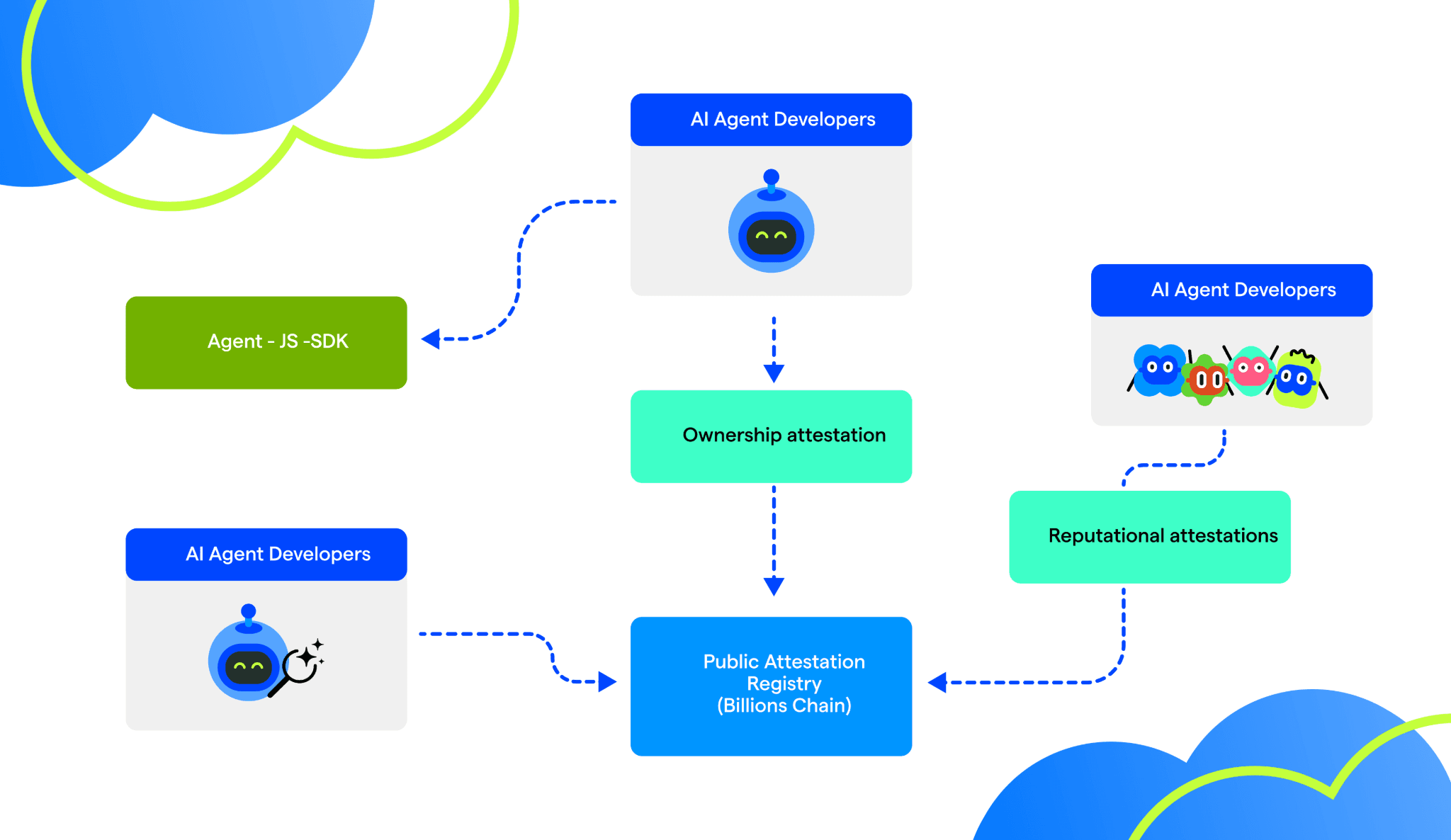
KYA Operation Architecture, source: https://billions.network/blog/billions-know-your-agent
How does BILL (Billions Network) work?
Billions Network’s technical architecture is built on Ethereum security and uses a Layer 2 network based on rollup architecture to support large-scale expansion and low-cost identity verification. Its core components include Issuer Nodes, mobile identity wallets, and a Verifier SDK. These components together form a full lifecycle management system that covers credential issuance, storage, and final verification. Issuer Nodes are responsible for reviewing and issuing standards-compliant verifiable credentials, while users store those credentials in encrypted mobile wallets. When a third-party application needs to verify a user’s age, nationality, or uniqueness, the wallet uses zero-knowledge proof technology to generate cryptographic evidence. This proves that the required attribute is valid without exposing the raw data. This design creates a balance between privacy protection and compliance requirements.
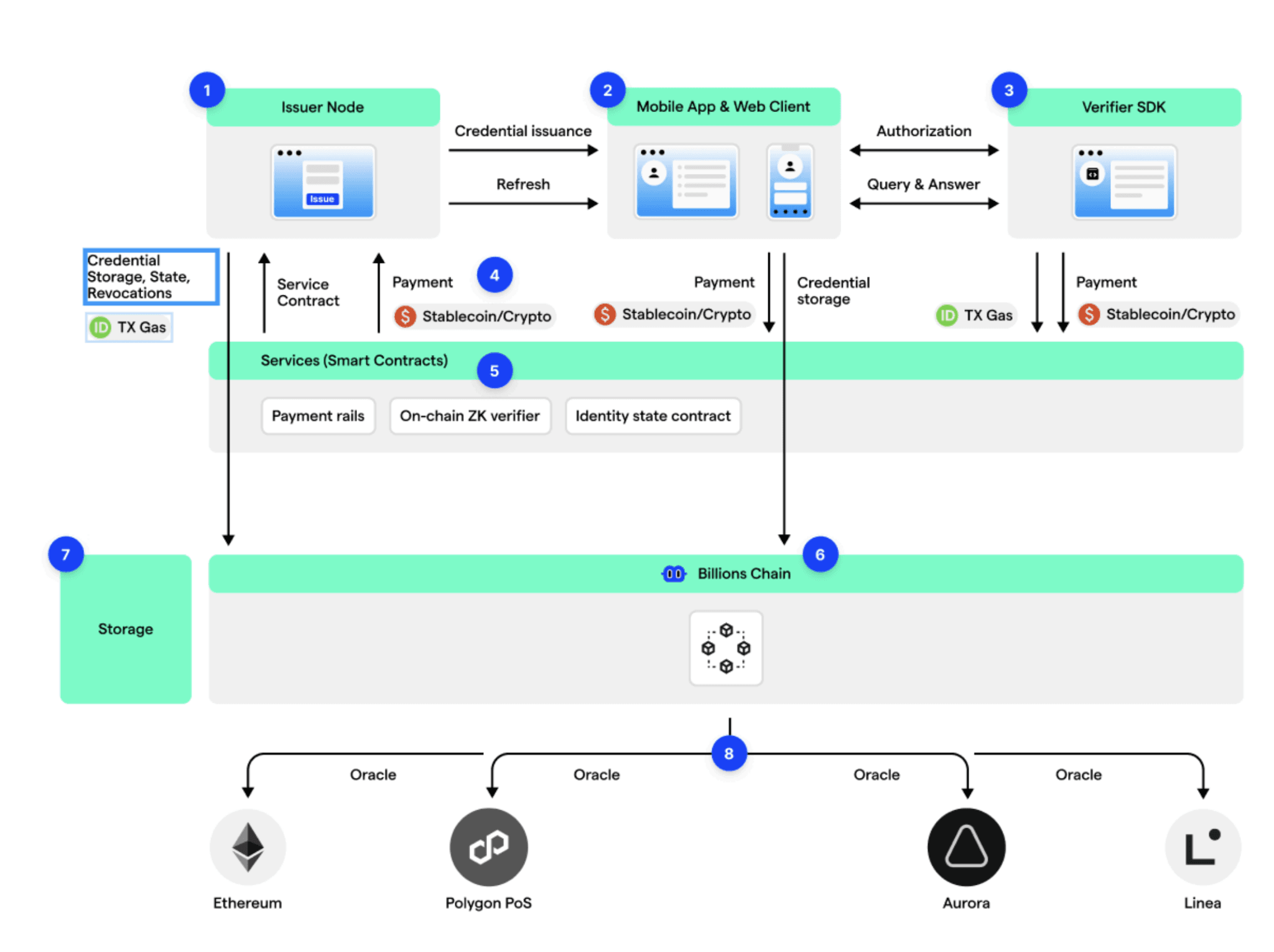
Billions Network Technical Architecture, source: https://cdn.prod.website-files.com/682b2da9ef522c285ba6550a/69c2d6c8710e5a24ff67111f_704e9fcb4864828b750e434703526a87_Billions_WhitePaper_v5.pdf
To support complex AI Agent interactions, the protocol introduces a dedicated DeepTrust framework for managing agent behavior rules. Under this mechanism, each AI Agent can be assigned its own decentralized identifier and connected with related permission proofs, model provenance, and developer reputation records. When an agent executes asset management or smart contract interactions onchain, the system can automatically check the authorization status of its identifier. This helps ensure that each operation complies with predefined security policies. By binding agent behavior to digital identity, the network provides the accountability mechanism needed for the future automated economy. It also helps prevent anonymous algorithms from expanding across markets in an uncontrolled manner, which supports the stability and transparency of the broader financial ecosystem.
Billions Network consists of multiple modules, including the Mobile Identity Wallet, Web Identity Wallet, Issuer Node, Verifier SDK, Universal OnChain Verifier, a public credential or registry layer, and a Polygon CDK-based Layer 2. The Issuer Node allows credential providers to issue verifiable credentials. The Verifier SDK allows applications to integrate identity checks through an OAuth-like flow. The Universal OnChain Verifier allows smart contracts to consume relevant proofs onchain. Billions L2 processes DID state updates, credential proofs, and reputation-related data, while anchoring finality to Ethereum. This helps balance scalability, low-cost verification, and security. The purpose of this architecture is not to put all identity data onchain. Instead, it places verifiable states, revocation states, and essential cryptographic evidence in locations that can be audited and called across systems.
Cross-chain interoperability is another technical pillar of the network. Through identity state oracles and onchain zero-knowledge verifier contracts, identity proofs can move across different blockchain environments. This means that reputation and credentials established by a user on one chain can be directly recognized by a decentralized finance protocol or social application on another chain, without requiring a repeated onboarding process. This standardized identity layer greatly lowers the integration barrier for developers. It allows them to implement secure identity checks as easily as calling a standardized interface. The modular design is also capable of supporting thousands of verification requests per second, meeting the technical requirements of large-scale commercial use cases from social media anti-bot protection to high-frequency financial transactions.
The protocol’s underlying storage mechanism uses a private, end-to-end encrypted distributed design, with access permissions managed by smart contracts. This ensures that users retain full control over their identity data at all times. Unlike traditional identity databases, which are vulnerable to single points of failure and large-scale data breaches, Billions Network’s distributed architecture disperses the attack surface and improves overall network resilience. At the same time, the Verifier SDK gives application developers a smooth experience similar to traditional internet authorization protocols. Developers do not need deep cryptography expertise to integrate high-strength privacy verification into their products. This full-stack design, from the technical base layer to developer tooling, positions the network as a preferred identity verification layer for multiple major public blockchain ecosystems. Billions Network’s real-world applications cover both Web3 and enterprise scenarios. Secure token distribution can use proof of humanity and uniqueness verification to reduce abuse in airdrops, faucets, and task rewards caused by multi-wallet farming. Reusable KYC and AML credentials can support RWA investors, fintech platforms, and compliant DeFi environments, allowing users to prove compliance across platforms without repeatedly submitting sensitive data. Age verification can help applications meet regional regulatory requirements while avoiding the storage of full birthdates or identity documents. KYA and Agent Policy Proofs can support autonomous commerce, AI marketplaces, agent-driven financial interactions, and enterprise customer service scenarios, making it easier for users to confirm whether they are interacting with a genuine business representative or a traceable AI Agent.
BILL (Billions Network) market price & tokenomics
The $BILL token is the native utility asset of this trust network. It is used for verification payments, staking-based reputation, network participation, and ecosystem incentives. $BILL is an ERC20 token on Ethereum, while proofs, credentials, and reputation operate on Billions L2 and obtain finality through Ethereum. This design means BILL is not merely a governance symbol in a broader narrative. It is connected to real network activities such as verification demand, credential issuance, credential reuse, Attester participation, application integration, and AI Agent registration. While $BILL is a kind of utility token, it does not represent equity, dividend rights, or corporate voting rights. Its economic logic is therefore closer to a trust economy built from infrastructure usage fees, reputation staking, and participation incentives.
The total supply of BILL is fixed at 10 billion tokens with no future inflation. This deflation-oriented design is intended to preserve token scarcity. The token’s value capture logic is directly linked to network usage frequency. Whenever a new identity credential is issued, an AI Agent completes identity registration, or a third-party application initiates a verification request, BILL is required as a service fee. To maintain balance within the token ecosystem, the protocol includes an automated burn mechanism that removes a portion of network revenue from the circulating supply. In terms of token allocation, the project reflects a community-first governance principle. 40% of the supply is allocated to ecosystem rewards and community growth. Another 32% belongs to foundation reserves, which support long-term technical development and liquidity maintenance. Contributors and investors hold 20% and 8% respectively, with strict lock-up and vesting schedules designed to reduce excessive market volatility.
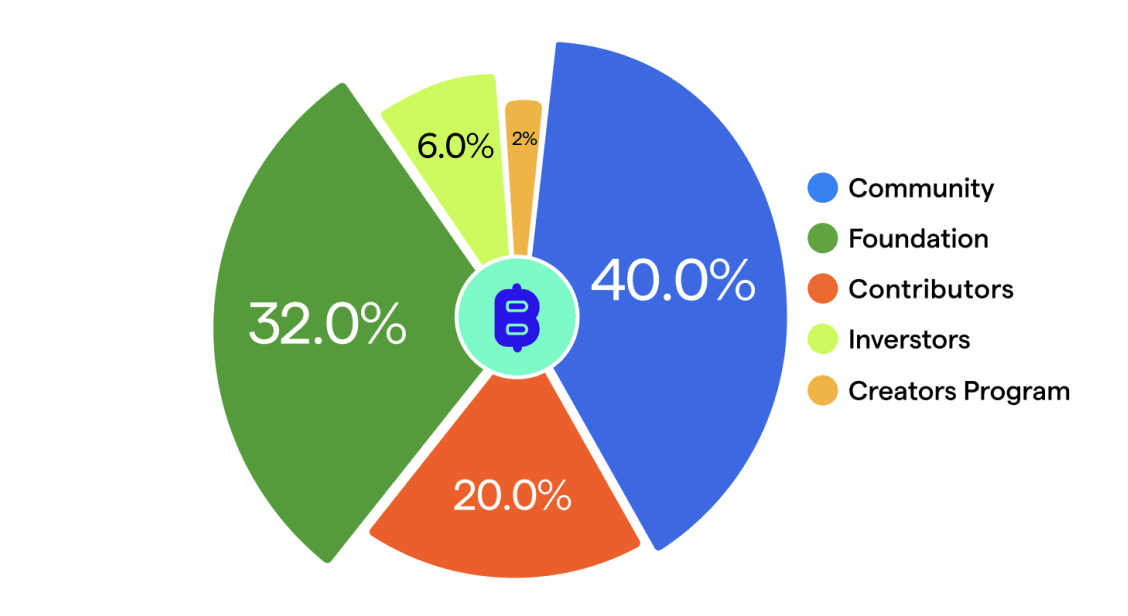
$BILL Token Allocation, source: https://cdn.prod.website-files.com/682b2da9ef522c285ba6550a/69c2d6c8710e5a24ff67111f_704e9fcb4864828b750e434703526a87_Billions_WhitePaper_v5.pdf
Another core function of the token is staking and reputation. Holders can lock tokens in the protocol to increase the weight of their identity or earn node-related rewards. For verification service providers, staking tokens is a necessary condition for participating in network maintenance and receiving a share of fees. This adds an economic guarantee layer that discourages malicious behavior. Ordinary users can also gain higher-level reputation labels through staking, which may give them priority access to partner promotions or airdrop campaigns. This design converts token market liquidity into network security. It creates a self-reinforcing cycle in which greater verification demand drives a higher staking ratio, which then improves the credibility of the overall identity network and strengthens the token’s intrinsic utility. Over the long term, BILL’s economic model is built on a reusable credential system, creating a continuous and cyclical source of token demand. Unlike the traditional one-time identity verification fee model, the protocol’s credentials have long-term validity and cross-platform reusability. This means every cross-chain credential call and reputation update can create small but high-frequency token consumption.
Why do you invest in BILL (Billions Network)?
Investing in Billions Network lies in its control over one of the most critical scarce resources in the AI era such as identity verification in the digital world. As generative technologies develop at an exponential pace, the future internet will be filled with information and entities that are increasingly difficult to distinguish as real or synthetic. Projects that can provide a neutral and reliable identity authentication layer may therefore build a strong commercial moat. Unlike the traditional one-time identity verification model, Billions Network promotes a reusable credential system. Users only need to verify once, then reuse their credentials across countless scenarios.
The project’s strong institutional backing and successful early user accumulation also provide support for its investment value. Top-tier institutions including Coinbase Ventures and Polychain Capital participated in its 2025 funding round. This capital support not only provides sufficient development resources but also brings extensive ecosystem collaboration opportunities. It allows the project to integrate more quickly into mainstream decentralized trading platforms and financial applications. For market participants looking for exposure to the intersection of decentralized identity and artificial intelligence, the project offers a rare target with both technical leadership and market maturity. In addition, the protocol’s expansion potential in real-world asset tokenization opens a larger long-term demand space for its token. When real-world properties, bonds, or funds move onto blockchain networks, strict identity and compliance checks become essential. Billions Network’s zero-knowledge identity verification directly addresses the conflict between compliance and privacy. This dual application across crypto-native markets and traditional finance makes the token more than a governance tool. It positions BILL project as a potential access layer for the future digital financial system.
Is BILL (Billions Network) a good investment?
The project’s core advantage lies in its early positioning around AI Agent identity. This gives it a broader use case range and a deeper market entry point compared with similar competitors such as Worldcoin. By deeply connecting identity verification with a reputation system, Billions Network does more than answer the question of who is human. It also addresses the question of which agents can be trusted. This differentiated strategy gives the project strong resilience in the market. However, market participants should also pay attention to the risk of fragmented identity credential adoption. If the market fails to form unified identity standards, the network’s utility may be limited by the scope of its integrations.
At the macro level, the regulatory environment for digital identity is changing quickly. Governments are placing stricter controls on personal data and biometric data flows, which raises the compliance requirements for project teams. Although the protocol uses zero-knowledge proof technology to minimize the risks of storing sensitive data, changes in legal frameworks may still affect the token’s value capture mechanism. In addition, the token’s gradual unlock schedule over the coming years will continue to add supply to the market. This means ecosystem demand must maintain strong growth in order to absorb new circulating supply effectively. Market participants may need to closely monitor the staking ratio and active verification count after 2026, as these metrics are key indicators of the project’s health. Overall, Billions Network is an infrastructure project with strong narrative value and substantial technical foundations. It directly addresses a core pain point in the convergence of artificial intelligence and blockchain. Although the identity verification sector remains highly competitive and technical development still carries uncertainty, the project’s market presence and ecosystem depth make it a high-potential asset to watch within the current crypto market landscape.
Explore the latest BILL (Billions Network) price and live chart, trade BILL on FameEX, and access real-time market data! Get started now with a seamless trading experience!
Disclaimer: The information provided in this article is intended only for educational and reference purposes and should not be considered investment advice. Conduct your own research and seek advice from a professional financial advisor before making any investment decisions. FameEX is not liable for any direct or indirect losses incurred from the use of or reliance on the information in this article.