NVDA (NVIDIA Corporation Common Stock) Token Price & Latest Live Chart
2026-04-24 10:36:10

What is NVDA (NVIDIA Corporation Common Stock)?
NVIDIA has evolved far beyond its original identity as a gaming graphics card maker. It now stands at the center of the global AI buildout. The company’s core edge comes from the continued development of its GPU architecture, especially the CUDA platform, which was built to optimize large-scale parallel computing. That architecture allows NVIDIA hardware to do far more than render images. It supports the compute layer behind modern large language models such as ChatGPT. In that sense, NVIDIA is no longer just a semiconductor manufacturer. It has become part of the operating logic and industrial standard of modern artificial intelligence. In the context of Web3 and decentralized finance, NVDA is no longer only a Nasdaq ticker. Through real-world asset tokenization, it has also become an on-chain reference asset tied to a company with real economic weight. That transition rests on the deep connection between NVIDIA’s hardware performance and its software ecosystem. Its Tensor Cores, which are optimized for tensor operations, help turn compute power into something the market can price, divide, and trade around the clock. This allows the value of global compute resources to circulate in tokenized form on blockchain networks and gives decentralized systems access to an underlying asset with tangible real-world relevance.
By April 2026, NVIDIA had moved another step forward when it announced deeper collaborations with Adobe and WPP. That shift showed a strategic move away from simply supplying compute and toward defining autonomous workflows. Agentic AI was being embedded directly into enterprise marketing and production systems. This did not just improve business efficiency. It also gave NVIDIA-linked tokenized assets a more concrete application layer and a stronger fundamental narrative. Another major milestone was the rollout and wider use of OpenShell, a security runtime designed for enterprise level autonomous agents. OpenShell addresses one of the biggest adoption barriers for large organizations, which is how to use AI systems without losing control over governance and privacy. It allows autonomous agents to operate inside isolated sandbox environments while using cryptographic controls to protect brand assets, user data, and commercial intelligence. That framework keeps AI actions within observable and auditable boundaries. For the RWA sector, the importance of OpenShell lies in the compliance and transparency layer it helps establish. It strengthens the technical foundation for turning compute related economic value into trustworthy on-chain assets. In practical terms, it helps NVIDIA’s market value move beyond the closed environment of traditional finance and into blockchain based systems that rely on real time verification and stronger trust assumptions. The combination of security architecture and tokenization effectively extends NVIDIA’s technological moat into a financial moat that can move across platforms.
NVIDIA’s technology map now reaches into strategic national infrastructure. Its Omniverse platform and the OpenUSD standard are both pushing toward a new framework for how the physical world is measured, simulated, and interacted with in digital form. Through persistent and highly accurate digital twins, NVIDIA gives AI agents the ability to understand physical constraints and simulate complex industrial processes. That means AI can run hundreds of millions of stress tests in virtual environments before those outputs are applied to automated factories, logistics systems, or smart cities in the real world. By April 2026, NVIDIA had also announced participation in seven new U.S. government supercomputer projects and a USD 1 billion investment in Nokia to support 6G wireless research. This shows that its footprint had already expanded beyond chip design into communications infrastructure and state level strategic compute. For Web3 users, gaining exposure to NVIDIA related assets is a way to participate in the economic layer of the future automation stack. Through RWA tokenization, what was once an expensive and geographically restricted equity can be split into freely transferable digital units. That opens the door for global users to access the value of advanced compute infrastructure without depending on traditional financial intermediaries, and it places them closer to the long term upside of an economy increasingly shaped by AI and automation.
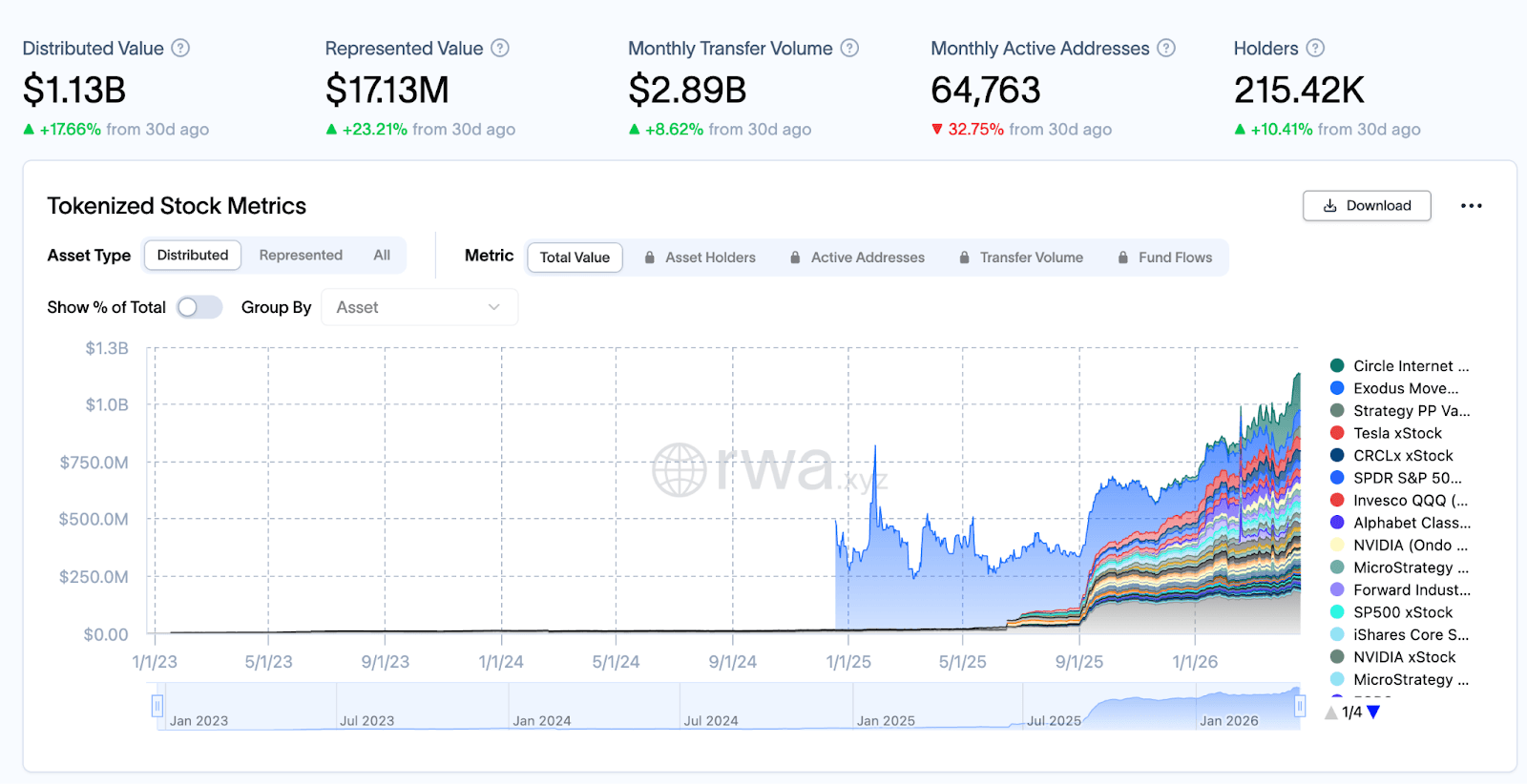
Tokenized Stock Metrics for Distributed Assets, Source: https://app.rwa.xyz/stocks
How does NVDA (NVIDIA Corporation Common Stock) work?
The logic behind NVDAUSDT perpetual contracts shows how traditional equity value can be fused with the high frequency derivatives framework of crypto markets. At its core, this product is designed to track NVIDIA’s real-time spot price on Nasdaq. It does that while using the funding rate mechanism that is native to perpetual swaps in Web3 markets. This mechanism helps keep the contract price dynamically aligned with the underlying spot market. Traditional stock futures come with expiry dates and settlement schedules. Perpetual contracts remove that structure and allow traders to keep positions open for longer periods, while adjusting leverage and risk exposure in response to changes in AI chip demand, earnings expectations, or macro policy signals. That design gives global participants a highly responsive price discovery tool. It becomes especially useful during after hours volatility or geopolitical events that hit outside U.S. trading sessions. Because perpetuals trade 24/7, they fill the liquidity gap that exists in traditional equity markets during nights and weekends. Traders can use digital assets as margin and react quickly, whether the goal is hedging or capturing volatility in a major technology stock.
In terms of stability, the NVDAUSDT contract also reflects a layered risk management structure that can serve traders with very different risk appetites. Options market makers and large institutional traders can use perpetuals for complex delta hedging, and the liquidity generated by those flows can support deeper trading and more accurate pricing for NVDA-linked RWA assets onchain. Based on market observations from early 2026, every major NVIDIA product breakthrough or revenue update had the potential to trigger a cross market feedback loop. A sharp rise in on-chain demand could push perpetual contracts into premium territory, which would then attract arbitrage activity between crypto venues and traditional equity markets. That mechanism helps compress price gaps across markets and improves overall capital efficiency. More importantly, it breaks down the old separation between traditional equities and digital assets. Capital can move between both systems in a more optimized way, which lowers access barriers and friction costs for global retail users who want exposure to top-tier technology names. It also brings real-world value, backed by strong corporate cash flow, into the digital asset market.
NVDA (NVIDIA Corporation Common Stock) market price & tokenomics
NVIDIA reached a historic USD 5 trillion market capitalization milestone in October 2025. That achievement was not just a financial headline. It marked compute power as a kind of digital gold in the AI era and reinforced its role as a universal economic input. NVIDIA’s business model had already evolved beyond pure hardware sales into a more layered structure built on hardware infrastructure, software subscriptions, and cloud based compute services. That made its revenue base more diversified, more stable, and less exposed to a single cycle. According to fiscal 2025 data, its data center revenue rose 114% year over year, and quarterly revenue at one stage reached USD 39.1 billion. That level of cash flow generation gave NVDAUSDT perpetual contracts a far stronger fundamental anchor than most tokenized market products. In digital finance terms, the value mapped into these instruments reflects how deeply NVIDIA has penetrated the global AI ecosystem. Its pricing moves with the shipment intensity of advanced accelerators such as the H200 series and with subscription demand across its software platforms. In other words, the tokenized representation tracks not just market sentiment, but also real demand for physical compute infrastructure.
As the RWA sector’s total value locked expanded rapidly in early 2026, NVIDIA related assets came to be seen as one of the clearest liquidity barometers and value storage instruments in that segment. In some respects, they began to carry both growth and defensive characteristics. Industry reporting through late 2025 showed that NVIDIA’s data center revenue had become a leading indicator for global technology capital expenditure. When major cloud providers announced larger spending plans, that signal could quickly convert into buy pressure for NVDA on-chain assets and increased open interest in perpetual contracts. This made NVIDIA RWA look different from a standard equity narrative. It started to function as both a stabilizer and an accelerator within digital asset portfolios. It offered growth exposure to the AI expansion cycle, while also drawing support from real industrial demand and strong revenue visibility.
At a broader modeling level, the existence of NVDAUSDT contracts also pushed the convergence of compute commoditization and equity tokenization. That trend is reshaping how global capital evaluates high technology firms. NVIDIA’s economic role is increasingly financialized in the sense that global compute supply now has a direct relationship with the marginal productivity of the digital economy. Under that concept, NVDA RWA began to resemble a form of strategic digital infrastructure exposure. Holding NVDAX or trading NVDA perpetual contracts is no longer just a secondary market activity. It is also a way of taking position in the ownership layer of critical compute resources before those resources become even more central to the AI economy. That strategic angle became more visible in early 2026, when sovereign AI programs across multiple countries began moving from policy discussion to real deployment. As order visibility improved and long term contract scale expanded, the intrinsic support for NVIDIA tokenized assets also strengthened. This structure places NVIDIA at the center of a bridge between physical high technology production and virtual on-chain capital markets, giving RWA participants a lower barrier route into one of the most important infrastructure buildouts of this cycle.
Why do you invest in NVDA (NVIDIA Corporation Common Stock)?
The core value behind investing in tokenized NVIDIA exposure is a long term view on compute demand. As generative AI expands from text into video, robotics, and drug discovery, GPU demand is no longer confined to the technology sector. It is becoming part of national competitiveness and industrial capacity. NVIDIA has continued to deepen its moat through repeated hardware iteration, and that makes it difficult for rivals to close the performance and efficiency gap in a short time. By 2026, NVIDIA had positioned itself not just as a chip supplier, but as an AI factory supplier. It was not only shipping components to firms such as Microsoft or Google. It was also tied to large scale industrial transformation projects, including Samsung’s AI megafactory initiative. This move from component vendor to full stack AI infrastructure provider raises the long term value of each customer relationship and strengthens the business foundation behind the asset.
From a broader perspective, NVIDIA matters because it accelerates the convergence of the digital and physical worlds. Through its technology stack, work that once required months of creative production or industrial design can now be compressed into minutes through AI agents and simulation systems. For longer term holders, the real question is not short term price movement. It is whether NVIDIA can continue acting as one of the base layer allocators of global intelligence resources. Whether the use case is autonomous driving perception, industrial robotics, or next generation 6G signal optimization, the underlying compute standard often traces back to frameworks NVIDIA helped define. Investing in NVDA related assets therefore means gaining entry into the future automation economy. Between 2025 and 2026, NVIDIA also extended its reach into multiple AI application verticals through strategic investments and capital deployment, including positions tied to Poolside and Wayve. That approach helps ensure that no matter which application layer wins, NVIDIA still has a path to capture value as the core compute platform underneath.
Is NVDA (NVIDIA Corporation Common Stock) a good investment?
Even though NVIDIA delivered a 171% gain in 2025 and maintained year to date growth above 50% into early 2026, its rich valuation also means the market leaves very little room for disappointment. Any signal tied to supply chain disruption, tighter export restrictions, or a slowdown in capital spending from hyperscalers can trigger a sharp repricing. The risk around export license reviews in January 2026, and that type of policy headline can matter as much as product demand in a stock priced for continued execution. Investors using perpetual contracts or tokenized stock wrappers also face an extra layer of risk that does not exist in plain equity ownership. That includes smart contract security, issuer creditworthiness, custody structure, and the operational stability of the blockchain network itself. The RWA sector is growing quickly, but the legal regulation of these assets still differs across jurisdictions, so regulatory friction remains part of the tradeoff behind 24 by 7 access.
Overall, NVIDIA represents a rare mix of high growth and high strategic certainty. That combination is unusual in any market. Its strength comes from a deep technological lead and from ecosystem lock-in through products such as CUDA. Its challenges come from geopolitical fragmentation and from the fact that competitors will continue trying to narrow the gap. For professional traders, NVDA has already grown beyond the category of a single stock. It increasingly behaves like an AI sector index in its own right. Hedging through perpetual futures and building cross market allocation through NVDA linked assets has become a standard practice in many modern digital asset portfolios.
Explore the latest NVDA (NVIDIA Corporation Common Stock) price and live chart, trade NVDA on FameEX, and access real-time market data! Get started now with a seamless trading experience!
Disclaimer: The information provided in this article is intended only for educational and reference purposes and should not be considered investment advice. Conduct your own research and seek advice from a professional financial advisor before making any investment decisions. FameEX is not liable for any direct or indirect losses incurred from the use of or reliance on the information in this article.