NOM (Nomina) Token Price & Latest Live Chart
2026-04-08 10:51:33

What is NOM (Nomina)?
Nomina is an interoperability protocol built on the Ethereum and unified trading platform built to address one of the biggest structural problems in onchain finance, which is the fragmentation of liquidity and execution caused by the rapid expansion of Layer 2 rollups. As Ethereum scaled through multiple rollup environments, throughput improved, but capital, trading activity, and execution logic became scattered across separate domains. That fragmentation made cross-rollup trading slower, more expensive, and operationally messy. Nomina is designed to solve that problem by bringing decentralized perpetual futures exchanges across different rollups into a single execution environment with much stronger coordination. It is not a conventional frontend aggregator. It is an interoperability layer with native security properties that allows professional traders and core DeFi users to direct liquidity across environments such as Arbitrum, Optimism, and Base from one interface. The result is a more seamless path for capital movement and strategy execution in a fragmented market, with each onchain instruction handled with the speed and precision expected from institutional-grade trading infrastructure.
The project’s evolution reflects a strategic shift from pure infrastructure messaging toward a more focused financial application layer. Its earlier identity was Omni Network, and in 2025 it was formally rebranded as Nomina to align more precisely with its role as a programmable interface for global onchain value. The technical strength of Nomina lies in the way it tackles cross-rollup communication. By combining an optimized CometBFT consensus design with security anchored to Ethereum Layer 1, the network is built to deliver sub-second cross-rollup message verification. In practical terms, this means a transaction or execution instruction moving across Ethereum scaling environments can be confirmed with latency that feels much closer to a single-chain experience. That materially reduces the waiting time and slippage risk that traditional bridging flows often introduce. More importantly, Nomina does not rely on a loosely trusted external validator cartel for its core security model. Through mechanisms such as restaking, its protection is tied back to the economic security of Ethereum itself, which makes Nomina function more like an extension of Ethereum’s execution reach than a detached crosschain overlay.
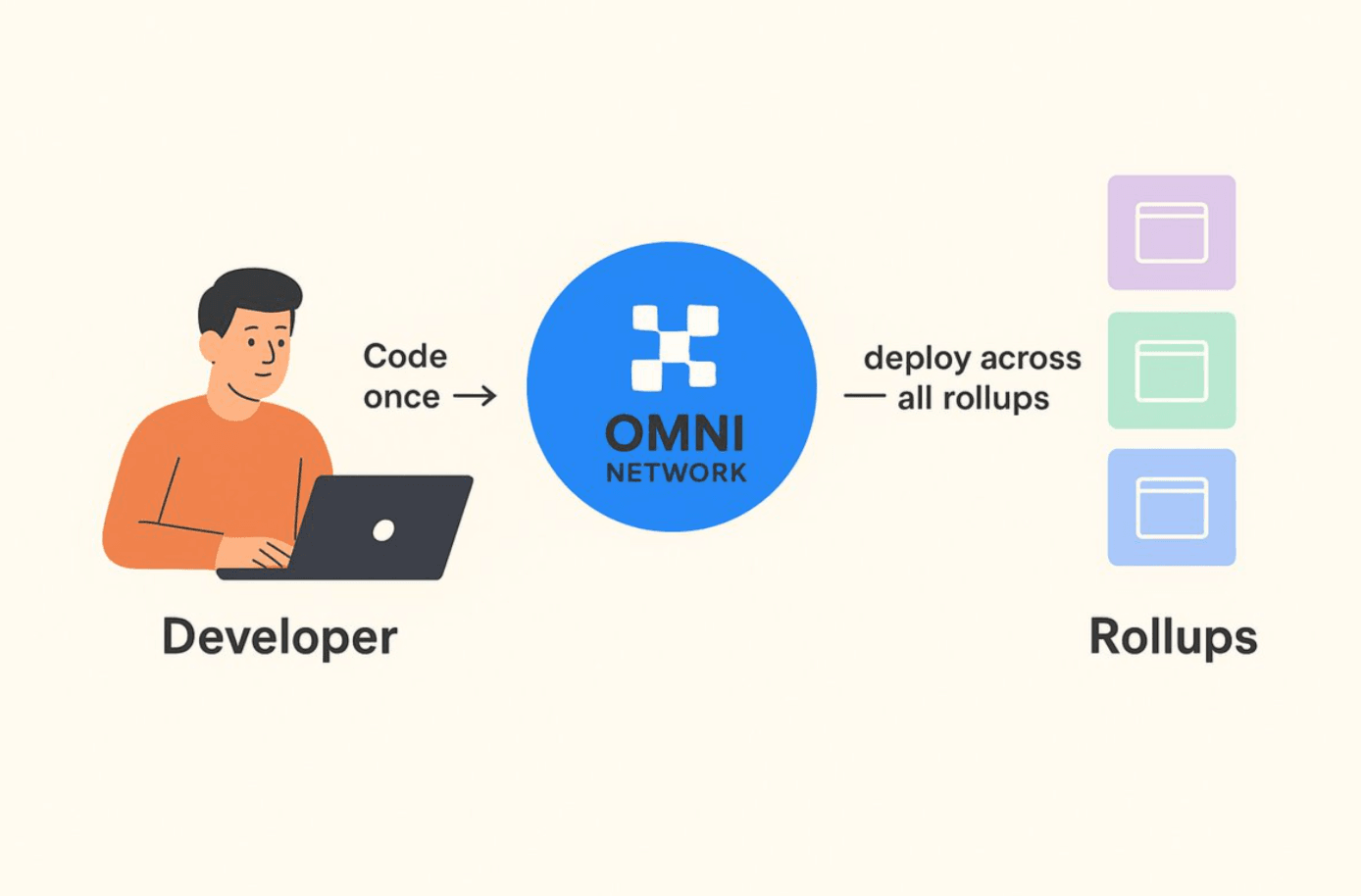
With NOM, developers can write code once and deploy it across all rollups. Source: https://x.com/Nomina/status/1961397708511703146?s=20
For users operating in the crypto market at a high level of speed and precision, Nomina acts as an onchain command center. Its trading terminal combines automation modules with prebuilt strategy tooling that lowers the operational burden of running advanced financial strategies. Within the platform, users can coordinate position synchronization across exchanges and execute workflows such as funding rate arbitrage or automated hedging without constantly switching between wallets, networks, and trading venues. That kind of integrated environment improves capital flexibility and makes execution more scalable. It also adds a stronger layer of monitoring through real-time oversight and automated alerts, which helps create more room for risk control in fast-moving onchain markets.
How does NOM (Nomina) work?
Nomina operates through the native Ethereum coordination architecture built to achieve high-speed consensus across multiple rollup states. At the center of that design is an optimized CometBFT consensus engine. This engine is intended to support high throughput and fast finality in a highly dynamic blockchain environment, so cross-rollup messages can be verified and relayed in under a second. When a user initiates a cross-rollup instruction through Nomina, the network detects the state change on the source chain, verifies it, reaches agreement across the validator set through its cryptoeconomic model, and then forwards the execution message to the destination environment. Because the security layer is deeply tied to Ethereum Layer 1, this process does not depend on the kind of third-party custody or loosely trusted external verifier sets that have historically made crosschain systems vulnerable. Instead, it inherits a security profile that is much closer to Ethereum’s own base layer, which allows Nomina to address a long-standing tradeoff in interoperability design between speed and trust assumptions.
To turn that underlying complexity into a more intuitive user experience, Nomina introduced the Universal Gas Marketplace and a broader gas abstraction framework. This is one of the most important parts of the system. In traditional multichain trading, users need to maintain native gas assets on each separate rollup just to keep transactions running. That creates unnecessary capital fragmentation and adds friction to every strategy. Nomina changes that by allowing users to pay for transactions across connected networks with the native asset of the originating chain or directly with $NOM. The system abstracts away the backend mechanics of asset conversion and cross-rollup settlement, so the trading experience feels much closer to operating on a single network. This type of infrastructure optimization is a prerequisite for large-scale automation and for the reliable execution of complex cross-market strategies. It makes cross-rollup financial activity more precise, more programmable, and far less disruptive from an operational perspective.
At the application layer, Nomina’s Trading Terminal combines exchange integrations with smart contract logic to transform liquidity across separate perpetual futures DEXs into a unified and programmable trading environment. The platform does more than display positions in one place. It includes synchronized position management and a powerful automation engine that can trigger cross-exchange opening, closing, or rebalancing actions in response to changing market conditions. If funding rates on one venue diverge sharply from another, Nomina can execute the required arbitrage workflow with minimal delay. All of that happens within a framework designed to preserve Ethereum-grade security assumptions. This vertical integration from consensus and messaging to execution and automation is what makes Nomina more than a route between networks. It functions as an operating layer for onchain action, giving advanced users a stable and seamless point of entry into a DeFi environment that would otherwise remain fragmented and operationally expensive.
NOM (Nomina) market price & tokenomics
The $NOM token is the core economic asset of the Nomina ecosystem. It was designed to support a durable incentive structure and value layer across the protocol’s decentralized interoperability stack. As the native token of the network, $NOM plays several roles inside the system, including supporting economic security, serving as a payment asset within the gas abstraction model, and acting as a governance instrument for protocol-level decision making. In Nomina’s economic design, the token’s relevance is tied to network usage, especially the volume of cross-rollup activity and the frequency of execution messages processed through the system. That relationship matters because it positions $NOM as infrastructure-linked utility rather than a purely symbolic governance token. The more the network is used as an execution and coordination layer, the more central the token becomes to the functioning of the ecosystem.
On the supply and distribution side, Nomina follows a structure intended to balance long-term development with ecosystem incentives. The broader goal is to support a validator network with meaningful economic security and long-run participation. Node operators are required to stake $NOM or associated restaked assets in order to participate in CometBFT consensus and earn protocol-generated service fees. That mechanism ensures that the cost of attacking the network rises alongside the value secured and the level of activity flowing through the ecosystem. This is a critical design point, because it ties the network’s defensive strength to its economic relevance rather than to a static trust model. Token holders also participate in governance, which gives them influence over future protocol parameters and integration priorities. That governance role is not just cosmetic. It is part of the system’s feedback loop, allowing the protocol to evolve alongside shifts in market structure and user demand.
Nomina’s tokenomics are built to convert the strengths of the underlying technology into a more durable value framework for token holders. By coupling gas payments, staking incentives, and governance power, the network creates a model that is harder to replicate than a token whose utility rests on exchange liquidity alone. As onchain derivatives infrastructure expands beyond the early adoption phase, $NOM can be understood not just as a payment asset, but as a gateway into the execution layer of a broader Ethereum rollup economy. Its long-term relevance depends less on narrative momentum and more on whether Nomina succeeds in becoming a widely used coordination and execution layer for serious onchain trading activity. That is where the real economic case for the token begins.
Why do you invest in NOM (Nomina)?
The core strategic appeal of investing in Nomina lies in its exposure to Ethereum’s structural shift from a single-chain system to a multi-rollup network. Nomina’s positioning makes it a communication and execution hub across Ethereum’s scaling stack. That means it is not competing directly with any single Layer 2. Instead, it can benefit from the growth of any rollup that gains traction within the ecosystem. This “infrastructure on top of infrastructure” profile gives the project a stronger defensive character and a broader network effect. The team, led by Harvard-trained founders Austin King and Tyler Tarsi, combines deep quantitative trading experience with advanced blockchain engineering expertise. That combination gives Nomina a clear advantage in building products for professional users who demand both speed and security in fragmented cross-rollup markets. In a highly competitive DeFi landscape, that level of execution focus is a major differentiator.
Nomina’s institutional backing also strengthens its market credibility and gives it access to meaningful ecosystem resources. Support from firms such as Pantera Capital and Coinbase Ventures does more than provide funding for research and development. It also signals that the project may be well positioned for future institutional-grade services and more standardized onchain trading infrastructure. After completing its rebrand in 2025, Nomina shifted its market strategy away from pure technical storytelling and toward practical tools that professional traders can use at scale. What draws long-term attention is its ambition to become a singular programmable interface for the onchain economy. If that interface becomes widely adopted, Nomina could take on a role similar to a clearing layer or communications standard in traditional financial markets. That is what gives the project its long-duration strategic value.
Is NOM (Nomina) a good investment?
Nomina stands out in onchain finance because it addresses two foundational requirements at the same time, which are security and execution efficiency. Very few projects are built to deliver sub-second and cross-rollup verification while also inheriting security assumptions directly from Ethereum. For large traders and financial institutions, that kind of technical scarcity carries strong market appeal. As more global financial activity moves onchain through 2026, demand is likely to grow for tools that can coordinate liquidity across markets and simplify complex cross-rollup execution paths. At the same time, investors still need to recognize the volatility and competitive pressure of the crypto market. Interoperability is a large opportunity, but it is also a crowded field with multiple technical approaches competing for adoption. Nomina’s long-term success will depend on how quickly its ecosystem expands and how deeply the $NOM token becomes embedded in real trading activity. Although the project showed strong momentum and growth across 2025 and 2026, it remains important to track the pace of protocol upgrades and changes in the competitive landscape. Overall, for investors focused on blockchain infrastructure, the long-term future of Ethereum’s omni-rollup architecture, and technically strong founding teams, Nomina offers a great opportunity backed by a clear thesis and solid fundamentals. It is a strategic project that deserves close study within the fast-evolving Web3 landscape.
Explore the latest NOM (Nomina) price and live chart, trade NOM on FameEX, and access real-time market data! Get started now with a seamless trading experience!
Disclaimer: The information provided in this article is intended only for educational and reference purposes and should not be considered investment advice. Conduct your own research and seek advice from a professional financial advisor before making any investment decisions. FameEX is not liable for any direct or indirect losses incurred from the use of or reliance on the information in this article.