SKYAI (SKYAI) Token Price & Latest Live Chart
2026-05-08 11:23:20

What is SKYAI (SKYAI)?
SKYAI is a Web3 data infrastructure platform built for large language models (LLMs). Its core mission is to solve the fragmentation of blockchain data and the difficulty AI applications face when trying to read onchain information directly. In traditional development environments, AI models are often constrained by stale training data, which prevents them from understanding and interacting with highly volatile onchain assets in real time. By introducing and extending the Model Context Protocol (MCP), SKYAI builds a bridge that allows AI agents to natively access blockchain data. This enables AI to move beyond the role of an external conversational tool and become a participant that can read, analyze, and execute onchain logic under authorized conditions. The technology is designed to break down data silos across different blockchain networks and transform raw, fragmented blockchain records into AI-readable, logically connected, and high-value data assets.
From a technical perspective, SKYAI emerged in early 2025, when the crypto market already had many AI-themed projects but most of them still operated as traditional AI products wrapped in a Web3 shell. They lacked true blockchain-native capabilities. To make AI a native component of blockchain infrastructure, the SKYAI team developed a standardized data access framework. This framework supports major networks such as BNB Chain and Solana, with plans to expand gradually to Ethereum, Base, and other major public chains. The project’s broader vision is to create a decentralized data economy where data providers can commercialize the onchain information they collect, while AI developers can access that information through standardized interfaces. This mechanism gives AI the ability to assess market sentiment in real time, evaluate token risks, and manage wallet balances. It also reshapes the way users interact with decentralized applications at a fundamental level.
At the ecosystem level, SKYAI defines itself as a foundational rail for AI x Web3. It mainly serves three key groups of participants. For end users, SKYAI provides a Playground environment that does not require deep technical knowledge. Users can issue natural language instructions and allow AI to assist with complex onchain transactions and data analysis. For developers, SKYAI provides IDE plugins and standardized APIs that significantly shorten the development cycle for AI-driven dApps. It also reduces the technical burden of handling ABIs, transaction signatures, and other blockchain-specific processes. For data providers, standardized data streams can be connected to the MCP Marketplace to unlock data liquidity and monetization. This multi-sided architecture helped SKYAI gain strong official support from BNB Chain in May 2025, further strengthening its position in the AI infrastructure sector.
How does SKYAI (SKYAI) work?
SKYAI operates through a deeply extended version of the Model Context Protocol (MCP), originally proposed by Anthropic. The protocol was designed to standardize communication between AI models and external tools. SKYAI adapts it into a data routing and interpretation system built for blockchain environments. Through this extended protocol, AI agents can bypass complex middleware and request structured data directly from blockchain nodes. The system includes a large data aggregation layer that has already accumulated more than 10 billion rows of onchain records. These records are cleaned and standardized so that when AI calls a specific data metric, the returned information has contextual logic and can be used immediately for forecasting or decision-making. This architecture gives AI a form of real-time awareness across the blockchain environment. SKYAI also extends the protocol into blockchain-specific data scenarios, allowing AI systems to read onchain transactions, wallet states, protocol data, token activity, and aggregated indicators through a unified format. The key purpose is not to let AI replace users in every operation. It first solves the more fundamental problem that onchain data is difficult for models to interpret in a stable and consistent way. Once data formats, query paths, and returned outputs are protocolized, AI agents can reason and interact within a more reliable context.
To ensure secure data transmission and privacy protection, SKYAI integrates trusted execution environment (TEE) technology. This provides an isolated encrypted computing space when the system processes sensitive data related to DeFi liquidity or user information. The combination of software and hardware security addresses one of the most common concerns around decentralized AI. SKYAI has also developed dedicated smart contract APIs that function like the operational layer for AI agents. These interfaces allow agents not only to observe data but also to respond to market changes through automated logic. When an AI agent detects abnormal onchain activity, it can generate and send a transaction request through an MCP-based route according to preset strategies. This creates a full workflow that connects data acquisition, analysis, and execution into a single automated process.
SKYAI’s architecture also includes application entry points for both general users and developers. Playground is the most direct product example. It allows users to ask questions about onchain data through natural language and analyze addresses, tokens, protocols, or multichain activity without first understanding private keys, ABIs, event indexing, transaction signatures, or node queries. For developers, SKYAI provides MCP APIs, tool modules, and potential IDE plugins so that AI-driven onchain applications can connect to data services more quickly. This means SKYAI is not only delivering data to end users. It is also trying to become a middleware layer for application development. Wallets, analytics tools, DeFi protocols, blockchain games, risk control systems, and AI agent platforms can all build functionality on top of the same data standard.
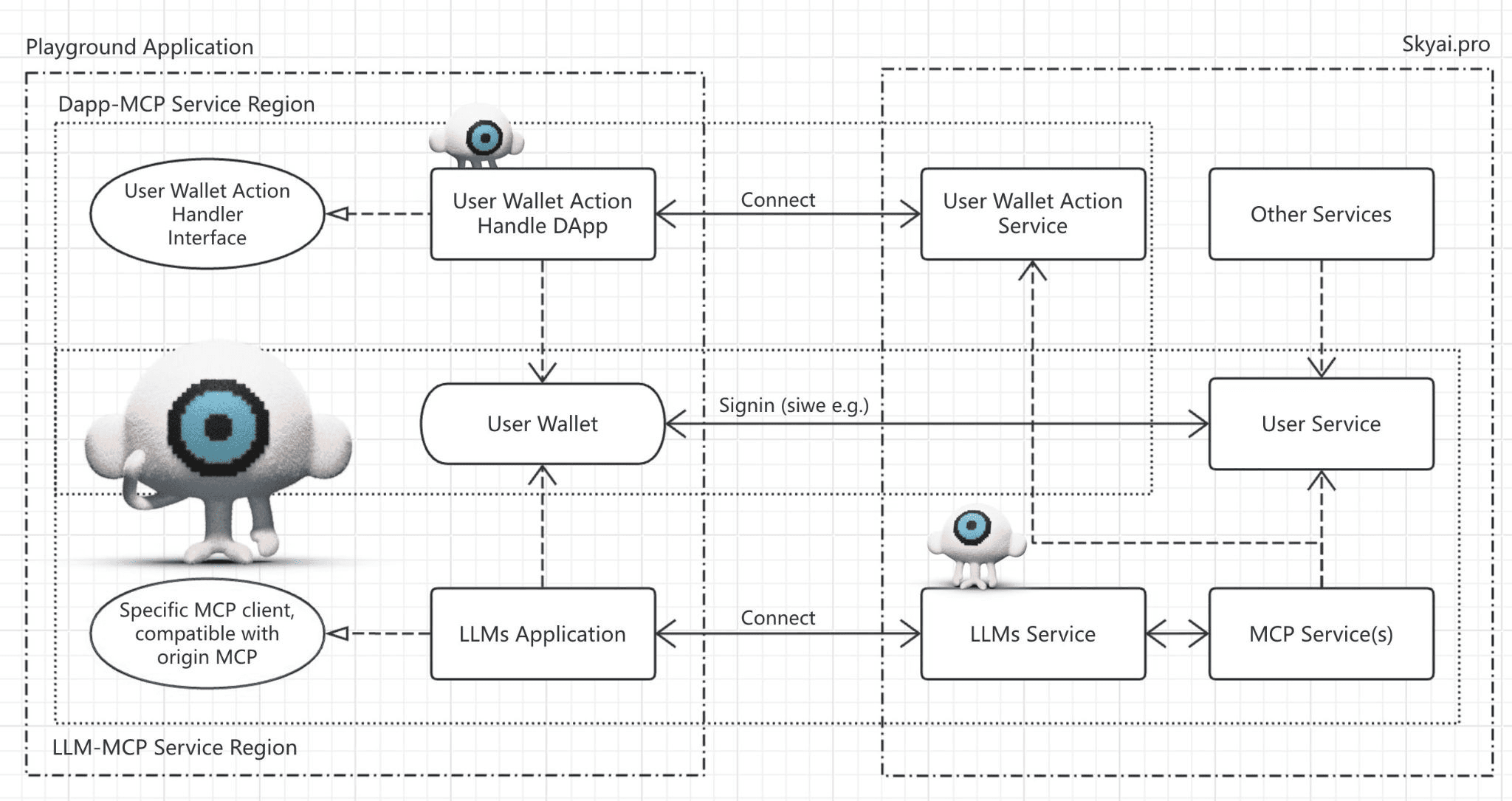
Playground Application, Source: https://x.com/SKYAIpro/status/1922321793463025882?s=20
The MCP Marketplace is the more economic layer of SKYAI’s ecosystem design. Traditional onchain data services are often controlled by a small number of centralized data providers, internal indexing systems, or application backends. External developers usually need to rely on closed APIs, commercial licensing, or self-built indexing infrastructure when they require data. SKYAI’s planned MCP Marketplace allows data providers to list data services in a format that complies with MCP standards. Developers, AI agents, and end users can then discover, call, and pay for these services. Data providers do not need to build a full frontend or complex user interface. They only need to make their data services compliant with the protocol standard before entering the marketplace. This design connects data supply, AI demand, and onchain settlement. It could form an onchain data service market based on data quality, call frequency, and application demand.
In terms of cross-chain interoperability, SKYAI uses its multichain data service layer to remove the inconsistency between different blockchain formats. The system normalizes Solana’s account-model data and BNB Chain’s EVM-compatible data into a unified query interface. This means developers building AI applications do not need to write separate data processing logic for every chain. They can access the required information across chains by connecting to SKYAI’s MCP service. This efficient data flow supports the core MCP Marketplace, where data exchange, model calls, and resource leasing are automatically settled through the underlying token. The result is an on-demand decentralized computing and data market network with a more efficient operating structure.
SKYAI (SKYAI) market price & tokenomics
SKYAI is the native BEP-20 token of the SkyAI ecosystem, with a fixed total supply of 1 billion tokens. Its allocation strategy is highly community-oriented. 80% of the token supply is allocated to the community, including early presale participants, ecosystem incentives, and future staking rewards. The remaining 20% is reserved for market liquidity. Notably, the SKYAI core team does not retain a dedicated token allocation. This design aims to maximize decentralization and ensure that the token’s value dynamics are driven by market supply and demand, as well as actual ecosystem utility. The token’s main functions include paying for data services, settling activity inside the MCP Marketplace, and staking to receive veSKYAI for governance voting.
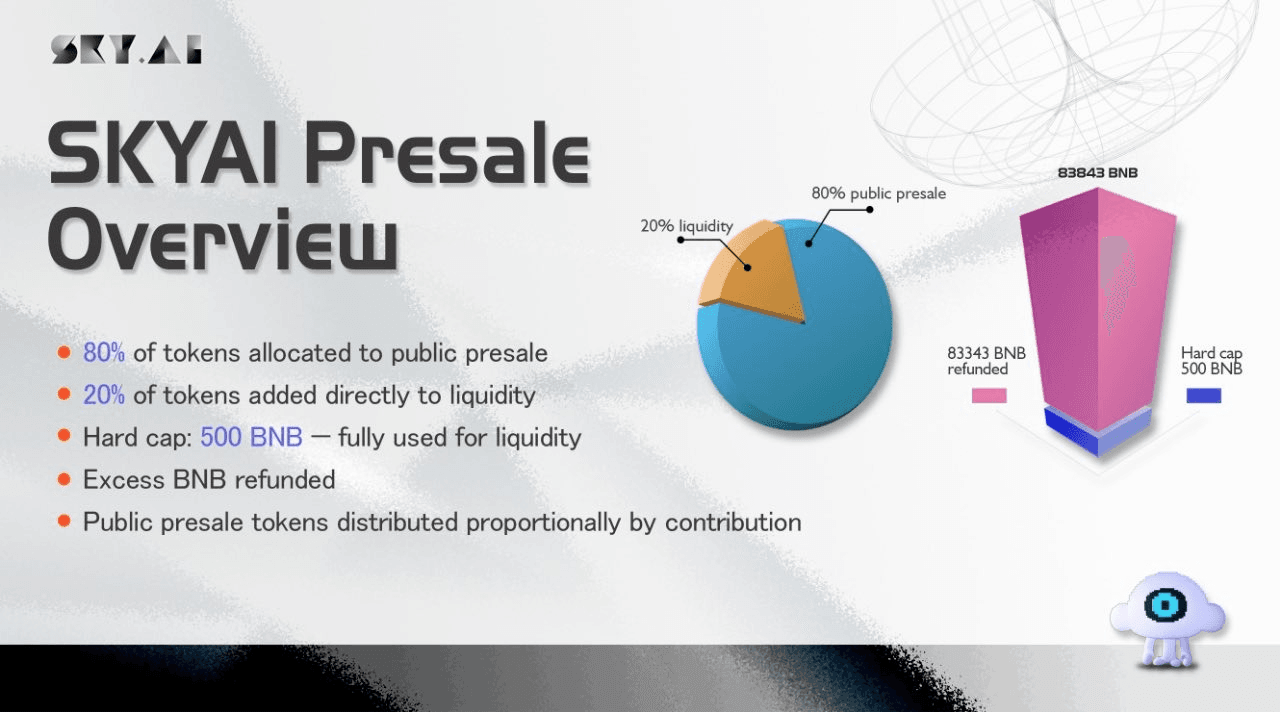
$SKYAI Presale Overview with Token Allocations, source: https://x.com/SKYAIpro/status/1913575932583121248?s=20
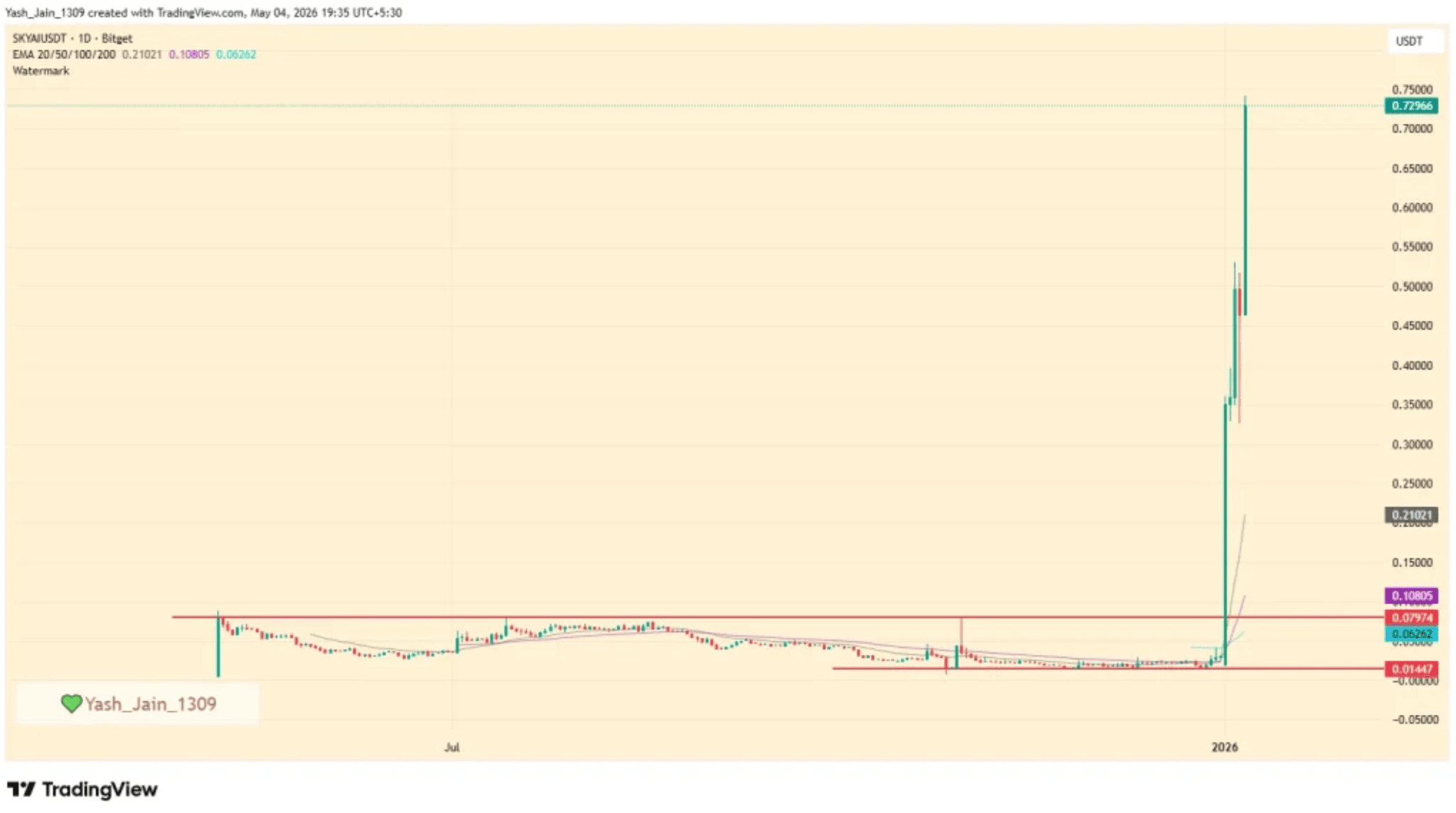
Looking back at its historical price performance, SKYAI showed strong expansion momentum in the secondary market after completing its oversubscribed presale in May 2025. During that month, the token’s initial trading price stabilized near $0.063, with a circulating market capitalization of approximately USD 63 million. This provided a solid valuation base for the AI infrastructure sector at the time and reflected strong market recognition of its positioning as an AI-native data rail. This early liquidity surge not only validated market expectations around the technical potential of the MCP protocol but also set the stage for a larger breakout in 2026. SKYAI’s price recorded a dramatic +4100% surge in May 2026, breaking out of a year-long consolidation range and reaching a high of $0.72645. The core driver behind this sharp move was the overlap between the rise of the AI agent narrative and tangible technical progress. In late April 2026, the token’s CEX listing provided the first spark of liquidity. On May 3, 2026, the team announced that its core infrastructure, SKYAI MCP Hub, had entered the final testing phase. This announcement intensified market attention. The technology was viewed as a collaborative brain for AI agents, capable of handling dynamic routing across multiple MCP servers and shared context across agents. It helped shift market perception from pure speculation toward infrastructure demand with a clearer moat.
Token holders can stake $SKYAI into staking contracts to help strengthen network security and stability. In return, they may receive a share of ecosystem-generated rewards. This mechanism reduces circulating supply and creates an economic loop that links long-term holders more closely with project development. SKYAI adopts a pay-as-you-go business model. This means that every time a developer or AI agent calls data or services through the MCP Marketplace, actual demand for $SKYAI is created. Because this model is tied to platform usage, the token has a clearer utility base than a purely speculative asset.
Why do you invest in SKYAI (SKYAI)?
The core concept behind SKYAI’s investment appeal lies in its attempt to fill a structural gap between AI and data in Web3. As automated trading and AI agents play an increasingly important role in decentralized finance, demand for high-quality, real-time, and easy-to-integrate onchain data is growing rapidly. Through its extended MCP protocol, SKYAI positions itself as both a supplier and an intermediary for this large market. The market is not only looking at token price volatility. It is also paying attention to the technical barriers SKYAI is building in AI infrastructure, as well as the strong community consensus and capital recognition shown by more than 110,000 wallet addresses participating in its 2025 presale.
The project has received official support from important ecosystem players such as the BNB Chain Foundation. This provides meaningful credibility in a crypto market that is often full of uncertainty. In May 2025, BNB Chain purchased nearly USD 100,000 worth of SKYAI tokens through their incentive program. This direct capital support and ecosystem resource allocation from a major chain suggest that the project has passed a certain level of screening in terms of technical compatibility and ecosystem value. SKYAI is also not limited to a whitepaper-stage concept. It has already structured more than 10 billion rows of data. This concrete product progress gives the project a more visible growth path, especially as AI and Web3 integration becomes a stronger industry trend.
Therefore, SKYAI is better understood as an infrastructure project trying to build an AI-native onchain data layer, rather than simply another AI token. Its value proposition is built on three layers. First, it uses the extended MCP to solve the connectivity problem between LLMs and blockchain data. Second, it uses multichain data aggregation and Playground to reduce usage and development barriers. Third, it uses the MCP Marketplace to create an onchain economic loop between data providers and data consumers. These designs give SKYAI a clear product logic. Its long-term value still needs to be validated by actual adoption, marketplace liquidity, cross-chain support depth, and ecosystem partnerships. For this type of early-stage infrastructure project, a rational assessment should not be based only on short-term price performance. It should focus on whether AI agents, developers, and onchain applications continue to use the product in real workflows.
Is SKYAI (SKYAI) a good investment?
Compared with purely conceptual AI tokens, SKYAI has a real implementation scenario. It provides large language models with the onchain context they need to function effectively. This demand-driven characteristic may give the project stronger resilience during weaker market periods, because AI agents need data support regardless of market cycles. However, the AI infrastructure sector evolves quickly. Although SKYAI showed strong price momentum and community attention between 2025 and 2026, its long-term value will depend on whether it can continue expanding supported chains and maintain activity inside the MCP Marketplace.
Now, data shows that SKYAI is executing its broader roadmap step by step. This includes a roadmap transition toward DAO governance after 2026 and the development of a mobile application for real-time AI model tracking. These initiatives may help further decentralize control and improve user retention. Overall, SKYAI is a high-potential asset with clear technical risks. For market participants focused on Web3 ecosystem value discovery, SKYAI offers exposure to the growth of AI-native infrastructure. Still, its multichain integration progress, competitive landscape, and real usage metrics should remain the key factors to monitor. Any allocation should be made within an appropriate personal risk framework.
Explore the latest SKYAI (SKYAI) price and live chart, trade SKYAI on FameEX, and access real-time market data! Get started now with a seamless trading experience!
Disclaimer: The information provided in this article is intended only for educational and reference purposes and should not be considered investment advice. Conduct your own research and seek advice from a professional financial advisor before making any investment decisions. FameEX is not liable for any direct or indirect losses incurred from the use of or reliance on the information in this article.