COPPER (Copper) Token Price & Latest Live Chart
2026-07-08 10:08:17

What is COPPER (Copper)?
In traditional financial markets, Copper usually refers to copper as a base commodity metal, not a company, stock, or crypto token. Copper is a core industrial metal used across the global economy. It is widely applied in wires and cables, electrical equipment, construction, automobiles, electronics, data centers, and new energy infrastructure. Since copper is closely linked to industrial production, infrastructure development, and energy demand, its price movement is often viewed as an important indicator of global economic conditions. This is why copper is also known as “Dr. Copper.”
Copper matters because it has two major attributes as an industrial raw material and a macro asset. From an industrial perspective, copper is essential for power transmission and manufacturing. When demand rises for electric vehicles, AI data centers, power grid upgrades, or infrastructure projects, demand for copper often increases as well. From a financial perspective, copper prices are affected by global manufacturing activity, the U.S. dollar, interest rates, mine supply, inventory levels, trade policy, and geopolitical factors. Copper is not just a metal. It is also an important commodity asset used in traditional financial markets to observe economic cycles and industrial demand.
How does COPPER (Copper) work?
In TradFi, copper is usually traded through commodity futures, spot pricing, contracts for difference, or commodity-related financial products. This means most traders do not buy and store physical copper. Instead, they access copper price movements through trading products such as futures or other commodity contracts. Large institutions, commodity traders, manufacturers, and investors may access the copper market through venues such as the London Metal Exchange (LME) or the Chicago Mercantile Exchange (COMEX). These markets are commonly used for hedging, pricing, and managing exposure to copper price volatility.
For crypto users, products such as COPPERUSDT are not crypto tokens. They bring copper price trading from traditional finance into a crypto perpetual contract trading. Users are not trading physical copper itself. They are trading a contract price linked to copper price movements. This is why COPPER can be seen as an intersection of TradFi and RWA sector. Its price foundation comes from the real-world copper market, while its trading format is converted into a USDT-margined contract model that crypto users are more familiar with.
The COPPERUSDT perpetual contract further lowers the entry barrier for this type of commodity exposure. Users do not need a traditional brokerage account. They also do not need to enter the commodity futures market through bank wires. Instead, they can use USDT as margin to trade contract products linked to copper prices. This allows a traditional commodity asset such as copper to enter a trading environment that crypto traders already understand. The core of COPPERUSDT lies in price tracking and contract settlement. The platform uses external copper price indices or related market prices as references, allowing the contract price to follow movements in the global copper market. Users trade the rise and fall of copper prices, not physical copper. When copper prices move up or down, the floating profit or loss is reflected in USDT.
This type of product has 3 key features:
- It allows traditional commodity assets to be traded with crypto assets as margin.
- It makes RWA assets such as copper easier to access and trade.
- It brings the macro situation of traditional commodity markets into crypto trading, including supply and demand changes, industry cycles, policy impact, and global manufacturing demand.
The COPPER price is not driven by community hype, on-chain activity, or token burn mechanisms. It is shaped by real-world supply and demand, mine output, inventory levels, the U.S. dollar, tariff policy, energy transition trends, and global economic expectations.
COPPER (Copper) market price & tokenomics
COPPER does not have the “tokenomics” structure seen in traditional crypto projects. Most crypto projects discuss total supply, circulating supply, unlock schedules, staking mechanisms, governance rights, and ecosystem incentives. Derivative products such as COPPERUSDT are different. Their essence is a copper price contract, not an independently issued crypto token. From a commodity market perspective, copper prices are mainly affected by supply and demand. On the demand side, key drivers include electric vehicles, power grid upgrades, AI data centers, semiconductor equipment, construction, and industrial manufacturing. When global infrastructure expands, or when new energy and digital infrastructure grow quickly, copper demand may rise. On the supply side, copper is affected by mining activity, smelting capacity, logistics, mine accidents, environmental policy, and the investment cycles of major mining companies. Copper supply is especially constrained by time. A new mine can take many years or even decades to move from exploration and permits to construction and production. This means supply may not catch up quickly, even when demand increases rapidly. Therefore, copper prices can show strong cyclicality and volatility.
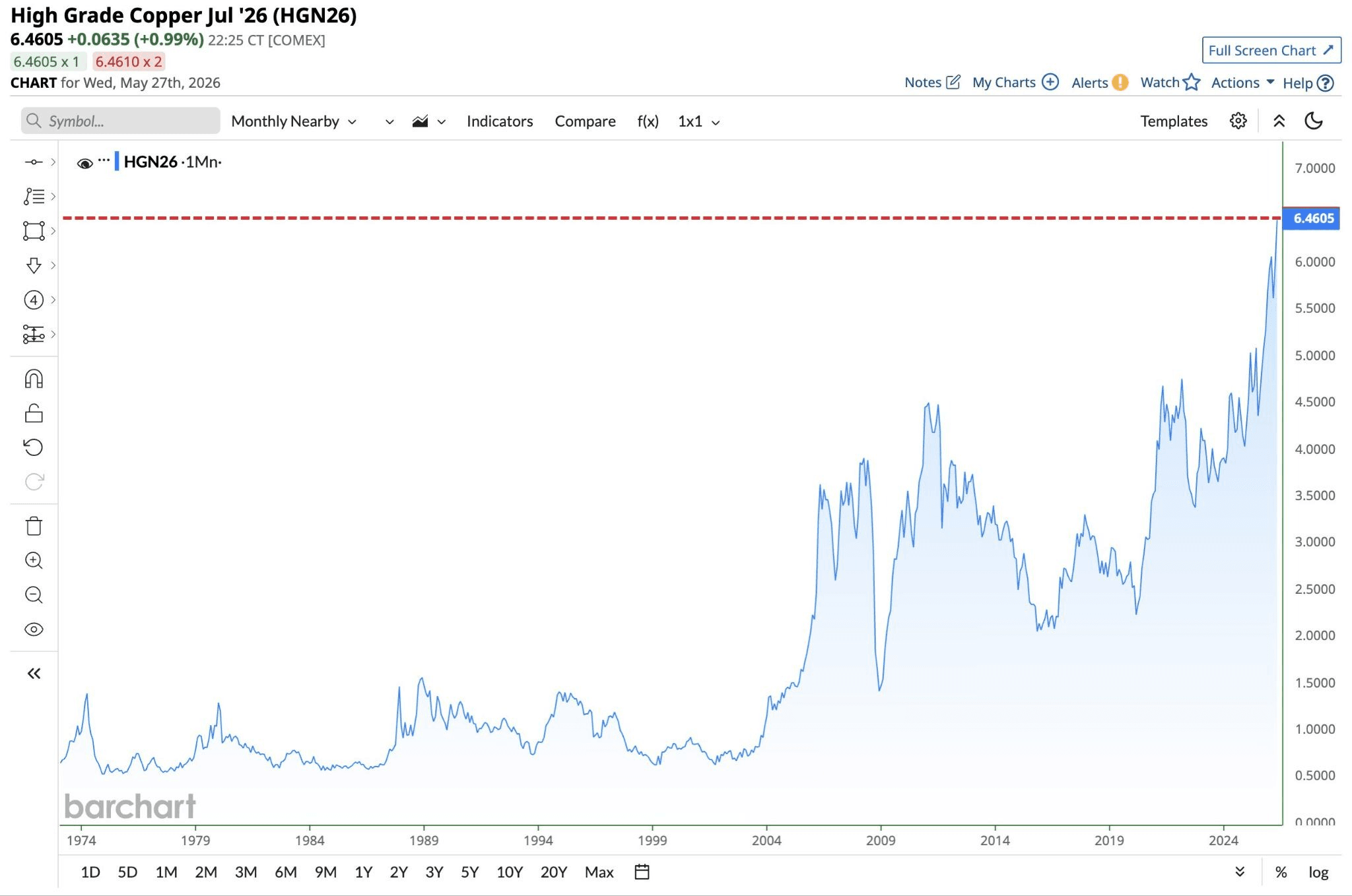
In 2026, copper prices are expected ATH price in history. Source: https://x.com/Barchart/status/2059478609304461321?s=20
From a contract product perspective, the value of COPPERUSDT is not set by the platform itself. It forms around global copper prices. Users should pay attention not only to copper spot prices, but also to perpetual contract mechanisms, margin requirements, leverage, funding rates, liquidity, price index sources, and liquidation rules. COPPER does not tokenize physical copper and put it on-chain for circulation. Instead, it introduces copper as a real-world asset price exposure into a crypto contract trading system. Its focus is not “holding copper,” but “trading copper prices.”
Why do you invest in COPPER (Copper)?
In the past, copper was mainly linked to construction, home appliances, wires, industrial equipment, and manufacturing. Its price movement was often seen as a signal of global economic conditions. When construction activity increased, industrial production expanded, or manufacturing orders recovered, copper demand often rose as well. In recent years, however, the demand structure for copper has changed. Electric vehicles require more copper than traditional internal combustion engine vehicles. Copper is used in motors, battery systems, charging infrastructure, and high-voltage wiring. Power grid upgrades also require large volumes of copper, as renewable energy, energy storage systems, and long-distance power transmission all rely on highly conductive materials. AI data centers have also increased market attention on copper, because high-density computing requires massive power supply, cooling systems, and advanced wiring.
Copper is no longer only a raw material within traditional industrial cycles. It is gradually becoming a foundational resource behind AI, electric vehicles, and the energy transition. When the market discusses computing power, data centers, power grid bottlenecks, and new energy expansion, copper is often a key physical layer behind these trends. This is also the meaning of COPPER as a TradFi trading asset in RWA sector. It allows crypto users to access traditional commodity markets in a more familiar way, without directly entering complex futures trading systems. For users who want to understand macro assets, commodity cycles, and real-world asset pricing, COPPER provides an entry point for observing the copper market.
Explore the latest COPPER (Copper) price and live chart, trade COPPER on FameEX, and access real-time market data! Get started now with a seamless trading experience!
Disclaimer: The information provided in this article is intended only for educational and reference purposes and should not be considered investment advice. Conduct your own research and seek advice from a professional financial advisor before making any investment decisions. FameEX is not liable for any direct or indirect losses incurred from the use of or reliance on the information in this article.