ULTIMA (Ultima) Token Price & Latest Live Chart
2026-07-02 11:00:04

What is ULTIMA (Ultima)?
ULTIMA is a cryptocurrency ecosystem built around the ULTIMA token. Its core concept is to extend crypto assets beyond pure trading scenarios into payments, wallets, DeFi, marketplaces, travel, crowdfunding, and other everyday application services. Unlike many crypto projects that focus on a single function, Ultima is closer to a multi-product integrated ecosystem. It aims to make ULTIMA more than a tradable asset. The token is also designed to serve as a medium of value transfer across different services within the ecosystem.
Many tokens in the market have trading liquidity but lack real use cases. Users may trade tokens on exchanges or participate in on-chain investment activities, yet crypto assets still face high barriers when it comes to daily payments, cross-border transfers, online spending, or real-world services. Ultima project addresses this gap by using payment cards, wallets, marketplaces, and ecosystem platforms to make crypto assets easier for general users to understand and use.
ULTIMA was first launched in March 2023 and the Ultima community now spans 120 countries and has more than 2.8 million users. This shows that the project has already built a certain level of global community foundation. For an ecosystem-based project, community size can provide an initial user base. The real question is whether these users will continue using the products inside the ecosystem and whether the token can form long-term circulation within those products. From a project background perspective, Ultima is not purely driven by a blockchain technology narrative. It is closer to a combination of crypto infrastructure and application products. Its ecosystem includes DeFi-U, ULTIMA Card, Marketplace, ULTIMA Store, ULTIMA Travel Club, crowdfunding platforms, crypto wallets, and trading platforms.
How does ULTIMA (Ultima) work?
ULTIMA can be understood through several layers from the underlying blockchain infrastructure, the token circulation mechanism, and the application products built on top of the ecosystem.
1. Underlying Infrastructure: ULTIMA is built on Smart Blockchain, a network that uses the DPoS, or Delegated Proof of Stake, consensus mechanism. DPoS is a blockchain consensus model that emphasizes efficiency and scalability. It usually relies on representative or delegated nodes to maintain network operations, instead of requiring all nodes to participate in validation in the same way. This design helps improve transaction confirmation speed and reduce transaction costs. It is also more suitable for high-frequency transfers and payment scenarios.
Smart Blockchain produces a new block every 3 seconds and can theoretically support up to 2,000 transactions per second. For general blockchain applications, these technical parameters help reduce user waiting time and transaction costs. If a project wants to enter payment, card spending, or cross-border transfer scenarios, speed and cost are essential conditions. Daily payments cannot require long waiting times like some on-chain operations and they also cannot lose usability because of high fees.
2. Token Circulation Mechanism: The ULTIMA token is the foundational circulating asset of the Ultima ecosystem. It supports payments, transfers, rewards, and user participation across the ecosystem. Users can hold ULTIMA through crypto wallets and use it in different ecosystem products. This makes ULTIMA more than a token record on the blockchain and becomes a connecting tool within the broader product system.
3. Application Products: The Ultima ecosystem covers several areas. Key components include DeFi-U, ULTIMA Card, Marketplace, ULTIMA Store, ULTIMA Travel Club, crowdfunding platforms, crypto wallets, and trading platforms.
- DeFi-U is a mechanism related to ULTIMA token rewards. It allows users to participate in ecosystem activities through the token and receive corresponding rewards. This type of mechanism can often increase user participation. However, the source and sustainability of rewards still need to be considered. If the reward mechanism is connected to real demand, it can support ecosystem growth. If it relies too heavily on incentives, it may create an imbalance between token supply and demand.
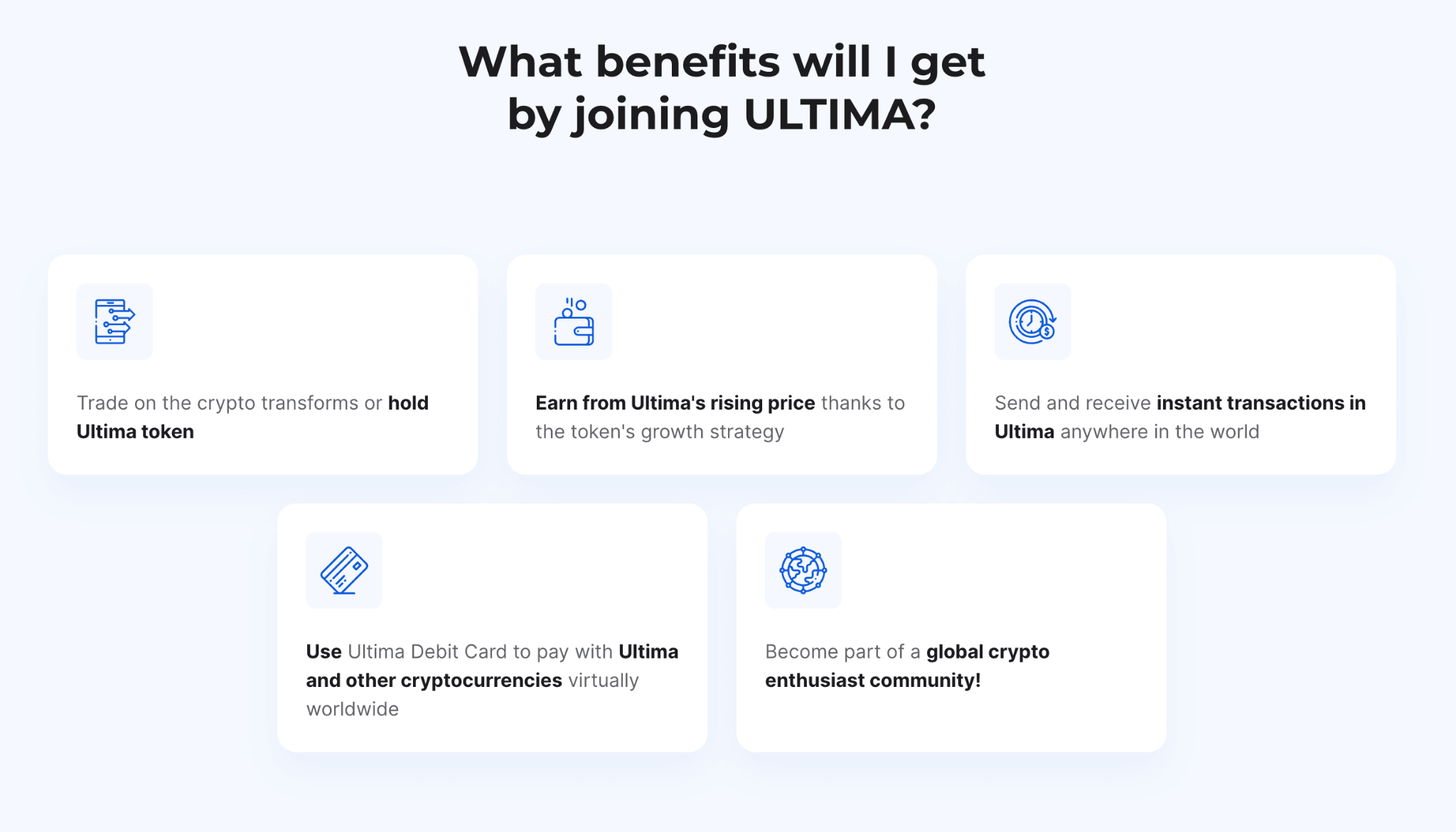
- ULTIMA Card is one of the more user-friendly products in the Ultima ecosystem. It aims to connect crypto assets with real-world payment scenarios. According to the project’s official information, ULTIMA Card can be used in more than 100 countries and supports Apple Pay and Google Pay. This means users may be able to spend crypto assets through a card or mobile payment tool in environments that are closer to everyday consumption. For a crypto ecosystem, this type of product helps reduce the gap between on-chain assets and the real world.
- Marketplace and ULTIMA Store provide platforms for goods and services transactions. Their role is to move the token beyond wallets and exchanges into consumption and circulation. ULTIMA Travel Club extends the application scenario into travel services. The crowdfunding platform connects the ecosystem with project financing, community funding, charity, and startup support.
ULTIMA (Ultima) market price & tokenomics
ULTIMA is the native token of the Ultima ecosystem. It is also the foundational asset used for payments, transfers, rewards, and ecosystem interactions across the network. Unlike many high-supply tokens, ULTIMA’s tokenomics places stronger emphasis on scarcity. Its maximum supply is capped at 100,000 tokens, which means ULTIMA follows a low-supply model from its issuance structure. Compared with many cryptocurrencies that have supplies in the billions or even higher, ULTIMA has a much smaller supply scale. Therefore, its market price may be more sensitive to liquidity, order book depth, and changes in supply and demand.
ULTIMA’s economic model is built around a hyper-deflationary logic. In simple terms, this design aims to gradually reduce the total token supply over time instead of allowing it to keep increasing. When supply continues to shrink, token scarcity can become more pronounced if market demand remains stable or grows. However, a deflationary model does not guarantee price support by itself. Its actual impact still depends on whether the Ultima ecosystem can create real usage demand. This includes token consumption and circulation in payments, transfers, DeFi-U, Marketplace, ULTIMA Store, Travel Club, and other platform services.
Another important part of ULTIMA’s tokenomics is its halving mechanism. This is similar to Bitcoin’s supply reduction logic, where the number of new tokens entering the market decreases at regular intervals. However, ULTIMA uses shorter halving intervals than Bitcoin. The first halving took place in early 2024, and later halving events continued to tighten new supply. The purpose of this design is to reduce the pace at which new tokens enter the market through a faster supply reduction cycle which may create a “supply shock” system. When fewer new tokens become available while demand does not fall at the same pace, the market’s supply-demand structure may change.
ULTIMA also uses a burn mechanism to strengthen its deflationary nature. In the Ultima network, every transaction generates a small fee. A portion of that fee is permanently removed from circulation, which means it is burned. Therefore, higher network usage theoretically leads to more token burns. If ecosystem activity increases and transaction volume rises, the burn mechanism may further reduce ULTIMA’s total supply. This model is different from inflationary currencies, where continuous supply growth may dilute unit value over time. ULTIMA instead uses a supply cap, halvings, and transaction burns to create a token structure that leans more toward digital scarcity.
- Official Website: https://ultima.io/en/
- Smart Contract Address: https://smartexplorer.com/blockchain/tokens/sWd6JcnEA3QJdh3zK1NHchyU2j4cEsiUdi
Why do you invest in ULTIMA (Ultima)?
Unlike many crypto assets that lack practical application scenarios, ULTIMA is deeply connected to its self-developed DPoS consensus network. The network features high throughput and low transaction costs. It is designed for global micro-payments and instant settlement in everyday use cases. Within its ecosystem, users may rely on the token as a value transfer medium and a network fee asset. This applies to activities such as participating in decentralized reward distribution through DeFi-U, spending within the ecosystem marketplace, or supporting startup projects through its crowdfunding platform. These internal use cases create a clearer functional demand for the token inside the ecosystem, rather than relying only on market speculation.
Another area worth watching is the project’s attempt to connect digital assets with real-world financial activity. This directly addresses one of the most common pain points in crypto adoption like daily payments. By integrating the ULTIMA ecosystem with the Ultima Card, a crypto debit card supported in many countries, and by connecting it with mainstream mobile payment tools such as Apple Pay and Google Pay, the project builds a cross-border spending bridge with high limits and low latency. Supported by an existing community of more than 2.8 million users across over 120 countries, this model connects blockchain infrastructure with the real retail world. It gives the project a distinct product position at the intersection of traditional finance and decentralized finance, while also making it a useful case study for large-scale crypto adoption.
Explore the latest ULTIMA (Ultima) price and live chart, trade ULTIMA on FameEX, and access real-time market data! Get started now with a seamless trading experience!
Disclaimer: The information provided in this article is intended only for educational and reference purposes and should not be considered investment advice. Conduct your own research and seek advice from a professional financial advisor before making any investment decisions. FameEX is not liable for any direct or indirect losses incurred from the use of or reliance on the information in this article.