AMD (Advanced Micro Devices) Token Price & Latest Live Chart
2026-08-21 14:17:31
What is AMD (Advanced Micro Devices)?
AMD is one of the world’s leading semiconductor companies. Headquartered in Santa Clara, California, AMD is a traditional technology company that designs high-performance computing chips. Its products are widely used across personal computers, servers, data centers, gaming consoles, industrial equipment, automotive electronics, and artificial intelligence workloads.
From a historical perspective, AMD was founded in 1969 by a group of semiconductor pioneers. In its early years, the company mainly focused on memory chips. It entered the microprocessor market in 1975 and gradually became one of Intel’s strongest competitors. Although AMD faced major market pressure and competitive challenges in the late 2000s, it regained momentum in the late 2010s with its Ryzen processors. By offering strong performance at a competitive price, AMD returned to the center of the global semiconductor market. In 2022, its market capitalization surpassed Intel’s for the first time.
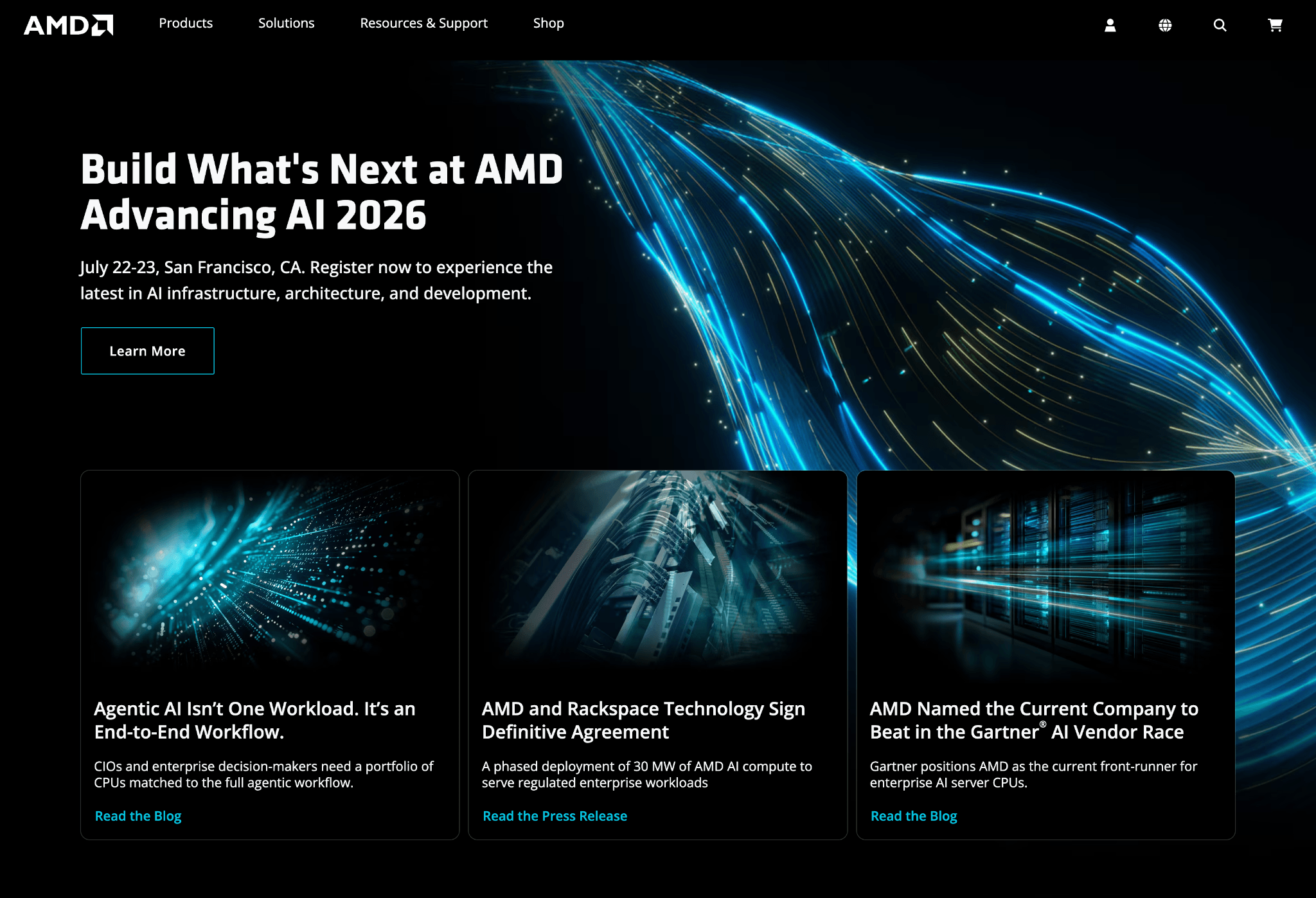
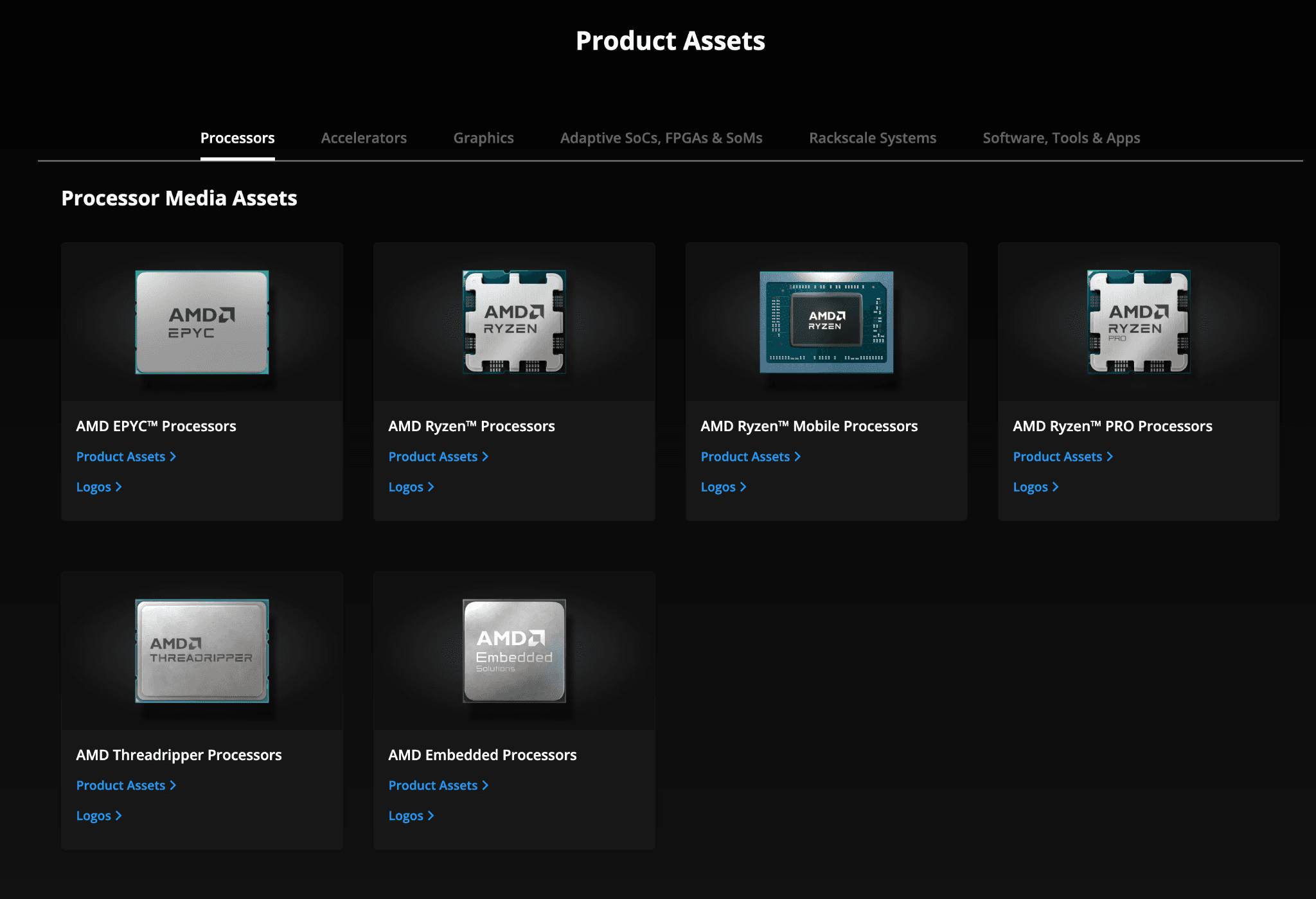
AMD’s core business is semiconductor chip design. Semiconductors can be understood as the basic building blocks of modern digital devices. AMD mainly designs chips used for computing, graphics processing, and high-performance data processing. One of AMD’s most important product categories is the CPU, or central processing unit. The CPU is the brain of a computer or server. It handles the main computing tasks of the system. AMD’s Ryzen series mainly serves personal computers, laptops, and workstations. Its EPYC series targets servers and data centers. EPYC has become increasingly important in recent years because cloud service providers, enterprise data centers, and AI infrastructure all need high-performance CPUs for data processing, model inference, and system coordination.
Another core AMD product category is the GPU, or graphics processing unit. GPUs were originally used mainly for gaming, image rendering, and graphics workloads. With the rise of artificial intelligence, they have also become important hardware for AI training and inference. AMD’s Radeon series mainly serves consumer graphics and workstation markets. Its Instinct series is designed for data centers and AI acceleration. This is one of the main reasons AMD has attracted stronger market attention in recent years. Beyond CPUs and GPUs, AMD also expanded into FPGAs and adaptive computing through its acquisition of Xilinx. An FPGA is a reconfigurable chip that is often used in industrial, automotive, communications, aerospace, and specialized high-performance computing scenarios. This has allowed AMD to expand from traditional CPUs and GPUs into a more complete high-performance computing platform.
AMD is not built around a single product. It provides a broader set of computing hardware and platforms. Its target markets include personal computers, gaming consoles, data centers, AI computing, embedded systems, industrial equipment, and automotive electronics. The chips used in major gaming consoles such as Sony PlayStation and Microsoft Xbox are also connected to AMD’s semiconductor design capabilities. As demand for AI, cloud computing, and high-performance computing continues to rise in 2026, AMD is no longer viewed only as a PC or gaming hardware company. It has become an important participant in global computing infrastructure.
How does AMD (Advanced Micro Devices) work?
AMD’s business model can be understood through three main layers, including chip design, external manufacturing, and market sales. First, AMD’s core capability lies in chip architecture design. It designs CPUs, GPUs, SoCs, FPGAs, and AI accelerators for different use cases. Personal computers need to balance performance, power consumption, and cost. Data centers need stronger multi-core computing power, energy efficiency, and stability. AI accelerators need to process large-scale matrix operations, model inference, and high-bandwidth data transfer.
Second, AMD operates under a fabless model. This means AMD mainly designs chips but does not manufacture its most advanced chips at scale by itself. AMD used to manufacture its own processors in its early years. After GlobalFoundries was spun off, the company gradually shifted toward external foundry manufacturing. Today, AMD relies heavily on advanced foundries such as TSMC to manufacture its key chips. This model allows AMD to focus its resources on design, product planning, and market expansion. The trade-off is that advanced process capacity, yield rates, and supply chain scheduling can directly affect shipment capacity. AMD has also adopted chiplet technology. In the past, many chip designs placed all major functions on one large monolithic chip. If a small area of the chip was damaged, the entire chip could become unusable. AMD’s chiplet approach breaks a large chip into multiple smaller functional units. These units are then connected through high-speed interconnect technology. This design improves manufacturing yield and gives AMD meaningful advantages in cost control, flexibility, and product scaling.
Third, AMD serves different customers through different product lines. Ryzen processors target consumers and enterprise PC markets. Radeon GPUs serve gaming, content creation, and workstation users. EPYC CPUs are mainly used by cloud service providers, enterprise data centers, and high-performance computing environments. Instinct AI accelerators are designed for AI training and inference. FPGAs and embedded chips serve industrial, automotive, communications, and specialized application markets. Through this structure and operating model, AMD has built three core product lines to meet different market needs:
In the AI cycle, data centers need more than GPUs. They also require CPUs, memory, networking, software tools, and system-level integration. AMD’s advantage is that it owns server CPUs, AI GPUs, embedded chips, and adaptive computing capabilities at the same time. This allows it to offer a more complete hardware portfolio for data center architecture. However, AI chip competition is not only about hardware specifications. It also depends on software ecosystems, developer tools, customer adoption costs, and supply chain stability. AMD continues to improve software tools such as ROCm to lower the barrier for enterprises and cloud customers that want to adopt AMD AI accelerators.
AMD (Advanced Micro Devices) market price & tokenomics
In traditional financial markets, AMD is a publicly listed company on Nasdaq. Driven by the AI infrastructure wave, AMD has delivered strong financial performance. Its full-year revenue reached a record high of $34.6 billion in 2025. In the first quarter of 2026, its data center revenue grew 57% year over year. AMD’s overall market capitalization is currently estimated to be between $680 billion and $900 billion. AMD itself is a listed stock, not a crypto token. Therefore, it does not have the tokenomics commonly seen in crypto projects, such as total token supply, circulating supply, unlock schedules, burn mechanisms, staking rewards, or governance voting.
AMD’s market value comes from the stock market. Traditional financial markets price AMD stock based on revenue, profit, gross margin, product competitiveness, customer demand, industry cycles, and future growth expectations. If AMD appears in the RWA or TradFi trading section in the form of AMDUSDT, users should understand that it is usually a USDT-denominated trading product that tracks the price performance of AMD stock. The core of this type of product is not a native on-chain token. Instead, it brings a real-world asset or traditional financial instrument into a digital asset trading interface. In other words, the reference asset behind AMDUSDT is AMD stock. For this reason, users need to focus on AMD’s company fundamentals, the semiconductor cycle, AI data center demand, the competitive landscape, supply chain conditions, and broader market risk. TradFi or RWA products such as AMDUSDT allow users who are familiar with USDT to gain more direct exposure to the price performance of traditional technology stocks.
In 2026, the market is mainly watching five key points around AMD. First, AI Agent workloads are increasing demand for high-performance CPUs. AMD CEO Lisa Su has also raised the company’s estimate for the server CPU total addressable market in 2030 to around $120 billion. This shows that data center CPUs remain an important growth area for AMD. Second, the MI450 accelerator and Helios AI supercluster are seen as major catalysts for the second half of 2026. Oracle’s 50,000-GPU Helios supercluster and Meta’s customized MI450 GPU deployment may become important sources of future revenue for AMD. However, AMD’s fabless model also means its key chips depend heavily on TSMC’s advanced processes. If 2nm or 3nm capacity becomes tight, AMD’s shipment pace and revenue upside may be directly affected. From a business structure perspective, data centers have become AMD’s largest and most profitable growth pillar. In the first quarter of 2026, AMD’s data center revenue grew 57% year over year to $5.8 billion.
Why do you invest in AMD (Advanced Micro Devices)?
AMD matters because it sits at the center of the global high-performance computing and AI infrastructure supply chain. Its products cover multiple key computing scenarios, from PC processors and gaming graphics chips to data center CPUs and AI accelerators. As cloud services, enterprise AI, AI Agents, and high-performance computing continue to expand, the market no longer sees AMD only as a traditional computer chip company. It is increasingly viewed as an important participant in the data center and AI computing supply chain. EPYC server CPUs and Instinct AI accelerators have become two of the most important product lines for investors who want to understand AMD’s growth potential.
From the perspective of RWA tokenization and TradFi trading, AMD is also meaningful because it is a traditional technology stock with clear business fundamentals. Products such as AMDUSDT allow users to access AMD stock-related price performance through USDT. General users should pay attention to AMD’s revenue growth, data center demand, AI chip competition, TSMC advanced process capacity, HBM memory supply, and product progress from competitors such as NVIDIA and Intel. In other words, AMD’s investment value is not based on short-term market trends alone. The key question is whether AMD can continue to expand its market position across AI, data centers, and high-performance computing cycles.
Explore the latest AMD (Advanced Micro Devices) price and live chart, trade AMD on FameEX, and access real-time market data! Get started now with a seamless trading experience!
Disclaimer: The information provided in this article is intended only for educational and reference purposes and should not be considered investment advice. Conduct your own research and seek advice from a professional financial advisor before making any investment decisions. FameEX is not liable for any direct or indirect losses incurred from the use of or reliance on the information in this article.