MU (Micron Technology) Token Price & Latest Live Chart
2026-06-22 10:52:42
What is MU (Micron Technology)?
In traditional finance (TradFi) and the technology sector, Micron Technology, Inc. is a U.S.-based multinational semiconductor giant founded in 1978. Its stock trades on Nasdaq under the ticker symbol MU. Micron is a global leader in memory and storage solutions. It is also the only remaining major U.S.-based memory manufacturer, which gives it a special position in the reshaping of global semiconductor supply chains and U.S. domestic manufacturing policy. In the global market, Micron is widely recognized as one of the “Big Three” memory chipmakers alongside South Korea’s Samsung Electronics and SK Hynix.
Micron’s history also reflects the broader evolution of the global memory industry from the early PC era to today’s AI infrastructure cycle. In its early years, the company focused mainly on DRAM memory. At that time, the memory market was highly competitive and driven by rapid technological iteration. DRAM is the essential short-term memory for computers and servers during active processing. Its demand changes with cycles in PCs, enterprise servers, and consumer electronics. As a result, Micron has operated in a capital-intensive industry with high technical barriers and clear pricing cycles since its early development. After entering the 2000s, Micron gradually expanded from a pure DRAM supplier into a more complete memory and storage company. It once partnered with Intel to establish IM Flash Technologies, which helped advance NAND Flash technology. It also owned the consumer storage brand Lexar and sold memory and SSD products to retail users through the Crucial brand. These developments allowed Micron to serve not only enterprises and data centers, but also PCs, gaming, consumer electronics, and personal storage markets.
How does MU (Micron Technology) work?
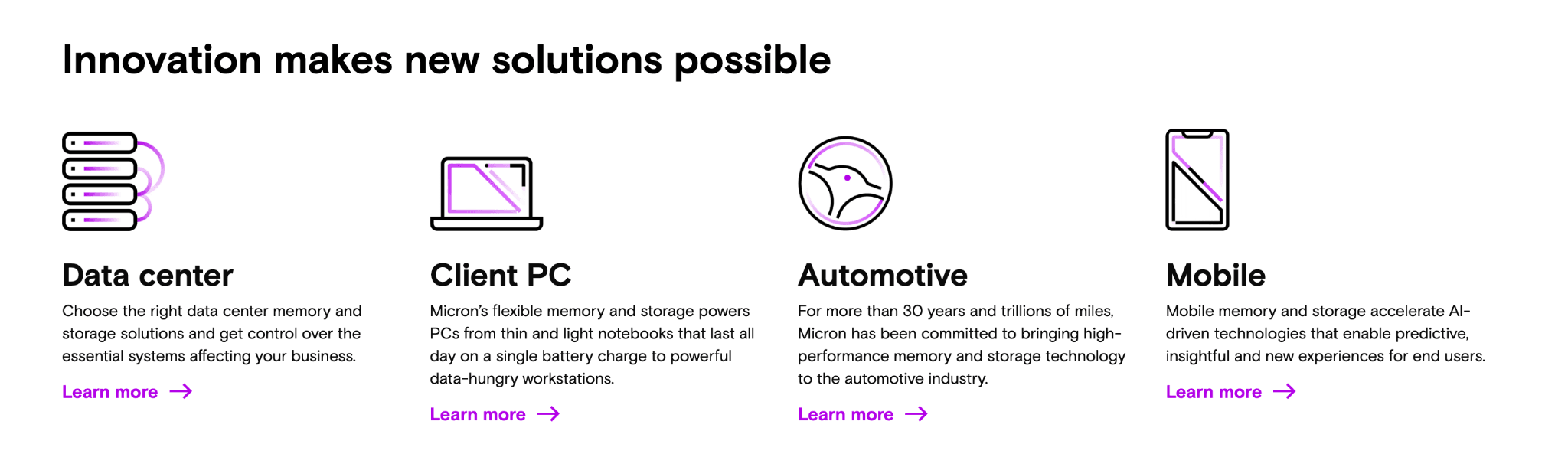
Micron’s core business is the design, manufacturing, and sale of memory and storage products. Its key products include DRAM, NAND Flash, HBM, and SSDs. These products are not end-user devices that most consumers interact with every day. However, they are essential components behind smartphones, personal computers, cloud servers, AI data centers, automotive electronics, and industrial equipment. If chips are the computing core of the digital world, memory is the critical infrastructure that allows data to be read, stored temporarily, and processed at high speed. AI model training, cloud computing, GPU servers, and large-scale data centers all require massive amounts of high-speed memory. This is why Micron is gradually shifting from a traditional memory supplier to an important participant in the AI infrastructure supply chain. Micron’s core products can be divided into several major categories:
1. Memory (DRAM) and Storage (NAND Flash)
- DRAM, or dynamic random-access memory, is responsible for temporary data storage when a computer or server is processing tasks. The speed of DRAM has a direct impact on how smoothly a system handles multitasking and high-performance workloads.
- NAND Flash is responsible for long-term data storage. It is the core component of solid-state drives (SSDs) and smartphone storage.
2. The Computing Engine of the AI Era: High Bandwidth Memory (HBM)
With the rapid growth of large language models and AI data centers, traditional memory bandwidth has become a bottleneck for GPU computing, including Nvidia-based systems. Micron’s key technology in this area is HBM, or High Bandwidth Memory. HBM works by vertically stacking multiple layers of DRAM dies in a 3D structure, then connecting them to processors through advanced packaging technology. This structure provides extremely high data bandwidth. This architecture delivers extremely high data transfer bandwidth. It works like expanding a narrow single-lane road into a multi-lane expressway, allowing massive volumes of data to move between memory and processors at much higher speeds. Therefore, HBM has become a strategic infrastructure layer for modern data centers that train and run AI models.
3. High Capital Intensity and Process Technology
The memory industry has extremely high entry barriers. Micron operates a global manufacturing network through fabs in the United States, Taiwan, Singapore, Japan, and India. Chip manufacturing requires continuous advancement toward more advanced process nodes, such as 1-gamma DRAM and G9 NAND. This also requires tens of billions of dollars in annual capital expenditure to upgrade equipment and expand production capacity.
From a business structure perspective, Micron serves a wide range of markets. Its customers include cloud data centers, enterprise servers, PCs, smartphones, automotive systems, industrial equipment, and embedded systems. Among these areas, the growth of AI data centers and HBM demand has become one of the main reasons behind Micron’s rising revenue profile and stronger market attention in recent years. However, the memory industry is still highly cyclical by nature. When demand is strong and supply is tight, DRAM and NAND prices may rise. This can improve a company’s gross margin. When capacity expands too quickly, or end-market demand slows, pricing can reverse, and profitability may come under pressure. For this reason, Micron’s business model is supported by long-term AI demand, but it is still affected by semiconductor cycles.
MU (Micron Technology) market price & tokenomics
MU usually refers to Micron Technology, Inc., whose stock trades on Nasdaq under the ticker symbol MU. In traditional financial markets, MU represents Micron’s common stock. On crypto trading platforms or in RWA-related TradFi products, the MUUSDT perpetual contract usually refers to an equity perpetual contract that tracks the price performance of Micron Technology stock. It does not represent actual ownership of Micron shares.
The trading underlying assets of MU on crypto trading platforms reflects the growing convergence between RWA products and equity derivatives. In the past, users who wanted to trade U.S. stocks usually needed a traditional brokerage account. They were also subject to U.S. stock market hours, regional rules, and funding channel restrictions. Equity perpetual contracts and tokenized stock products attempt to provide exposure to traditional stock prices through margin trading and stablecoin settlement, which are already familiar to crypto users. This type of asset offers several potential advantages:
- First, it allows crypto users to gain exposure to the price movements of traditional equity assets through stablecoins such as USDT. Examples include MU, NVDA, TSLA, and other U.S. stocks.
- Second, it expands RWA beyond bonds, funds, and real estate into equities and equity derivatives. This means traditional financial assets are being repackaged into forms that are more suitable for crypto market trading.
- Third, it allows the market to observe the risk appetite for crypto assets and traditional technology stocks within the same trading environment. AI stocks, semiconductor stocks, and crypto assets may sometimes be influenced by similar macro liquidity conditions and technology growth narratives.
However, users must clearly understand that these products are not the same as holding real stocks. They should be understood as trading contracts that track stock prices. The risks of these products do not only come from movements in MU’s stock price. They also come from leverage, funding rates, contract liquidity, platform rules, and broader market volatility.
According to recent reports, Micron surpassed a $1 trillion market capitalization for the first time on May 26, 2026. Its stock jumped 19% that day, driven mainly by surging demand for memory chips from AI servers and agentic AI workloads. The rally was also supported by UBS, raising its price target sharply from $535 to $1,625. The market increasingly believes that AI has changed the supply-demand structure of the memory industry. A global memory shortage has also given major suppliers such as Micron, SK Hynix, and Samsung stronger pricing power. Since the beginning of 2026, Micron’s stock has more than tripled. In just a few weeks, its market value climbed from above $700 billion to $1 trillion. This reflects how investors are reassessing Micron’s long-term value in AI memory and the advanced semiconductor supply chain.
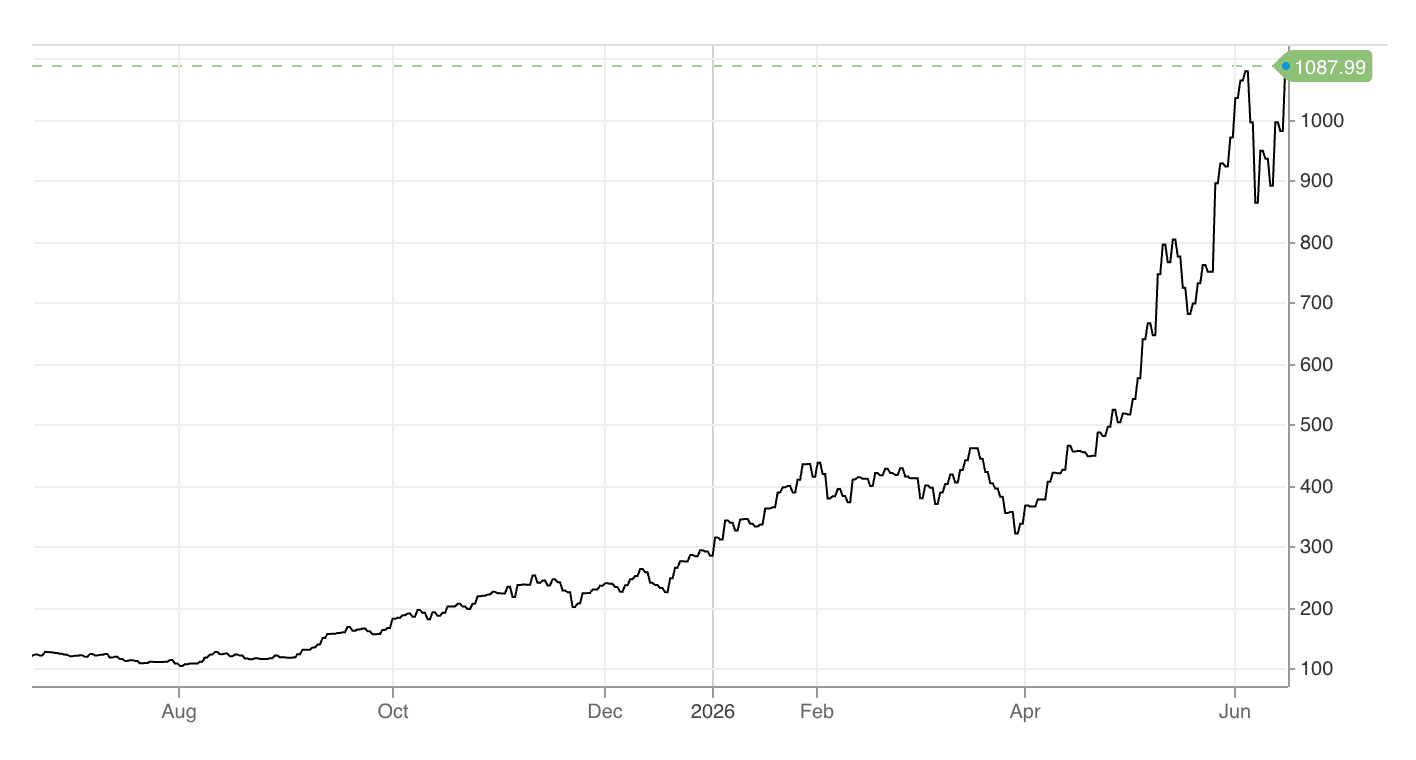
MU 2026 Price Rally Chart
Why do you invest in MU (Micron Technology)?
The core reason is that Micron stands at the 2026 intersection of AI infrastructure expansion and a reshaping memory cycle. In the past, Micron was mainly viewed as a classic memory cycle stock. Its revenue and earnings were highly affected by DRAM and NAND supply-demand conditions. Today, the rapid growth of AI data centers, GPU servers, and large-scale model computing has made High Bandwidth Memory (HBM) a key component in AI computing architecture. As one of the world’s three major memory manufacturers, Micron has a full product portfolio across DRAM, NAND, HBM, and SSDs. This allows it to benefit directly from rising demand for high-performance memory and storage solutions in AI servers. From this perspective, MU’s investment logic is not just about being a semiconductor stock or an AI-related stock. It reflects the market’s combined pricing of AI memory demand, advanced process capabilities, supply chain positioning, and long-term data center expansion.
However, evaluating MU should not be about chasing short-term price performance. The key question is whether Micron can turn AI memory demand into sustainable revenue, margins, and customer orders. If HBM demand remains strong, DRAM and NAND supply-demand conditions stay healthy, and Micron maintains its technology and supply position against Samsung and SK Hynix, MU’s fundamentals may continue to receive support. At the same time, Micron’s large-scale capital expenditure shows that the company is investing in future capacity and technology upgrades. This also brings risks related to cash flow, capacity utilization, and a potential reversal in the semiconductor cycle.
Explore the latest MU (Micron Technology) price and live chart, trade MU on FameEX, and access real-time market data! Get started now with a seamless trading experience!
Disclaimer: The information provided in this article is intended only for educational and reference purposes and should not be considered investment advice. Conduct your own research and seek advice from a professional financial advisor before making any investment decisions. FameEX is not liable for any direct or indirect losses incurred from the use of or reliance on the information in this article.