ORCL (Oracle Corp) Token Price & Latest Live Chart
2026-05-26 02:22:45
What is ORCL (Oracle Corp)?
In the main architecture of today’s digital world, data is the most critical asset. Oracle Corporation was founded in 1977 and is one of the world’s leading companies in managing, storing, and applying enterprise data. If the operation of a modern enterprise is compared to a highly automated factory, Oracle’s core business is to build the most stable “data foundation” for that factory and provide the “core operating system” that keeps the entire structure running.
Core Business Pillars
Oracle is not a consumer-facing technology company like Apple or Google. Its customers are primarily large enterprises, government agencies, healthcare systems, and financial institutions worldwide. Its core products and services can be understood across three layers:
- Database and Cloud Infrastructure (Database & OCI): This is the foundation of Oracle’s business. The company pioneered commercial SQL relational databases, allowing enterprises to store massive amounts of information in a structured way. As technology evolved, these capabilities have been upgraded into Oracle Cloud Infrastructure, or OCI, which now competes directly with traditional cloud giants such as Microsoft Azure and Amazon AWS.
- Enterprise Applications: Enterprises cannot rely on databases alone. They also need tools to handle daily business operations. Oracle provides a comprehensive software suite that includes ERP, or enterprise resource planning for finance and operations management; HCM, or human capital management for employees and personnel; and SCM, or supply chain management.
- Industry-Specific Solutions: Oracle also provides specialized systems for industries that require a high degree of customization. A key example is Oracle Health, built after Oracle fully acquired healthcare IT giant Cerner in 2022. The platform is designed to manage electronic health record systems for large hospital networks around the world.
How does ORCL (Oracle Corp) work?
In the Traditional Finance market, as TradFi, ORCL represents the publicly traded stock ticker of Oracle Corporation on the New York Stock Exchange. Oracle is one of the world’s largest enterprise technology companies. For users without a technology or finance background, ORCL can be understood as a “core data toll collector” for modern business society. From the core settlement systems of major banks to cross-border supply chain management and large electronic health record systems, many critical operations rely heavily on services provided by Oracle.
ORCL is classified as a mega-cap technology blue-chip stock. It is an important component of both the S&P 500 and the S&P 100. Unlike high-growth technology companies that depend heavily on market sentiment or remain in early-stage losses, ORCL is supported by strong profitability and extremely high customer retention. This gives it a dual profile in the market. It carries the defensive qualities of a value stock while also retaining the growth flexibility of a technology stock.
In the past, Oracle’s business model focused on selling expensive on-premise software licenses to enterprises. Companies would purchase the license and install the software in their own data centers. This model made revenue more sensitive to economic cycles. When business conditions weakened, enterprises could delay new purchases. Today, ORCL has successfully transformed toward a cloud subscription model. Customers no longer need to pay a large upfront license fee. Instead, they pay monthly or annually based on their usage of OCI and software services. For investors, this means ORCL’s revenue has become more recurring and more predictable.
In the cloud computing market, Amazon AWS, Microsoft Azure, and Google GCP are the traditional big three hyperscalers. ORCL has adopted a more open strategy based on multicloud connectivity and chip neutrality. It has built deep interoperability agreements with Microsoft, Google, and Amazon, allowing Oracle databases to be embedded directly inside rival cloud platforms. This addresses a major concern for multinational enterprises, which often fear being locked into a single cloud provider. It also makes it possible for data to remain with Oracle while computing power can be allocated across major cloud platforms. This strategy has created significant incremental market opportunities for ORCL.
ORCL (Oracle Corp) market price & tokenomics
Under the TradFi ecosystem, ORCL is a mature technology stock listed on the New York Stock Exchange. Its market price directly reflects how global investment institutions value Oracle’s cloud business growth, software profitability, and AI computing infrastructure strategy. This is a strictly regulated market with limited trading hours. Investors also receive shareholder rights, including dividends and voting rights. As financial technology continues to evolve, RWA tokenization has created a bridge between traditional equities and blockchain networks. This allows the value of ORCL to exist in tokenized form within the Web3 ecosystem.
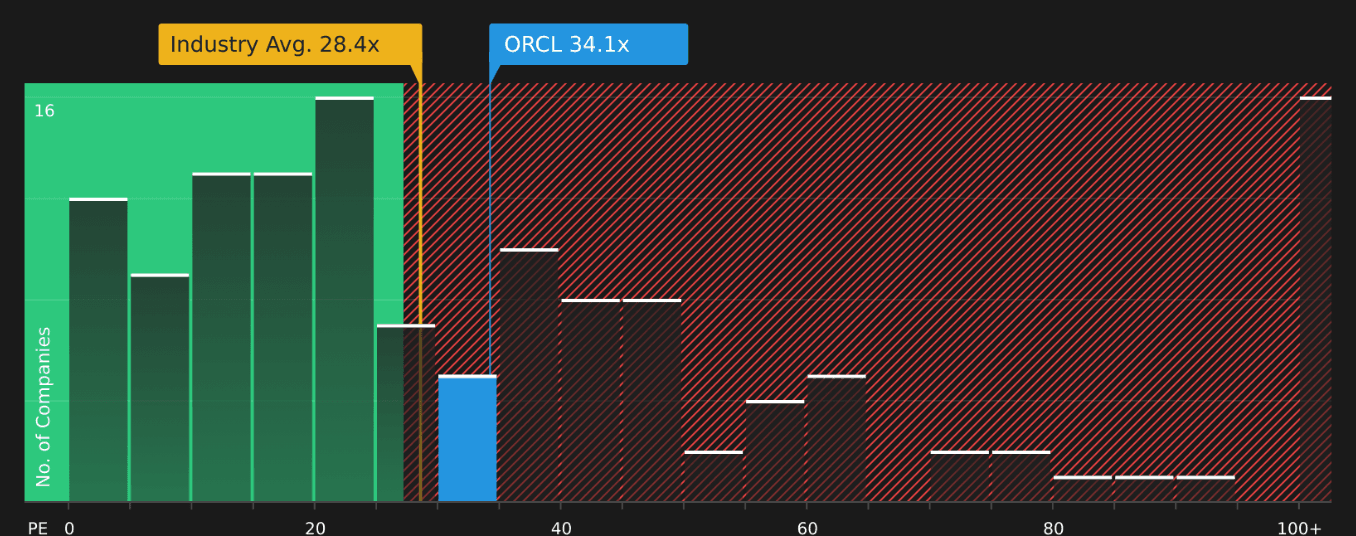
ORCL P/E Ratio as at May 2026
This type of RWA token is not a virtual asset detached from the underlying real-world asset. Instead, it is usually issued through a compliant custody structure, with real NYSE-listed shares held as underlying collateral to support a 1:1 digital mirror token. For investors, this creates two major changes. The first is a breakthrough in trading availability. On-chain tokens are not restricted by U.S. stock market trading hours and can provide around-the-clock liquidity. The second is asset composability. These tokens can potentially be used as collateral within DeFi protocols, creating capital flexibility that traditional stocks in brokerage accounts usually cannot provide. This model preserves the intrinsic value anchor of the asset while expanding global access to large enterprise growth.
Beyond these financial instruments, there are also derivatives linked to ORCL, such as perpetual contracts. Unlike RWA spot products, these contracts do not represent ownership of any equity. They are leveraged trading instruments based purely on price movements. Perpetual contracts use a funding rate mechanism to prevent the contract price from deviating to ORCL’s real stock price. If the contract price trades above the spot price, long positions pay funding fees to short positions. If the reverse happens, short positions pay long positions. This mechanism helps guide the contract price back toward balance. Since these instruments often involve leverage, they can amplify potential gains but also carry very high risk. If the market price reaches the preset margin threshold, the position may face forced liquidation. Therefore, these derivatives are more suitable for short-term risk hedging than long-term asset allocation.
Why do you invest in ORCL (Oracle Corp)?
Unlike technology startups that pursue explosive growth without solid profitability, Oracle’s value is built on deep business stickiness. The core operating systems of large financial institutions, government agencies, and multinational supply chains are often deeply embedded in Oracle’s database architecture. This high switching cost gives the company strong defensive qualities. Even when macroeconomic conditions become unstable and enterprises reduce budgets, renewals and maintenance for these critical infrastructure systems remain essential spending. This gives ORCL a degree of countercyclical resilience similar to utility-oriented infrastructure businesses.
Moreover, the market also views ORCL as a potential infrastructure beneficiary of the AI revolution. As AI model training drives exponential demand for data processing and high-speed computing power, Oracle Cloud Infrastructure has evolved from a traditional software licensing business into an enterprise-grade AI compute hosting platform. Investors are focused on how Oracle can convert decades of data management experience into cloud subscription revenue. This transformation creates a long-term growth curve for the company. The current cloud subscription model not only improves revenue visibility but also helps Oracle reduce its reliance on legacy hardware sales and optimize its margin structure. In uncertain capital market, this visible, stable, and scalable revenue base makes ORCL an important technology allocation target for both conservative and growth-oriented capital. Investors are not only looking at the narrative of technological innovation. They are also assessing how deeply Oracle’s technology architecture is embedded in the foundation of modern society, and how well the company can balance stable profitability with continuous technological iteration.
Explore the latest ORCL (Oracle Corp) price and live chart, trade ORCL on FameEX, and access real-time market data! Get started now with a seamless trading experience!
Disclaimer: The information provided in this article is intended only for educational and reference purposes and should not be considered investment advice. Conduct your own research and seek advice from a professional financial advisor before making any investment decisions. FameEX is not liable for any direct or indirect losses incurred from the use of or reliance on the information in this article.