FameEX Futures Trial Fund Rules & FAQ
2026-07-07 06:28:49FameEX Futures Trial Funds are available in two forms: Trial Fund Coupons and Effective Trial Fund. Coupons are shown in the 'Rewards Center.' Once users meet the requirements and claim them, the Trial Funds will be automatically credited to their Futures Account and become effective as Trial Fund balances.
Q1: What Are FameEX Futures Trial Funds?
The FameEX Futures Trial Fund can only be used in trading assets for Futures. It cannot be withdrawn, transferred, or used in other trading scenarios.
The Futures Trial Funds become effective automatically after they are claimed. They will be credited directly to the user’s Futures Account. Users can use them together with their own funds under cross-margin. They can also be used to offset trading fees, funding fees, and realized losses based on a fixed deduction ratio. Trial Funds cannot be withdrawn, but profits generated from using Trial Funds can be withdrawn.
Trial Funds must be used together with the user’s own funds. The system will automatically calculate the current usable Trial Fund amount based on the fixed deduction ratio set for the coupons. When the user’s own funds change due to positions, open orders, transfers, or isolated-margin operations, the maximum Trial Fund amount available for a single order will also change accordingly.
Q2: How Can I Get and Claim Trial Funds?
(1) Claim Coupons: Trial Funds can be earned through FameEX platform events and are issued as ‘Trial Fund Coupons’ to your [Rewards Center] - [My Rewards].
- WEB: Go to Homepage → Click ‘Rewards Center’ at the top → ‘My Rewards.’
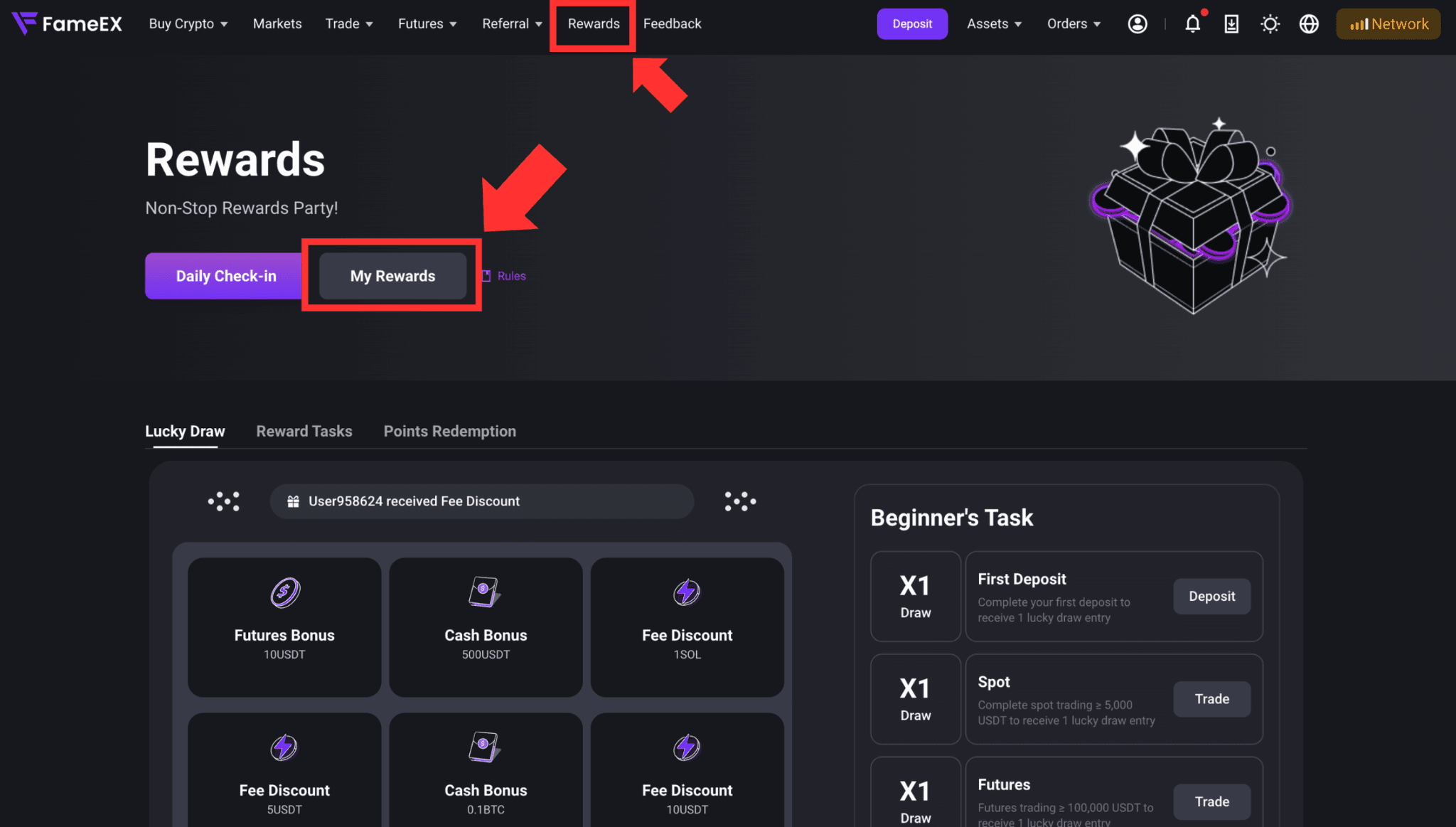
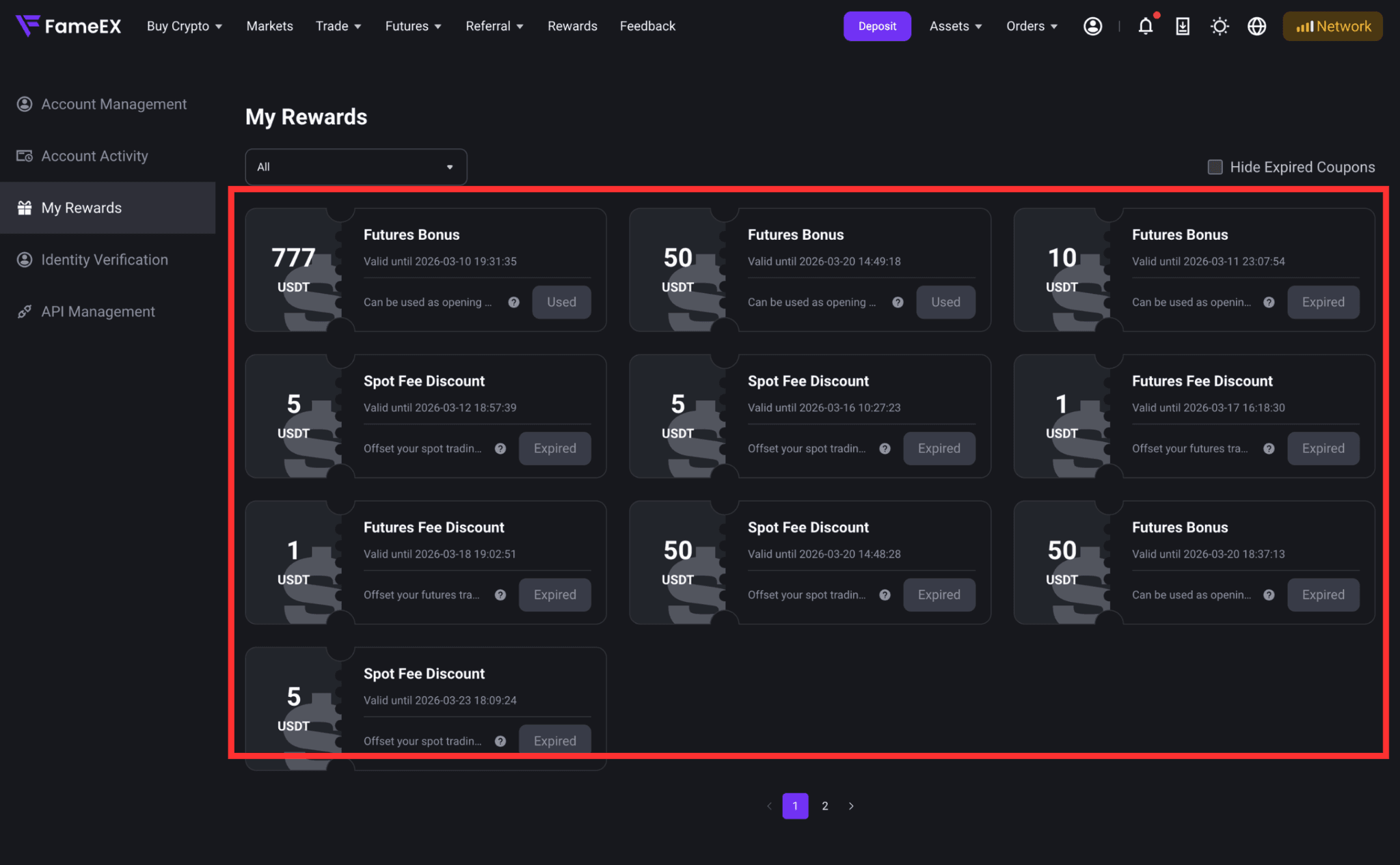
- APP: Open the app → Click the ‘Profile Icon’ in the top left → ‘Rewards Center’ → ‘My Rewards.
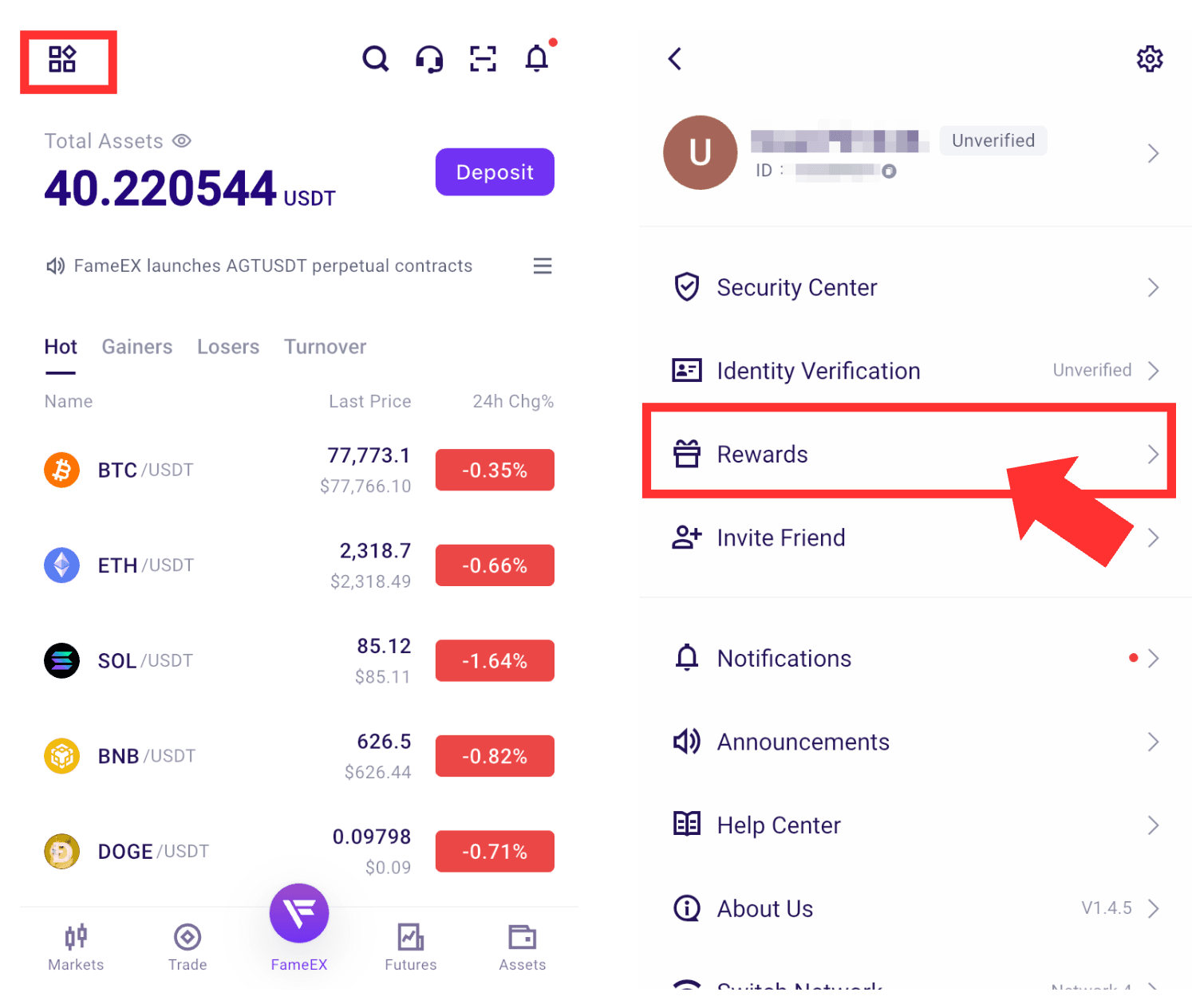
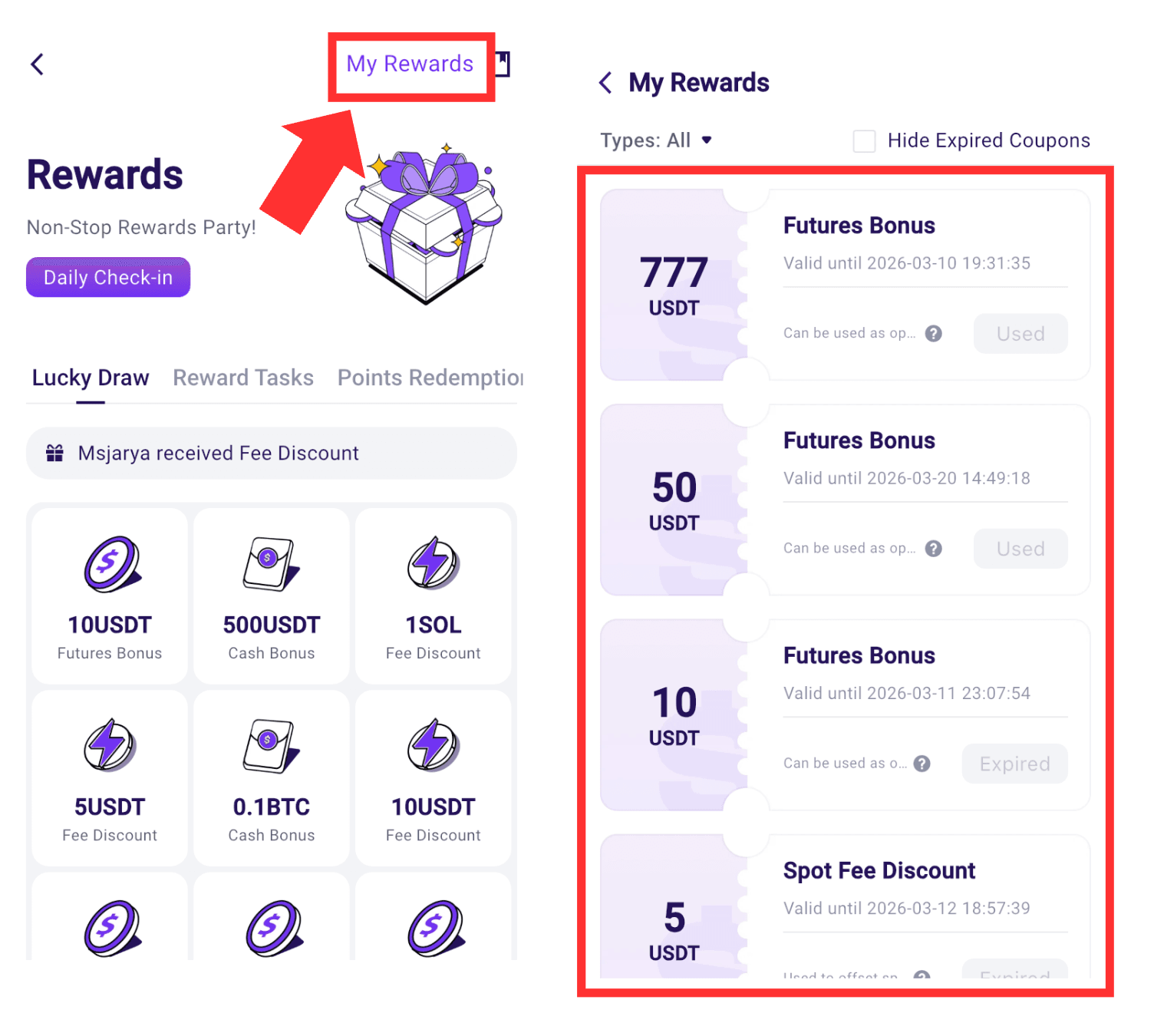
(2) Claim Your Trial Funds: After users click “Claim,” the system will automatically check the coupon’s claim requirements and risk control status. If all requirements are met, the Trial Funds will be credited directly to the Futures Account and become effective immediately.
If the user has not completed identity verification, the system will guide the user to complete verification first. If the user’s own funds are insufficient, the system will guide the user to transfer funds or add more funds to the account. If the account has positions or open orders that do not meet the risk control requirements, the system will show the specific reason.
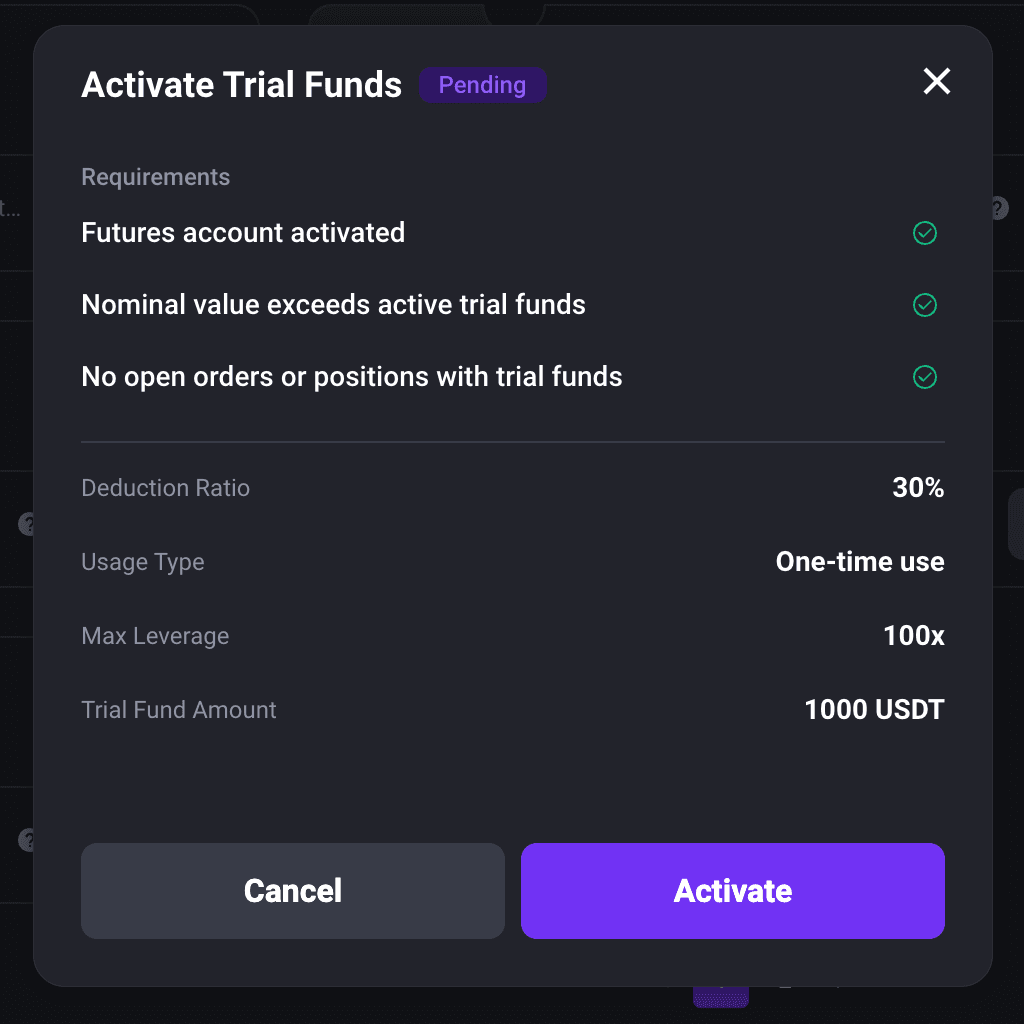
(3) How to Check Your Trial Fund Details & Conditions? Each coupon specifies its amount, validity period, fixed deduction ratio, usage type (One-time or Reusable), and requirements. Some coupons require Primary Identity Verification (KYC) before activation.
After a coupon is successfully claimed, users can view the total Trial Fund amount, used amount, remaining amount, validity period, deduction ratio, and usage status in the Futures Account or on the Trial Fund details page.
(4) Trial Funds Transaction History:
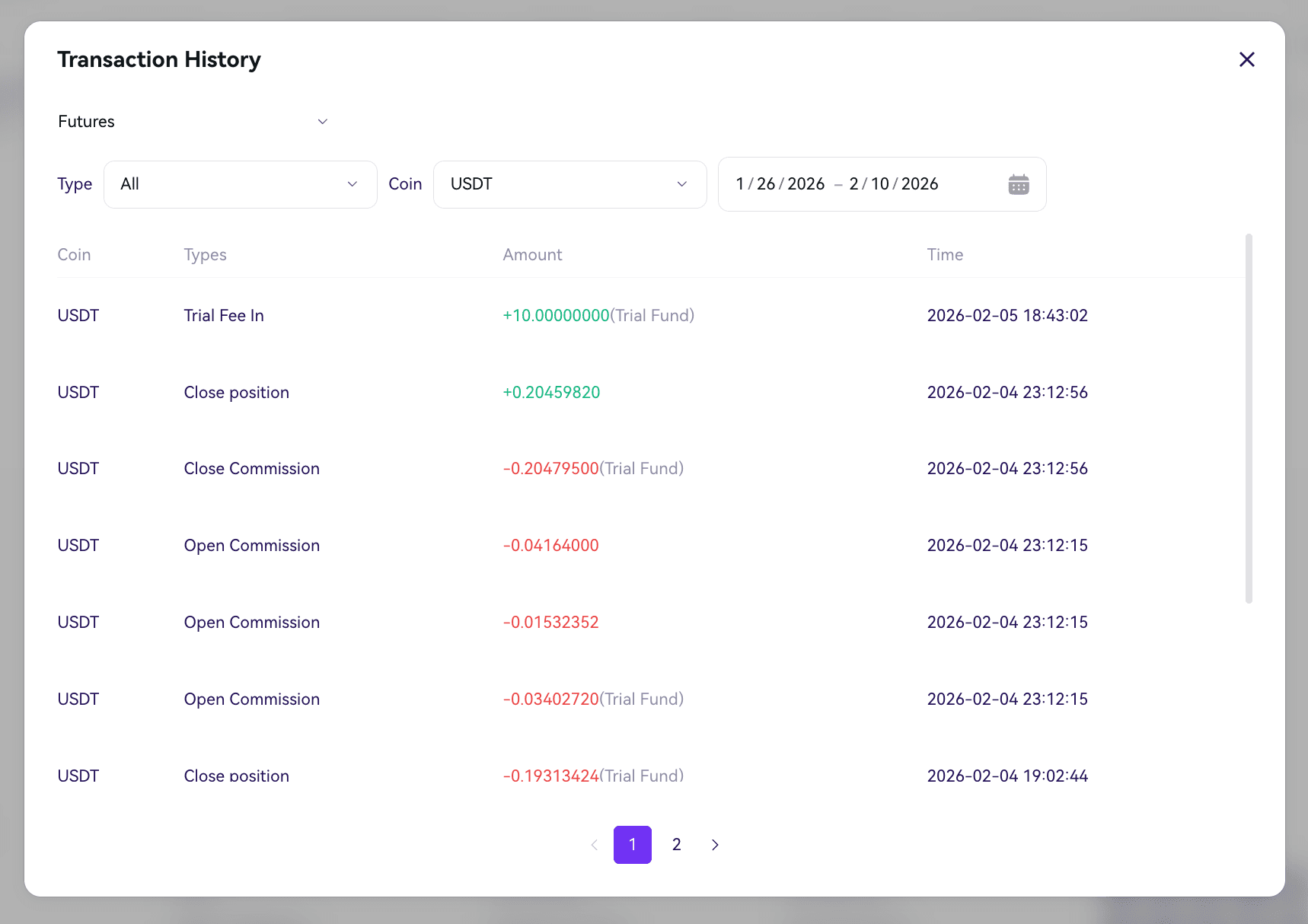
You can view details in [Futures Account] - [Transaction History]. Each trial fund entry is marked with a unique ‘Coupon ID.’ The fund transaction records clearly will show the amounts of fees, funding fees, or losses separately by the trial fund and the user’s own funds. This allows users to easily check how the trial fund was applied and deducted.
Q3: What is the Fixed Deduction Ratio in Trial Funds?
The fixed deduction ratio refers to the allocation rule between Trial Funds and the user’s own funds when opening positions and paying trading fees, funding fees, and offsetting losses. The system will allocate the usage and deductions of the user’s own funds and Trial Funds based on the fixed deduction ratio set for the coupon.
For example, if a Trial Fund has a 30% deduction ratio, the Trial Fund can cover up to 30% of the eligible amount in a trade when all conditions are met. The remaining portion will be covered by the user’s own funds.
The fixed deduction ratio mainly applies to the following scenarios:
- Opening Margin: The system calculates the maximum Trial Fund amount that can be used for the order based on the user’s available own funds and the deduction ratio.
- Fee Sharing: Trading fees will be shared by Trial Funds and the user’s own funds based on the fixed deduction ratio.
- Funding fee sharing: When funding fees are incurred, the system will deduct them based on the fixed deduction ratio.
- Loss Offset: When a position is closed at a loss, the system will use Trial Funds and the user’s own funds to cover the loss based on the fixed deduction ratio.
*Example: A user’s stop-loss order triggers with 10 USDT trading fee, 10 USDT funding fee, and closes with 100 USDT losses. The user’s account has 100 USDT in the user's own funds and 30 USDT trial fund with the 30% deduction ratio. The details of the transaction records are as follows:
- Trading Fee (10 USDT): 7 USDT deducted from own funds; 3 USDT from trial funds.
- Funding Fee (10 USDT): 7 USDT deducted from own funds; 3 USDT from trial funds.
- Total Losses (100 USDT): The trial fund covers 30 USDT (100 × 30%) based on the ratio. Trial Funds cover 30 USDT, while the user’s own funds cover 70 USDT.
If the Trial Fund balance is not enough to cover its allocated amount, the remaining amount will be covered by the user’s own funds. If the user’s own funds are also insufficient, the order may fail, the margin may become insufficient, or the position may face liquidation risk.
Q4: What Types of Trial Funds Are Available?
To support different campaign and trading needs, FameEX Futures Trial Funds may be available in different usage types. Users can check the coupon’s usage type, validity period, deduction ratio, and usage restrictions on the claim page.
- One-time Use Trial Fund: Limited to a single use. Once a position using this trial fund is closed (partially or fully), the remaining balance is reclaimed and the trial fund becomes invalid.
- Reusable Trial Funds: These can be used multiple times during the validity period. If an order is canceled, remains unfilled, or does not actually use part of the occupied amount, the unused amount will be released back to the available Trial Fund balance. It can then be used for future trades.
For more information about Reusable Trial Funds, please refer to: https://www.fameex.com/en-US/support/rewards/how-to-use-reusable-trial-fund
If the user closes a position in several partial closes, the system will not immediately recover the entire Trial Fund amount. Instead, it will deduct the corresponding amount based on the deduction ratio after each execution. After the related position is fully closed, the remaining unused Trial Funds will be recovered according to the Trial Fund type and campaign rules.
Q5: How Do I Use Trial Funds?
Futures Trial Funds become effective once they are claimed. The system will automatically apply them to eligible futures trades under cross margin. Each order can use only one Trial Fund. Users cannot manually select multiple coupons or combine several coupons for the same order.
Trial Funds can be used to offset margin, trading fees, funding fees, and realized losses. Related fees and losses will be shared by Trial Funds and real funds based on the fixed deduction ratio. If the Trial Fund balance is insufficient, the remaining amount will be covered by real funds automatically. If real funds are also insufficient, the order may fail, or the position may be liquidated.
Trial Fund usage restrictions:
- Trial Funds can only be used under cross margin.
- Trial Funds only support the one-way position. Users cannot open new opposite-direction positions.
- Users cannot open a new isolated margin while holding Trial Funds.
- Existing isolated margin before claiming Trial Funds can still be added, reduced, or closed. However, isolated margins and holding positions will not be included in the Effective Trial Fund amount calculation.
- Trial Funds must be used together with the user’s own funds. When the user’s own funds decrease, the maximum usable Trial Fund amount will also decrease.
Q6: How Is the Effective Trial Fund Amount Calculated?
After Trial Funds are claimed, the Effective Trial Fund remains in the account. However, the maximum Effective Trial Fund amount that can be used for a single order will change based on the user’s own funds in the account.
When the user’s own funds increase, the Trial Fund amount that can be matched for use may increase. When the user’s own funds decrease due to open order occupied, position occupation, unrealized losses, transfers to isolated margin, or other operations, the Effective Trial Fund amount will also decrease.
- The Trial Fund opening position calculation rules are as follows:
Effective Trial Funds = Total Trial Fund − Trial Funds occupied by positions − Trial Funds frozen by open orders
Maximum usable Trial Fund limit of the account = Current available own funds in cross margin ÷ (1 − deduction ratio) − Current available own funds in cross margin
Trial Funds deductible for this order = min (Maximum usable Trial Fund limit, effective Trial Funds)
If the own funds required are less than or equal to the available own funds in the account, the order can be placed successfully. If the own funds required exceed the available own funds in the account, the system will suspend the order and show the following message: “Insufficient own funds. Due to the Trial Fund deduction rules, the position cannot be opened. Please transfer funds and try again.”
Example 1: How do trial funds contribute to the available margin when open positions?
Let’s suppose a user has 100 USDT as the user's own funds and 100 USDT in trial funds with the 50% deduction ratio.
- Calculation: A 50% deduction ratio means trial funds can cover 50% of the total margin ( 1:1 match between the user’s own funds and trial funds).
- Effective Amount: 100 USDT in the user’s own funds can match 100 USDT in trial funds.
- Result: The total available margin for opening a position is 100 USDT (Own Funds) + 100 USDT (Trial Funds) = 200 USDT.
Example 2: How are trading fees shared proportionally?
Let’s suppose a user opens a position with 200 USDT margin (including 100 USDT own funds + 100 USDT trial funds), 50% deduction ratio, and 1% fee rate.
- Total Fee: 200 USDT × 1% = 2 USDT
- Allocation: Based on the 50% ratio, the system deducts 1 USDT from trial funds and 1 USDT from the user’s own funds.
- Position after deduction: The position remains with 198 USDT (99 USDT own funds + 99 USDT trial funds)
*Note: If the trial fund balance is insufficient to cover its shared portion, the remaining fee will be automatically covered by the user’s own funds.
Example 3: How are losses shared proportionally after closing a position?
Let’s suppose a user holds the 200 USDT position (including 100 USDT own funds + 100 USDT trial funds) with the 50% deduction ratio. The position is closed with 100 USDT losses.
- Loss Covered by Trial Funds: 100 USDT (Loss) × 50% (Ratio) = 50 USDT
- Loss Covered by User’s Own Funds: 100 USDT - 50 USDT = 50 USDT.
- Remaining Balance After Closing: The system will release the remaining 50 USDT in the user’s own funds and 50 USDT in trial funds. If using the one-time use trial fund, the released 50 USDT trial funds will be invalid.
*Note: Any profits generated from the trade are settled 100% in the user’s own funds.
Q7: Why Can’t I Open a Position Despite Having Trial Funds?
This usually occurs because the user’s own funds in the account are insufficient to meet the Trial Fund deduction ratio requirement.
Trial Funds must be used together with the user’s own funds at a fixed deduction ratio. Even if the user still has the effective Trial Fund, the system will reduce the maximum Trial Fund amount available for the order if the user’s own available funds are insufficient. The same applies when the user’s own funds are occupied by positions, open orders, or isolated-margins.
Example:
A user attempts to open 20,000 USDT position (including 19,990 USDT own funds and 10 USDT trial funds) with the 50% deduction ratio and the 1% fee rate.
- Total Fee: 20,000 USDT × 1% = 200 USDT
- Allocation: At the 50% ratio, the trial fund should cover 100 USDT, and the user’s own funds should cover 100 USDT.
- Actual Deduction: Since only 10 USDT in trial funds remain, the system will exhaust the entire 10 USDT.
- Deficit Coverage: The remaining unpaid fee of 190 USDT must be covered by the user’s own funds.
- Reason for Failure: If your own fund balance (after deducting the opening margin) is insufficient to pay the 190 USDT fee, the position cannot be successfully opened.
Q8: Why Does My Available Trial Fund Amount Decrease Even Though I Did Not Do Anything?
This is a normal situation. The available Trial Fund amount is calculated in real time based on the user’s own funds in the account. If the user’s own funds decrease due to open order occupied, unrealized losses, position increases, fund transfers, or isolated-margin operations, the usable Trial Fund amount will also decrease automatically.
For example, if the user transfers funds from cross margin to isolated margin or adds margin to an isolated-margin position, the own funds in the account will decrease. Since funds are not included in the Trial Fund calculation, the available Trial Fund amount may decrease or even show as 0.
To restore the available Trial Fund amount, users can transfer more of their own funds to cross margin, close positions to release margin, cancel open orders, or transfer funds from isolated margin back to cross margin.
Q9: Will Frozen Trial Funds Be Returned After I Cancel an Order?
Yes. If Trial Funds are frozen when an order is placed and are not actually used by an executed trade, they will be returned to the available Trial Fund balance after the order is fully canceled or released by the system.
If a limit order is partially filled, the system will deduct the corresponding Trial Fund amount based on the actual executed margin. The frozen Trial Funds for the unfilled amount will be released automatically. No extra amount will be deducted.
If market fluctuations cause the frozen Trial Fund amount to become insufficient, the order may fail to match. In this case, all frozen amounts will be released. No funds will be lost.
Q10: What Happens to Trial Funds When a Position Is Closed?
If the user closes a position in several partial closes, the system will not immediately release or recover the entire Trial Fund amount. Instead, it will deduct the corresponding amount based on the actual executed ratio. During the holding period, Trial Funds can still be used to offset fees and losses normally.
After the related position is fully closed, the system will release the remaining Trial Funds that have not been deducted from the position. The remaining amount will then be recovered according to the Trial Fund type, validity period, and campaign rules.
If the Trial Funds are reusable Trial Funds and are still within the validity period, the unused amount may return to the available Trial Fund balance and continue to be used for future trades. If the Trial Funds are one-time Trial Funds, the remaining amount will become invalid or be recovered after the position is fully closed.
Q11: What Happens After Trial Funds Expire?
After the trial funds expire, the system will process them based on whether there are still positions using them.
If there are no positions using the Trial Funds, they will be recovered directly by the system after expiration.
If there are positions using the Trial Funds, the Trial Funds can still be used for deductions during the holding period. After the user fully closes the positions, the system will automatically recover the remaining unused Trial Fund amount.
Trial Fund expiration and recovery will not deduct any extra amount from the user’s own funds. Trial Funds that are normally recovered after expiration or after the position is closed usually cannot be restored. If users believe there has been an abnormal recovery, they may contact customer support for verification.
Q12: Under What Conditions Does the Trial Fund Expire or Become invalid?
The validity of Trial Funds may be affected by the validity period, trading status, and account operations. Before using Trial Funds, users should understand the following situations that may cause Trial Funds to expire or be recovered.
- Expiration: If Trial Funds are not used within the validity period and no positions are using them, the system will automatically recover them after expiration. If positions are still using the Trial Funds at the time of expiration, the system will recover the remaining unused amount after all related positions are fully closed.
- Impact of claiming a new coupon: Only one Trial Fund can be used in the same account at a time. If the user claims new Trial Funds, the existing Trial Funds may expire or be replaced according to the rules. Please check the requirements before claiming.
- Deduction: Once Trial Funds are used to offset losses, trading fees, or funding fees, the deducted part is considered consumed and will expire immediately.
- Position closure: If the Trial Funds are one-time Trial Funds and are used as position margin, they will automatically expire after the position is closed, regardless of whether the trade ends in profit or loss.
Q13: Are There Restrictions or Scenarios Where the Trial Fund May Be Reclaimed?
The trial fund may not be used for wash trading, self-trading, reverse positions, or other abnormal trading behaviors. If the platform determines that the trial fund has been misused or abused, it reserves the right to reclaim the trial fund and take further action on the user’s account.
The FameEX Trial Fund system offers flexible margin support but operates under strict rules. To ensure smooth trading, users are advised to monitor trial fund amounts, personal balance levels, and expiration times carefully, and confirm that no related positions with trial funds are open before initiating transfers.