APR (aPriori) Token Price & Latest Live Chart
2026-03-23 08:05:03

What is APR (aPriori)?
aPriori is a DeFi protocol built natively on the Monad blockchain. It tightly combines liquid staking with MEV optimization to address two structural issues that often appear on high performance blockchains, inefficient trade execution and constrained capital mobility. The protocol functions as an intelligent order flow coordination layer. It does more than provide a staking entry point. Its architecture is designed to align the incentives of validators and traders at the infrastructure level. In a traditional proof of stake system, staking usually means locking assets for an extended period and giving up the ability to deploy that capital elsewhere. aPriori breaks that constraint through its liquid staking token, aprMON. This allows participants to support network security while still preserving capital flexibility and using their assets across the broader DeFi ecosystem. Through this design, aPriori turns what would otherwise be a fragmented execution environment into a coordinated market structure. It preserves the openness and composability of DeFi while aiming for execution speed and liquidity depth that can compete with centralized crypto venues.
High speed and high throughput blockchains have redefined the outer limits of performance. Even so, real market efficiency requires more than raw speed. It depends on alignment between validators, traders, and the data layer that connects them. aPriori exists to create that alignment. It does so through a proprietary architecture that combines intelligent order flow segmentation with MEV aware infrastructure. In traditional staking models, users must either run their own validator and absorb substantial technical friction, or delegate to another validator and give up direct control over capital usage. Both paths usually come with reduced liquidity. aPriori changes that equation. Once assets are deposited into the protocol’s staking vault, the system automatically allocates them across a curated set of high performance validators. By distributing stake and actively rebalancing delegations, the protocol supports both decentralization and network security. This approach reduces the operational complexity associated with staking and allows participants to engage more seamlessly with the underlying economics of the chain. It also creates a path for value generated at the validator layer to flow back into the broader protocol.
Across the full ecosystem, aPriori establishes a two layer structure that combines yield generation with governance to meet the needs of an expanding decentralized market. Its core value lies in the fact that it is not merely a staking product. It is a full infrastructure layer that spans trade routing, blockspace optimization, and value distribution. When users hold the liquid staking token, they are not simply holding a receipt asset. They are participating in a larger and continuously growing network of data and transaction flow. That design allows aPriori to capture value produced by network level activity and redistribute it across ecosystem participants. Through this deep integration at the infrastructure layer, the protocol is positioned to maintain value capture even as market volumes fluctuate. Those captured flows become part of the economic foundation that supports the protocol over time. In effect, aPriori is attempting to reshape how high performance blockchains process, coordinate, and distribute network generated value.
How does APR (aPriori) work?
aPriori operates through four tightly connected pillars. The first is its proprietary intelligent order flow segmentation engine. This is an AI driven real time classification system that analyzes each transaction based on order quality, wallet behavior, and transaction context. The engine continuously collects and processes live trading data from environments such as Ethereum, BNB Chain, and the Monad testnet. That data is used to train routing models and improve the protocol’s market intelligence. Clean flow is directed toward highly efficient liquidity pools, while higher risk or potentially toxic flow is redirected elsewhere. This approach helps protect liquidity providers and supports fairer pricing outcomes. The segmentation engine also serves as the core data layer behind Swapr, the protocol’s built in DEX aggregator. Therefore, trades can be routed through more efficient paths, which reduces slippage and avoids unnecessary execution friction. That directly improves capital efficiency across the system.
The second core mechanism is its MEV infrastructure, which is purpose built for fast block time environments. This custom auction framework is designed to capture value efficiently while also offering protection, improving both user fee outcomes and validator rewards. At the same time, it feeds the routing system with exclusive real time data. When paired with Monad’s parallel execution architecture, this infrastructure can identify and act on profit opportunities in transaction flow with a level of speed and precision that would be difficult to achieve on more traditional linear blockchains. Because multiple transactions can be processed simultaneously, network throughput increases significantly and more complex strategies become viable. That matters because sophisticated execution logic depends on both speed and coordination. The result is a mutually reinforcing system in which validators can earn more through more efficient value extraction, and that additional value is then routed back into the liquid staking pool through smart contract based distribution.
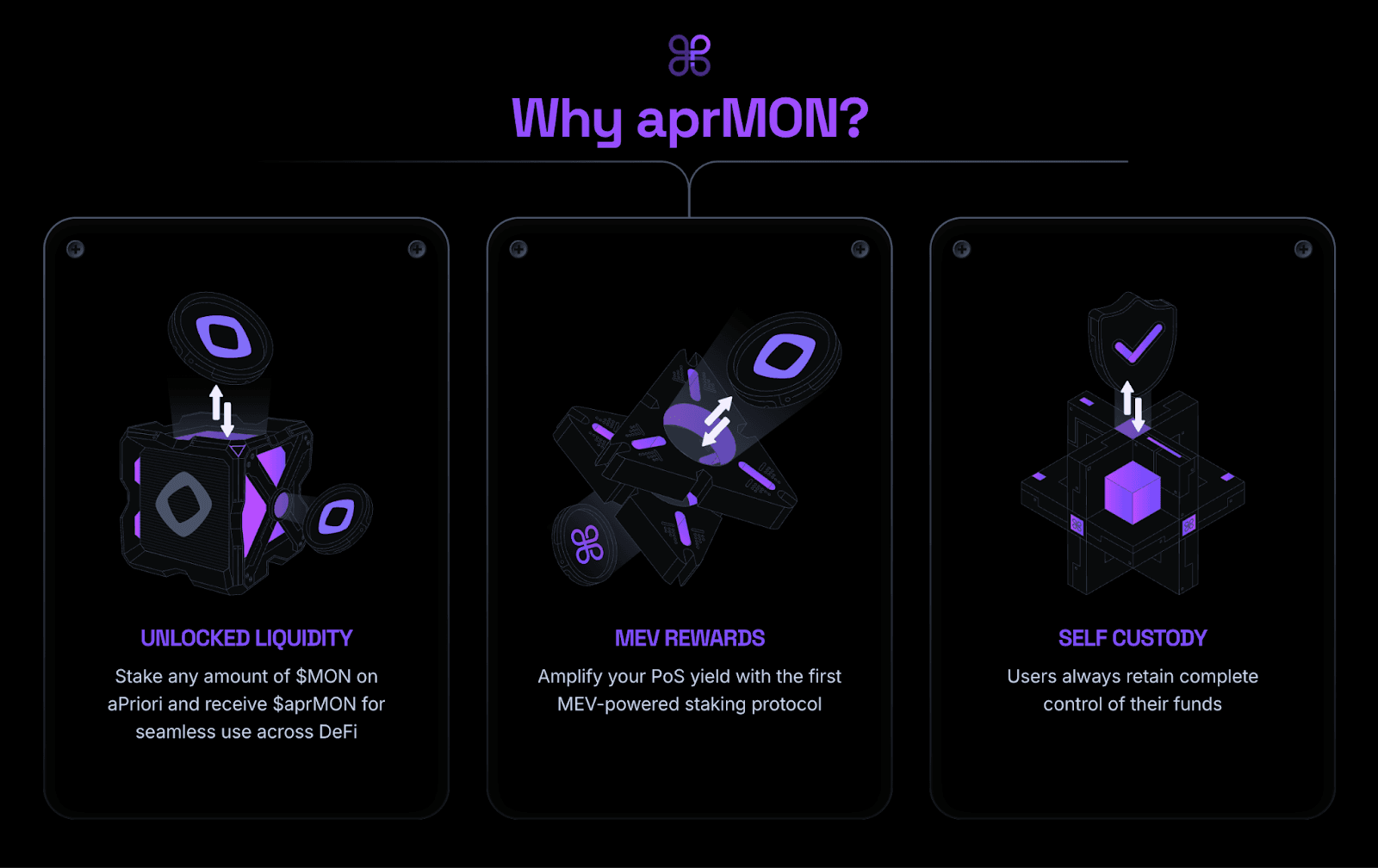
At the user level, all of this complexity is abstracted through aprMON, the protocol’s liquid staking token. Unlike rebasing assets that automatically change wallet balances, aprMON uses a reward bearing model. That means the total token supply and the user’s wallet balance remain constant, while the value represented by each token rises over time as staking rewards and MEV revenue accumulate. When users deposit MON into the protocol, they receive aprMON in return. That token can then be used across DeFi as collateral or as a liquid asset in other applications. When users choose to redeem, they can convert based on the accumulated exchange rate and receive more underlying MON than they initially deposited. The withdrawal process still depends on validator unstaking queues, so redemption is not instant. Even so, that delay is part of the security design of proof of stake systems, and it allows the protocol to preserve network safety while maximizing the compounding potential of productive capital.
APR (aPriori) market price & tokenomics
The token economy of aPriori is centered on its native token $APR. Total supply is fixed at 1 billion tokens, and the allocation is divided across early backers, core contributors, the foundation, the genesis airdrop, community incentives, ecosystem growth, and liquidity and market stability. The structure is deliberate. It is designed to keep long term incentives aligned across fundraising, team building, community expansion, and ecosystem development. Early backers receive 16%, core contributors receive 16%, the foundation receives 16%, the genesis airdrop accounts for 12%, community incentives represent 22%, ecosystem growth receives 17%, and liquidity and market stability account for 1%. Structurally, this is not a model that pushes a large share of supply straight into the secondary market. Most of the token’s function is tied to a multi year path of governance, incentives, and ecosystem expansion. That means APR’s long term value support depends more on whether the protocol can sustain participation and integration than on short term trading attention alone.
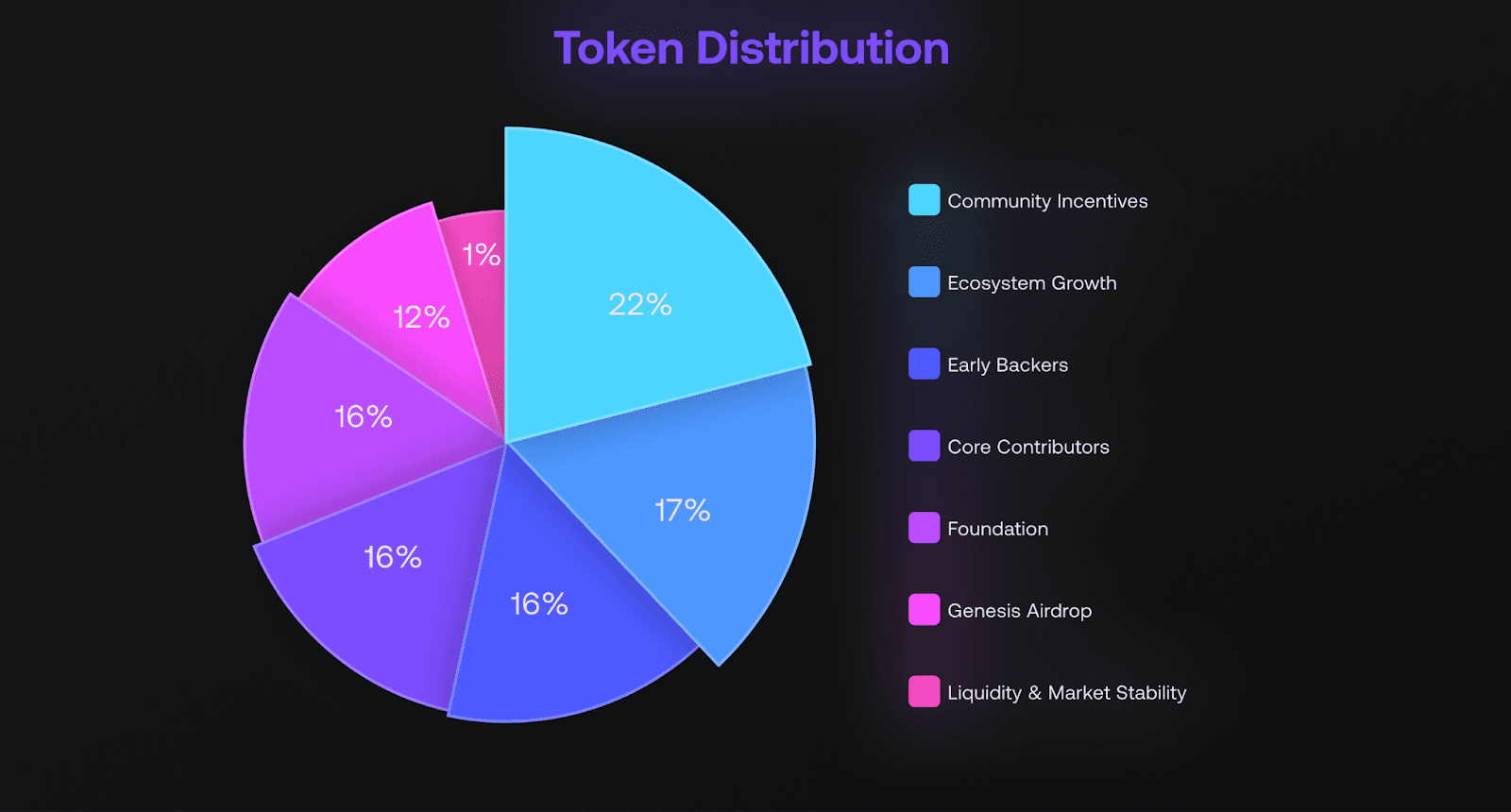
APR Token Distribution, Source: https://0xapr.substack.com/p/introducing-apr
In terms of market traction and capital support, aPriori has shown strong institutional appeal. By August 2025, the protocol had raised about 30 million dollars across multiple financing rounds. That included an 8 million dollar seed round completed in July 2024 at a 100 million dollar valuation. This level of backing gave the project meaningful development resources and helped build market confidence before the launch of the Monad mainnet. By October 2025, aPriori had attracted more than 500 million dollars in total value locked, with thousands of participants depositing capital into its liquid staking vault to access optimized yield. Within the broader economic model, APR is positioned as both a utility token and a governance token. During the token generation event, the protocol introduced a flexible claim structure that allowed users to unlock part of their allocation immediately or commit additional total value locked in exchange for a higher unlock ratio. This design did more than manage early circulating supply. It also supported higher protocol TVL during the initial phase. Although APR follows a fixed supply model and does not include a burn mechanism, the protocol maintains operational sustainability through a 10% fee on staking rewards and a 0.1% withdrawal fee. The 1% of total supply is reserved specifically for exchange liquidity, which helps absorb early volatility and support more stable market conditions after listing. In March 2026, $APR token showed notable price rising in market trading. Its single day price range reached 40.2%, rebounding from a low of $0.12372 to $0.1827. That move was reportedly driven by large scale whale accumulation in the $0.1315 to $0.1320 dollar range, with daily trading volume rising to roughly 8.09 million dollars.
Why do you invest in APR (aPriori)?
One of the core reasons aPriori attracts attention is that it brings high frequency trading infrastructure logic directly into DeFi at the protocol layer. The founding team comes from top tier global market making and quantitative trading environments, and that background is reflected in the way the system is designed. From the outset, the protocol was built to handle large order flows and optimize execution paths at a very fine level. That technical edge is not just theoretical. It translates into a concrete value capture mechanism. By leveraging the properties of a parallel execution blockchain, the protocol can identify and extract latent value from network activity at high speed, then redistribute value that would traditionally be captured by validators or independent arbitrage actors back to staking participants. In that model, users are not limited to a basic inflationary staking reward. They gain exposure to a layered yield stream tied to broader network activity. In terms of capital efficiency, that is materially different from conventional staking, and it gives participants a more competitive option if they value both yield and asset flexibility.
The utility of APR further strengthens the internal cohesion of the ecosystem. Users who hold and stake the token can access fee reductions on the protocol, which carries real economic significance for participants who are active in liquidity deployment and DEX related activity. At the same time, APR sits at the center of the governance structure. Token holders are able to participate in decisions around protocol upgrades, incentive programs, and strategic partnerships. As the Monad network expands and more decentralized applications integrate with aPriori’s infrastructure, APR is positioned as a key coordination asset for intelligent order flow and base layer liquidity. That functional demand can grow alongside ecosystem depth. When a protocol combines underlying infrastructure innovation with a clearly defined token role, it creates a stronger internal economic loop. That is one of the main reasons aPriori stands out as more than a simple staking protocol.
Is APR (aPriori) a good investment?
As blockchain architecture moves toward high throughput and low latency parallel execution, managing the explosive growth of transaction data and order flow is becoming one of the next major infrastructure bottlenecks. aPriori is positioned directly within that niche. It offers a full stack solution that combines liquid staking with value optimization, rather than treating them as separate verticals. Before the launch of the Monad mainnet, the protocol had already established itself as a core infrastructure candidate and built integration relationships with validators and DeFi protocols across the ecosystem. That early positioning matters because infrastructure level network effects can compound as the base chain gains adoption. aPriori’s AI driven routing system also lays technical groundwork for a future data economy in which execution intelligence itself becomes a valuable asset class within blockchain markets.
The long term trajectory of any protocols is still shaped by macro conditions and execution risk. aPriori’s success is closely tied to the stability and adoption rate of the Monad blockchain itself. Its MEV capture framework is technically sophisticated, but that also means it must prove itself under the real stresses of large scale mainnet conditions, including network congestion and potential implementation vulnerabilities. Even with those risks, the protocol has already demonstrated meaningful capability in addressing liquidity constraints and execution inefficiency through an architecture that is more advanced than standard staking models. For participants who understand the direction of blockchain infrastructure and who pay attention to innovation at the market structure layer, aPriori represents a modern DeFi case study with a strong technical moat and a clearly defined path for value capture.
Explore the latest APR (aPriori) price and live chart, trade APR on FameEX, and access real-time market data! Get started now with a seamless trading experience!
Disclaimer: The information provided in this article is intended only for educational and reference purposes and should not be considered investment advice. Conduct your own research and seek advice from a professional financial advisor before making any investment decisions. FameEX is not liable for any direct or indirect losses incurred from the use of or reliance on the information in this article.