INTC (Intel Corp) Token Price & Latest Live Chart
2026-04-23 11:08:03
What is INTC (Intel Corp)?
Intel Corporation stands as a cornerstone of the global semiconductor industry and a central force in the revival of U.S. manufacturing. In the mid 21st century technology landscape, it plays a defining role in the transformation of the integrated device manufacturer model. The company is not only focused on designing and producing processors for personal computers and servers, but is also pushing an ambitious strategic shift under CEO Lip-Bu Tan through what it calls IDM 2.0. That strategy is meant to move Intel away from a closed production chain and toward an open systems foundry model. Through this transition, Intel is no longer simply a chip vendor. It is evolving into an infrastructure platform that can provide advanced process technology to fabless design companies around the world. In crypto trading, INTC refers to the INTCUSDT perpetual contract that tracks Intel’s stock price. This product uses a synthetic structure that allows users to participate in the price movement of the tech giant with stablecoins, without needing a traditional stock brokerage account.
On most crypto trading platforms, INTCUSDT functions as a stock derivative contract margined in U.S. dollar stablecoins. Its core value lies in offering a round the clock trading environment with flexible leverage. This type of contract does not represent actual ownership of Intel Corporation equity. It does not grant voting rights or dividend rights in the way traditional shareholders would receive them. Instead, it serves as a pure price discovery tool that brings a Nasdaq listed underlying asset into the operating logic of digital asset markets. Through this synthetic instrument, traders can take both long and short exposure to Intel’s market performance. That creates a level of directional flexibility that is far harder to access in conventional equity markets. For crypto users, products like this remove the friction of opening and funding accounts across multiple financial systems. They create a more seamless connection between crypto collateral and traditional equity value. From an industry perspective, Intel holds a national champion position in the U.S. semiconductor sector because it combines in house research, chip design, and manufacturing capability. Its business spans consumer facing client computing for laptops and desktops, as well as data center and AI divisions that support modern artificial intelligence workloads. As expectations around the 18A process node strengthened in April 2026, Intel increasingly came to be seen not just as a hardware supplier, but as a strategic semiconductor manufacturing pillar backed by billions of dollars in U.S. CHIPS Act subsidies and financing support.
This distinctive IDM 2.0 strategy gave Intel notable market resilience in April 2026. Its deeper cooperation with major technology companies such as Tesla in silicon manufacturing further reinforced its position as a western alternative in advanced semiconductor production. This transition is not only a technical upgrade. It is a full scale reconstruction of the business model, with the stated ambition of becoming the world’s second largest foundry by 2028. For users in digital asset markets, the INTC perpetual contract offers a direct gateway into that macro narrative. It allows the upside tied to industrial transformation and geopolitical reordering to flow directly into profit and loss on a crypto trading venue. That connection creates a deeper interaction between traditional financial assets and crypto liquidity, and it points toward a broader future for asset tokenization and derivatives built on real world market exposure.
How does INTC (Intel Corp) work?
Intel’s core operating model is built on highly complex semiconductor physics and the most advanced scaling technologies in chip manufacturing. At the center of that effort is the 18A process node, which serves as the key engine behind Intel’s attempt to regain technology leadership. By March 2026, that process had entered large scale production and incorporated the new RibbonFET transistor design together with PowerVia backside power delivery. These innovations significantly improved power efficiency and logic density. This architectural leap allows Intel to pack tens of billions of transistors into extremely small areas of silicon, giving the next generation Panther Lake processors the computational foundation they need. The importance of this progress goes beyond protecting Intel’s position in the PC market. It also creates the technical basis for a stronger push into the higher margin AI server segment, where performance gains can no longer rely on older power intensive design approaches.
On the business model side, Intel operates through an increasingly independent foundry division that forms deep production and technology relationships with external customers. This is what Intel describes as a systems foundry model. In April 2026, Intel announced a deeper partnership with Elon Musk’s Terafab project to jointly develop computing clusters targeting one terawatt of annual compute capacity. That development signaled that Intel’s fabs were moving toward customized manufacturing for Tesla autonomous driving chips and for SpaceX related communications infrastructure. This operating model is fundamentally different from Intel’s old fully internal production system. It requires the company to maintain both cutting edge chip design expertise and world class foundry execution. It also depends on a large scale manufacturing footprint in places such as Ohio and Arizona, where new U.S. fab clusters are being built to lower the supply chain risks tied to geopolitics. In April 2026, Intel also launched the Core Series 3 processor line, highlighting its ambitions in edge computing and AI PCs. Those products launched in coordination with hardware partners such as Dell and Samsung and helped build a more complete ecosystem loop. Their development relied on advanced packaging methods that combine chips built on different process technologies inside the same package, creating a more balanced mix of performance and efficiency. That logic reflects the broader evolution of the semiconductor industry from single die design toward system level packaging.
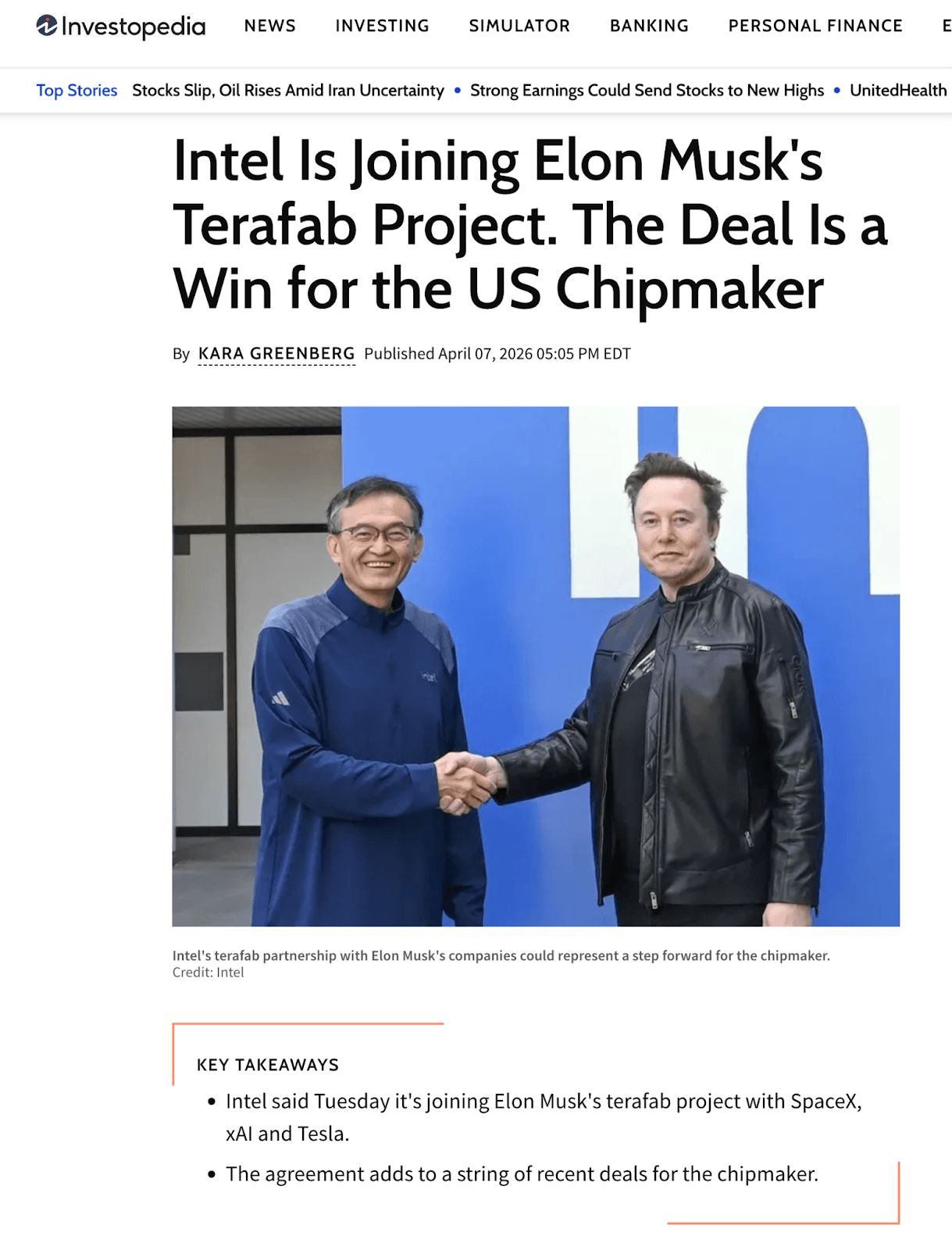
Intel announced to join Elon Musk’s Trafab Project in April 2026, Source:https://www.investopedia.com/intel-is-joining-elon-musk-terafab-project-here-is-why-its-a-win-for-the-chipmaker-11944936
At the crypto derivatives layer, the INTCUSDT perpetual contract works through a pricing structure that depends on precise oracle based reference data and a funding rate mechanism that keeps the contract closely anchored to Intel’s live Nasdaq price. Trading platforms connect to high speed financial market data feeds to track the latest movement in Intel stock, then use automated systems to adjust long and short positioning within the leverage framework. The funding mechanism, which settles every eight hours, helps contain the gap between the synthetic price and the underlying cash market price. When bullish positioning becomes too crowded, longs pay funding to shorts. When sentiment swings the other way, shorts pay longs instead. This structure helps keep the contract aligned with the real market even when the traditional stock exchange is closed. As a result, crypto traders can continue to hedge risk or express directional views in response to after hours headlines and global macro events.
INTC (Intel Corp) market price & tokenomics
Intel reached a historic milestone on April 16, 2026, when its stock surged 5.48% in a single session and closed at $68.50. That move pushed the company to its highest level in five years. The breakout was not simply a technical event. It also reflected stronger market confidence in Intel’s relationship with Terafab and a favorable reaction to upward analyst revisions for server revenue. From March to April 2026, Intel’s stock delivered a gain of more than 55%. That sharp momentum reflected a deeper structural shift in market perception. Investors were no longer treating Intel as a fading legacy giant. They were increasingly pricing it as a core layer of AI infrastructure. On the chart, the former resistance zone around $66.60 had already turned into a meaningful support area, creating the base for a move toward $72 and potentially beyond.
As for the tokenomics and asset structure of the INTCUSDT perpetual contract, it does not have the standard supply model associated with a typical crypto token. There is no fixed issuance, no circulating supply schedule, and no maximum token cap in the usual sense, because the instrument is fundamentally a synthetic contract that tracks an external asset price. On trading platforms, its circulating supply and token limit are both shown as zero. That reflects its non native nature rather than a missing dataset. The product derives its value entirely from Intel’s performance and liquidity in traditional financial markets. It does not rely on an on chain inflation or deflation model driven by token demand. Users post USDT as collateral to open positions, and profit and loss is also settled in USDT. This makes INTC a synthetic bridge between traditional equity exposure and the stablecoin ecosystem, giving crypto capital holders a way to diversify risk across asset classes without leaving the digital trading environment.
Why do you invest in INTC (Intel Corp)?
One of the main reasons capital is drawn to Intel is its role as the western world’s only major systems foundry platform with advanced process ambitions. In the geopolitical environment of April 2026, semiconductor manufacturing autonomy had become a matter of national level strategic importance for the United States. Intel’s access to CHIPS Act support and broader policy backing created a meaningful competitive moat. That national champion status gives Intel more room to absorb volatility and benefit from political tailwinds than many of its competitors. For market participants looking at long duration growth themes, this is not just exposure to a chipmaker. It is exposure to a historic realignment of global technology supply chains, and opportunities of that scale are rare in semiconductor history.
Another major attraction lies in Intel’s early positioning in the AI PC cycle. With the launch of the Core Series 3 processors in April 2026, Intel pushed AI capable computing further into the mass market. That supports a steadier stream of cash flow, which can in turn help fund the company’s heavy research budget and foundry expansion plans. This structure, where mature businesses help finance future growth, gives Intel a profile that combines elements of growth and value at the same time. When markets become uneasy about highly valued AI chip names such as Nvidia, Intel can appear more attractive as a relatively cheaper infrastructure supplier. That often makes it a destination for institutional rotation and defensive repositioning inside the broader semiconductor sector.
Is INTC (Intel Corp) a good investment?
The answer depends heavily on whether Intel can sustain a real recovery in manufacturing execution. A return to technical leadership requires the 18A node to maintain very high yields, and any mistake in the production chain could translate into billions of dollars in losses together with sharp downside pressure on the stock. In the April 2026 outlook, a stable 18A yield above 75% would have marked a decisive break from the technical setbacks that weighed on Intel in earlier years and could have opened the door to a much higher valuation ceiling. At the same time, the foundry business remains extremely capital intensive. That means the company could still face negative free cash flow through 2027, which matters for market participants focused on short term shareholder returns or rapid capital rotation.
From a portfolio hedging perspective, Intel displayed characteristics in 2026 that made it a useful way to diversify technology exposure. Because the company operates on both the design side and the manufacturing side, it can partly offset some of the risks faced by purely fabless chip companies when foundry costs rise. Even so, competition remains intense. AMD continues to press for more server market share, while TSMC still holds an advantage in process maturity and manufacturing consistency. Those two rivals remain major sources of pressure on Intel’s long term execution story. Investors therefore need to watch the late April 2026 earnings release closely, along with utilization data and broader fab efficiency indicators. Taken together, Intel represents a high risk, high upside turnaround story. It is best suited to participants who believe in the long term reindustrialization of the U.S. semiconductor base and who can tolerate the cyclicality that comes with large scale manufacturing.
Explore the latest INTC (Intel Corp) price and live chart, trade INTC on FameEX, and access real-time market data! Get started now with a seamless trading experience!
Disclaimer: The information provided in this article is intended only for educational and reference purposes and should not be considered investment advice. Conduct your own research and seek advice from a professional financial advisor before making any investment decisions. FameEX is not liable for any direct or indirect losses incurred from the use of or reliance on the information in this article.