SENT (Sentient) Token Price & Latest Live Chart
2026-04-07 10:37:11

What is SENT (Sentient)?
Sentient is a decentralized protocol focused on building Open AGI. Its core goal is to break away from the closed AI structure that has been dominated by a small group of major technology companies. In the traditional AI development model, firms such as OpenAI and Google control training data, compute resources, and the final decision-making layer. That structure reduces transparency and concentrates the benefits of technical progress in the hands of a few corporations. Sentient argues for a different model. It treats intelligence as a public good that should be built, owned, and governed by a broader community. By using blockchain infrastructure, it is creating an ecosystem where developers, researchers, and users can participate in the evolution of advanced AI rather than remaining outside a closed corporate system. The project is built on the belief that future AGI should not take the form of a single opaque black-box model. It should emerge from a decentralized network of specialized and modular intelligence units working together, which is the vision Sentient is trying to turn into a real operating system for open intelligence.
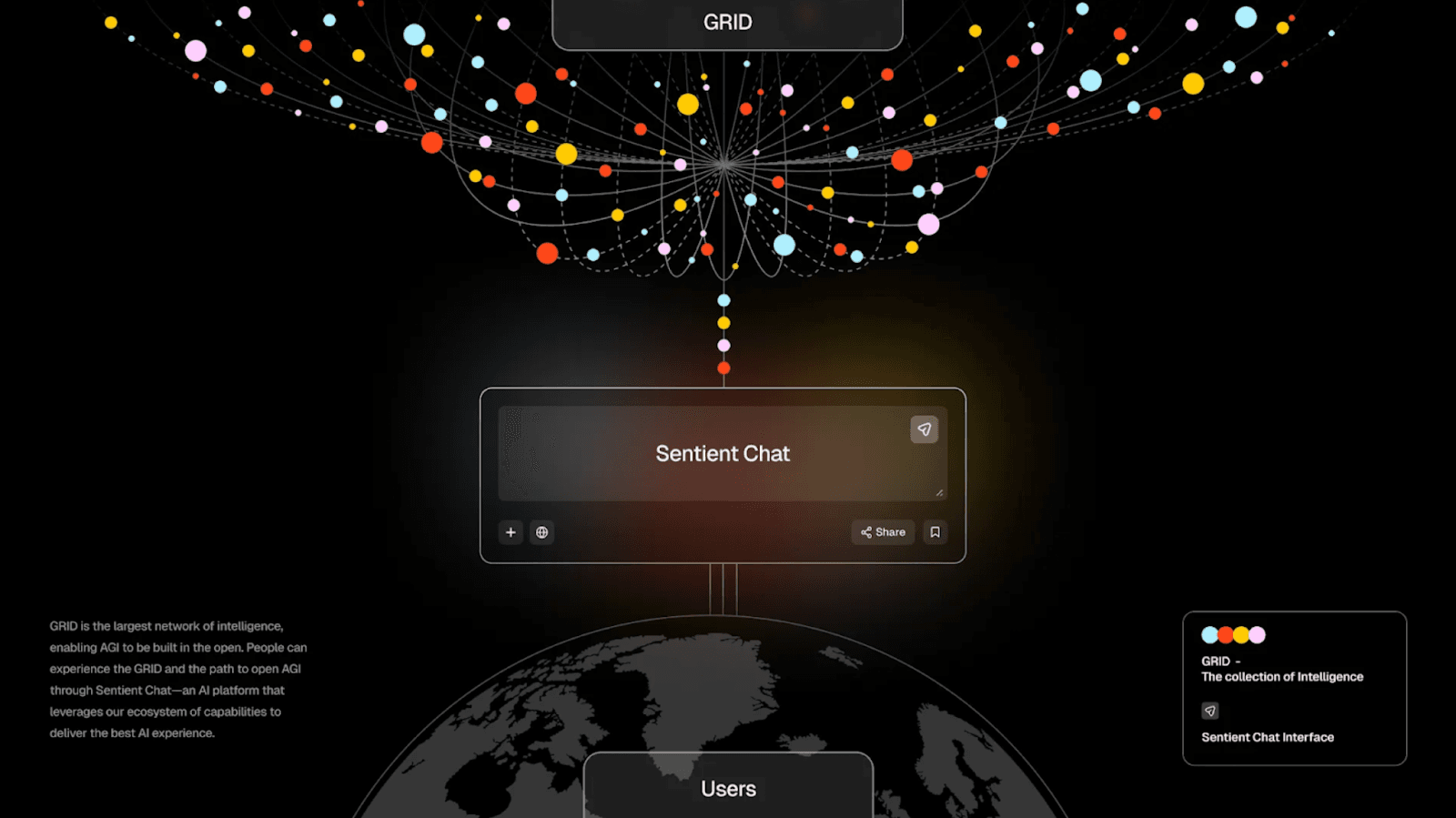
SENT ecosystem, source: https://docs.sentient.xyz/
As an Open AGI platform, Sentient provides an infrastructure layer called GRID, short for Global Research and Intelligence Directory, that allows developers around the world to collaborate within one unified decentralized framework. This is not just a loose collection of code and models. It functions more like an evolving global intelligence pool that connects data providers, model builders, agent developers, and compute contributors into a system that can operate like a self-improving digital brain. Through this open architecture, Sentient aims to keep AI development aligned with long-range human values instead of limiting it to short-term commercial objectives or the growth targets of a single company. That design also changes the competitive landscape. Independent developers and small teams no longer need to match the full scale of major technology companies on their own. They can contribute a specific intelligence component to the network and still receive economic upside if that component becomes useful within the broader system.
The project also stands out for the depth of its technical foundation. Its core research has been presented at top-tier AI conferences such as NeurIPS, covering areas including cryptographically enforced control, scalable model fingerprinting, and automated multi-agent orchestration. That matters because many crypto projects remain at the whitepaper stage and never develop meaningful technical substance. Sentient has already launched concrete products, including Dobby, a language model optimized for the Web3 and crypto-native environment, and it offers a direct user interface through Sentient Chat. As of April 2026, the project had brought in more than 110 ecosystem partners across both Web2 and Web3, including data providers, compute platforms, and specialized AI agents. These participants are building practical applications on top of the GRID infrastructure. That full-stack positioning, from protocol design to end-user interface, gives Sentient a strong early lead in the decentralized AI sector.
How does SENT (Sentient) work?
Sentient operates around a system called GRID, the Global Research and Intelligence Directory. This is a deeply integrated infrastructure layer designed to make AI components discoverable, composable, and shareable. In practical terms, GRID works like a decentralized digital neural architecture. It connects modular units known as Artifacts, which can include fine-tuned models, live data sources, compute tools, plugins, or agents built to handle specific tasks. When a user submits a complex request through a front-end such as Sentient Chat, the coordination layer breaks that request into smaller parts and routes each part to the most suitable Artifact in the network based on its technical characteristics. This is what allows the system to draw on the collective intelligence of developers around the world and produce high-quality outputs without depending on a single centralized server. It also makes the resulting analysis more structured and more explainable than a system that relies on one monolithic model to handle everything.
Within the GRID architecture, complex task execution is supported by a set of specialized frameworks, and one of the most important is ROMA, a recursive meta-agent framework. ROMA is responsible for orchestrating teams of specialized agents so they can function like a highly segmented expert workforce. This makes it possible to solve domain-specific problems that a single large model may handle poorly or too loosely. Another key component is SERA, short for Semantic Embeddings and Reasoning Agent. SERA is built for fast and reliable tool calling, large-scale data handling, and structured reasoning. That makes it especially relevant for areas such as crypto market analysis, where speed, data quality, and workflow consistency matter a great deal. Sentient also developed a Model Fingerprinting Library to protect developer ownership and preserve traceability in an open-source environment. By embedding unique and verifiable markers into model parameters, the system can prove authenticity and ownership. That function is critical in a decentralized collaboration setting because trust cannot rely on a single company acting as the ultimate authority.
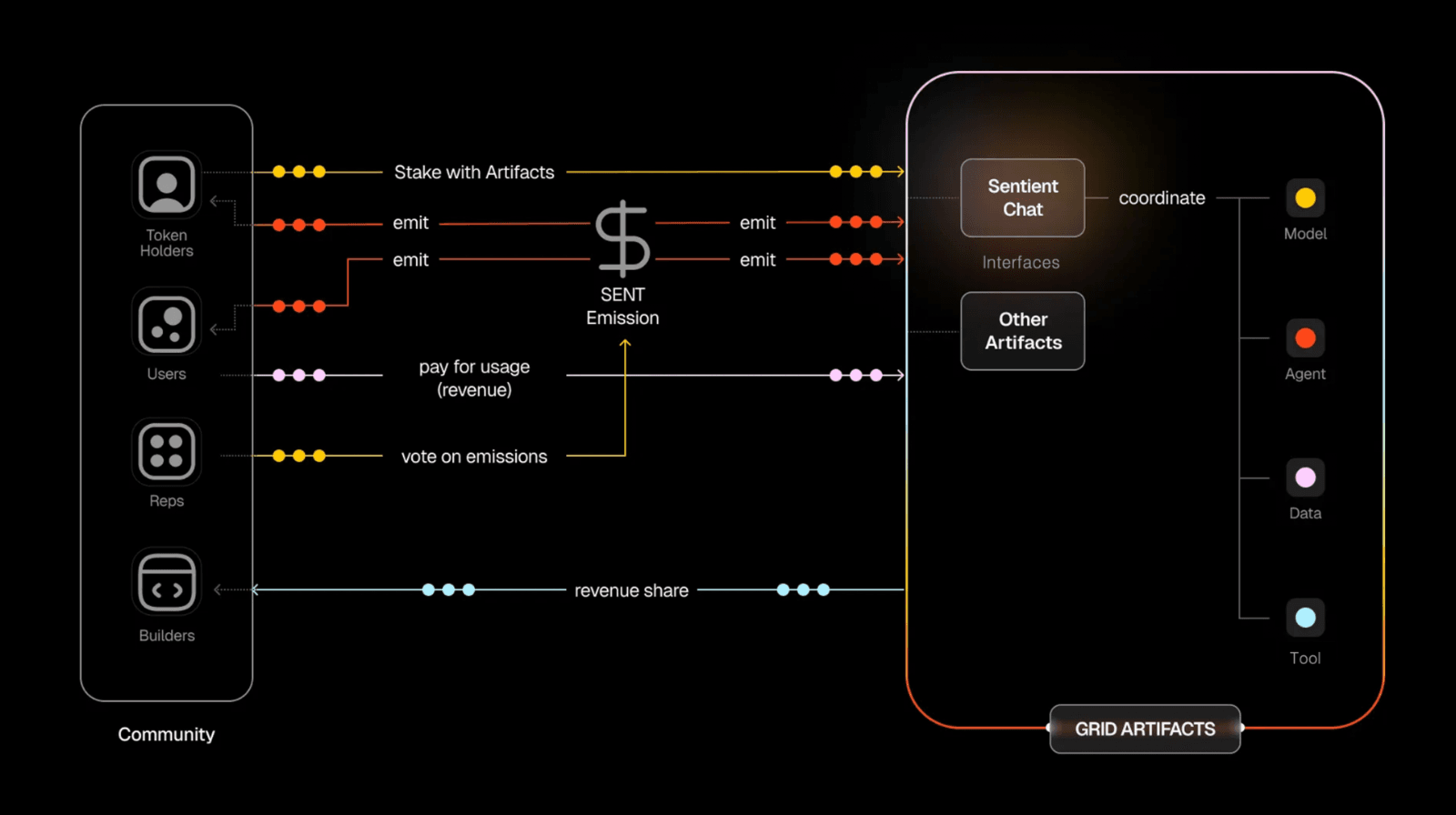
Breakdown of the Sentient architecture and the interactions among its components., source: https://docs.sentient.xyz/architecture
The economic incentive layer is what keeps this network running as a living system rather than a static technical framework. SENT aligns the interests of all participants and ties them together over the long run. The network uses a contribution-based emission model to reward activity that creates real value. Rewards primarily flow to four major groups, which are builders who create high-quality Artifacts, representatives who take part in governance and network stewardship, token holders who stake to identify and support useful components, and active users whose usage contributes data and demand to the ecosystem. The reward formula does not rely on a single input. It incorporates real revenue generated by an Artifact, the staking support it receives from the community, and reputation-based voting by expert participants. This multi-layer evaluation system is meant to ensure that resources flow toward the most effective and most trusted components. In effect, it gives the network a built-in mechanism for continuous self-optimization and technical evolution.
SENT (Sentient) market price & tokenomics
SENT is the native utility and governance token of the Sentient protocol. Its total supply is fixed at 34,359,738,368 tokens, a highly specific number that reflects the project’s engineering-driven design philosophy. On the allocation side, Sentient follows an unmistakably community-first structure. A full 44% of total supply is reserved for community initiatives and airdrops, with that bucket specifically intended to reward contributors performing verifiable work on the GRID, including development, testing, sharing, and maintenance. Under this structure, roughly 13% of total supply, which represents 30% of the community allocation, was unlocked at the token generation event so the network could begin with meaningful decentralization and usable market liquidity. The remaining portion unlocks linearly over the following four years. This design is intended to filter out purely short-term capital and attract participants who are willing to grow with the network over time. Outside the community allocation, 19.55% is reserved for ecosystem development and R&D, 22% is allocated to the team, 12.45% goes to early investors, and 2% is designated for a public sale.
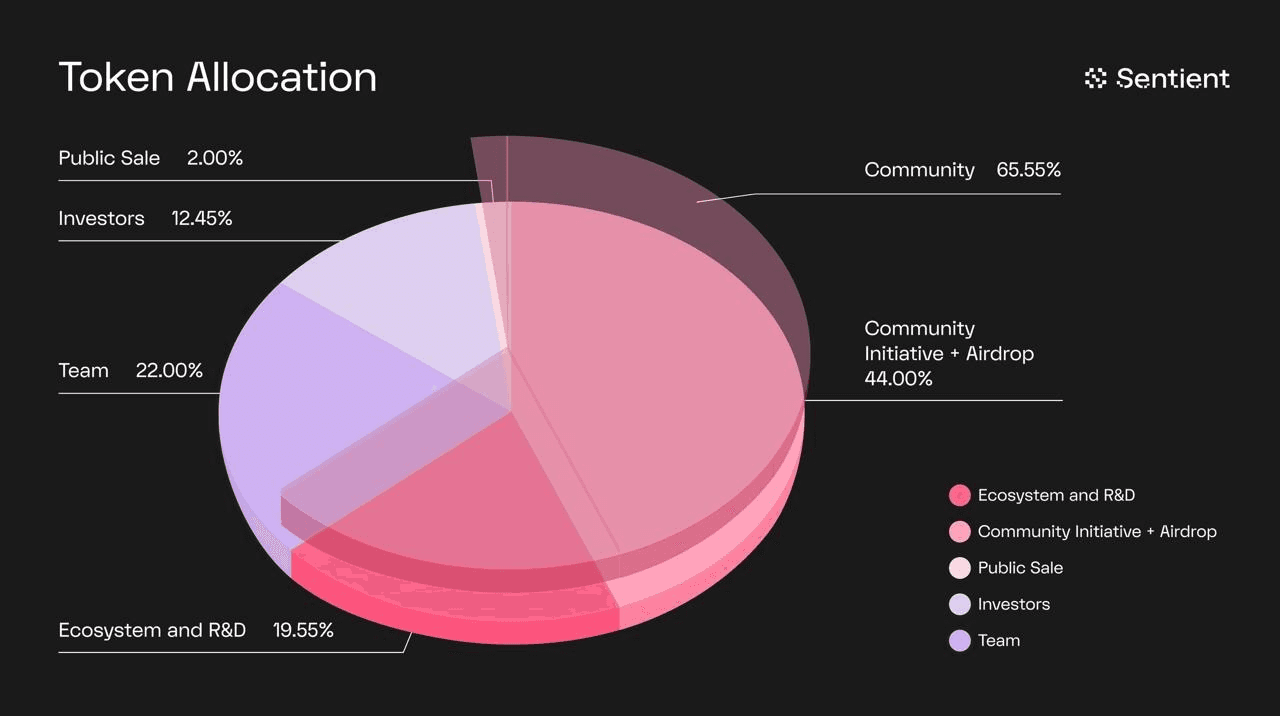
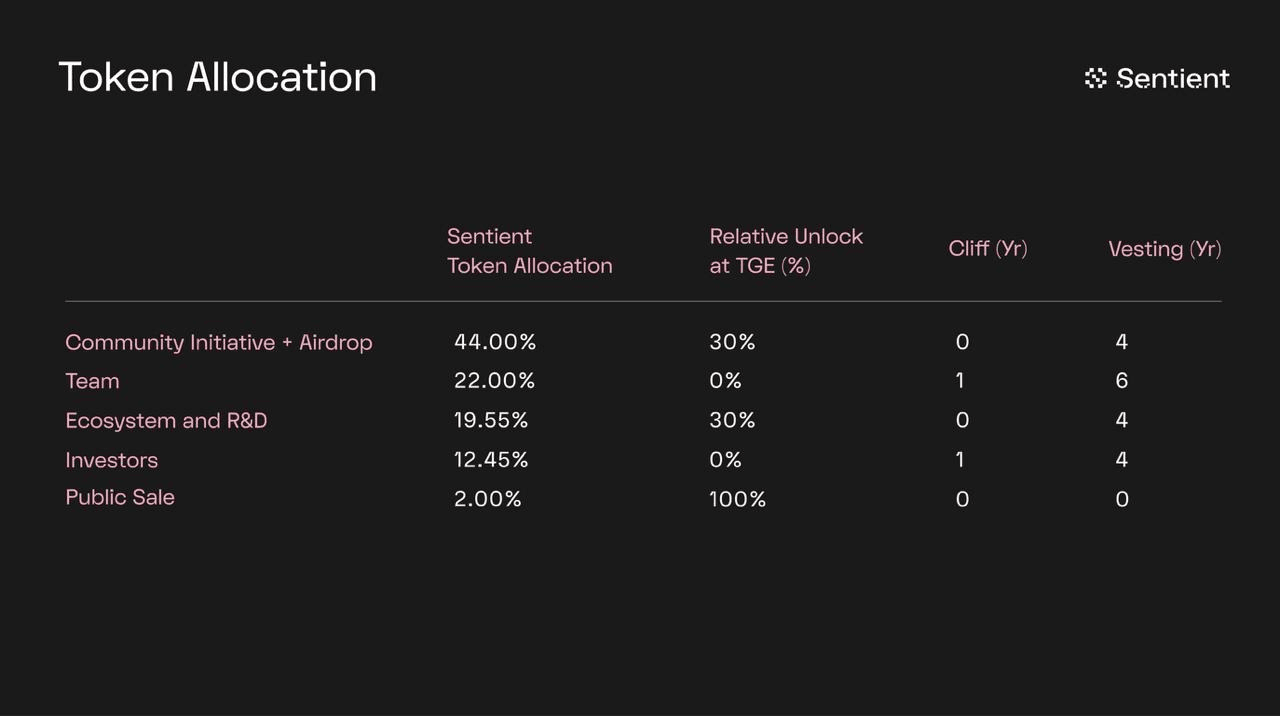
SENT token allocation, source: https://x.com/SentientAGI/status/2011852858413760974?s=20
SENT has shown strong support and consistent trading interest in the crypto market, and much of that strength is tied to the project’s financing profile. In its seed round, Sentient raised USD 85 million from major investors including Founders Fund, Pantera Capital, and Framework Ventures. That capital base gives the project meaningful room for long-term R&D and ecosystem expansion. In terms of utility, SENT plays three roles across the network. It functions as a payment asset, a staking asset, and a governance asset. First, it serves as the settlement currency within the GRID ecosystem. Users who access advanced AI agent services, specialized market intelligence, or certain premium tools use SENT for payment, and that revenue is distributed to the relevant builders according to protocol rules. Second, token holders can stake SENT on the Artifacts they believe offer the highest utility. That process helps stronger components attract more emissions, while stakers themselves can share in part of the value generated by those components. Third, SENT gives holders direct governance power. Community members can vote on major protocol upgrades, treasury allocation, and changes to emission parameters. By combining real economic utility with decentralized governance, SENT functions as the core value layer behind Sentient’s push toward open-source AGI.
Why do you invest in SENT (Sentient)?
The core investment case for Sentient is tied to a structural problem in AI itself, which is the concentration of power in a small number of closed and centralized systems. As AI becomes more deeply embedded in society, developers and capital alike have become more aware of the risks that come with opaque governance, concentrated data control, and limited public accountability. Sentient offers an alternative with real technical depth. It is not just presenting an ideological critique of closed AI. It is building a full stack that includes developer tooling, open infrastructure, an active contributor community, and live products such as Dobby. That gives the project a more concrete foundation than many narratives built around AI and crypto.
From a long-term industry standpoint, Sentient is positioned at the leading edge of decentralized AI. The GRID network is designed to benefit from strong network effects. Every additional Artifact, developer, data source, or workflow can increase the system’s capability and expand its value to users. This is different from projects that rely almost entirely on narrative momentum. Sentient has a visible utility model, identifiable infrastructure, and meaningful partnerships across both Web2 and Web3. That combination of openness and practical usefulness gives it a credible path toward becoming a foundational protocol in the future AGI stack if execution continues to hold.
Is SENT (Sentient) a good investment?
In the 2026 market environment, Sentient stood out because of its USD 85 million funding base and the backing of top-tier venture firms from Silicon Valley and the broader crypto investment landscape. That support gave the project meaningful resilience and strong access to talent, capital, and ecosystem relationships. More importantly, Sentient is not simply trying to ship another AI application. It is building a decentralized infrastructure layer where AI innovators can deploy products, earn from usage, and participate in a shared intelligence economy. That infrastructure-first strategy gives the project a much higher level than a standard application-layer token if the network succeeds in scaling adoption.
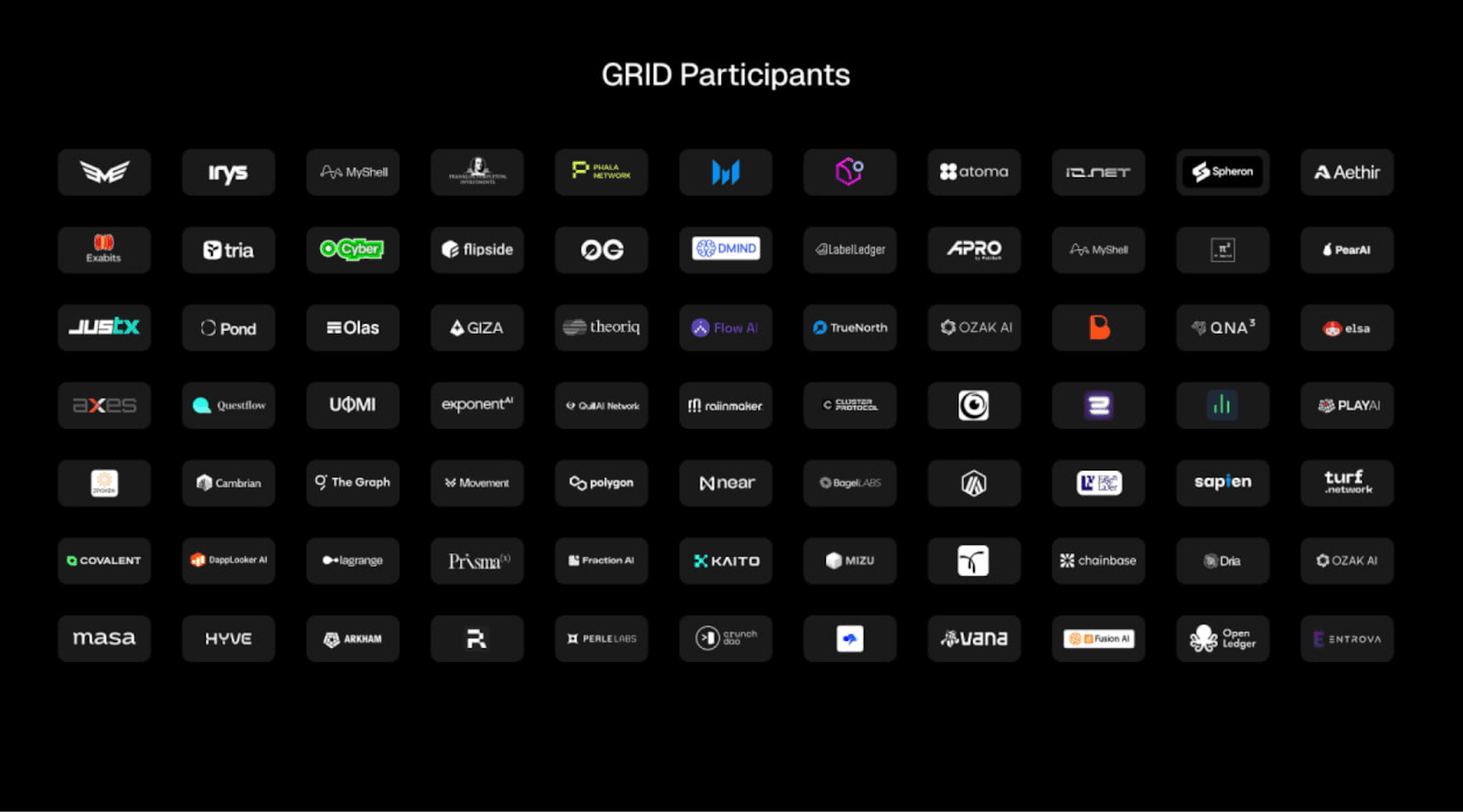
GRID has integrated more than 110 partners, source: https://docs.sentient.xyz/grid/artifacts
The path toward decentralized AGI remains difficult, and no project in this category can avoid major execution challenges. Even so, Sentient brings together serious research, a coherent protocol design, and a token model built around incentive alignment rather than pure speculation. For market participants focused on long-duration value and exposure to foundational shifts in technology, SENT represents more than a token attached to an AI narrative. It reflects an attempt to reclaim ownership, governance, and economic participation in the development of advanced intelligence. That makes it a project with substantial technical depth, broad ecosystem support, and a large long-term thesis behind it. It is a name that remains worth following as AI and blockchain continue to converge.
Explore the latest SENT (Sentient) price and live chart, trade SENT on FameEX, and access real-time market data! Get started now with a seamless trading experience!
Disclaimer: The information provided in this article is intended only for educational and reference purposes and should not be considered investment advice. Conduct your own research and seek advice from a professional financial advisor before making any investment decisions. FameEX is not liable for any direct or indirect losses incurred from the use of or reliance on the information in this article.