UBER (Uber) Token Price & Latest Live Chart
2026-07-24 02:19:22
What is UBER (Uber)?
Uber is a global technology platform built around real-time supply and demand matching. Most consumers see Uber as a ride-hailing or delivery app. From an operational perspective, however, these services are only the top layer of the platform for users. What Uber has actually built is a real-time coordination system that manages consumer demand, vehicles, service providers, merchants, and logistics capacity in the physical world. The company does not need to own most of the vehicles operating on its platform. It also does not need to organize every driver and courier into a conventional corporate fleet. Instead, Uber uses mapping technology, algorithms, payment infrastructure, identity verification, pricing systems, and order allocation to turn fragmented supply into services that consumers can access on demand. In its annual report, Uber also describes itself as a technology platform that uses large-scale networks, proprietary technology, and operational expertise to move people and goods. Its network connects riders with drivers, consumers with merchants, and shippers with carriers.
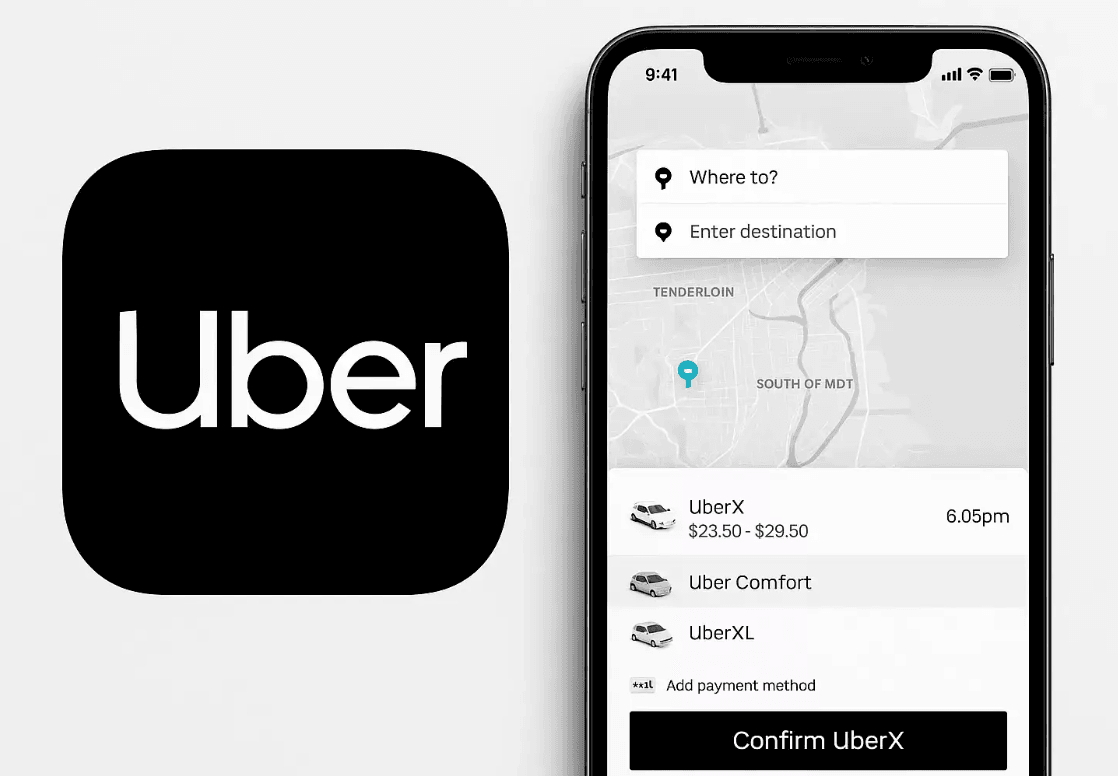
In a traditional taxi environment, passengers may not know whether an available vehicle is nearby. Drivers may also have little visibility into where the next request will appear. Food delivery involves an additional layer of complexity because consumers, merchants, and couriers must all coordinate with one another. A lack of information at any stage may result in long waiting times, inefficient delivery routes, or failed orders. Uber brings this information together on one platform and matches supply with demand based on location, demand intensity, traffic conditions, service capacity, and estimated arrival times. What the company provides is not simply a ride or a delivery. It provides the ability to obtain a reliable service at a particular time and place. This is the main reason Uber has expanded from a taxi-calling tool into food delivery, grocery services, retail delivery, corporate transportation, freight, and autonomous mobility. Uber’s primary role is to connect riders with drivers, consumers with restaurants and couriers, and shippers with carriers. It does not complete every service itself.
How does UBER (Uber) work?
Uber’s business model depends heavily on what is known as the liquidity network effect. Its core revenue mechanism is the platform take rate. Simply put, Uber operates like a digital toll booth. When a user pays for a ride or delivery, the full transaction value is recorded as Gross Bookings. Uber does not own the vehicles that complete most of these services. Instead, it retains a portion of the transaction value as platform revenue. This portion is known as the take rate. The remaining amount is paid to drivers or couriers and, in the case of delivery orders, settled with restaurants or other merchants. This asset-light structure allows Uber to expand across more than 10,000 cities without maintaining a large company-owned vehicle fleet.
Uber relies on sophisticated algorithms to balance supply and demand:
- Dynamic Pricing: When demand rises in a particular area, prices may increase to encourage more drivers to move into that location.
- Route Planning: Uber uses AI and real-time traffic data to estimate efficient routes and reduce passenger waiting times and estimated arrival times.
- Cross-Platform Coordination: Drivers may be able to switch between passenger trips and delivery orders. This helps improve hourly utilization and earning opportunities.
Since its founding in 2009, Uber has evolved from a premium taxi service into a much broader ecosystem. Its operations now cover three main areas:
- Mobility: Car calling and other urban transportation services, ranging from affordable trips to premium and shared options.
- Delivery: An on-demand delivery network led by Uber Eats. It connects consumers with restaurants, grocery stores, convenience retailers, and other local merchants.
- Freight: A digital freight platform that applies matching and logistics technology to long-distance transportation and commercial shipping.
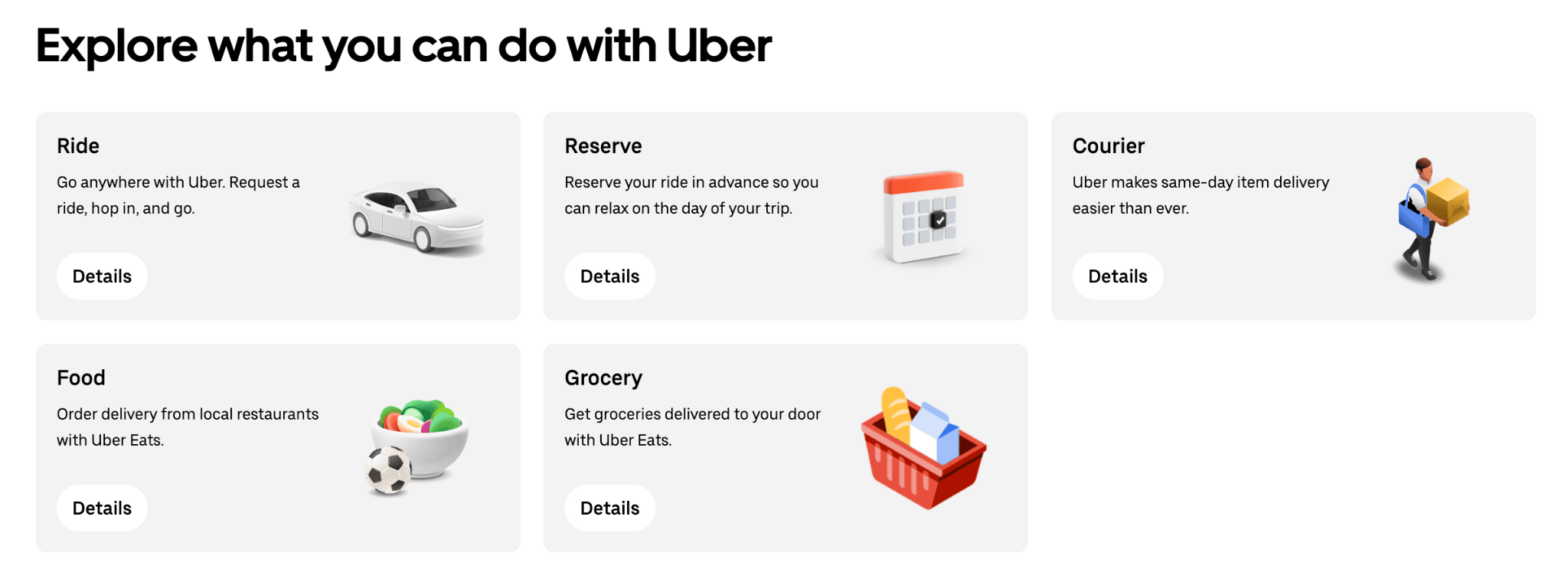
Uber currently operates through its Mobility, Delivery, and Freight business segments. Mobility covers car-hailing, taxi integration, and other urban transportation services. Delivery is centered on Uber Eats, although the business has expanded beyond restaurant meals into groceries, convenience products, and general retail. Freight applies similar digital matching capabilities to the commercial logistics market. It enables shippers to find carriers and manage freight transportation. These businesses serve different markets, but they share much of the same underlying infrastructure. This includes mapping, payments, identity management, customer support, risk controls, and demand forecasting. Because these systems can be reused, Uber does not need to rebuild its entire platform whenever it enters a new service category. Car-hailing and delivery demand also tend to peak at different times. Some service capacity can therefore be reallocated throughout the day, which may improve overall network utilization.
In the first quarter of 2026, Uber reached 199 million Monthly Active Platform Consumers and completed 3.643 billion trips and delivery orders. Gross Bookings rose 25% year over year to $53.72 billion, while revenue increased 14% to $13.203 billion. GAAP operating income reached $1.923 billion. Adjusted EBITDA was $2.481 billion, and free cash flow totaled $2.286 billion. These figures show that the focus of Uber analysis has gradually shifted. The main question is no longer whether the company can expand through subsidies. It is whether Uber can consistently convert its scale into operating profit and cash flow.
Uber is also expanding revenue from subscriptions and advertising. Uber One charges users a monthly or annual membership fee in exchange for eligible ride and delivery benefits. The value of this model does not come only from subscription fees. Membership can also improve retention and increase the use of multiple Uber services. Once users have paid for a membership, they may be more likely to book rides, order meals, and purchase retail products through the same platform. This can increase the long-term value of each customer. In the first quarter of 2026, Uber One reached 50 million members worldwide. Members generated approximately half of the combined Gross Bookings from Mobility and Delivery. This suggests that the subscription business is becoming an important link between Uber’s two largest operating segments.
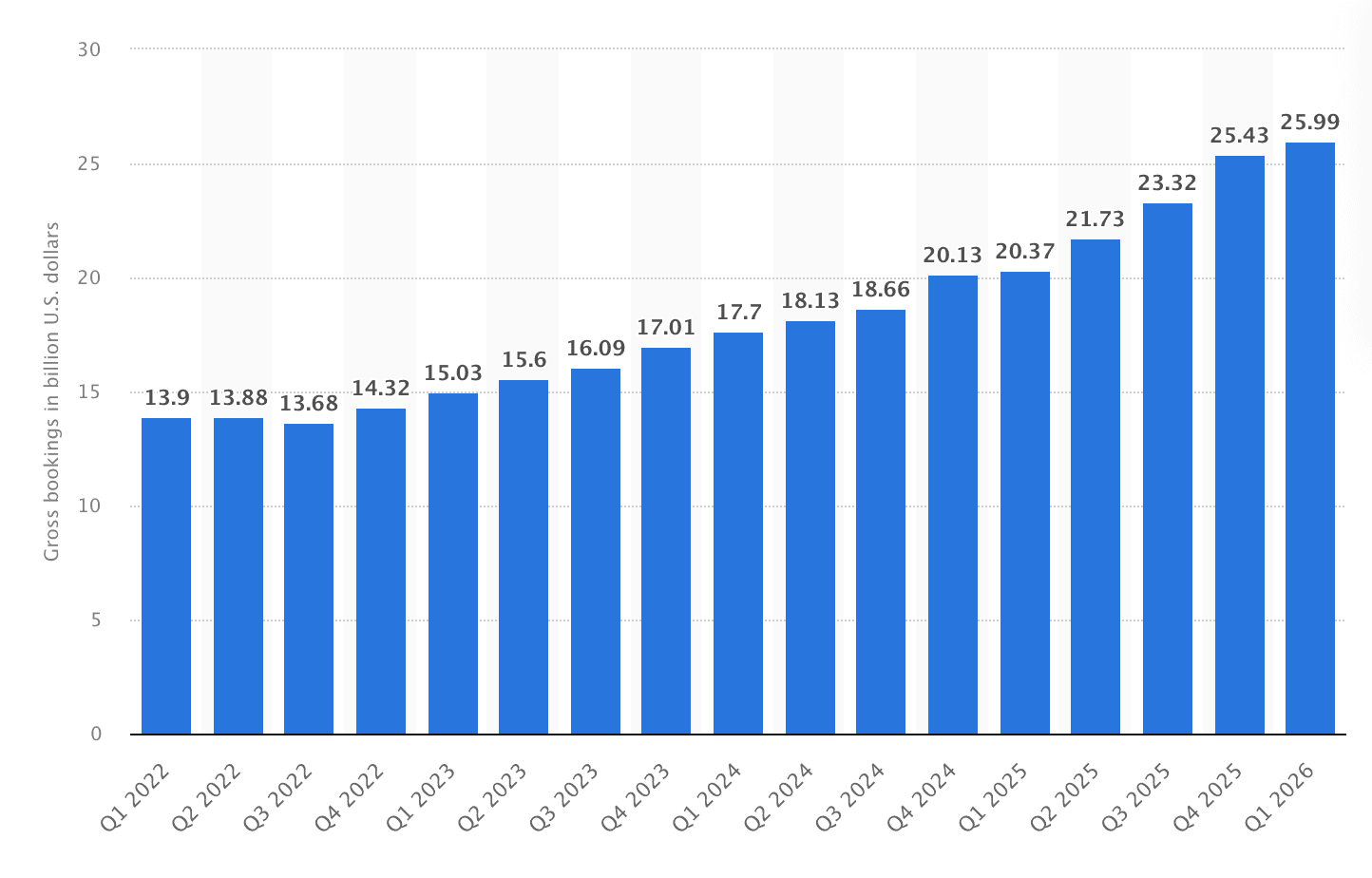
Uber Eats Global Gross Bookings from Q1 2022 to Q1 2026, in billions of U.S. dollars, Source: https://www.statista.com/statistics/1471388/uber-eats-gross-bookings-worldwide/?srsltid=AfmBOoqURoXJWUIA2BXFCiAgVQrrw17WxPmvSZtmKzfwUQBweqqmlDdE
Moreover, advertising is another revenue source worth monitoring. Restaurants, retailers, and consumer brands can pay for higher visibility in Uber Eats search results and recommendation interfaces. Uber has also expanded Uber Eats from a food delivery service into a broader local retail gateway. In June 2026, the company announced the addition of beauty, office supply, sporting goods, and pet retailers. This development reflects a broader long-term strategy for the Delivery segment. Uber no longer aims only to deliver meals. It is also attempting to become an on-demand commerce platform through which consumers can access a wide range of local products.
UBER (Uber) market price & tokenomics
UBER is the stock ticker of Uber Technologies in the United States. It represents partial ownership in a publicly listed company. Uber has not issued an official cryptocurrency called UBER, and UBER shares are not digital assets that exist natively on a blockchain. Direct ownership of UBER common stock gives investors an equity interest through the securities market. The associated rights are determined by corporate law, securities regulations, the share class, and the structure of the investor’s brokerage account.
UBERUSDT offered on a trading platform is different. It is a perpetual contract that tracks the price of Uber Technologies common stock and uses USDT as the settlement currency. Unlike traditional futures contracts, it does not have a fixed expiration date. A funding rate is settled every eight hours to help keep the contract price aligned with the underlying market. UBERUSDT and UBER shares may both reflect Uber’s market value, but they are fundamentally different types of financial instruments. Holding UBERUSDT does not mean holding Uber stock, and it does not make the trader an Uber shareholder. The contract mainly provides profit or loss exposure based on changes in the underlying reference price.
For Web3 users, the significance of UBERUSDT is not that Uber itself has become a Web3 project. It also does not mean that Uber equity has been placed directly on-chain. Instead, the product brings exposure to a traditional stock price into a TradFi-oriented trading environment built around stablecoins, perpetual contracts, and crypto trading accounts. In the past, crypto users who wanted exposure to U.S. equity prices often had to convert digital assets into fiat currency. They would then need to transfer the funds through the banking system to a securities brokerage account and adapt to a separate account structure, trading schedule, margin framework, and settlement system.
UBERUSDT allows eligible users who already hold USDT to monitor and manage positions linked to Uber’s share price within the same trading environment. This can reduce the operational friction involved in moving funds between crypto markets and traditional financial markets. UBERUSDT remains exposed to U.S. market closures, corporate earnings, regulatory developments, and unexpected company events. When the stock market is closed but the perpetual contract continues to trade, its price may primarily reflect market expectations rather than live transactions in UBER shares. Liquidity may also decline during these periods. Once the stock market reopens, the contract and the underlying share price may need to move toward a new market equilibrium.
Why do you invest in UBER (Uber)?
The main reason the market continues to study UBER is that Uber has gradually evolved from a taxi platform that relied heavily on subsidies into a global mobility and local commerce infrastructure business capable of converting a large transaction network into operating profit and free cash flow. In the first quarter of 2026, trips, Gross Bookings, and operating income all continued to grow. This indicates that Uber is still expanding transaction volume while improving the economic value generated by its platform. GAAP net income for the quarter was only $263 million, but this figure was affected by a $1.5 billion pre-tax unrealized loss from the revaluation of equity investments. Therefore, investors need to examine core operating indicators such as Gross Bookings, operating income, and free cash flow rather than relying on a single net income figure. Uber’s long-term investment case is built on its large demand network and the interaction among its different businesses. Mobility, Delivery, Uber One, and advertising can share mapping technology, payment infrastructure, user accounts, merchant relationships, customer support, and demand forecasting systems. As order increases, driver idle time, user waiting times, and the cost of completing each transaction may decline. Membership and advertising can also increase the long-term value of each customer. If new transactions no longer require a proportional increase in subsidies and operating costs, Uber may develop stronger operating leverage. Revenue growth could then translate more consistently into higher profitability and cash flow.
Another factor worth examining is Uber’s attempt to preserve its role as a demand and coordination platform in the autonomous driving era. In March 2026, Uber announced a partnership with Rivian. The initial plan covers the deployment of 10,000 fully autonomous R2 robotaxis, with the potential to expand the arrangement to as many as 50,000 vehicles. This suggests that Uber’s strategy is moving beyond allowing third-party autonomous vehicles to connect to its app. The company is becoming more involved in fleet deployment, capital investment, and operating arrangements. If Uber becomes a common order distribution, payment, customer support, and fleet management platform for multiple robotaxi operators, it may participate in the next stage of transportation industry growth without bearing the full cost of developing autonomous driving technology internally. However, UBER is not a growth opportunity without material risks. Any assessment should also consider driver reclassification, driver incentives, consumer subsidies, insurance and accident costs, local regulation, market competition, and the capital requirements associated with autonomous vehicles and major acquisitions. Uber’s long-term value ultimately depends on whether it can continue improving platform liquidity. It must help riders access services more quickly, reduce driver idle time, generate more orders for merchants, and convert this network into sustainable free cash flow. Growth in user numbers or transaction volume alone is not enough.
Explore the latest UBER (Uber) price and live chart, trade UBER on FameEX, and access real-time market data! Get started now with a seamless trading experience!
Disclaimer: The information provided in this article is intended only for educational and reference purposes and should not be considered investment advice. Conduct your own research and seek advice from a professional financial advisor before making any investment decisions. FameEX is not liable for any direct or indirect losses incurred from the use of or reliance on the information in this article.