AAPL (Apple Inc. Common Stock) Token Price & Latest Live Chart
2026-05-04 03:16:24
What is AAPL (Apple Inc. Common Stock)?
Apple Inc. is a U.S.-based multinational technology company whose core businesses encompass consumer electronics, software, and a diverse range of digital services. Founded in 1976 by Steve Jobs and his co-founders, the company grew into one of the most influential corporations in the world. AAPL, its common stock ticker on the Nasdaq, represents not only one of the largest equity assets in traditional finance by market capitalization, but also a benchmark allocation for both institutional and retail investors in 2026. As technology converges with blockchain infrastructure, the meaning of AAPL has moved beyond a simple stock symbol. It also exists in the form of tokenized stocks across decentralized networks, allowing users to access the economic value of this technology giant directly through blockchain rails.
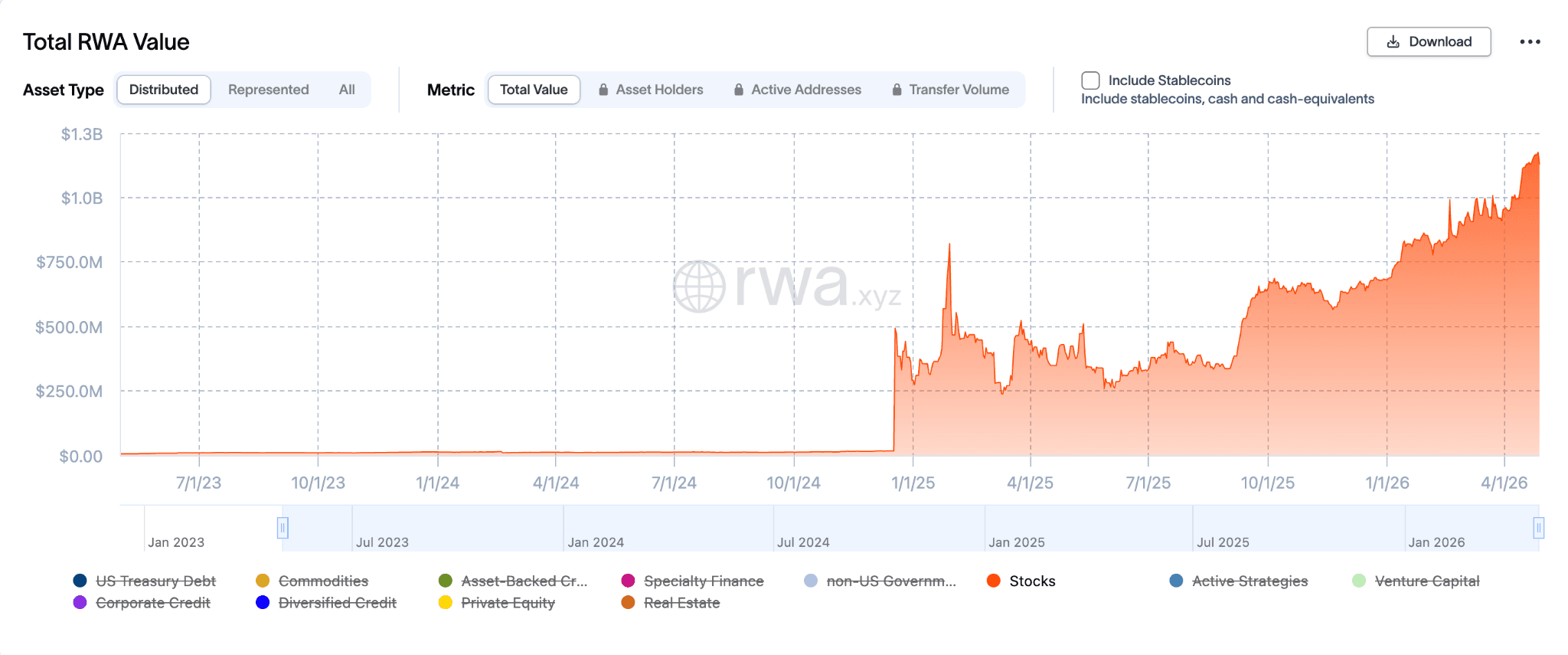
Total Value of tokenized stocks in the RWA market, Source: https://app.rwa.xyz/
Apple is widely viewed as a key bridge connecting hardware devices, operating systems, and the artificial intelligence ecosystem. Its product lineup includes the iPhone, iPad, MacBook, and the expanding Apple AI stack. Since its initial public offering in 1980, the company has undergone several major business transitions. It evolved from a personal computer manufacturer into a vast ecosystem with more than 2.5 billion active devices. That scale gives its services business a powerful moat and supports its dominant weight in major indices such as the S&P 500 and Nasdaq 100. It also makes Apple an important barometer for global technological innovation and consumer demand. Financial data released by Apple in early 2026 showed record quarterly revenue of $143.8 billion. The iPhone segment contributed $85.3 billion and delivered 23% year-over-year growth. That performance was driven mainly by strong demand for the iPhone 17 Pro and the new iPhone Air, as well as the company’s Gemini AI partnership with Google, which helped turn AI into a core engine for the next hardware upgrade cycle.
As Web3 infrastructure matures, AAPL has taken on multiple forms inside the crypto ecosystem, including AAPLUSDT perpetual contracts and tokenized equity assets. These instruments track Apple’s price performance in traditional markets through blockchain-based infrastructure, allowing users to gain exposure on 24-hour decentralized trading venues without relying on a conventional securities broker. Such assets are typically offered by regulated issuers such as Backed Finance or Ondo Finance. They are backed by real AAPL shares as collateral and combine the relative stability of traditional finance with the borderless liquidity of blockchain networks. This has made them an important pillar within the real-world asset sector.
How does AAPL (Apple Inc. Common Stock) work?
The operation behind AAPL combines traditional corporate governance with emerging onchain tokenization technology. In traditional finance, Apple Inc. maintains shareholder value through regular financial reporting, dividend distributions, and large-scale share repurchases. By holding AAPL stock, investors hold a claim on the company’s future cash flows and retain voting rights at shareholder meetings, which gives them a direct role in the governance process of a company valued at more than $3.8 trillion. The strength of AAPL also reflects Apple’s deep integration with artificial intelligence. In January 2026, Apple entered a long term partnership with Google to bring Gemini models into Siri and Apple Intelligence. That mechanism pushed Apple beyond the role of a pure hardware vendor and positioned it as a distribution platform for AI services. This integrated hardware and software model helps keep users inside the ecosystem throughout their upgrade cycles and supports recurring subscription revenue.
On the blockchain, tokenized AAPL relies on a regulated mint-and-burn framework. Issuers such as Backed Finance place real AAPL shares with qualified custodians and then issue an equivalent amount of tokens on chains such as Solana or Ethereum. Each token represents economic exposure to the underlying asset and remains linked to the traditional market price through real-time oracle feeds. When users buy these tokens on decentralized exchanges, the blockchain records the transaction and enables near-instant settlement. That creates a clear efficiency advantage over the T+1 or T+2 settlement cycle of traditional equity markets and removes the limits imposed by exchange trading hours. These perpetual contracts track the live market performance of Apple Inc. common stock on Nasdaq and use USDT as the margin and settlement asset. This structure addresses several pain points of traditional U.S. stock trading, including account opening barriers, cross-border capital friction, and discontinuous trading sessions. Through this model, AAPL is transformed from a conventional security into a highly liquid on-chain derivative. Traders can use leverage to improve capital efficiency or build short exposure during periods of sharp volatility, making it possible to move flexibly between top-tier global equity exposure and stablecoin liquidity.
At the execution layer, these perpetual contracts do not have expiry dates compared to traditional futures. This means traders can keep positions open indefinitely as long as they maintain sufficient initial and maintenance margin. To prevent contract prices from drifting too far from the underlying U.S. stock market, the system applies a funding rate mechanism that is recalculated every few hours. When the contract trades above spot, long positions pay shorts. When it trades below spot, shorts pay longs. This economic incentive helps pull prices back toward the benchmark and allows AAPLUSDT to preserve reasonable liquidity and pricing discipline even outside regular U.S. market hours.
AAPL (Apple Inc. Common Stock) market price & tokenomics
As of April 2026, AAPL traded in the $260 to $271 range on Nasdaq, reflecting market confidence in the iPhone 17 supercycle and the company’s AI transition strategy. Unlike traditional crypto assets, AAPL’s tokenomics are driven by Apple’s large-scale capital return program. In the fiscal quarter that ended in December 2025, Apple repurchased $25 billion worth of stock. That effectively removed about 93 million shares from circulation, reduced supply in the open market, and lifted earnings per share. This deflationary capital structure has helped AAPL remain resilient during periods of macro volatility. The record quarterly operating cash flow of $53.9 billion provided strong financial support for that supply reduction.
Within the onchain ecosystem, tokenized Apple stock shows a distinct data profile. Data from early 2026 indicated that tokenized AAPL on Ethereum and BNB Chain carried roughly $3.10 million in total value locked, while monthly transfer volume reached about $21.7 million. This points to strong participation from non-U.S. investors. A Solana-based version of AAPL attracted more than 8,500 unique wallet addresses, and its net asset value remained closely aligned with the traditional market price. These onchain tokens generally do not provide direct shareholder voting rights or direct dividend distributions. However, issuers often reflect dividend economics through net asset value adjustments, allowing token holders to capture an economic return comparable in structure to traditional holders through price appreciation.
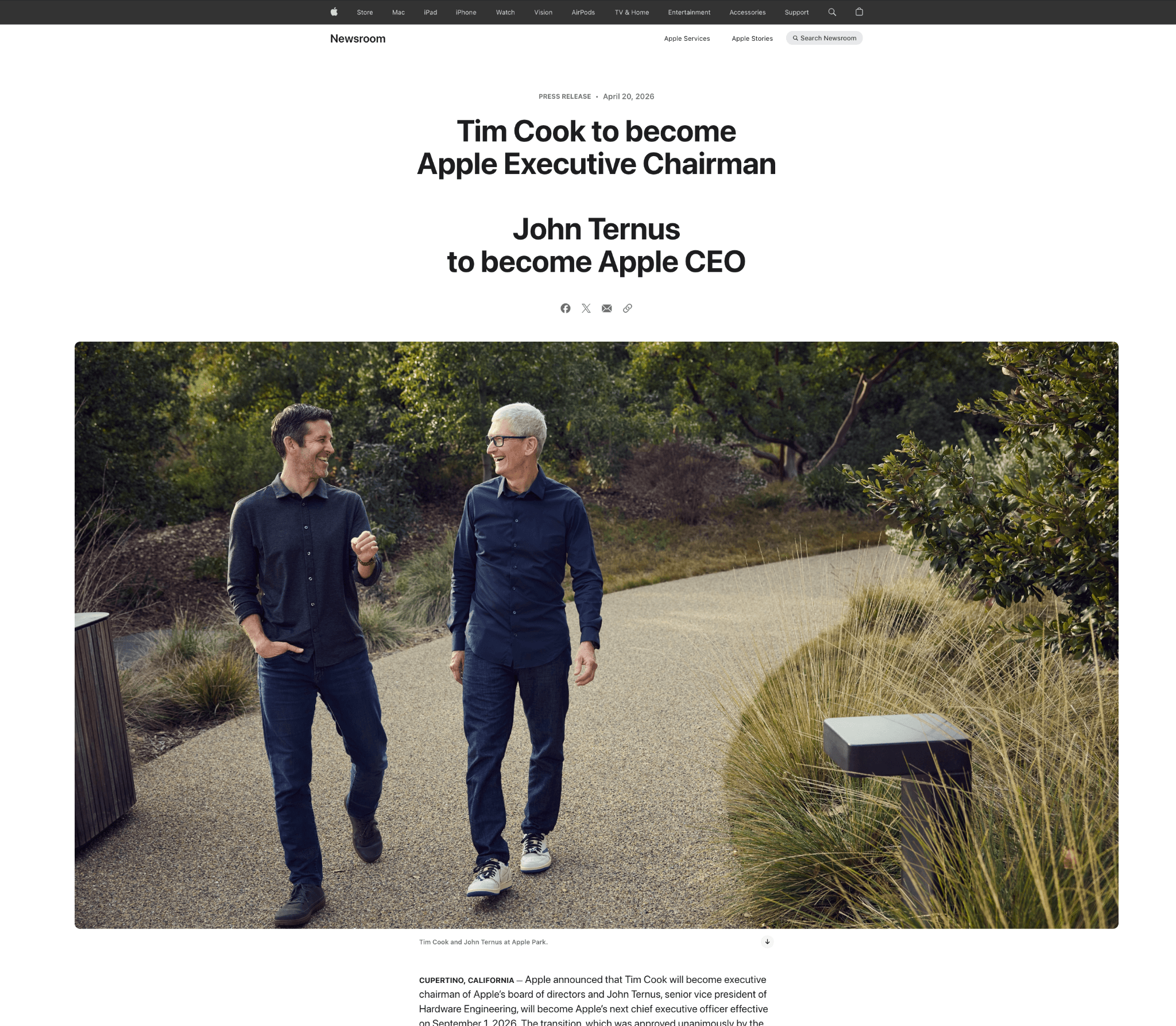
On April 20, 2026, Apple officially announced that its longtime leader, Tim Cook, would step down as Chief Executive Officer on September 1, 2026, and transition into the role of Executive Chairman of the Board. He would be succeeded by John Ternus, Apple’s Senior Vice President of Hardware Engineering. The announcement created only a modest ripple in capital markets. After the opening on April 21, 2026, AAPL price dipped by about 1% before quickly stabilizing. This stood in sharp contrast to 2011, when Steve Jobs’ death triggered a drop of about 6%. The difference suggests that the market has strong confidence in Apple’s succession planning. John Ternus has spent more than 25 years at the company and played a central role in the iPad roadmap and the Mac chip transition. Wall Street sees him as the successor best equipped to preserve Apple’s design discipline and engineering excellence. His technical background and deep understanding of Apple Silicon have reinforced confidence that Apple will maintain strategic continuity and operational stability through the AI transition and hardware refresh cycle in the second half of 2026.
Why do you invest in AAPL (Apple Inc. Common Stock)?
The core investment for AAPL lies in the stickiness of the Apple iOS ecosystem and the continued expansion of its global installed base. By early 2026, Apple had more than 2.5 billion active devices in use worldwide. That means a substantial share of connected users already live inside Apple’s ecosystem. This installed base allows the company to promote high-margin subscription services and AI features to existing users without materially raising customer acquisition costs. Once users become accustomed to Apple’s seamless cross-device experience, switching costs rise sharply. That creates a form of growth with strong defensive qualities and helps explain why AAPL is often treated as a preferred asset during periods of market uncertainty.
From a financial management standpoint, AAPL also offers a stable and highly visible cash flow profile. Apple has long targeted a net cash neutral position, which means excess profits beyond operating needs are returned through buybacks and dividends. For on-chain investors, tokenized Apple exposure offers an additional layer of utility. It provides access to the capital appreciation associated with technological progress while using decentralized blockchain rails to enable cross-border asset allocation. This model breaks through geographic and identity barriers and allows users who may struggle to open a U.S. stock account to participate in the growth of one of the world’s premier technology companies, while also benefiting from the efficient liquidity profile of RWA assets in DeFi environments.
Is AAPL (Apple Inc. Common Stock) a good investment?
In April 2026, AAPL traded at roughly 30 times forward earnings. That sits at the upper end of its historical range and suggests the market had already priced in the success of the iPhone 17 cycle and the premium attached to Apple’s AI transition. Even so, Apple’s 16% revenue growth and 19% earnings per share growth in the first quarter of 2026 showed that the company was still capable of outperforming expectations despite its already massive scale. For users seeking long-term, relatively stable returns, AAPL still stands as a core defensive holding. The record quarterly operating cash flow of $53.9 billion provides substantial room for execution mistakes and macro shocks.
At the same time, the risk profile cannot be ignored, especially when it comes to tariffs driven by geopolitical pressure. In the first quarter of 2026, Apple paid about $1.4 billion in tariffs. As trade policies shift across jurisdictions, that burden could keep rising and weigh on profit margins. The sharp increase in memory component prices, including NAND and DRAM, also creates pressure on hardware gross margins. In parallel, antitrust scrutiny around the roughly $20 billion annual payment Google makes to Apple for default search placement could disrupt the high-margin structure of Apple’s services business. These uncertainties mean AAPL is not a risk-free asset. Its price behavior often remains tightly linked to tariff policy and memory supply chain dynamics.
Overall, AAPL remained exceptionally well-positioned in 2026, with their 38% revenue rebound in China that exceeded the expectations of many analysts. For crypto users, using AAPLUSDT perpetual contracts for shorter-term hedging is one way to combine traditional equity exposure with the operational flexibility of blockchain markets. High valuation and tariff risk remain real headwinds. Even so, Apple’s moat of 2.5 billion active devices and its coming Siri AI cycle continue to make it one of the highest-conviction names in global technology. Its ultimate investment value depends on how users assess the speed of AI monetization and how much macro trade risk they are willing to absorb.
Explore the latest AAPL (Apple Inc. Common Stock) price and live chart, trade AAPL on FameEX, and access real-time market data! Get started now with a seamless trading experience!
Disclaimer: The information provided in this article is intended only for educational and reference purposes and should not be considered investment advice. Conduct your own research and seek advice from a professional financial advisor before making any investment decisions. FameEX is not liable for any direct or indirect losses incurred from the use of or reliance on the information in this article.