MSFT (Microsoft Corporation Common Stock) Token Price & Latest Live Chart
2026-05-05 02:49:34
What is MSFT (Microsoft Corporation Common Stock)?
Microsoft Corporation is no longer viewed only as a traditional software developer in the global technology landscape. It has been redefined as one of the world’s leading enterprise AI and cloud platform providers. Its core asset, MSFT common stock, represents ownership interest in this multinational technology giant and supports a full-stack technology ecosystem that spans foundational silicon design, large-scale data center construction, and upper-layer generative AI applications. After 2026, Microsoft’s project profile underwent a fundamental shift. The company completed its architectural transition from a software-first model to an AI-first model and became a core infrastructure provider for the Fourth Industrial Revolution. The value foundation of MSFT is now jointly driven by Azure AI services and the Copilot productivity engine. These two product lines have achieved scaled enterprise penetration with more than 200 million paid users. Through Microsoft’s deep and exclusive partnership with OpenAI, they also give the company priority access to some of the market’s most powerful language model inference and training capabilities.
As RWA tokenization technology matures, MSFT can be mapped onto blockchain networks through protocols such as Ondo and converted into a tokenized asset with 24/7 liquidity. This allows global investors to gain fractional exposure to the growth of a technology giant whose market capitalization has remained above $3 trillion for an extended period. Microsoft’s business scope covers the Windows operating system, Office productivity suite, Azure cloud computing, GitHub, and other core developer tools. In the 2026 crypto ecosystem, MSFT is no longer limited to Nasdaq-listed trading. Through MSFTUSDT perpetual contracts and tokenized stocks, it has become a bridge between traditional equity ownership and blockchain-native liquidity. The MSFTUSDT perpetual contract is a derivative product that tracks the price of Microsoft Corporation common stock. It allows traders to gain margin-based exposure to Microsoft’s growth premium in enterprise AI and cloud computing without holding physical shares. At the same time, the underlying MSFT tokenized asset plays a key role in the RWA market. Regulated institutions can lock physical shares in custody accounts and issue 1:1 equity-linked tokens onchain. This structure transforms MSFT from a traditional security constrained by market hours into an onchain value carrier with 24/7 liquidity, fractional trading, and potential DeFi collateral utility. It breaks down the asset barrier between traditional financial markets and decentralized finance. The existence of MSFT tokenized assets not only introduces high-quality equity exposure into the onchain ecosystem but also provides a precise price anchor for perpetual contracts. This helps synchronize virtual derivatives with real economic output and allows investors to participate in Microsoft’s growth narrative directly within a Web3 environment.
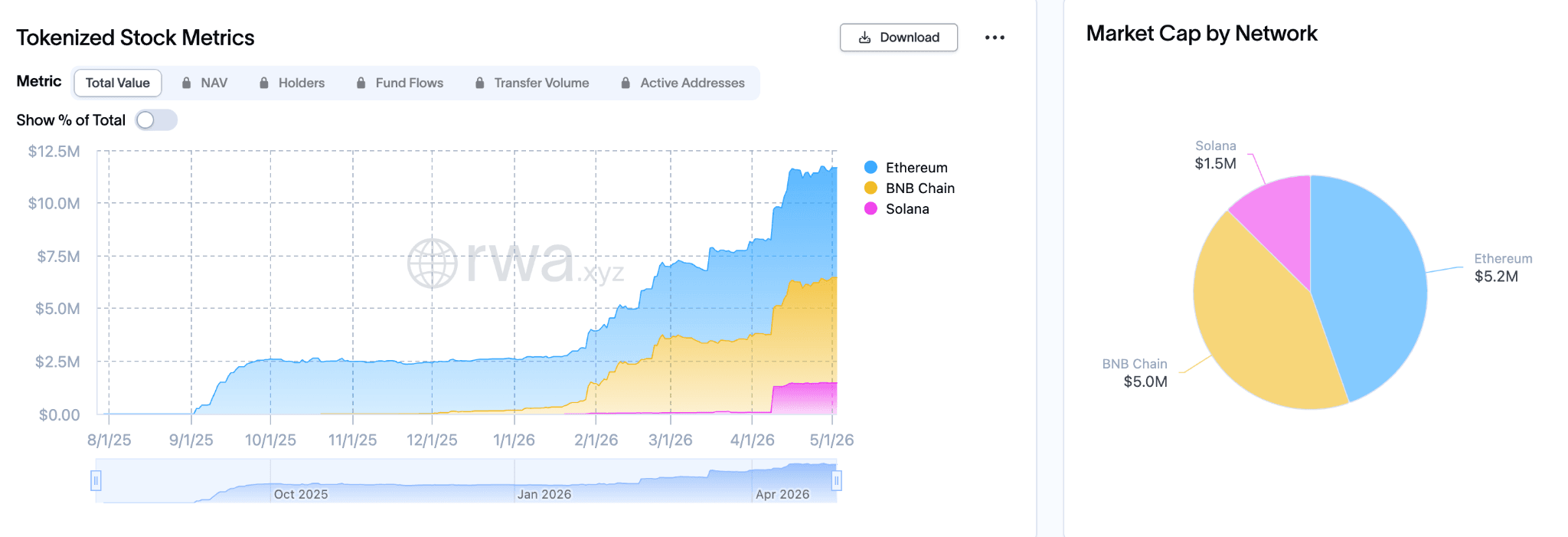
Microsoft (Ondo Tokenized Stock) of Total Value and Market Cap, Source: https://app.rwa.xyz/assets/MSFTon
How does MSFT (Microsoft Corporation Common Stock) work?
Microsoft’s operating mechanism is built on a highly integrated vertical ecosystem. It captures value and delivers technology through a three-layer structure of infrastructure, platform, and application. At the foundational layer, Microsoft invests heavily in global data centers and its self-developed Maia AI accelerator chips. This gives the company stronger cost control and supply stability than many competitors when global demand for AI compute expands rapidly. Azure serves as the middle layer. It converts these compute resources into AI APIs and cloud services that developers and enterprises can use. By early 2026, Azure had achieved revenue growth of more than 30%. This mechanism allows Microsoft to extract recurring technology revenue from global enterprise digital transformation instead of relying only on single software licenses.
At the application layer, Copilot is Microsoft’s core mechanism for commercializing AI at scale. It embeds generative AI directly into Microsoft 365 productivity tools, which already serve billions of users. This operating model benefits from high switching costs and strong user stickiness. Enterprise customers can become AI users without changing their existing workflows, which helps increase average revenue per user. Microsoft also has a mature governance mechanism and shareholder return framework. Through continuous share repurchases and dividend distributions, the company reallocates free cash flow generated by its AI business back to MSFT holders. This combination of stable cash flow production and high-growth technology exposure creates a financial model with both defensive and offensive characteristics. It also gives Microsoft strong resilience during macroeconomic volatility.
The concept of the MSFTUSDT perpetual contract lies in its price anchoring mechanism. This mechanism is mainly implemented through oracle technology and the funding rate system. Oracles aggregate the real-time Nasdaq price of MSFT with the trading price of onchain tokenized assets. They then transmit the resulting mark price to the perpetual contract engine. When the contract price deviates from the traditional spot market price, the funding rate mechanism guides compensation between long and short positions. This pushes the contract price back toward spot value. Unlike the traditional stock market, this mechanism supports leverage and has no expiry date. Traders can hold long or short exposure to Microsoft’s AI transformation for an extended period. This derivative structure significantly improves capital efficiency. It allows investors to hedge risk or capture trends related to Microsoft’s self-developed Maia AI chips and global data center capital expenditure with a smaller capital base. When these fundamentals translate into stock price movement, the transmission through tokenized assets allows the MSFTUSDT perpetual contract to respond with minimal delay. This hybrid model combines RWA-backed value with derivative liquidity. It creates a financial matrix with both defensive and offensive features and allows holders to optimize asset allocation while maintaining exposure to Microsoft’s equity growth.
MSFT (Microsoft Corporation Common Stock) market price & tokenomics
As of April 2026, MSFT was trading near historical highs. This reflected the market’s strong recognition of Microsoft’s full-stack AI strategy. From a tokenomics perspective, MSFT common stock cannot be analyzed in the same way as a crypto-native token. Its total supply is shaped by Microsoft’s capital management policy. Regular share repurchase programs create deflationary pressure on the share base and can improve earnings per share and ownership concentration for remaining holders. In 2025, Microsoft generated approximately USD 245 billion in total revenue, up 16% year over year. Intelligent Cloud had become the company’s most important revenue pillar and contributed more than half of the incremental profit growth. This shift in revenue structure shows that Microsoft has evolved from a cyclical software vendor into a persistent infrastructure provider.
The onchain price dynamics of the MSFTUSDT perpetual contract are closely linked to Microsoft tokenized equity. These tokenized assets can support fractional trading with a minimum exposure of 0.01 share. This significantly lowers the entry threshold for retail users who want exposure to high-priced blue-chip equities. It also improves asset turnover through DeFi protocols. Data from April 2026 showed that analyst targets for MSFT were generally distributed between $480 and $550, while bullish scenarios extended as high as $600. This price expectation was not purely sentiment-driven. It was supported by Azure AI’s segment growth of more than 50% and Copilot paid seats exceeding 200 million in 2026. For participants in the MSFTUSDT perpetual contract, this deep real-world value foundation means lower manipulation risk and stronger fundamental anchoring. It also demonstrates that real-world assets can retain powerful fundamental drivers after being transformed into derivative products.
Why do you invest in MSFT (Microsoft Corporation Common Stock)?
In the 2026 technology cycle, Microsoft has successfully converted generative AI from a pure research and development expense into a measurable revenue engine. By embedding Copilot into enterprise workflows around the world, Microsoft has built a digital operating position that is extremely difficult to replace. This vertically integrated business model allows investors to capture both foundational compute exposure through Azure AI and upper-layer application economics through Microsoft 365. It also carries strong countercyclical resilience because enterprise demand for productivity tools remains stable even during economic volatility. In addition, Microsoft’s deep and exclusive partnership with OpenAI helps preserve its lead in core model technology. This technical moat is supported by a highly stable balance sheet and an ongoing share repurchase policy. Together, these factors create an investment return structure that combines growth potential with defensive strength. MSFT is one of the few assets in the fast-moving AI sector that can offer a meaningful long-term margin of safety through both operating scale and financial discipline.
For Web3 and RWA investors, MSFT is more about demand for high-quality onchain assets and diversified allocation. Through MSFTUSDT perpetual contracts or tokenized equity, investors can anchor part of their portfolio to a leading U.S. enterprise with real economic output. This is fundamentally different from native tokens that rely mainly on market sentiment. Microsoft acts as a toll collector of the global digital economy. Its stable cash flow and dividend policy can be made more liquid through tokenization, allowing investors to access equity-linked growth within an onchain environment while staying synchronized with traditional financial markets. This allocation is not limited to a single company. It also reflects strategic exposure to the next decade of global digital infrastructure development. Its relatively high liquidity and lower volatility profile make it a potential cornerstone asset within decentralized finance, where it can help improve the risk-adjusted return profile of a broader portfolio.
Is MSFT (Microsoft Corporation Common Stock) a good investment?
Although the market has short-term concerns about margin pressure from Microsoft’s heavy data center expansion and AI chip procurement, Azure AI’s segment growth of more than 50% shows that these investments have already produced strong marginal benefits. Microsoft’s demonstrated margin resilience suggests that the company has moved beyond the early pain points of technology deployment and entered a stage of scaled monetization. This is particularly challenging in the highly competitive fields of cloud computing and software development. Analysts generally believe that Microsoft’s valuation premium has strong fundamental support as long as the company maintains its enterprise AI penetration pace. From the standpoint of technological transformation, Microsoft is one of the most representative and structurally stable growth assets in the current digital transition. The combination of stable market position and future growth potential gives it high investment quality.
However, MSFT remains exposed to macro conditions and regulatory policy as an investment instrument. This is especially true for antitrust scrutiny targeting large technology companies and supply constraints in high-performance chips across the global supply chain. Investors still need to monitor changes in capital market expectations for AI monetization. If enterprise AI adoption slows at the margin, or if the payback cycle for infrastructure investment takes longer than expected, the stock could face short-term valuation correction. Even so, Microsoft’s deep software ecosystem moat and cloud subscription revenue give it stronger downside protection than pure hardware manufacturers. Based on operating data and market penetration analysis, Microsoft remains a top-tier equity asset in global risk asset allocation in 2026. Its stable dividend history and innovative technology roadmap together support its long-term investment profile.
Explore the latest MSFT (Microsoft Corporation Common Stock) price and live chart, trade MSFT on FameEX, and access real-time market data! Get started now with a seamless trading experience!
Disclaimer: The information provided in this article is intended only for educational and reference purposes and should not be considered investment advice. Conduct your own research and seek advice from a professional financial advisor before making any investment decisions. FameEX is not liable for any direct or indirect losses incurred from the use of or reliance on the information in this article.