SNDK (Sandisk Corporation Common Stock) Token Price & Latest Live Chart
2026-05-11 12:30:28

What is SNDK (Sandisk Corporation Common Stock)?
SNDK represents the common stock of SanDisk Corporation. In the digital asset trading environment, it is usually presented through the SNDKUSDT perpetual contract, which is designed to track the real-time value of this global storage technology leader in the Nasdaq market. The company was founded in California in 1988 and completed its strategic separation from Western Digital in early 2025, returning to the public market as an independent listed entity focused on the development and manufacturing of data storage solutions based on NAND flash memory technology. On April 20, 2026, SanDisk officially replaced Atlassian as a constituent of the Nasdaq 100 Index. This milestone triggered mechanical buying from passive funds tracking more than USD 600 billion in assets, transforming the company from a cyclical hardware component supplier into a highly liquid technology heavyweight with a stronger institutional ownership base. For users on Web3 platforms, the SNDK derivative contract provides a transparent and efficient gateway to hedge or gain exposure to a core enterprise asset at the center of the AI compute arms race, without the need to open a traditional US equity brokerage account.
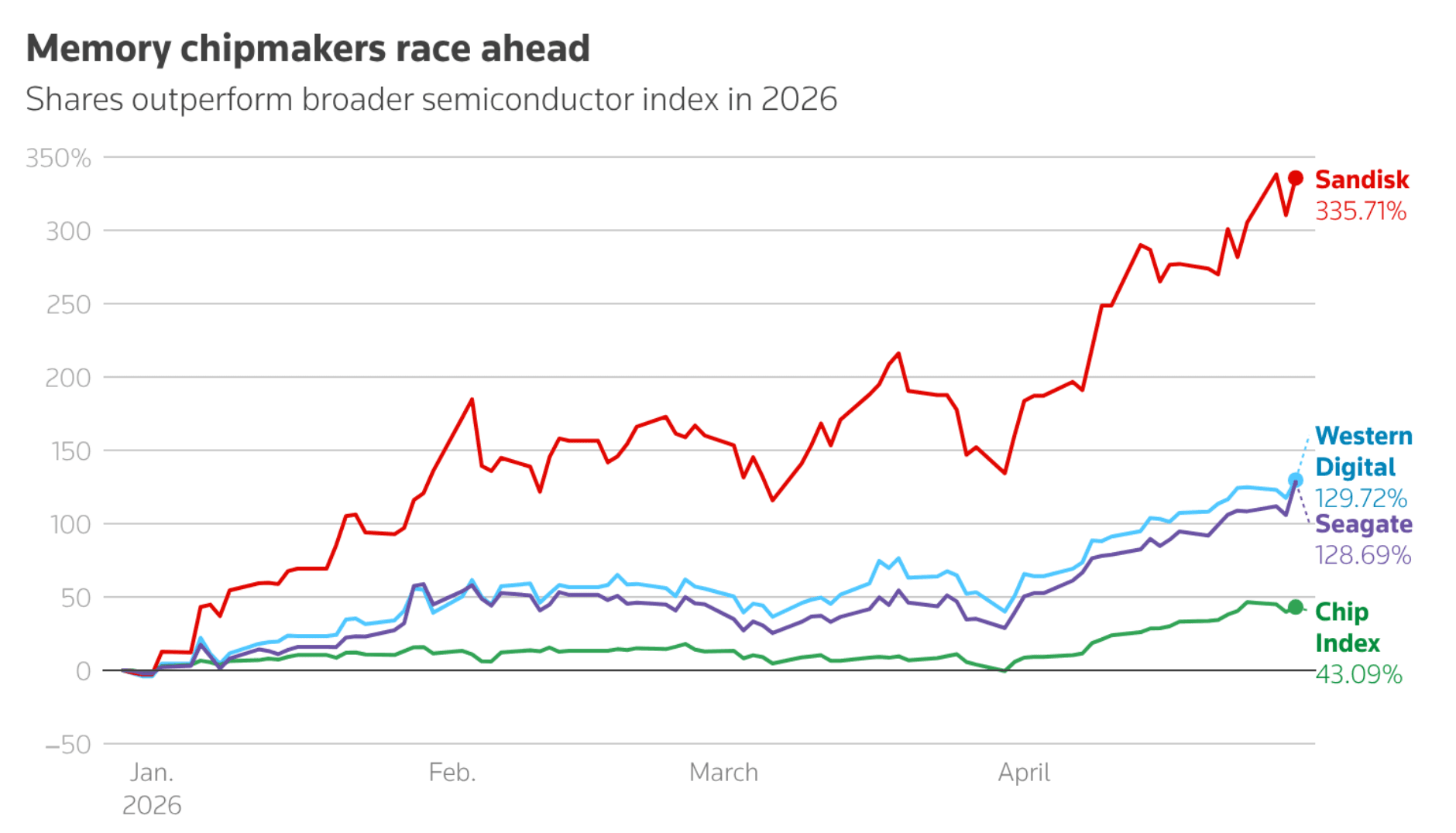
Chart comparing memory chipmarks’ price performance with the Philadelphia Semiconductor Index, Source: LSEG Datastream
The purpose of this asset lies in the deeper integration between real-world assets (RWA) and onchain financial mechanisms. This is especially relevant in 2026, when demand for high-performance storage from AI models has grown at an exponential pace. SNDK has become an important benchmark for measuring the cost and efficiency of AI infrastructure. SanDisk’s technical center of gravity has shifted from traditional consumer-grade products to enterprise solid-state drives, which serve as a foundational hardware layer for data centers running large language models. In its fiscal third-quarter report released in late April 2026, the company further strengthened its pricing power across the semiconductor supply chain through strong revenue performance and explosive earnings-per-share growth. Through the SNDKUSDT perpetual contract, market participants can capture the value fluctuations of this technology company within the 2026 AI supercycle through USDT underlying assets and a round-the-clock trading environment. This form of digitized equity exposure improves capital circulation efficiency and allows global users to participate in the growth of leading technology enterprises within a unified onchain financial ecosystem.
How does SNDK (Sandisk Corporation Common Stock) work?
The operating logic of SNDK is built around the shift toward storage-as-compute, a technical pathway that has emerged from the extreme data throughput requirements of large language models. SanDisk’s vertically integrated model gives it control across the chain from wafer manufacturing to finished enterprise SSD products, allowing the company to maintain strong pricing power during the severe global NAND supply shortage seen in 2026. The company’s technical foundation is closely tied to the new business model introduced in early 2026, which was designed to break the long-standing boom-and-bust cycle of the storage industry. By signing capacity agreements with strategic partners such as Nanya Technology and maintaining strict build-to-demand discipline, SanDisk can support a steadier increase in average selling prices while reducing the risk of uncontrolled supply expansion.
SanDisk’s 2026 technology roadmap focuses on improving the performance of the data persistence layer inside large-scale AI clusters. This direction helps preserve hardware demand even as software optimization tools such as Google’s TurboQuant challenge traditional memory consumption patterns. SNDK’s technical mechanism is rooted in a highly integrated NAND flash manufacturing process, giving the company direct control over the path from wafer production to final enterprise SSD deployment. Under the new business model launched in early 2026, SanDisk used long-term capacity protection agreements and strict demand-based production discipline to reduce the severe supply and demand swings that have historically defined the storage industry. This storage-as-compute transition shifts the company’s research and product focus toward enterprise-grade solutions with extremely high data throughput, which directly aligns with the data center requirements of large-scale parallel computing in 2026.
Moreover, SNDK’s market operation is also deeply shaped by passive fund management mechanisms, especially after SanDisk officially replaced Atlassian as a Nasdaq 100 constituent on April 20, 2026. This inclusion required ETFs tracking more than USD 600 billion in assets to purchase billions of dollars in SanDisk shares, creating a high-liquidity base in the market. In the onchain environment, the liquidity spillover created by institutional allocation can be reflected in tighter contract spreads and deeper order books. This makes SNDK one of the few cross-market assets that can maintain high volatility while still offering relatively strong execution certainty. The SNDKUSDT perpetual contract is an innovative equity derivative whose core function is to track the price movement of SanDisk Corporation common stock listed on Nasdaq through decentralized or hybrid trading venues. Unlike traditional securities trading, which is constrained by market hours, the SNDKUSDT perpetual contract provides global users with round-the-clock price discovery. It also relies on mark price and index price alignment to keep the onchain contract value closely synchronized with the underlying US equity market, reducing technical barriers to cross-market arbitrage. Tokenized SanDisk exposure is converted into precise perpetual contract parameters, giving users a risk management framework similar to professional institutional markets and enabling a deeper connection between the real economy and Web3 finance.
SNDK (Sandisk Corporation Common Stock) market price & tokenomics
SNDK showed an unprecedented parabolic move between 2025 and 2026, reaching a record closing high of $1,509 on May 6, 2026. Over the previous 12 months, the stock gained more than 3,300%, mainly driven by intense market demand for AI storage infrastructure during April 2026 and the company’s official inclusion in the Nasdaq 100 Index. The asset’s economic model also includes a high degree of strategic control over the supply cycle, which became a major topic in market analysis during May 2026. SanDisk’s gross margin was expected to reach 65% to 67% in the third quarter of 2026, supported by the broad adoption of enterprise SSDs across data centers. This segment had already replaced consumer electronics as the largest buyer of NAND. The company’s strong cash flow and profitability are directly reflected in the premium structure of its derivative contracts, making tokenized SNDK more than a simple price-tracking instrument. It functions as a high-quality collateral-like exposure backed by real industrial earnings. In the May 2026 trading environment, SNDK had established a closed-loop value transmission model from real-world corporate profit to onchain asset pricing, helping it stand out among tokenized real-world asset products.
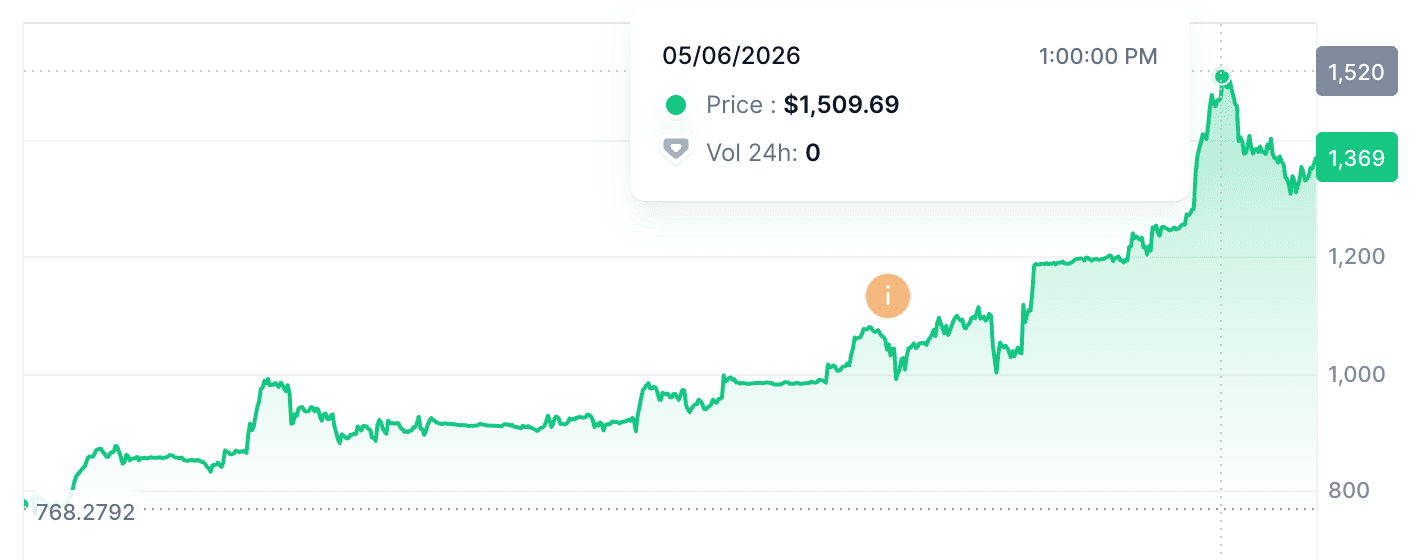
Within its longer-term economic mechanism, the SNDKUSDT contract uses high-frequency funding rate settlement to maintain cross-market value balance and reduce sustained premiums or discounts between the onchain contract price and the underlying equity market. Data from early May 2026 showed that as SanDisk’s share price held above the four-digit level, contract open interest continued to expand steadily. This reflected a stronger market consensus around its long-term growth profile. Unlike traditional futures, the perpetual contract structure removes rollover costs and expiry-date risk, which improves the efficiency of capturing exposure to the AI supercycle. SanDisk’s new business model significantly reduces operational volatility, and this lower-risk profile is transmitted into the derivatives market. Therefore, the SNDK contract carries an asset resilience closer to traditional blue-chip technology equities. In the 2026 global financial landscape, SNDK’s contract-based economic model has become an important framework for linking real industrial earnings with onchain capital allocation.
Why do you invest in SNDK (Sandisk Corporation Common Stock)?
The macro logic behind investing in SNDK is based on its position as a payment node for the AI tax. Any cloud service provider that wants to expand intelligent service capacity must purchase expensive high-performance storage equipment from suppliers such as SanDisk. The May 2026 market environment showed that data center demand was no longer a secondary component of the cycle. It had become the fastest-growing profit center, with 64% year-over-year growth demonstrating the scarcity of storage resources in the AI infrastructure race. For market participants, gaining exposure to SNDK derivatives means accessing this structural premium with high capital efficiency. This premium is supported by real supply dislocation rather than pure market speculation. Compared with the high competition and easy substitution risk in software development, SanDisk’s wafer manufacturing capability and vertically integrated system create a capital-intensive barrier that is difficult to replicate.
In asset allocation, SanDisk’s successful inclusion in the Nasdaq 100 Index on April 20, 2026 brought more than symbolic recognition of its technical strength. It also introduced a large passive ownership base, giving the asset stronger support during macro volatility than many smaller technology names. For Web3 users, the advantage of trading the SNDKUSDT contract lies in accessing the same level of transparent information available to institutional participants, while using the flexible leverage and execution tools offered by onchain or hybrid trading platforms. As global compute demand continued to expand in May 2026, SNDK offered a hard-asset-like exposure supported by real corporate cash flow. This created a complementary profile to purely code-driven crypto assets and helped reduce portfolio dependence on a single digital-native risk factor.
SanDisk has transformed itself from a traditional component manufacturer into a strategic supplier of AI infrastructure materials. This has led the market to view its stock as a tool for hedging against digital economy inflation. As storage performance becomes a core requirement rather than an optional feature for large language models, SanDisk’s technology patents and vertically integrated production capacity give it stronger bargaining power with major technology companies. Investing in SNDK derivatives means allocating capital to an asset with stronger auditability, real earnings support, and clearer corporate disclosure than purely speculative tokens in the RWA sector of Web3 ecosystem. This technical resilience and market leadership make SNDK an important equity asset within the 2026 technology allocation landscape, representing long-term exposure to the physical foundation of an increasingly AI digital society in the future.
Is SNDK (Sandisk Corporation Common Stock) a good investment?
Evaluating the long-term value of SNDK requires attention to capacity expansion from 2026 to 2028 and the pace of technological iteration among competitors. Although target prices had been raised above $1,250 by May 2026, market participants still need to account for the risk of cyclical maturity and supply-demand normalization after 2028. SanDisk’s strong rebound in April 2026 showed that its valuation framework had shifted from a commodity-based logic toward an AI infrastructure logic. This transition created a valuation premium, but it also made the stock more sensitive to global AI investment sentiment. For traders participating in the SNDKUSDT perpetual contract, data center revenue changes and NAND average selling price trends remain key indicators for assessing whether the asset can sustain elevated market levels.
On the risk side, the software efficiency improvements that appeared in March 2026 briefly triggered an 11% pullback in the stock price, suggesting that future optimization on the software side could eventually ease pressure on hardware shortages. Although the Nasdaq 100 inclusion in April 2026 brought significant technical buying, the stock could enter a longer consolidation phase after that buying flow is completed. Market participants also need to monitor support from key indicators such as the 50-day moving average after May 2026, as well as the potential effect of global macro conditions and semiconductor export policies. Risk assessment should also include technological substitution and efficiency gains. Google’s TurboQuant algorithm, introduced in March 2026, briefly reduced market confidence in physical memory demand. Analysts also warned that after 2028, the natural maturity of the storage cycle could expose SNDK to slower growth if supply begins to exceed demand. Even so, SanDisk’s leadership in enterprise storage and its reported sales visibility through 2028 allow it to retain a highly favorable position within the 2026 technology investment landscape.
Explore the latest SNDK (Sandisk Corporation Common Stock) price and live chart, trade SNDK on FameEX, and access real-time market data! Get started now with a seamless trading experience!
Disclaimer: The information provided in this article is intended only for educational and reference purposes and should not be considered investment advice. Conduct your own research and seek advice from a professional financial advisor before making any investment decisions. FameEX is not liable for any direct or indirect losses incurred from the use of or reliance on the information in this article.