FameEX Today’s Crypto News Recap | August 21, 2026
2026-08-21 07:05:49

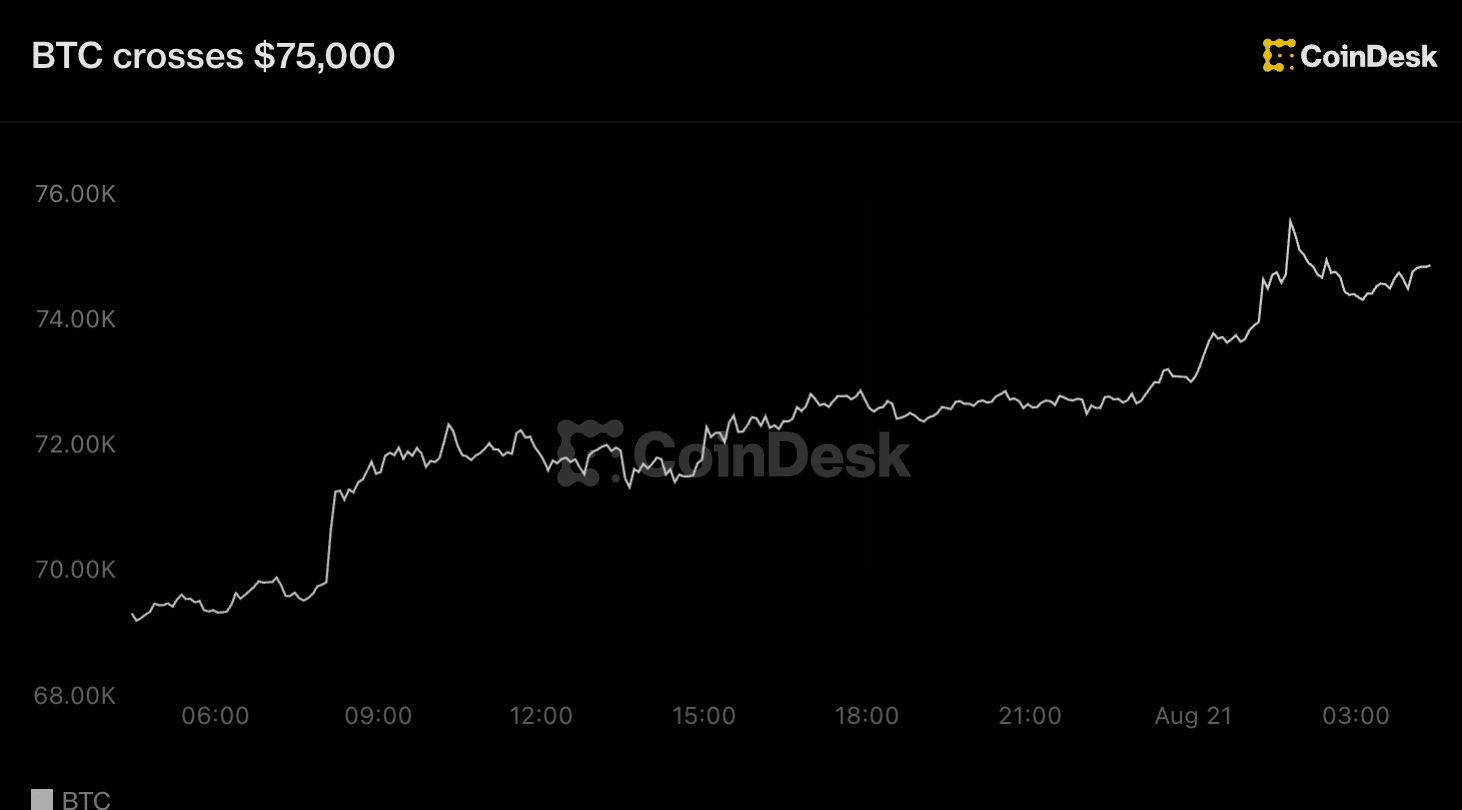
U.S. debt tops $40T as Bitcoin miners accelerate AI expansion and Operation Asterix exposes phishing risks; today’s BTC briefly reached $75K and entered Greed sentiment. Bitcoin has accelerated sharply in recent days and briefly reclaimed $75,000, with its 24-hour gain exceeding 8% at one point. ETH also followed the broader market rebound and moved back above $2,300. The rally was initially driven by rapid changes in the U.S. bond market. The U.S. Treasury announced an expansion of its long-term debt buyback program, doubling the size of individual purchases of 10- to 30-year Treasuries from about USD 2 billion to at least USD 4 billion. The move was intended to improve liquidity in the long-term Treasury market and ease pressure from the rapid rise in yields. Following the announcement, long-term U.S. Treasury yields fell sharply for a period while the dollar weakened. This temporarily eased concerns over tighter financial conditions and drew renewed market attention to alternative assets such as BTC and gold. At the same time, the U.S. government again signaled progress toward crypto market legislation, which helped improve expectations for the regulatory environment surrounding digital assets. According to market data, if Bitcoin falls below $70,909, cumulative long liquidation intensity across major CEXs could reach USD 1.961 billion. If BTC rises above $78,280, cumulative short liquidation intensity could reach USD 579 million. For Ethereum, a decline below $2,227 could expose around USD 1.341 billion in long liquidation intensity, while a move above $2,459 could result in USD 535 million in short liquidation intensity. As prices recovered sharply, unrealized losses on institutional holdings also narrowed significantly. On-chain data showed that one major institution's unrealized Bitcoin loss had fallen to USD 685 million, bringing its position close to breakeven. These developments highlight the latest shift in crypto market structure as changes in macro conditions intersect with institutional positioning.
Capital flows have also strengthened considerably. The U.S. spot Bitcoin ETFs recorded around USD 517 million in net inflows in a single day, marking their largest daily inflow in roughly three and a half months. This suggests that the latest rebound has not been driven solely by short-term retail activity. After BTC broke above the $60K to $65K range that had held for several weeks, accumulated short positions began to unwind. The resulting short covering amplified the upward move and turned a macro-driven rebound into a broader rally supported by spot demand, institutional capital, and position liquidations. Leverage also increased across the derivatives market. Total Bitcoin futures open interest now stands at around 734,900 BTC, worth approximately USD 54.967 billion, after rising 5.65% over 24 hours. Ethereum futures open interest reached about 13.1407 million ETH, worth approximately USD 30.917 billion, after increasing 5.17% over the same period. Market sentiment has also improved rapidly. The Crypto Fear & Greed Index rose from 62 yesterday to 72 and remains in the "Greed" zone. This marks a significant shift from the reading of 29 recorded one week ago. From a broader market structure perspective, the latest rebound in BTC and ETH has been supported by several factors. These include the repricing of the U.S. Treasury market, a weaker dollar, improving regulatory expectations, renewed ETF inflows, and concentrated short covering. The simultaneous rise in futures open interest also shows that leveraged trading activity is picking up alongside stronger spot demand.
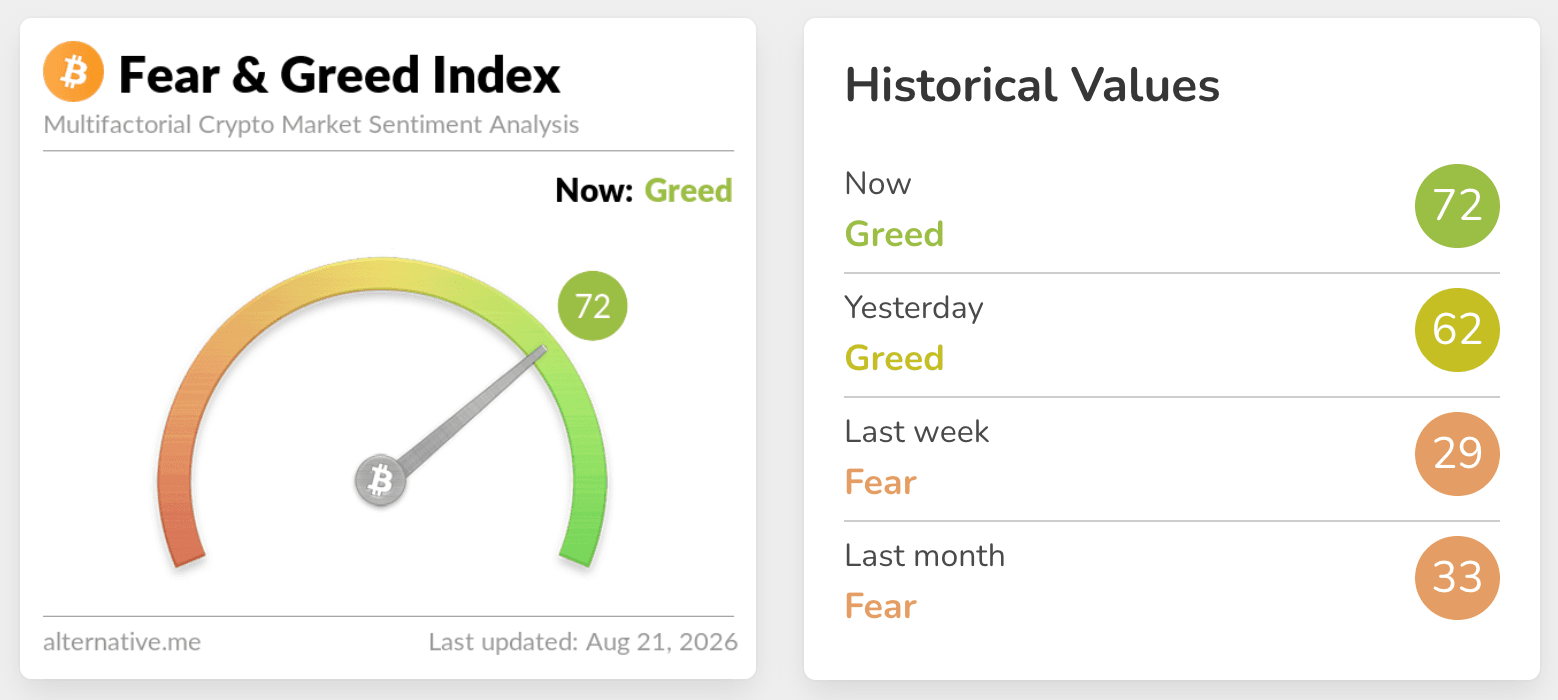
Source: Alternative
Key News Highlights:
U.S. Federal Debt Tops USD 40 Trillion as Bitcoin and Fiscal Risks Return to Focus
U.S. federal debt has surpassed USD 40 trillion for the first time, putting government borrowing, interest expenses, and the long-term purchasing power of the dollar back in focus across global financial markets. U.S. Treasury data shows that around USD 32.3 trillion of federal debt is held by the public, while approximately USD 7.8 trillion is held within government accounts. Total federal debt has more than doubled since 2017. Interest expenses have also continued to climb alongside the rapid increase in debt. During the first 10 months of fiscal 2026, federal interest costs surpassed Medicare spending and became the government's second-largest budget expense after Social Security. Long-term Treasury yields have also risen sharply in recent weeks. The 30-year Treasury yield briefly reached 5.34%, its highest level since 2007. The move reflected renewed investor concerns over fiscal deficits, government financing needs, and longer-term inflation risks. In response to volatility in the bond market, the U.S. Treasury announced that it would double the size of certain 10- to 30-year Treasury buyback operations to at least USD 4 billion per transaction. The measure is intended to improve liquidity in the long-term government bond market. Long-term yields briefly declined following the announcement, while the dollar weakened and both gold and Bitcoin moved higher. As U.S. debt reaches a new record, the market is again debating whether Bitcoin's fixed supply could attract greater attention during periods of heightened fiscal uncertainty. Some market participants view Bitcoin and gold as examples of non-sovereign assets that may receive greater attention under such conditions. Other analysts have noted that the size of U.S. federal debt alone does not determine Bitcoin's short-term price direction. Dollar strength, long-term Treasury yields, inflation expectations, and overall market liquidity remain important factors in asset pricing. The USD 40 trillion milestone has therefore renewed debate over public finances as well as the government's ability to manage borrowing costs, maintain Treasury demand, and address persistent fiscal deficits. The simultaneous rise in Bitcoin and gold has also brought the relationship between sovereign debt and non-sovereign assets back into market discussion.
Bitcoin Miners Accelerate AI Expansion as First-Half Capex Exceeds USD 5 Billion
Bitcoin mining companies are accelerating their expansion into artificial intelligence and high-performance computing as they seek new revenue sources from existing power capacity, data-center sites, and computing infrastructure. Data from BlocksBridge Consulting shows that nine comparable publicly listed Bitcoin miners spent more than USD 5 billion on AI- and HPC-related infrastructure during the first half of 2026. These businesses generated only around USD 341.2 million in revenue over the same period. Based on the relationship between capital expenditure and revenue, the companies invested roughly USD 15 in capital assets for every USD 1 earned from AI and HPC operations. Across a broader group of 15 Bitcoin miners and AI data-center companies, total capital expenditure reached USD 30.7 billion during their latest reporting periods. That figure was already 42.6% higher than total spending for all of 2025. Despite the heavy upfront investment, AI-related revenue has begun to increase at some companies. The nine miners generated around USD 205.8 million from AI and HPC operations in the second quarter, representing a 52% increase from the previous quarter. Converting mining infrastructure into AI-ready data centers involves far more than repurposing existing mining machines. Companies must build or upgrade substations, data-center facilities, cooling systems, networking infrastructure, and other equipment required for high-density computing. Some projects also require dedicated hardware such as GPUs, which further increases initial capital requirements. Bitcoin miners have faced several pressures in recent years, including lower block rewards, rising mining difficulty, volatile energy prices, and the need for frequent equipment upgrades. As a result, more publicly listed miners are seeking to provide their power and data-center capacity to AI and HPC customers. Some companies have also begun signing long-term data-center hosting and computing service agreements to reduce their dependence on Bitcoin prices and mining output. As demand for AI infrastructure continues to grow, the industry's attention is increasingly focused on how quickly miners can transition toward data-center operations and when their substantial capital investments can begin generating more stable revenue.
Operation Asterix Crypto Phishing Campaign Targets About 885,000 Phone Numbers
Cybersecurity firm Rapid7 has disclosed a large-scale cryptocurrency phishing campaign known as Operation Asterix. Investigators found that attackers had collected around 885,000 phone numbers from multiple countries and regions. The campaign was designed to steal crypto assets through phone calls, fraudulent emails, and fake applications. According to attack records recovered by Rapid7, large volumes of potential victim data had already been categorized by country, platform, and user type. The largest individual dataset contained 316,002 German mobile phone numbers. Other directories included records linked to Hong Kong, Bulgaria, the United Kingdom, the United States, Canadian fintech companies, and hardware wallet users. Investigators also found 5,576 accounts identified by attackers as users of a major CEX. These accounts had already been placed in a queue for future attacks. The recovered records also contained fraudulent emails impersonating other cryptocurrency service providers. One of the main tactics used in Operation Asterix involved sending fake customer support or security notification emails before contacting victims by phone. This approach was intended to make the messages appear more credible and encourage users to follow further instructions. Attackers also created fake applications and websites that impersonated wallet services such as Ledger, Trezor, and Exodus. Their goal was to trick users into entering sensitive information such as wallet seed phrases. Once a seed phrase was submitted, attackers could gain control of the associated wallet and transfer its crypto assets. These attacks do not require hackers to break blockchain protocols or wallet encryption directly. Instead, they rely on social engineering to persuade users to disclose login credentials, seed phrases, and other security information. Previous blockchain security data also shows that phishing and social engineering remain major sources of losses across the crypto industry. Such attacks caused around USD 306 million in losses during the first quarter of 2026, compared with approximately USD 482 million in total losses from crypto security incidents during the same period. The disclosure of Operation Asterix shows how crypto phishing has evolved beyond isolated fake websites into coordinated campaigns that combine large user databases, phone scams, fraudulent customer support, and fake applications.
Bitcoin Briefly Tops $75,000 as Major Crypto Assets Extend Rebound
Bitcoin's latest rebound continued to gain momentum as the asset briefly moved back above $75,000 for the first time since late May. Market data showed BTC reaching $75,021 at one point, representing an 8.18% gain over 24 hours and extending the sharp recovery seen in recent days. On a weekly basis, Bitcoin has recently gained close to 20%. This marks a clear shift from the prolonged consolidation around the $60K to $65K range. ETH also continued to recover and recently traded above $2,300, with its weekly gain reaching double digits. Other major crypto assets moved higher as well. XRP recorded a daily gain of around 16% at one point during the rally. Bitcoin's return above $75,000 also brought some large institutional holders close to their breakeven levels after previously carrying significant unrealized losses. Strategy, for example, has an average reported Bitcoin acquisition cost of around $75,385. Its unrealized loss narrowed sharply as BTC approached that level. On-chain cost-basis distribution data shows that a large amount of BTC previously changed hands between $61,849 and $63,111, making the range an important recent concentration of market activity. Trading activity has now shifted back toward the $75K area as prices move higher. Derivatives activity has also risen alongside spot prices. Open interest in both BTC and ETH futures increased by more than 5% over 24 hours, showing that more capital is returning to perpetual futures and other derivatives markets. U.S. spot Bitcoin ETF flows have also improved significantly. The products recently recorded around USD 517 million in daily net inflows, one of their strongest single-day readings since early May. BTC's return to the $75K level has therefore become one of the week's most closely watched crypto market developments. Trading activity, ETF flows, and derivatives positioning have all risen toward recent highs alongside the price rebound.
Disclaimer: The information provided in this section is for informational purposes only and doesn't represent any investment advice or FameEX's official view.