FameEX Today’s Crypto News Recap | August 11, 2026
2026-08-11 07:01:42

Thailand launches five-year crypto tax relief as Trump Media revamps its treasury and TRON USDT supply hits a record; today’s BTC trades near $64K in Fear sentiment. Overall crypto market sentiment remains in the Fear zone. The Fear and Greed Index currently stands at 29, slightly below yesterday's 30. Last week's data was 25, which fell within the Extreme Fear range. This suggests that the market is gradually attempting to stabilize and repair sentiment after the recent volatility. On-chain data shows that the number of wallets holding at least 10,000 BTC has risen to 90, marking a six-month high. The increase reflects renewed strategic accumulation by large institutions and whale investors during a period of weak market sentiment. Meanwhile, BlackRock's Head of Digital Assets noted that the correlation between Bitcoin and U.S. equities has weakened significantly. Bitcoin also showed notable resilience during the recent sharp correction in the AI sector. This provides further support for the view that Bitcoin may serve as a portfolio diversification tool and a hedge against tail risk. Institutional flows also improved in July. Global crypto exchange-traded products recorded USD 600 million in net inflows, reversing two consecutive months of substantial outflows. Ethereum-native products led the market with USD 350 million in net inflows. In the derivatives market, Coinglass data shows that if Bitcoin breaks above $67,150, cumulative short liquidation intensity across major CEXs could reach USD 1.341 billion. If Bitcoin falls below $61,235, cumulative long liquidation intensity could reach USD 907 million. For Ethereum, a move above $1,968 could bring cumulative short liquidation intensity across major CEXs to USD 1.163 billion. If ETH falls below $1,792, cumulative long liquidation intensity could reach USD 550 million.
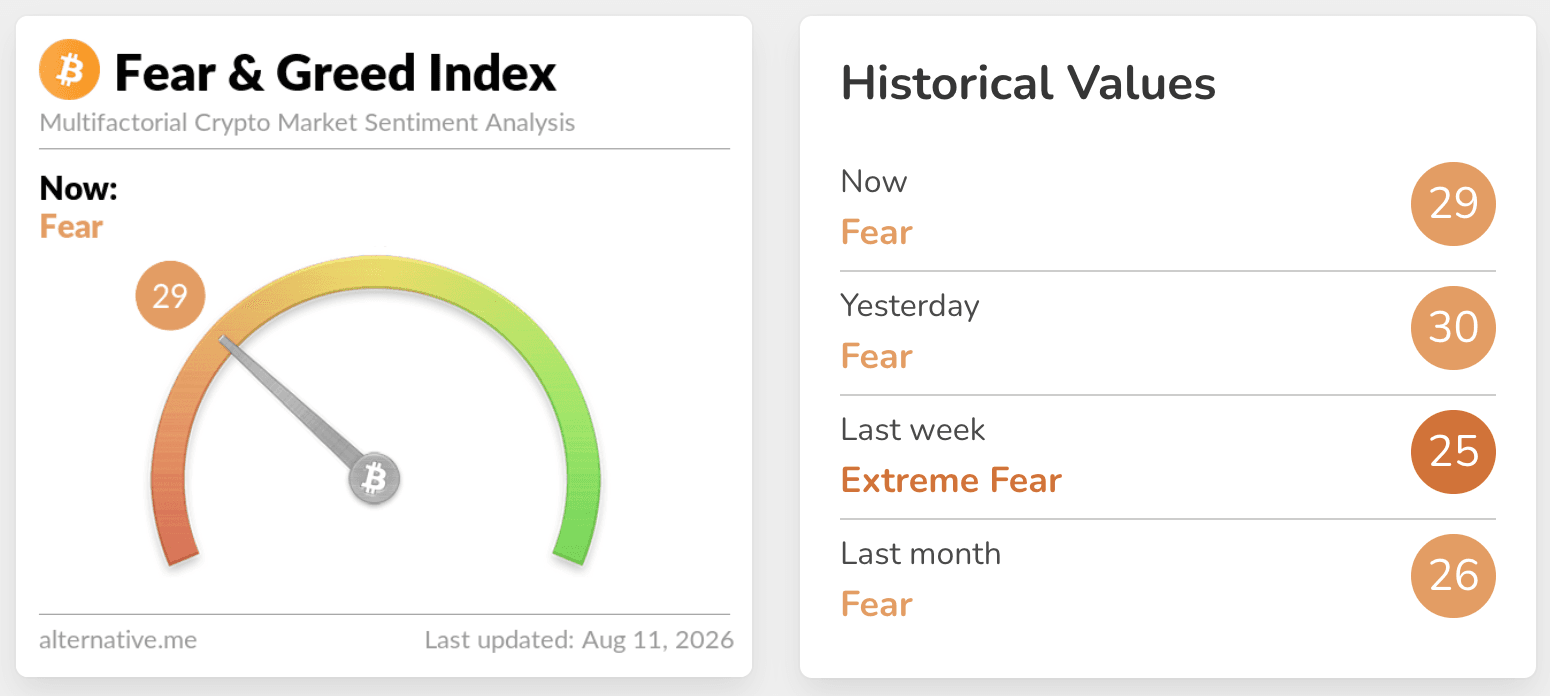
Source: Alternative
Key News Highlights:
Thailand Introduces Five-Year Crypto Capital Gains Tax Exemption for Trades on Licensed Platforms
Thailand has introduced a five-year tax incentive for income generated from crypto asset trading. Eligible investors can receive a capital gains tax exemption during the designated period. The policy applies from January 1, 2025, through December 31, 2029. It covers crypto asset sales conducted through digital asset service providers that are licensed and regulated by Thailand's Securities and Exchange Commission. The exemption does not apply to all crypto transactions. Trades conducted through unlicensed providers or overseas platforms remain outside the scope of the policy. Such transactions may continue to be subject to standard personal income tax rules, with rates of up to 38%. The Thai government introduced the measure to increase the appeal of its regulated digital asset market and strengthen the country's position as a regional hub for digital assets and financial services. Because the exemption is limited to licensed service providers, users must still comply with existing identity verification, anti-money laundering, and other regulatory requirements. The policy also extends Thailand's broader efforts to revise its digital asset tax framework. The country previously removed the 7% value-added tax on certain eligible crypto transactions. The new capital gains tax treatment further narrows the difference between the taxation of crypto assets and certain traditional financial assets. For local investors, the five-year exemption mainly changes the tax treatment of capital gains from eligible transactions. It does not remove other reporting, regulatory, or compliance obligations related to digital asset trading.
Trump Media Revamps Crypto Treasury Strategy as Q2 Net Loss Reaches USD 238 Million
Trump Media and Technology Group said it plans to revise the way it manages its digital asset treasury. The company intends to preserve its long-term exposure to digital assets while placing greater emphasis on volatility management and balance sheet efficiency. Trump Media reported a net loss of approximately USD 238 million in the second quarter. Its digital assets, pledged digital assets, and equity securities generated about USD 190.4 million in combined unrealized losses. The company said its new framework will take a more disciplined approach to asset allocation. It also plans to direct more resources toward Truth Social, Truth+, and other core media operations. As of June 30, Trump Media held 9,477.16 BTC, slightly below the 9,542.16 BTC held at the end of the previous quarter. Another 2,077.34 BTC was pledged as collateral for the company's Bitcoin options strategy. A further 4,260.73 BTC was used as collateral in connection with convertible notes. In July, the company sold approximately USD 159.6 million in Bitcoin-related securities and used part of the proceeds to purchase Bitcoin directly. This increased its direct BTC exposure. By July 31, Trump Media reported holdings of approximately 14,139 BTC, including pledged Bitcoin. The holdings were valued at around USD 890.5 million at the time. In addition to direct holdings, the company manages part of its BTC through options, lending, asset allocation, and other yield-generating arrangements. Trump Media also warned in its financial filings that placing Bitcoin with third parties through lending or similar arrangements may involve counterparty credit risk, liquidity risk, and the risk of failing to recover assets. Its revised treasury strategy will therefore also include measures to manage these risks.
TRON USDT Supply Reaches USD 87.9 Billion in Q2 as Quarterly Transfers Hit USD 2.1 Trillion
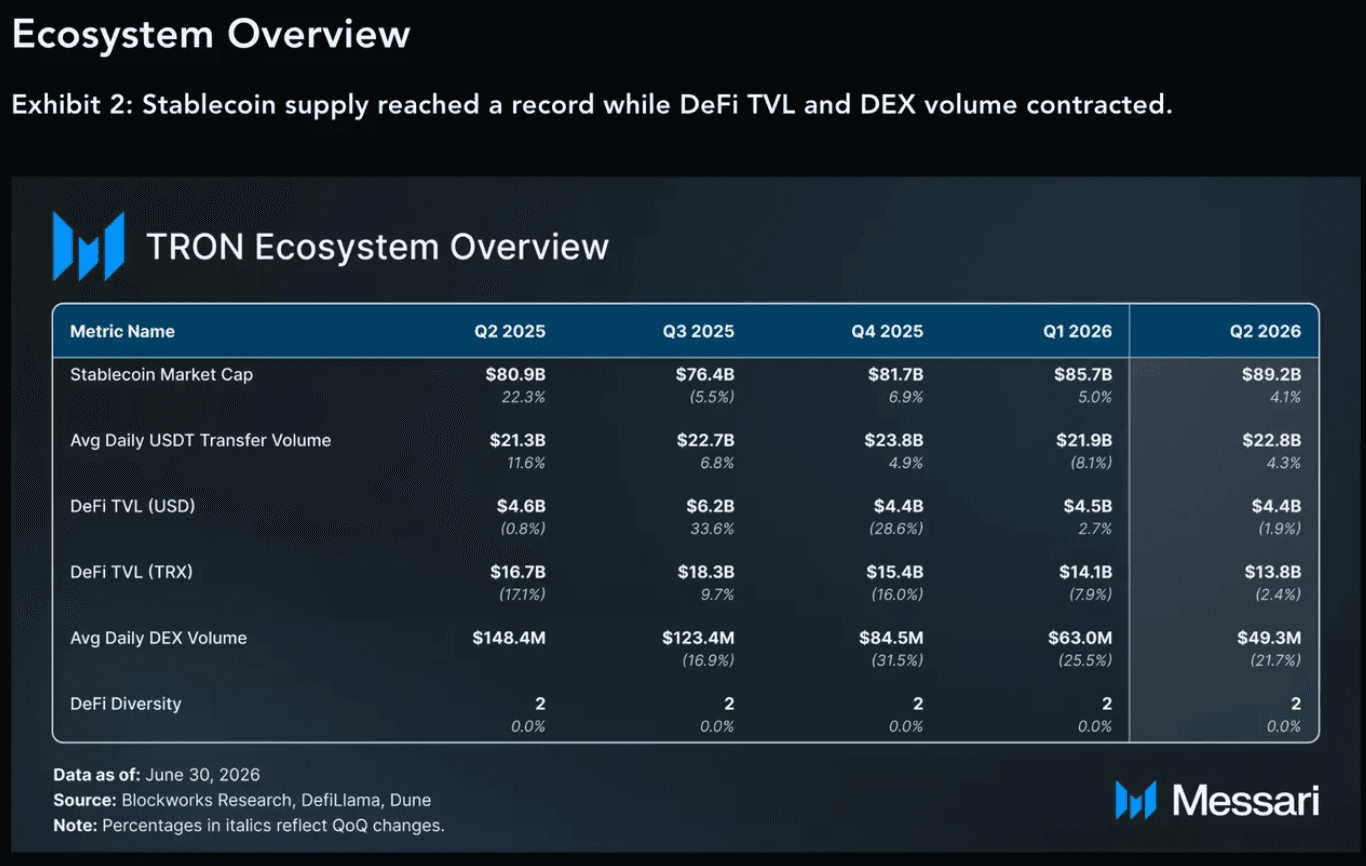
According to Messari's second-quarter report on the TRON network, circulating USDT supply on TRON reached USD 87.9 billion by the end of the quarter. Stablecoin supply and on-chain activity both reached new quarterly highs. USDT accounted for approximately 98.5% of TRON's total stablecoin market. The network's total stablecoin supply grew 4.1% quarter over quarter to approximately USD 89.2 billion. USDT transfers on TRON totaled about USD 2.1 trillion during the second quarter, showing that stablecoin transfers remain one of the network's primary use cases. Average daily USDT transfer volume rose to approximately USD 22.8 billion. This represented a 4.3% increase from the previous quarter and reversed the decline recorded in Q1. Overall network usage also increased. TRON processed an average of approximately 11.8 million transactions per day during the second quarter, up 8.7% quarter over quarter. Average daily active addresses increased 11.7% to approximately 3.6 million. On June 15, the network processed around 14.6 million transactions and set a new record for daily transaction activity. Higher network activity also supported a recovery in fees. Second-quarter network fees increased 15.9% to approximately USD 699.4 million, ending two consecutive quarters of decline. However, other ecosystem indicators showed a different trend. DeFi total value locked declined 1.9% to approximately USD 4.4 billion. Average daily DEX volume fell 21.7% to around USD 49.3 million, marking the fourth consecutive quarterly decline. TRON also continued to expand access to institutional assets and regulated financial products during the quarter. Stablecoin payments, tokenized assets, and institutional-grade digital asset services have therefore become increasingly important components of network activity.
U.S. Court Stays CFTC Civil Case Against Soldier Over Prediction Market Trades
A federal court in New York has granted a motion from U.S. prosecutors to stay the Commodity Futures Trading Commission's civil case against active-duty U.S. service member Gannon Ken Van Dyke. The civil proceedings will remain on hold while the related criminal case moves forward. Van Dyke is accused of using nonpublic government and military information to trade event contracts on a prediction market platform tied to the removal of former Venezuelan President Nicolás Maduro. The U.S. Department of Justice alleged that Van Dyke participated in the planning and execution of the related military operation. His role allegedly gave him access to sensitive and nonpublic operational information. Prosecutors said he later used this information to build positions in related event contracts and generated more than USD 400,000 in trading profits. The CFTC previously filed a parallel civil enforcement action over the same conduct. The case involves issues related to the use of nonpublic government information and the application of commodity trading rules. U.S. prosecutors requested a stay of the civil proceedings in July so the criminal case could proceed first. The court subsequently granted the motion. Van Dyke has pleaded not guilty to all criminal charges and has filed a motion to dismiss the indictment. His criminal trial could begin in late 2026 or early 2027. The court has not yet issued a final substantive ruling on the central legal disputes in the case.
Disclaimer: The information provided in this section is for informational purposes only and doesn't represent any investment advice or FameEX's official view.