FameEX Crypto Market Trend | August 6, 2026
2026-08-06 09:56:19
The Fed, ECB, and BOJ kept interest rates unchanged as U.S.-Iran tensions escalated again. Trump announced a renewed blockade of Iran and a 20% “protection fee” on shipping through the Strait of Hormuz. Crypto also broadly tracked U.S. equities, including the memory-chip rally on July 14 ET.
I. Core Market Overview
1. BTC Spot performance
Price range: [57,758.6] USD - [66,924.1] USD
Periodic amplitude: 15.87%
Key Driving Factors:
Primary Factors: The Federal Reserve (Fed), the European Central Bank (ECB), and the Bank of Japan maintained their interest rates unchanged at their policy meetings; the US and Iran resumed hostilities, with Trump announcing a renewed blockade of Iran and imposing a 20% "protection fee" on cargo shipments through the Strait of Hormuz.
Secondary Factor: During this period, the crypto market also mirrored the movements of the U.S. stock market. For example, the storage sector rallied alongside U.S. equities on the evening of July 14 (ET).
2. Central Bank Policy Updates
Policy Impact Assessment:
The Fed leans hawkish, hinting at continued interest rate hikes.
The ECB is focused on combating inflation, and the probability of it raising interest rates remains relatively higher than that of the Federal Reserve.
3. Other Key Updates
Programmer Stefan Thomas owns an IronKey encrypted USB drive containing the private keys to 7,002 Bitcoin. He received the Bitcoin in 2011 as payment for producing the educational video "What Is Bitcoin?". At a recent valuation of approximately US$111,000 per BTC, the holdings are worth about US$777 million. The IronKey is configured to permanently lock and erase its contents after 10 incorrect password attempts. Thomas has already used 8 attempts, leaving him with only 2 remaining. Kingston, the device manufacturer, has confirmed that there is no master password, backup password, or alternative recovery method beyond the original password set by the user. Thomas has sought assistance from digital forensics firm Naxo and security researcher Chris Tarnovsky. He also declined an offer from Unciphered, stating that he had already reached verbal agreements with two other teams. As of the end of 2025, the IronKey remained stored in a secure vault in Switzerland, and as of mid-2026, there has been no confirmed successful recovery of the private keys.
Dubai-based cryptocurrency exchange Shelbit has processed at least $4 billion in transactions since May 2024 and acted as a hub connecting Iranian gambling websites, the Central Bank of Iran, and entities linked to the Iranian Islamic Revolutionary Guard Corps. At least $676 million was transferred from Shelbit-related addresses to Binance, including approximately $540 million transferred after Dubai regulators fined the unlicensed exchange in January 2025. The report cannot independently determine who within the Iranian government controls Shelbit, nor whether the Iranian Islamic Revolutionary Guard Corps directly operates a wider network.
II. Market Health Index Analysis (Source: CoinMarketCap)
https://coinmarketcap.com/charts/
Conclusion:
The rebound in total market capitalization coupled with shrinking trading volume suggests a zero-sum game.
The Altcoin Season Index is in the 25-54 range, indicating that funds are rotating towards Bitcoin; ETF funds are flowing in, and the Fear & Greed Index is in the fear zone, reflecting a divergence in market confidence.
III. Derivatives Monitor (Source: CoinAnk)
1. Funding Rate
30-Day Avg Funding Rate of Bitcoin Across the Top Six CEXs: [0.5042]% (Positive)
30-Day Avg Funding Rate of ETH Across the Top Six CEXs: [0.2122]% (Positive)

Source: https://coinank.com/fundingRate/current
Interpretation:
A sustained positive rate indicates that bulls dominate the market and bearish expectations are weakening.
2. Open Interest Changes
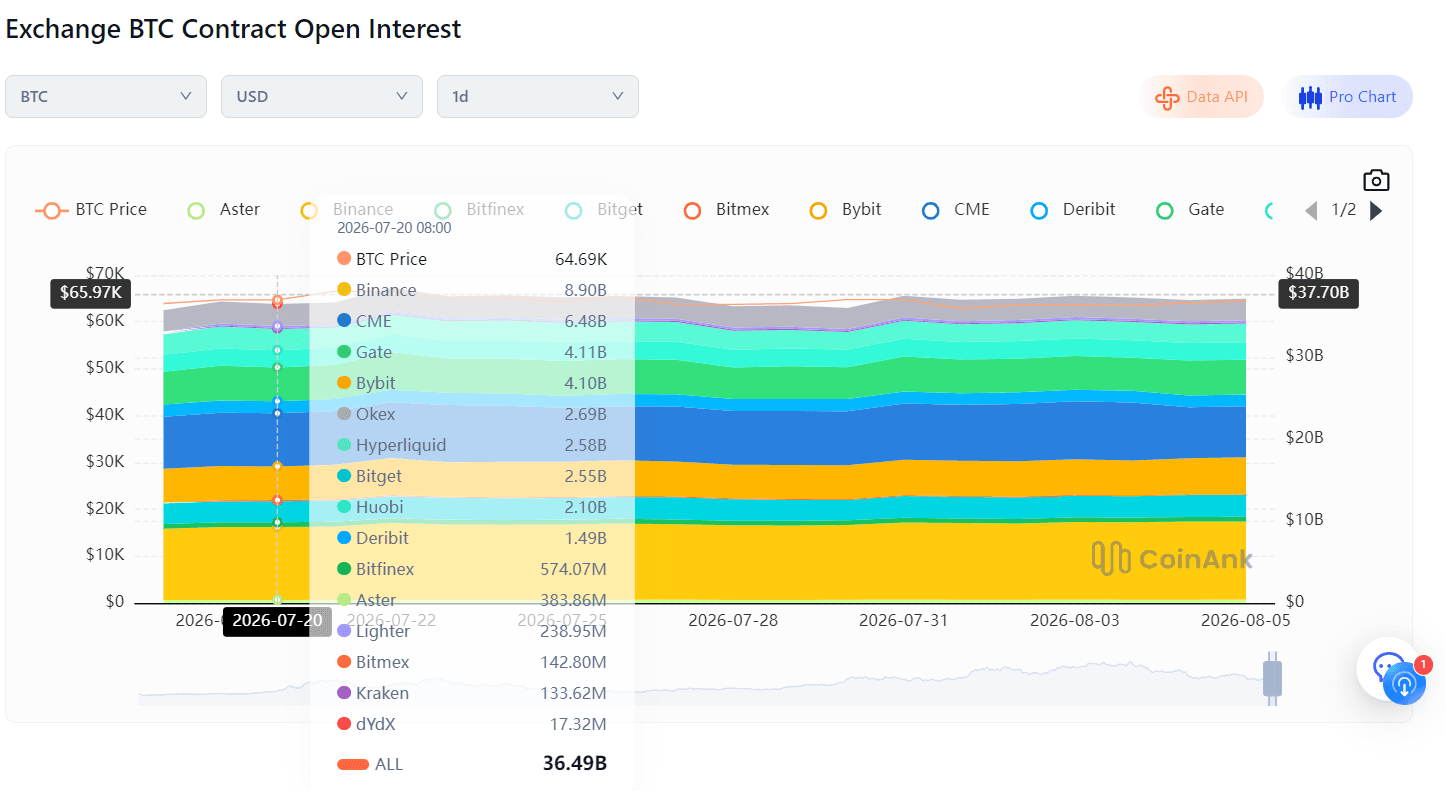
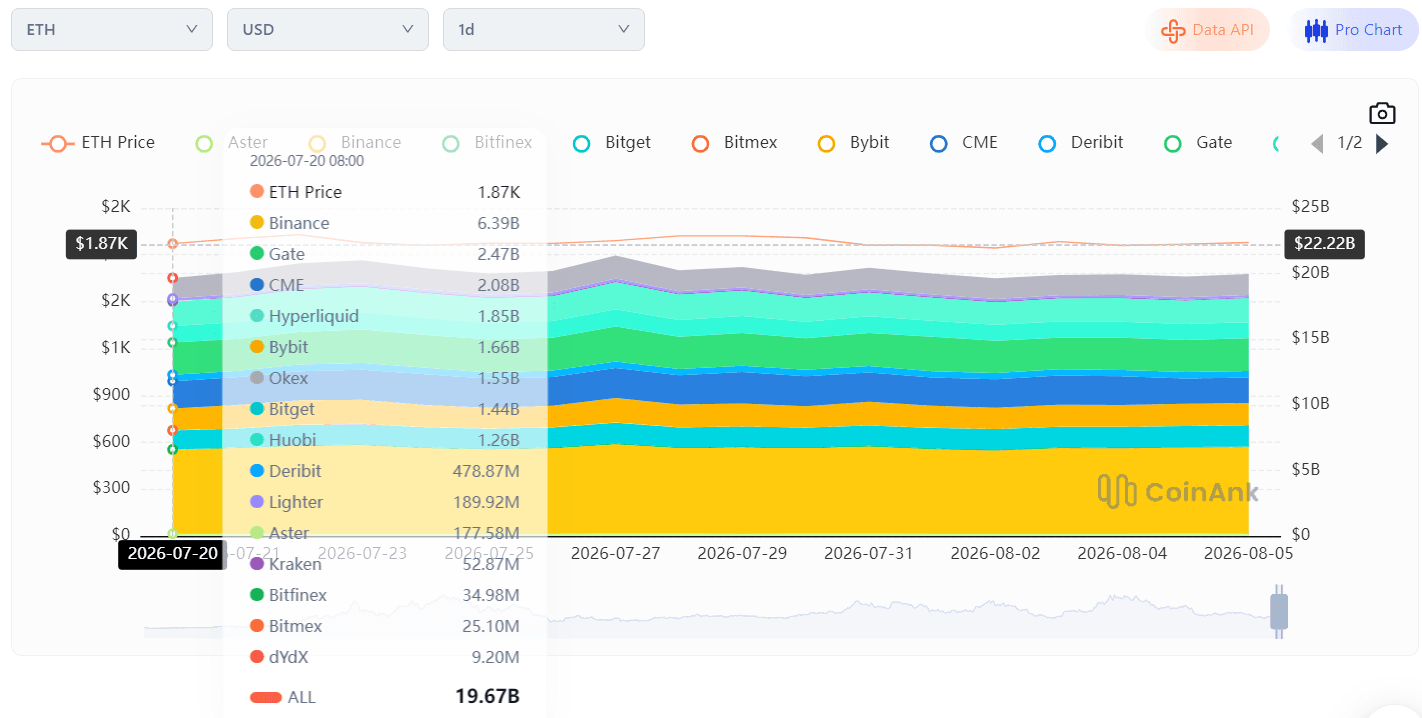
Source:https://coinank.com/indexdata/oivol/exOiHist
IV. Global Economic and Crypto Sector Developments
1. Global Macroeconomy
- July 30: Fed Interest Rate Decision (Upper Bound): 3.75% (Actual/Expected/Previous: 3.75%) → Impact: U.S. equities and Bitcoin moved in tandem; volatility in the U.S. Dollar Index (DXY).
- July 30: U.S. Initial Jobless Claims (Week Ended July 25): 197,000 (Expected: 200,000; Previous: 188,000, revised from 187,000) → Result: Better than expected, bearish for gold, silver, and cryptocurrencies.
1) On July 20, British Prime Minister Burnham stated that a new ten-year plan would be launched later this year.
2) On July 21, with efficiency improved by 50%, China Telecom completed the pilot application of a large-scale wireless network planning model.
3) On July 22, Goldman Sachs stated that hedge funds were selling off US technology stocks at a record pace.
4) On July 23, Iran's Supreme Joint Military Command stated that if the United States attacks Iran's nuclear facilities, it will target the interests of the U.S. and its allies across the region.
5) On July 24, Trump approved a 30-year nuclear cooperation agreement between the US and Saudi Arabia, which may pave the way for uranium enrichment in Saudi Arabia.
6) On July 25, the United States imposed tariffs of 10%-12.5% on 60 economies.
7) On July 28, the ECB kept interest rates unchanged as expected, but left room for a rate hike in September this year.
8) On July 30, Bank of England Governor Bailey said that the Bank stands ready to adjust its policy stance as the outlook evolves. Although there is no evidence of second-round inflation effects, it should remain vigilant. Bailey also stressed that the Bank of England should not be viewed as being close to raising interest rates.
9) On July 30, the US core PCE price index for June was 3.3% year-on-year, compared to an expected 3.30% and a previous value of 3.40%, which is bullish for gold, silver and cryptocurrencies.
10) On July 30, the Bank of England's central forecast, based on market expectations for energy prices and interest rates, indicated that interest rates would be raised by 25 basis points in the fourth quarter and by another 25 basis points in 2027.
11) On July 30, Federal Reserve Chairman Warsh stated that the core CPI data for June had little impact on policy decisions.
12) On July 31, the Bank of Japan voted 8-1 to keep interest rates unchanged, but will raise rates as needed.
13) On August 1, Bank of Japan Governor Kazuo Ueda: Exchange rate fluctuations are having a greater impact on prices than in the past. If we determine that financial conditions are excessively accommodative, we may accelerate the pace of interest rate hikes. One area of focus is how higher memory chip prices could contribute to upward pressure on inflation.
14) On August 3, wildfires ravaged Europe, causing economic losses of 3.1 billion euros to the Eurozone/
15) On August 4, U.S. Treasury Secretary Scott Bessent: It is reasonable for the Federal Reserve to consider expanding its repo facility.
16) On August 5, hawkish Fed officials took turns making hawkish statements: Schmid said interest rates were still not high enough, and Paulson warned that inflation risks had not disappeared.
2. Industry Updates
1) On July 20, cryptocurrency spot trading volume remained sluggish, with the 7-day average down nearly 80% from its 2025 peak.
2) On July 23, Vietnam introduced regulations imposing penalties for crypto-related violations, with unlicensed cryptocurrency trading subject to fines of up to US$1,900.
3) On July 25, US cryptocurrency stocks generally rose, with Coinbase up over 12%.
4) On July 27, Grayscale Investments filed a registration statement for a Worldcoin ETF with the U.S. Securities and Exchange Commission (SEC).
5) On July 29, MiCA was launched, ushering in a major reshuffle for the European crypto industry: high regulatory thresholds may spur a new wave of mergers and acquisitions.
6) On August 2nd, Vaulted CEO: Quantum computing may "end" Bitcoin within the next 4 years.
7) On August 3, South Korea finalized its 2026 tax reform plan and did not postpone the taxation of crypto assets again.
8) On August 4, DEX accounted for a record high of 24% of spot trading volume, while CEX spot trading volume fell to a 12-month low.
3. Regulatory Policy Updates
1) On July 20, the South Korean government launched legislative discussions on the "Digital Asset Basic Law," with a focus on the regulation of stablecoins.
2) On July 21, Trump agreed to include ethical provisions in the broader U.S. cryptocurrency bill.
3) On July 22, Indian law enforcement raided multiple cryptocurrency scam dens, targeting foreign investors as victims.
4) On July 23, the US Congress held bipartisan discussions on crypto-related ethical issues, and DeFi terms were also under negotiation.
5) On July 25, the Pakistani FIA established a virtual asset investigation department to focus on combating digital asset crimes such as money laundering and terrorist financing;
6) On July 27, the prospects for the passage of the CLARITY bill cooled, with Trump's conflict of interest in cryptocurrencies becoming the biggest obstacle;
7) On July 29, North Korea cracked down on an internal bank hacking gang: retired cyber warfare elites colluded with IT geniuses from prestigious universities to smuggle foreign exchange using cryptocurrency.
8) On August 1, the Vietnamese company “Fun Coffee” collapsed in Hong Kong due to a cryptocurrency scam, defrauding thousands of people of more than HK$1 billion.
9) On August 2nd, Hu Xiaowei, the alleged mastermind behind the Prince Group, was extradited to the United States. Hu was also identified as the ringleader of the "Knight Attack Group" cybercrime case, which involved the illegal intrusion into computer systems and was uncovered by Chongqing cyber police in China in 2010.
10) On August 3, Hong Kong received 25 cases of online romance fraud in a single week. A woman working in the insurance industry was induced to invest in virtual currency and lost more than HK$26 million.
11) On August 5, Putin signed the Russian digital currency comprehensive regulatory law, with the core provisions taking effect on September 1.
V. Market Outlook
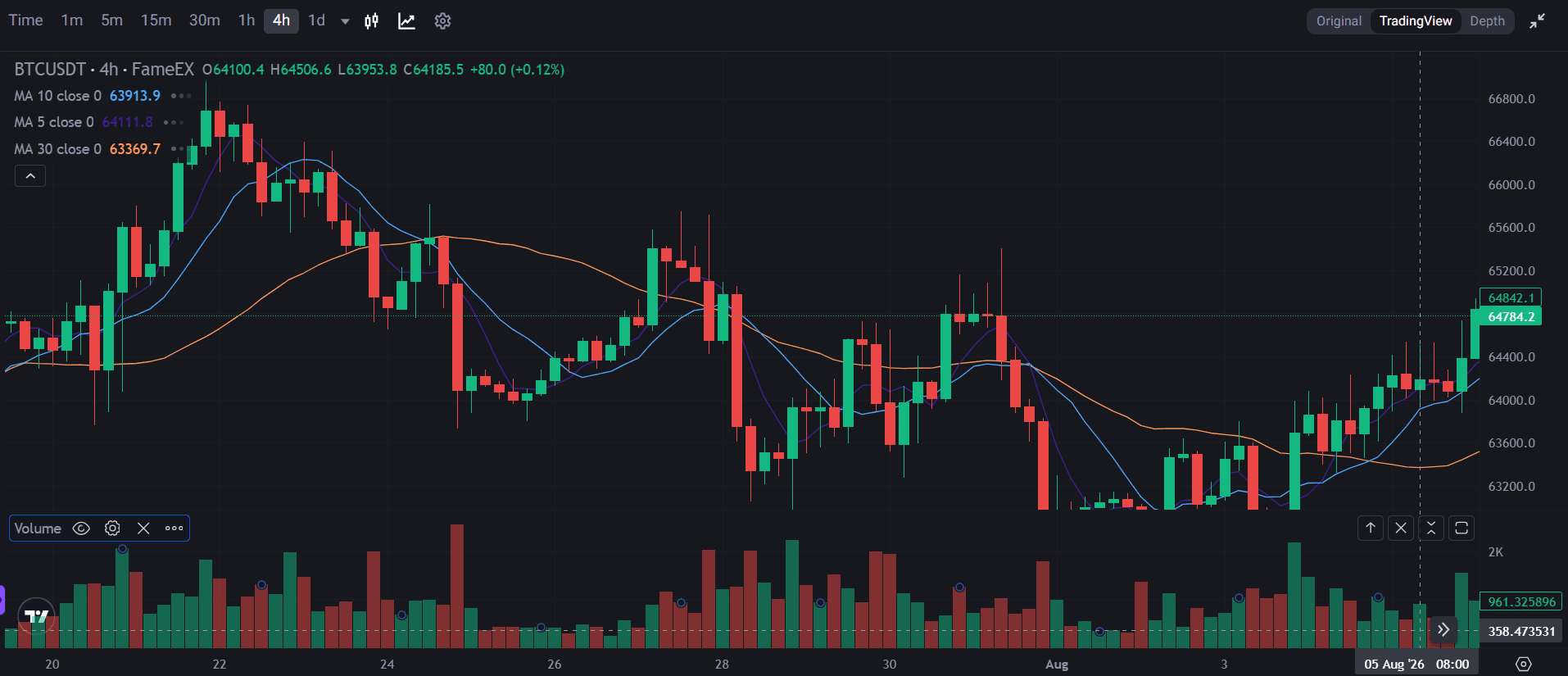
From August 6 to September 30, a long-term trading strategy remains in place:
BTC spot: Place sell orders at $135,900, $122,500, $109,050, and $82,150. Set bottom-fishing buy orders at $49,600, $35,450, and $21,300.
ETH spot: Place sell orders at $4,885, $3,485, and $2,200, with bottom-fishing buy orders at $1,240 and $1,085.
Since bottoming at US$57,758.6 in early July, Bitcoin has staged a modest recovery. Aside from the recent rebound in the Nasdaq Composite, however, the rally has lacked support from any major macroeconomic catalysts. This suggests that if U.S. equities enter a sustained downturn during August and September, Bitcoin is also likely to experience a significant correction, given the strong correlation between the two markets. The main exceptions would be the emergence of major bullish catalysts, such as the United States establishing a federal-level Strategic Bitcoin Reserve, a comprehensive end to the Russia-Ukraine war, or interest rate cuts by the Federal Reserve and other major central banks, including the Bank of England, the European Central Bank, the People's Bank of China, and the Bank of Japan. At present, however, further rate hikes appear more likely than rate cuts. Meanwhile, the market has become increasingly desensitized to the prospect of another U.S.-Iran peace agreement.
Investment firm Bernstein says the prospects for the passage of the U.S. Clarity Act on Digital Asset Markets are declining. If the Senate fails to advance the bill before the recess, it could trigger a short-term negative market reaction, putting further pressure on the valuation of Bitcoin and crypto assets as a whole. Bernstein points out that the failure of the bill may lead to an "instinctive sell-off" in the market, but in the medium to long term, it may also prompt the U.S. Securities and Exchange Commission (SEC) and the Commodity Futures Trading Commission (CFTC) to accelerate regulatory actions, including clarifying token classification rules, developing a decentralized finance (DeFi) regulatory framework, and advancing token issuance exemption mechanisms. Bernstein predicts that the crypto market may bottom out at the end of the third quarter or the beginning of the fourth quarter and gradually regain momentum before the US midterm elections.
VI. Risk Alert
1. Macro Risks: [Fed policy shift/escalation of geopolitical conflicts, etc.]
Escalation of US-Iran and Russia-Ukraine conflicts
2. Industry Risks: [Exchange failures/surprise regulatory inspections, etc.]
Major cryptocurrency exchanges have collapsed or gone bankrupt; the U.S. Digital Asset Markets Clarity Act failed to pass this time.
3. Technological risks:
None available
Operation suggestions:
Keep spot positions within ≤60% of total capital, and set dynamic take-profit and stop-loss levels to avoid blindly chasing rallies or selling into weakness with high leverage.
Disclaimer: The data in this report are sourced from publicly available information. FameEX makes no representations on the accuracy or suitability of any official statements made by the exchange regarding the data in this area or any related financial advice.