FameEX Today’s Crypto News Recap | April 20, 2026
2026-04-20 10:46:49

Kelp DAO exploit triggers Aave capital flight and RaveDAO manipulation probes as market sentiment shifts to fear; BTC briefly dips below $74K with USD 415 million in total liquidations. Today’s crypto market experienced notable volatility under the combined weight of macroeconomic pressure and a major DeFi security incident. Bitcoin and Ether both pulled back over the past 24 hours, while overall market sentiment was hit by geopolitical tensions and the sharp outflow of funds from Aave, one of the largest lending protocols in the sector. Although spot Bitcoin ETFs and spot Ethereum ETFs continued to post net inflows, showing that institutional capital was still buying, onchain data pointed to heavy liquidation pressure and cascading long liquidations, which suggests that short term speculative positioning is being aggressively flushed out. The probability of the Federal Reserve holding rates unchanged in April has climbed to 99.5%, delaying expectations for easier liquidity conditions and pushing investors toward a more cautious risk-off stance. Spot Bitcoin ETFs recorded USD 996 million in net inflows last week and extended their positive streak to three consecutive weeks. BlackRock’s IBIT led the group with USD 906 million in weekly net inflows, lifting its total net assets above USD 101.45 billion. Spot Ethereum ETFs also delivered solid performance, with USD 276 million in net inflows last week, while Fidelity’s FETH ranked first with USD 126 million. Across sectors, most segments moved lower as the US-Iran situation weighed on sentiment. The Meme sector fell 2.17%, while the DeFi sector declined 2.24%. Even so, the SocialFi and AI sectors showed stronger defensive characteristics and rose 1.92% and 0.95% respectively against the broader downturn, with Toncoin and Chiliz gaining 1.49% and 4.60%. Analysts noted that the market is going through an intracycle redistribution phase. Near term risk aversion remains elevated, but capital rotation across different application sectors shows that investors are still looking for assets with stronger fundamentals for medium and longer term allocation.
Crypto Markets Overview
The crypto market showed a clear risk-off today. The Crypto Fear & Greed Index stood at 29, which kept sentiment in Fear. This marks an improvement from the Extreme Fear reading seen last month, but overall market psychology remains weak. Bitcoin pulled back after testing higher levels and briefly fell below the $74,000 mark, showing 24 hour decline of 2.37%. Ether moved lower as well and slipped under $2,300. Data shows that total liquidations across the market reached USD 415 million over the past 24 hours, with long liquidations accounting for USD 336 million, which indicates that leveraged bullish positions took the heaviest damage during the retracement. The current 8 hour average funding rates for both BTC and ETH remain extremely low, with some readings turning negative, which reflects either a rise in bearish sentiment or fading momentum from the long side. From a market structure perspective, Bitcoin is attempting to fill the supply gap above $72,000. The upside still faces short liquidation pressure of as much as USD 1.271 billion, but last week’s USD 996 million in net inflows into spot Bitcoin ETFs continues to provide an important layer of support. This suggests that long term holders and institutional investors are still maintaining relatively stable confidence during the current period of volatility.
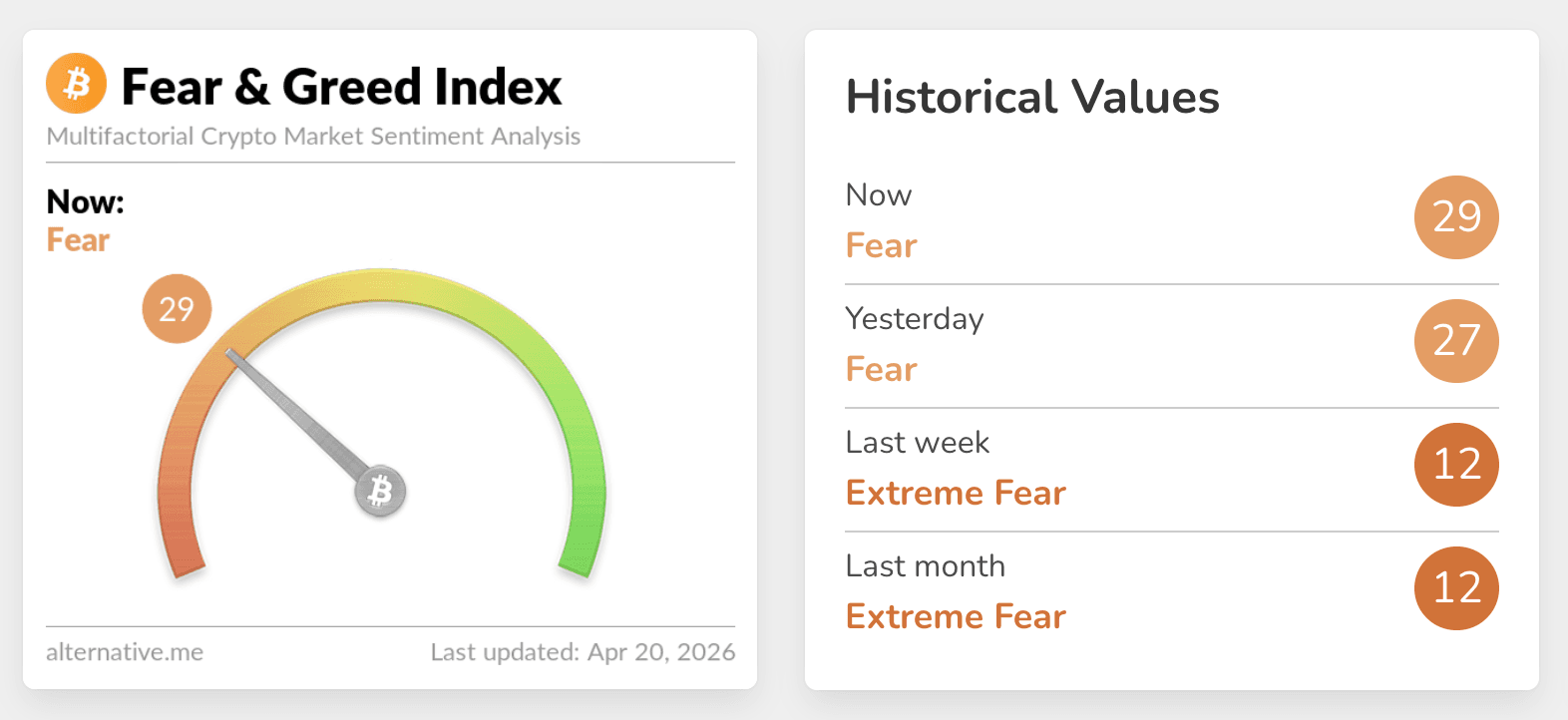
Source: Alternative
Key News Highlights:
Aave TVL Plunges By USD 8 Billion In A Single Day As The Kelp DAO Security Incident Ripples Through The Market
Aave, the leading decentralized lending protocol, is facing its most severe liquidity test since 2025. Its total value locked fell from USD 26.4 billion to USD 18.6 billion within just 24 hours, marking a one day loss of USD 8 billion. The crisis began after Kelp DAO’s LayerZero bridge was exploited. The attacker stole 116,500 rsETH worth about USD 293 million, then deposited those tokens into Aave v3 as collateral and borrowed a large amount of wrapped Ether. This left Aave with roughly USD 195 million in bad debt. The incident triggered broader panic across the market. Users, including large institutions, began withdrawing capital at scale, which drove utilization in Aave v3’s USDT and USDC lending pools to 100%. This means more than USD 5.1 billion in stablecoins cannot currently be withdrawn in a normal manner. Aave has responded by freezing multiple markets and activating stress measures under its Umbrella protection model. Even so, the AAVE governance token still dropped nearly 20% within 25 hours. The market is now watching closely to see whether the protocol can offset the bad debt through its treasury or automated liquidation mechanisms before the damage spreads further across the wider DeFi ecosystem.
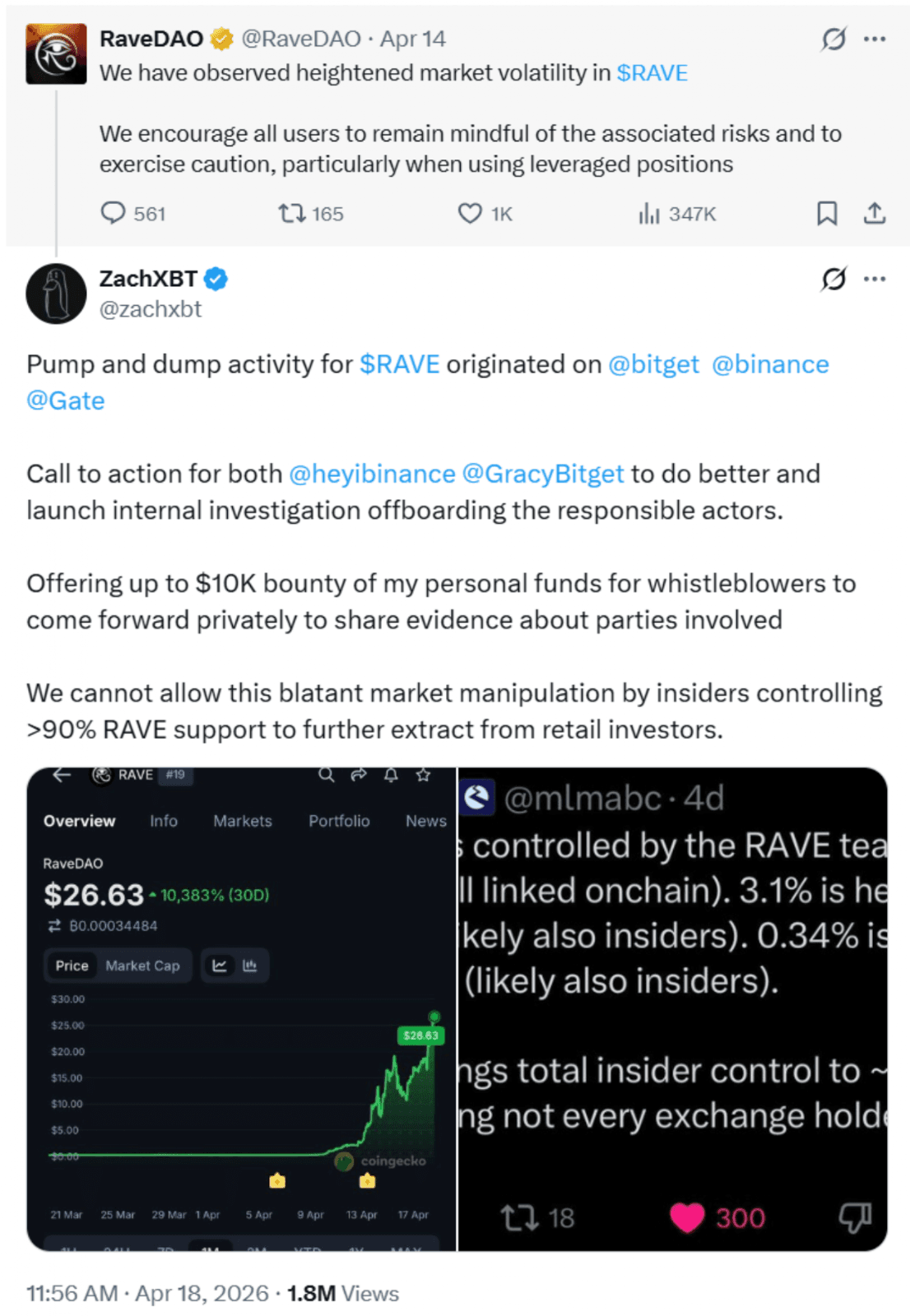
Major CEXs Launch Investigations Into Suspected RaveDAO Market Manipulation After Extreme Token Volatility
The crypto community has raised serious concerns over RaveDAO after allegations emerged that the project may have been involved in a pump-and-dump operation. The controversy followed an extreme move in the price of its RAVE token, which surged from around $0.25 to nearly $28 within a matter of days before collapsing by more than 80%. According to onchain data and market surveillance, the scale and speed of the move quickly drew attention across the industry. Prominent onchain investigator ZachXBT stated that more than 90% of the token supply may be controlled by insiders, and also pointed to suspicious exchange-related fund flows. In response to the suspected manipulation, the CEOs of several major CEXs have publicly confirmed that they are reviewing the trading activity tied to the token in order to protect market order and user interests. Although RaveDAO released a statement on social media denying any role in or responsibility for the recent price swings, mounting regulatory pressure and a growing crisis of market trust have already drained liquidity from the asset at a rapid pace. The case has once again triggered wider discussion about transparency and manipulation risks in small cap tokens. Professional market observers have warned that projects with highly concentrated holdings can expose participants to severe losses during violent moves in illiquid conditions.
Market Assesses KelpDAO Hack Recovery Paths As Potential Loss Could Imply An 18.5% Cut
After the Kelp DAO exploit created substantial bad debt on Aave, market analysts have started evaluating the possible recovery paths available to KelpDAO. Current discussion suggests that the protocol may consider three main strategies, including the socialization of losses across users. Based on initial estimates, a full loss-sharing approach could result in an 18.5% cut for all rsETH holders. If the protocol instead chooses to impose losses directly on holders across Layer 2 networks, bad debt could reach as much as USD 341 million on networks such as Arbitrum, Mantle, and Base. At present, Aave’s internal Umbrella mechanism is expected to cover around USD 55 million of losses. The remaining gap may need to be filled through treasury resources or through the sale of AAVE tokens held by the protocol, with the current treasury token value estimated at roughly USD 51 million. Another technical proposal involves using collateral left behind by the attacker to offset part of the deficit. However, the hacker already borrowed USD 124 million from Aave mainnet and another USD 18 million from Arbitrum, which leaves the actual recoverable value highly uncertain. The market is now closely watching whether KelpDAO will attempt to use a pre-hack snapshot as the basis for reimbursement. Even so, this approach would be extremely difficult to execute within pooled protocols where funds have been moving continuously, and it remains both operationally complex and highly controversial.
Trending Tokens:
- $PRL (Perle Labs)
As demand continues to rise for verifiable enterprise grade data quality in large language model training, the artificial intelligence sector is maintaining strong momentum. Perle Labs addresses this need through an AI data training protocol that brings expert human feedback directly onchain. The project reached a major milestone on March 25, 2026, when the team officially opened the claim process for its native token, $PRL. All eligible community contributors who completed the airdrop registration can now claim their tokens through a Solana compatible wallet. This distribution event drew broad market attention, especially because the project was founded by senior talent with roots in Scale AI. Through a transparent and fair rewards system for data annotators, the protocol is designed to sustain long term community participation and preserve data integrity. The combination of decentralized infrastructure and AI data processing has made Perle Labs one of the most closely watched names in the Solana ecosystem.
- $REQ (Request Network)
As many corporates continue to look for transparent and trust minimized payment infrastructure, onchain finance solutions and decentralized accounting protocols are entering a new wave of attention. Request Network is an open and distinctive protocol built to handle payment requests, invoices, and automated payroll management. Its core architecture defines how request data is processed and stored on distributed ledgers to ensure security and resilience. Crypto native organizations and freelancers often use the application to manage complex expense reimbursements and simplify audit workflows across multiple networks. The platform currently supports several blockchain environments, including Ethereum, Polygon, Near, Sonic, Gnosis, and Celo. Recent growth in network activity and transaction volume has pushed the token back into focus as an important utility layer within decentralized finance. Its ability to provide trust minimized and resilient financial infrastructure remains the key driver behind continued adoption and market relevance.
- $OFC (OneFootball Club)
The convergence of global sports and blockchain technology represents a fast growing narrative, as major media platforms search for new ways to engage massive fan communities. OneFootball Club, the world’s largest football media platform, reaches more than 200 million active users each month and officially launched its native token on April 9, 2026. The timing of the launch was clearly strategic, as it came just ahead of the FIFA World Cup, an event expected to draw roughly half of the world’s population. Users who took part in the CoinList community sale also received their token allocations on Ethereum mainnet shortly after the official launch. The project had previously secured a total of USD 300 million in funding from core backers including Liberty City Ventures and Animoca Brands. Through its dedicated lab division, the platform aims to use blockchain technology to distribute digital assets and deepen fan engagement across hundreds of leagues. With investors expecting the platform to deliver significant reach during the peak of the global football calendar, market attention around the token remains elevated.
Disclaimer: The information provided in this section is for informational purposes only and doesn't represent any investment advice or FameEX's official view.