FameEX Today’s Crypto News Recap | April 13, 2026
2026-04-13 13:06:40

EU crypto oversight, Hormuz blockade fears, and Telegram privacy alerts lead today's news; meanwhile, market sentiment hits extreme fear as BTC drops to $71K. Today’s crypto market remained fragile as macroeconomic uncertainty and rising geopolitical tension kept sentiment cautious and risk appetite subdued. The escalation in the Middle East weighed directly on broader risk assets, while price action suggested that participation thinned as volatility picked up. Bitcoin failed to sustain momentum after several attempts to push through resistance and gave back part of its recent rebound, slipping back below the $71,000 level. The move highlighted weaker follow-through at higher levels as safe-haven demand returned to the forefront. Selective strength in AI and meme tokens helped parts of the market trade with relative resilience, but that was not enough to offset the broader defensive tone. Market focus is now centered on the fallout from failed US-Iran peace talks and the announced Hormuz blockade, both of which have become key drivers of near-term cross-asset volatility.
Crypto Markets Overview
The crypto market continued to show a fragile and defensive structure, with the Crypto Fear & Greed Index falling to 12, which places sentiment firmly in Extreme Fear. Over the past 24 hours, total liquidations reached USD 284 million, including USD 203 million in long liquidations, which points to a concentrated flush in bullish positioning during the pullback. Bitcoin traded near $71K and remained below its 200-day EMA, while resistance continued to form around the $74,000 area. Total BTC open interest fell 6.41% over the past 24 hours to USD 51.337 billion, which suggests that leveraged positioning is being reduced as traders respond to elevated headline risk. BTC funding remained slightly positive at 0.0005% on an 8-hour basis, but the broader setup still reflected a cautious market that lacked strong upside conviction. If BTC breaks above $74,444, cumulative short liquidations across major CEXs could reach USD 1.099 billion. On the downside, a break below $67,769 could expose long positions to USD 834 million in liquidation pressure. ETH also remained under pressure in derivatives markets. The average 8-hour funding rate stood at -0.0002%, while the $2,300 area continued to act as a key short-term pivot. If ETH breaks above $2,309, cumulative short liquidations across major CEXs could reach USD 798 million, while a drop below $2,093 could expose longs to USD 581 million in liquidation pressure. On the institutional side, spot Ether ETFs recorded USD 187 million in net inflows last week. BlackRock’s ETHA led with USD 168 million in weekly inflows, while ETHB added USD 66.0015 million. Although Fidelity’s FETH saw USD 62.1274 million in weekly outflows, total net assets across spot Ether ETFs remained high at USD 12.96 billion, which shows that institutional allocation to Ethereum is still progressing despite sharp secondary market volatility.
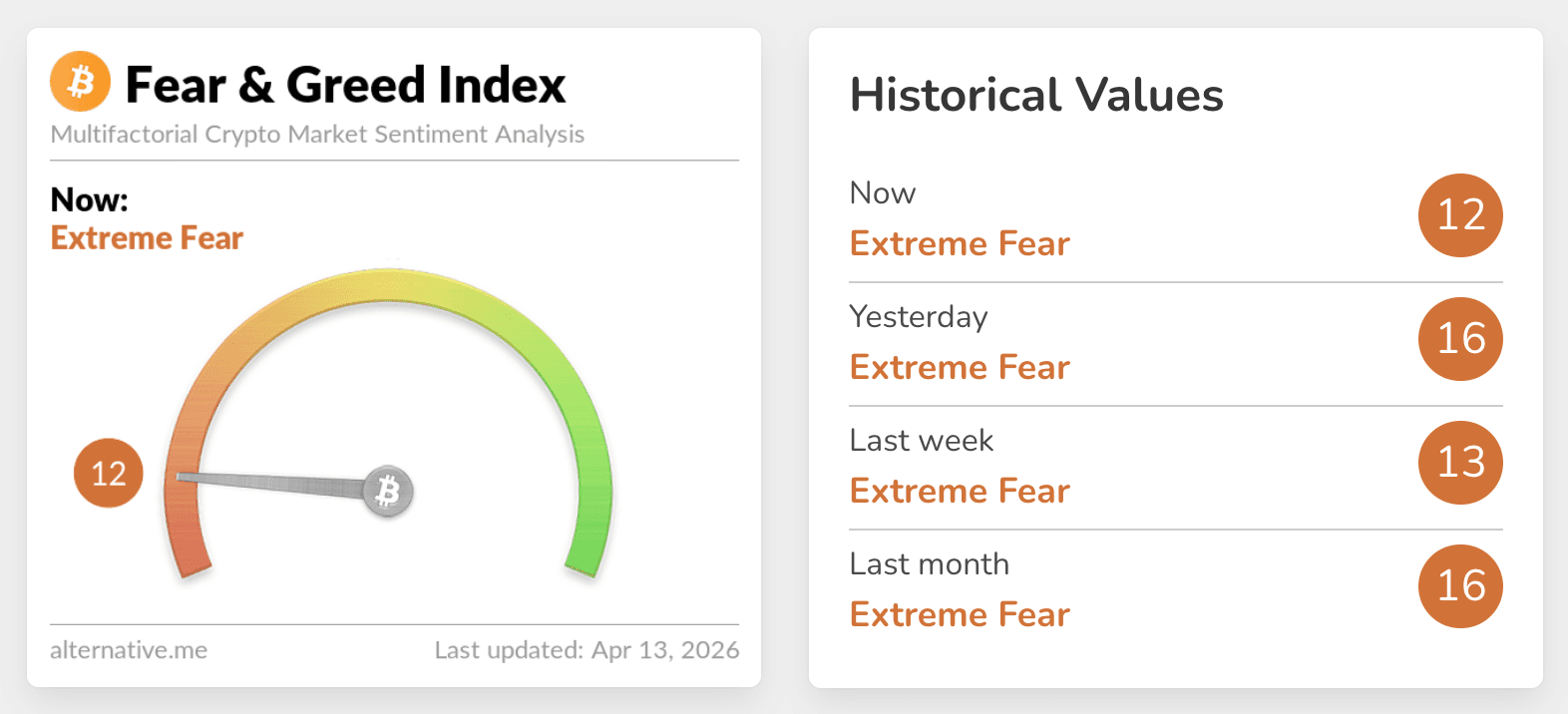
Source: Alternative
Key News Highlights:
European Central Bank Backs Plan To Shift Crypto Oversight To ESMA
The European Central Bank has formally supported a European Commission proposal that would place the supervision of major crypto companies under the European Securities and Markets Authority. The proposal would move oversight away from individual member state regulators and toward a more centralized EU-level framework. According to the ECB, the plan would support deeper integration of capital markets and financial supervision across the bloc, especially for systemically important cross-border firms such as large trading platforms and crypto service providers. The central bank argues that a unified supervisory structure could reduce regulatory fragmentation, improve convergence in enforcement standards, and better contain cross-border risks in digital asset markets. The move would also mark one of the most significant changes to the EU’s crypto regulatory structure since MiCA began coming into force. Some jurisdictions that have been active licensing hubs under MiCA have expressed concern that the proposal is moving too quickly, especially since the current regime for crypto-asset service providers only recently took effect. Even so, the ECB said the growing links between banks and crypto firms have strengthened the case for a centralized supervisory regime that can address systemic risk more effectively and help safeguard financial stability across the single market.
Bitcoin and Oil Swing Sharply After US Announces Hormuz Blockade
Bitcoin fell to as low as $70,623 after the United States announced a blockade of the Strait of Hormuz following failed peace talks with Iran. The decline came after President Donald Trump confirmed the blockade and said the talks had collapsed because Iran refused to abandon its nuclear weapons program. As U.S. futures markets opened, Bitcoin extended its losses while oil surged 9.5% to $105 per barrel within roughly half an hour. The Strait of Hormuz handles about one-fifth of global oil trade, so any disruption in the region carries immediate consequences for energy pricing and broader financial market volatility. The latest move added fresh pressure to crypto assets, which are already trading in a market shaped by macro uncertainty and inflation concerns. Analysts noted that the geopolitical shock could further delay expectations for rate cuts in 2026, especially as higher energy prices feed into inflation expectations. The event has reinforced the view that crypto is now trading within a broader cross-asset risk framework, where geopolitical developments, oil prices, and monetary policy expectations are all closely linked. Even though Bitcoin has held up better than some traditional assets since the conflict began, the immediate reaction to the blockade showed that headline risk remains a major driver of short-term price action.
Pavel Durov Warns Push Notification Logs May Undermine Privacy
Telegram co-founder Pavel Durov has warned that push notification logs could create serious privacy risks for users of encrypted messaging applications. His comments followed reports that forensic analysts were able to retrieve messages from Signal by accessing push notification system logs on an Apple iPhone. Durov said that disabling message previews is not enough to guarantee privacy, because users cannot assume that every person they communicate with has taken the same precautions. The warning has renewed attention on the limits of end-to-end encryption when applications still generate metadata or interact with operating system level services that may expose sensitive information. The broader issue is that message content may be encrypted while logs, timestamps, delivery traces, and other forms of metadata can still reveal meaningful communication patterns. This has become an important discussion point for privacy-focused users and developers, especially in crypto communities where secure communication often plays a central role in coordination and operations. Durov’s comments underscore that privacy protection cannot be judged only by the encryption standard used inside the app itself. The architecture of the mobile operating system and the surrounding notification infrastructure can still introduce weak points that compromise user confidentiality.
Trending Tokens:
- $OFC (OneFootball Club)
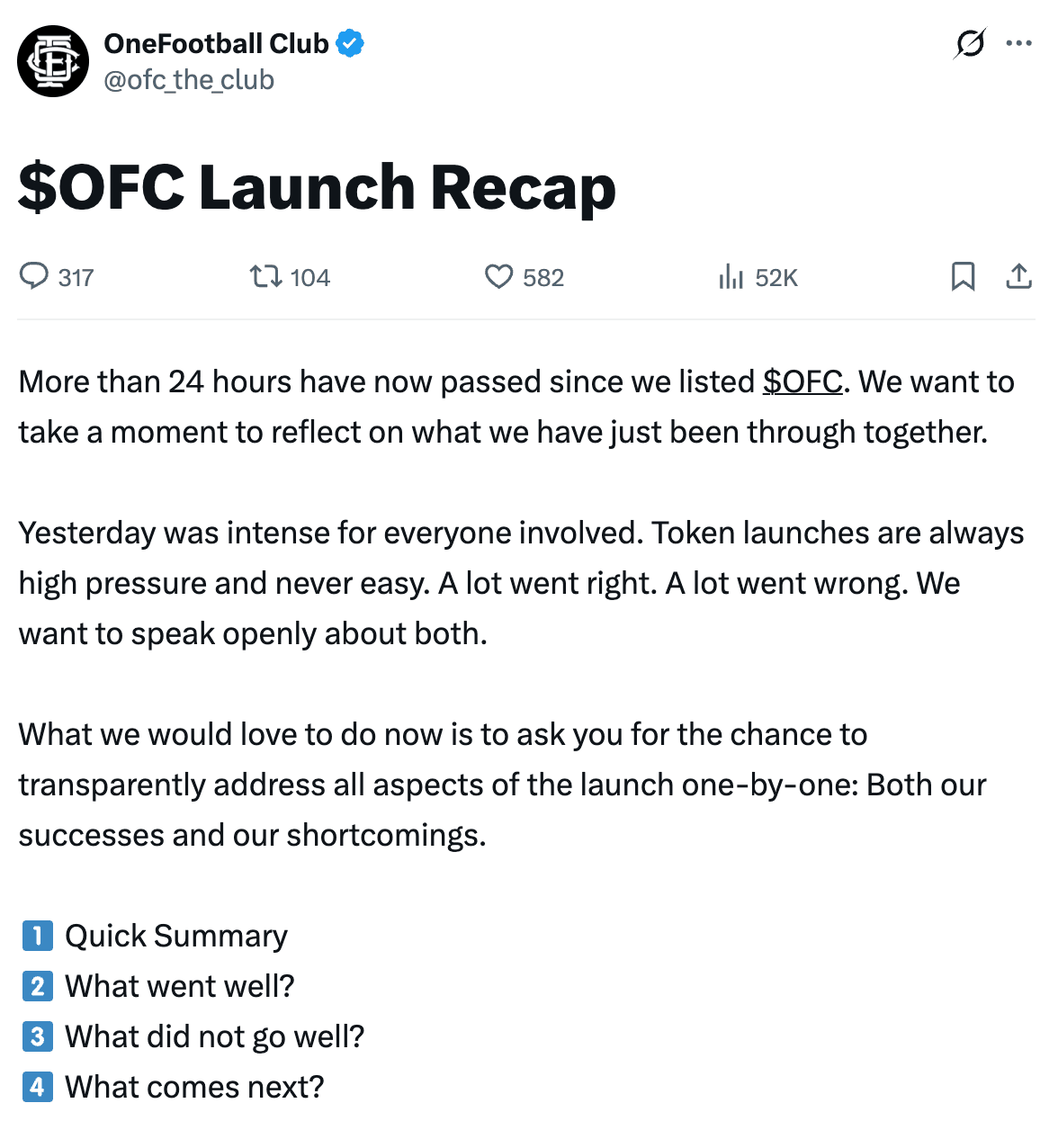
OneFootball Club has drawn strong market attention after launching $OFC on Base and tying the token directly to its broader push into a blockchain-based fan economy. The project reported more than USD 25 million in trading volume within the first 24 hours, which gave the launch immediate visibility across the market. It also said that around 90% of eligible users had already completed their airdrop claims, despite some early operational friction during the claim process. Beyond the token itself, the launch was tied to the rollout of OneFootball Predict and the first onboarding phase for FanPass, which positioned the event as a product expansion rather than a standalone listing moment. That product linkage is one of the main reasons the narrative has gained traction, because it connects token activity with a recognizable sports platform and an existing user base. The project’s stated goal of building a global fan economy has further strengthened the story, especially as Web3 continues to look for large-scale consumer use cases. With support from major industry partners and a long runway into the 2026 FIFA World Cup cycle, $OFC is being closely watched as a sports-focused token with mainstream reach potential.
- $RATE (weRate)
$RATE has gained traction after weRate partnered with Solflare for the Seek & Rate campaign, turning the collaboration into a user acquisition event inside one of the most established wallet ecosystems on Solana. Under the campaign structure, Solflare users could access special perks tied to participation, including bonus RATE rewards and exclusive digital traits, which helped the token gain visibility beyond its core audience. The narrative around weRate is built on tokenized incentives for authentic reviews and community feedback, which gives the project a clearer consumer-facing use case than many early-stage social applications in Web3. The Solflare integration matters because it lowers distribution friction and places the campaign directly in front of an active onchain user base. That combination of accessible onboarding and gamified participation has made the project more visible in recent market discussion. Market interest is also tied to the broader idea that verified user sentiment and review behavior could become a valuable data layer in crypto-native consumer platforms. As a result, $RATE is being watched as a narrative token at the intersection of community engagement, product discovery, and incentive-driven participation.
- $RAVE (RaveDAO)
$RAVE has attracted attention as RaveDAO continues to build a distinct identity around electronic music, crypto-native community culture, and participatory brand formation. The project stands out because it is not framed around a conventional DeFi or infrastructure use case, but around a CultureDAO model that connects events, creative collaboration, and community-led expansion. Recent jumps in heat and growth metrics have made the token more visible in trend tracking, which has helped push the project further into speculative discussion. The core narrative is centered on bringing together early crypto adopters, music communities, and technology workers who see culture itself as an onchain coordination layer. That positioning has given RaveDAO a differentiated place in the market, particularly at a time when SocialFi and culture-driven tokens continue to attract bursts of native attention. The project’s entertainment-led identity also gives it a wider emotional and community dimension than more utility-heavy tokens, which is part of the reason it can generate strong engagement even without a traditional financial story. In the current market, $RAVE is being followed as a culture-focused token whose momentum is tied to narrative strength, community resonance, and renewed interest in the broader CultureDAO segment.
Disclaimer: The information provided in this section is for informational purposes only and doesn't represent any investment advice or FameEX's official view.