FameEX Today’s Crypto News Recap | May 29, 2026
2026-05-29 07:06:49

Sui Network recovers, a $9B BTC options expiry looms, and Gemini integrates Grok AI. The crypto market remains defensive as BTC slips below $74K amid institutional selling. Against the global macroeconomics, investors are showing clear divergence and reassessment over the direction of Federal Reserve monetary policy. A recent comment from T. Rowe Price’s chief economist suggested that the market may be materially underestimating the possibility of further Fed monetary tightening. This is especially relevant as geopolitical conflict involving Iran continues to keep energy costs elevated, while US domestic economic data remains resilient. Under this situation, the probability that the federal funds rate will remain unchanged over the next 12 months stands as high as 45%. There is also a tail risk of another rate hike, while the expected probability of a rate cut is only 20%. Meanwhile, traditional financial markets are showing a very different sentiment profile. Japan’s TOPIX Index reached a record high, while the Nikkei 225 rose more than 2%. This suggests that capital flows are moving toward markets with specific economic recovery narratives, rather than simply seeking high-risk returns from crypto assets. This divergence in global liquidity allocation has directly limited the ability of the crypto market to attract sufficient marginal capital at the current stage. Under a highly uncertain macro environment, investors’ appetite for risk assets has continued to decline. They are demanding a higher risk premium, which helps explain the recent continued outflows from crypto-related investment products.
Crypto Markets Overview
Crypto market sentiment remains weak, with the Crypto Fear & Greed Index falling to 23 and staying in the “Extreme Fear” zone. This reflects an extremely cautious risk-off mindset among market participants. From the perspective of on-chain data and trading behavior, both Bitcoin and Ethereum spot ETFs have experienced persistent capital withdrawals. Bitcoin spot ETFs recorded a single-day net outflow of USD 229 million, while Ethereum spot ETFs saw a net outflow of USD 121 million. This indicates that institutional investors are reducing exposure to crypto assets under a high-rate and uncertain macro environment. Sector performance has also shown clear divergence. Although the broader market faced selling pressure, with Bitcoin falling below $74K and Ethereum briefly testing the $2,000 support level, the DeFi sector showed relative resilience and capital absorption. Some decentralized protocols moved higher against the broader trend. In addition, Coinglass data showed that total liquidations across the market reached USD 726 million over the past 24 hours, with long liquidations accounting for the vast majority. This reveals the structural risk faced by leveraged trading during the recent volatility. The market is going through a deleveraging-driven cleanup process, while trading strategies have shifted toward a more defensive mode.
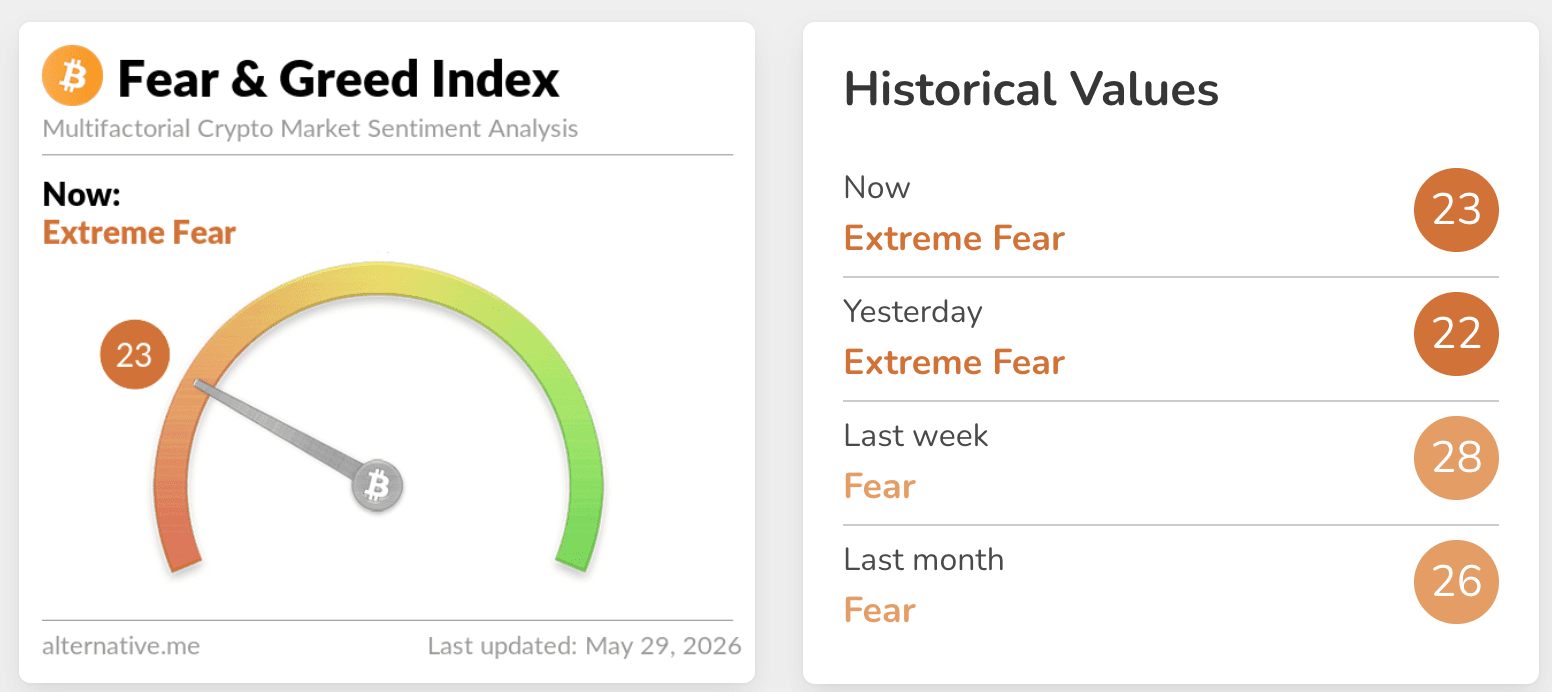
Source: Alternative
Key News Highlights:
Sui Network Resumes Operations After Prolonged Outage
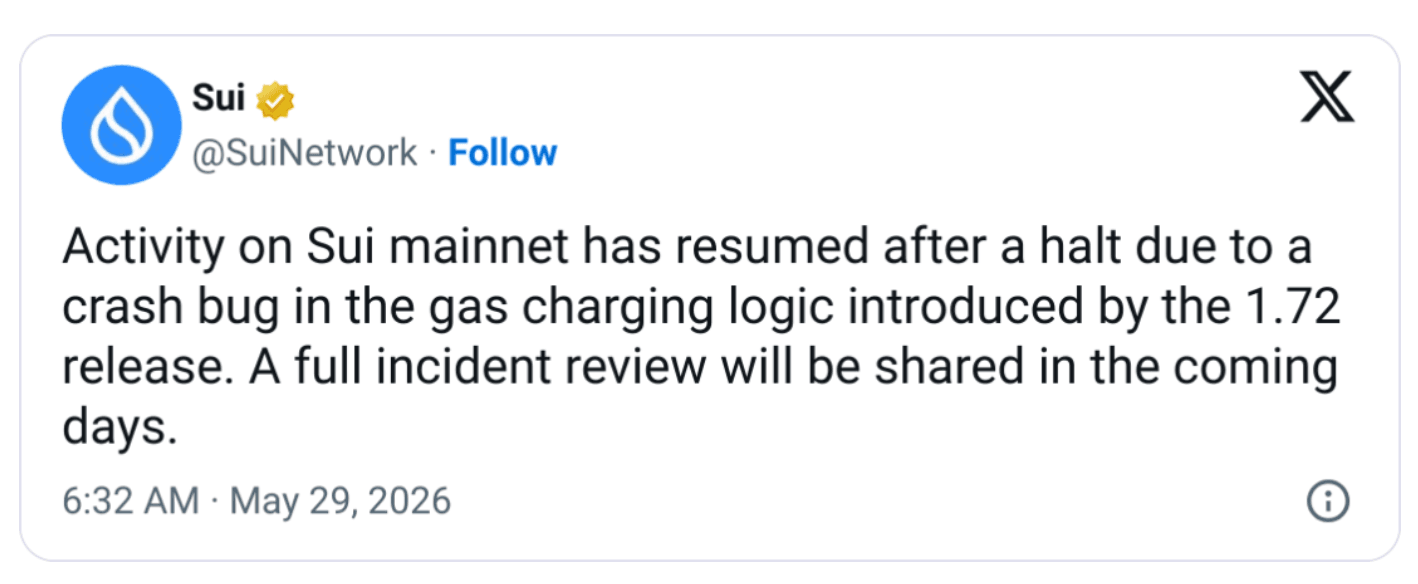
The Sui blockchain mainnet recently experienced a network outage lasting 5 hours and 55 minutes, temporarily preventing the chain from processing transactions. According to the official follow-up statement, the incident was caused by an error in the gas fee calculation logic introduced in a network update. This marked the second similar technical outage for the Sui blockchain in 2026. During the downtime, Sui’s native token SUI briefly declined by around 6.6%, touching a low near $0.90 before recovering slightly after the network resumed operations. Despite the technical challenge, Sui continues to maintain its development goal as a high-performance Layer 1 blockchain. The development team has committed to conducting a full incident review. This event highlights the potential technical pressure faced by decentralized networks when frequent system upgrades are carried out. Market participants will continue to monitor the network’s subsequent optimization progress in infrastructure stability.
Bitcoin Options Expiry Intensifies Market Uncertainty
As Friday’s Bitcoin options expiry approaches with a total size of up to USD 9 billion, market sentiment has turned increasingly cautious. This is especially the case after Bitcoin recently failed to break above the $74K psychological level, which strengthened the market influence of the bearish side. Data shows that if Bitcoin remains below this price range, call option positions will face the risk of losing value, while put options will remain in a relatively favorable position. This creates greater downside pressure and potential selling risk for the market. In addition to continued net outflows from Bitcoin spot ETFs, recent adjustments to Bitcoin holdings by corporate entities have further added to selling pressure. Analysts noted that risk-hedging demand has increased ahead of the options expiry. The lack of a strong short-term catalyst has also limited bullish momentum. Although options data does not yet show excessive panic-driven hedging activity, the overall market trend remains defensive. Traders generally believe that meaningful and sustained upside momentum may be difficult to observe before the options expiry.
Gemini Partners With Grok To Enhance AI Prediction Market Features
Crypto exchange Gemini recently announced a strategic partnership with an AI company under Elon Musk to integrate the Grok artificial intelligence model into its prediction market platform. The platform will launch a personalized information feed feature called Command Center. The initiative aims to use AI technology to actively filter and present key market intelligence based on users’ positions, watchlists, and previous prediction history. It is designed to help users make more timely decisions across crypto, sports, commodities, and macroeconomic markets. Against a backdrop of pressure on trading volume and profitability, multiple exchanges are actively seeking business diversification. They are introducing AI and prediction market tools to improve user engagement and the trading experience. Gemini’s move reflects a broader industry trend. Financial services are being combined with AI-native technology, as platforms seek to evolve into more comprehensive financial service providers in response to intensifying competition and structural changes in the digital asset market.
Trending Tokens:
- $ARX (Arcium)
Arcium recently launched its Mainnet Alpha, marking a key milestone in the development of its parallelized confidential computing network. This initial phase operates in a permissioned environment, using four node operators to form the foundational cluster and ensure system stability. The deployment serves as a strategic prelude to broader decentralization. It allows the core team to validate performance benchmarks and improve the user onboarding experience. At the same time, the network has demonstrated its utility through the deployment of Umbra Private Mainnet, the first live application integrated into the Arcium ecosystem. Developers are now building encrypted applications with updated documentation, while the community is watching the RTG Portal rollout and future eligibility assessments. By combining multi-party computation, fully homomorphic encryption, and zero-knowledge proofs, Arcium is positioning itself as a verifiable and efficient infrastructure layer for decentralized computation. As the network moves from a permissioned Alpha version toward a fully decentralized architecture, investors and developers are closely monitoring its ability to scale these privacy-preserving guarantees.
- $AORA (AtlasOra)
AtlasOra is attracting market attention as a settlement layer designed to address the complexity of real-world commercial transactions, with an initial focus on the vacation rental market. The project aims to bridge traditional business operations and decentralized finance by optimizing settlement flows on the Base ecosystem. Recent market engagement shows that the project has reached 2,000 tokenholders. This indicates growing confidence among early adopters, even as the broader product suite remains under development. Although the team faces scrutiny over the timeline for full product availability, its emergence as a niche infrastructure participant in the real-world asset sector has attracted market participants seeking vertical DeFi applications. Investors are now evaluating the protocol’s scalability as it seeks to convert traditional commercial rental activity into onchain settlement. As the project matures, the core focus remains on executing its roadmap, delivering tangible product utility, and supporting long-term community growth. Future market interest may depend on the platform’s ability to demonstrate sustained settlement volume and effective integration with established vacation rental workflows.

- $STRATA (Strata)
Strata has become an important participant in the yield optimization sector by introducing a perpetual yield tranching protocol designed to enhance the capital efficiency of synthetic stable assets such as Ethena’s USDe. The protocol provides a structured risk-return framework, allowing investors to choose between senior tranches for fixed yield and junior tranches for leveraged exposure to arbitrage strategies. Market interest rose sharply after the platform announced that it had transformed more than $10 million in Digital Credit into active Digital Money and Digital Yield. This mechanism creates a powerful credit flywheel effect and has attracted attention from sophisticated participants seeking to optimize portfolio exposure. By systematizing the management of Ethena-related yield, Strata provides a necessary layer of financial engineering that segments risk preferences for different investor groups. The project continues to draw market focus due to its prominent backing and its role in expanding the utility of Bitcoin-denominated credit markets. As the protocol scales, market participants are monitoring the sustainability of its yield generation and its ability to maintain deep liquidity across tiered portfolios.
Disclaimer: The information provided in this section is for informational purposes only and doesn't represent any investment advice or FameEX's official view.