FameEX Today’s Crypto News Recap | May 19, 2026
2026-05-19 06:38:05

Fed chair transition and heavy retail capital outflows trigger market caution, pushing Bitcoin down to $76.5K as Ethereum fluctuates around the $2,100 level. Today’s crypto market continued to show sharp downside volatility under the combined pressure of macroeconomic uncertainty and geopolitical tension. Hawkish expectations around a limited chance of Fed rate cuts this year weighed on sentiment during the transition to a new Federal Reserve chair. At the same time, renewed tensions around the US-Iran situation and the Strait of Hormuz pushed international oil prices higher, which intensified market concerns over a broader inflation rebound. Bond markets then saw renewed selling pressure, further eroding short-term risk appetite across global risk assets. Investors also remained cautious ahead of upcoming manufacturing PMI data and Nvidia earnings, while the derivatives market triggered a large wave of cascading long liquidations after several sessions of pressure. Total crypto liquidations expanded rapidly over the past 24 hours, directly pushing both Bitcoin and Ether below key technical and psychological support levels. Although selling and weaker retail participation in futures have created short-term fear, on-chain data still shows continued accumulation by mega-whales. The broader market structure is now undergoing a deep position reset as capital rotates and long-short positioning is repriced.
Crypto Markets Overview
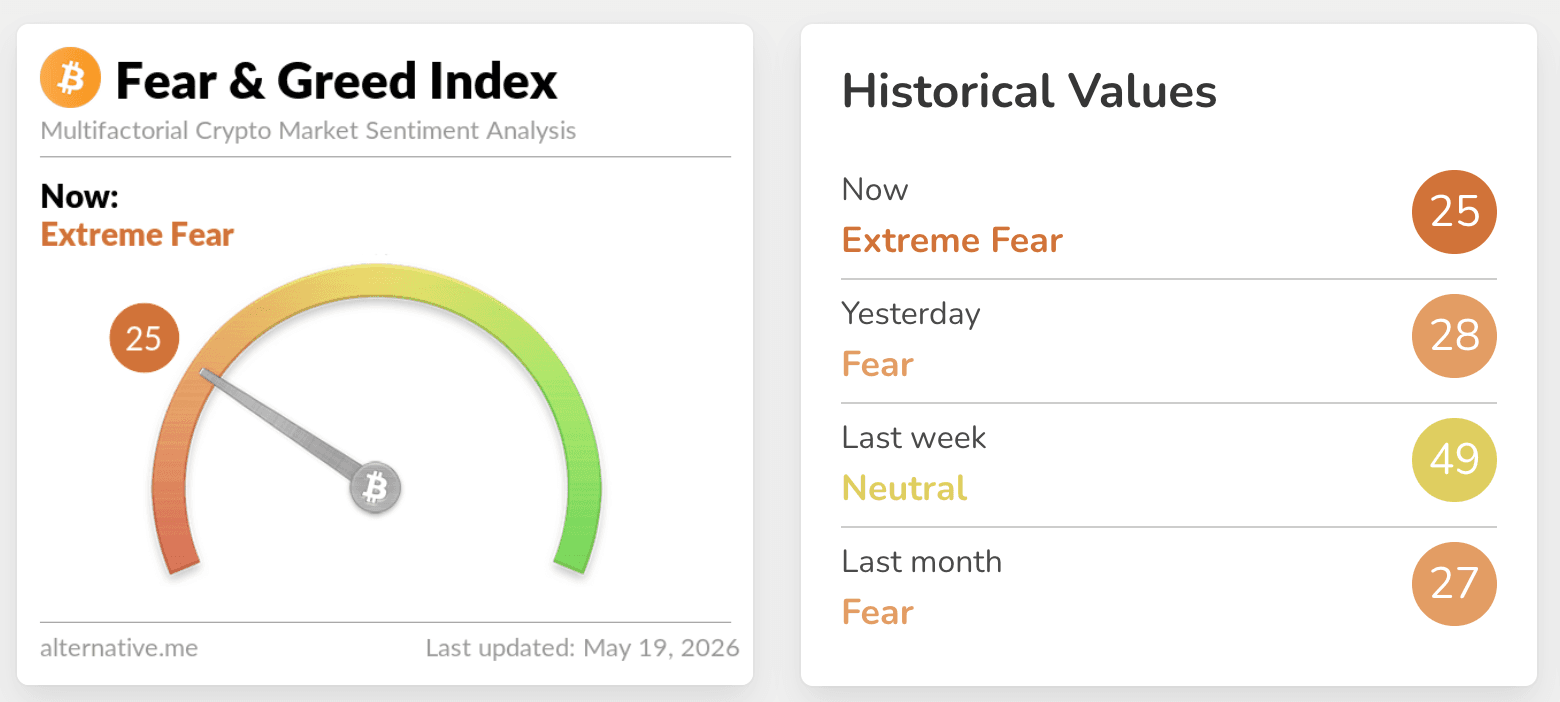
Panic sentiment in today’s crypto market deteriorated sharply amid the ongoing macro tug-of-war. The Crypto Fear & Greed Index fell from yesterday’s 28 in Fear zone to 25 today, entering the Extreme Fear zone. This indicates that market-wide risk appetite has dropped to a near-term low. In terms of price action, Bitcoin failed several attempts to break above the $82,000 level and then faced renewed long selling pressure and forced liquidations. The price continued to test support around $76,000 and even slipped to a monthly low near $76,500 after falling below the 21-week exponential moving average, which is widely viewed as part of the bull market support band. This marked the lowest level since May 1. Ether also weakened in parallel and is now fluctuating structurally around the $2,100 range. The move came as major CEX liquidation maps showed up to USD 800 million in cumulative long liquidation intensity around key downside levels. Since 30-day spot demand and futures demand remain heavily divergent, the broader market may struggle to stage a rapid V-shaped rebound before high-leverage positioning in derivatives is fully absorbed.
Source: Alternative
Key News Highlights:
New Fed Chair Set To Be Sworn In As Rate Cut Odds Fall To Historic Lows And Regulatory Policy Turns Cautious
Many economists and market analysts have expressed strong concerns over the independence of Kevin Warsh after he takes over as Federal Reserve chair, especially regarding whether future interest-rate decisions could face external political pressure. Warsh is scheduled to be officially sworn in this Friday. After the US Senate approved his nomination largely along party lines, prediction market data from Kalshi shifted sharply. Event contracts betting that the central bank would cut interest rates before 2027 have dropped from an overwhelming 96% in February to 38.2%. At the same time, CME FedWatch data shows a highly consistent hawkish outlook. Markets now assign more than a 94% probability that the Federal Reserve will keep the federal funds rate unchanged within the 3.50% to 3.75% range through mid-June and late July. Against this macro backdrop, CICC’s latest research report further noted that multiple inflation indicators have exceeded expectations. It expects US core PCE inflation to remain above 3% for the full year, well above the Fed’s 2% policy target. This means the Fed may maintain a more cautious stance in the near term, with further rate cuts unlikely this year. In addition, US lawmakers are still closely watching the nomination process for the full Commodity Futures Trading Commission panel. This is especially important as the Digital Asset Market Clarity Act, also known as the CLARITY Act, continues to advance. Leaders from both parties have called for a full slate of nominees to address urgent rulemaking and jurisdictional issues tied to future crypto market structure reforms.
Retail Bitcoin Demand Drops By More Than 70% As Heavy Futures Selling And Major Exchange Market Shares Shift
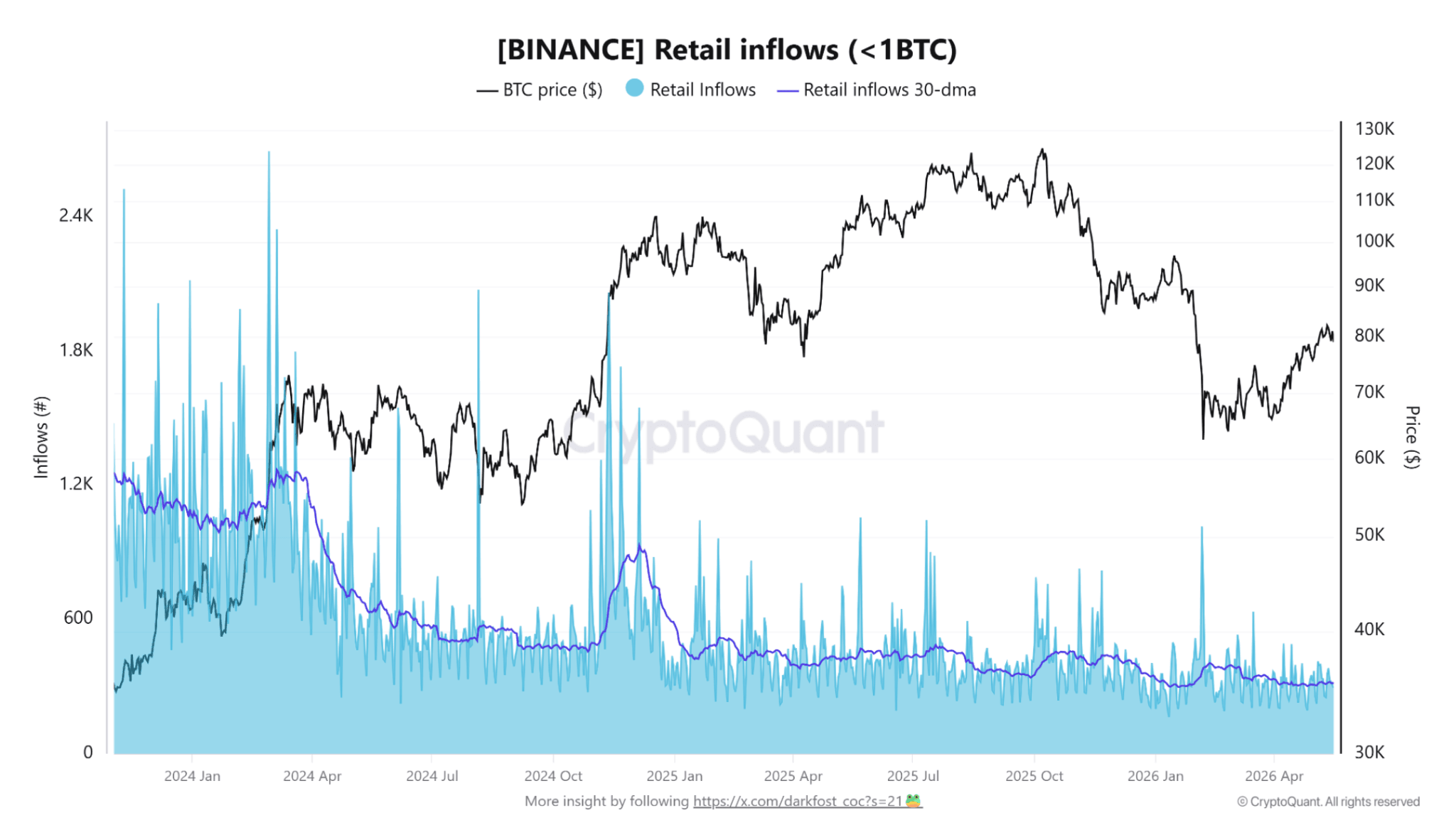
According to in-depth tracking from CryptoQuant’s on-chain analytics, retail Bitcoin activity on CEX platforms has fallen to a historic low. In 2026, the average monthly net inflow from typical retail wallets holding less than 1 BTC has dropped to about 314 BTC. This is a sharp contraction from roughly 1,200 BTC during the local market peak in March 2024. Market research suggests that this structural change in capital flows is largely linked to retail capital moving toward regulated spot Bitcoin exchange-traded funds, rather than holding spot BTC directly on traditional crypto exchanges. Therefore, the 30-day growth rate of retail net demand on exchanges has plunged by 73% over the past three weeks, leaving the market without healthy spot-buying support. Meanwhile, the derivatives market recorded aggressive futures taker selling and liquidation pressure of more than USD 2 billion during the recent period of sharp gold and oil price volatility. Concentrated selling pressure became especially visible when Bitcoin fell below the $77,000 level. More importantly, the current rebound attempt still faces a major structural risk because spot demand remains disconnected from futures-driven long positioning. Futures demand over the past 30 days stayed positive at 193,000 BTC, while spot demand has remained below the zero line for 65 consecutive trading days. This imbalance has also triggered a sharp reshuffling of market share among major exchanges.
Crypto Funds See USD 1.07 Billion In Heavy Outflows As US-Iran Tensions Drive Institutional Risk Reduction And Regulatory Debate
Global digital asset investment products faced heavy redemption pressure last week after US inflation data rebounded and US-Iran geopolitical tensions renewed concerns over possible disruption around the Strait of Hormuz. This ended the previous six-week streak of net inflows. According to CoinShares’ latest weekly fund flow report, digital asset exchange-traded products recorded USD 1.07 billion in net outflows for the week. This was the third-largest weekly outflow so far this year and also contributed to a synchronized pullback across traditional risk assets and crypto assets. Bitcoin investment products were the main target of institutional selling, with weekly outflows reaching USD 982 million. Ether investment products also weakened and recorded USD 249 million in net outflows, marking the largest weekly withdrawal since January 30. From a regional perspective, the outflow was almost entirely driven by US-based institutional investors, with the US market recording USD 1.14 billion in net outflows. Several European markets, including Switzerland, Germany, and the Netherlands, instead posted modest inflows. Despite broad market weakness, selected altcoin investment products showed strong resilience. XRP and Solana funds attracted USD 67.5 million and USD 55.1 million in inflows, respectively. This was mainly supported by improved regulatory expectations after the US Senate Banking Committee advanced the CLARITY Act with strong support. Some Democratic lawmakers still hold reservations over ethics provisions related to potential conflicts of interest between legislators and the crypto industry. Even so, the bill’s material progress in Congress has provided a degree of institutional support for selected assets during a broader macro risk-off phase.
Trending Tokens:
- $VVFIT (VitalVEDA)
As artificial intelligence and deep technology become more deeply integrated into decentralized consumer applications, the Move-to-Earn and Web3 fitness sectors are seeing a new wave of capital inflows. Founded in 2022, VitalVEDA is a fitness platform that combines blockchain, artificial intelligence, and augmented reality technology to provide personalized workout plans and gamified community experiences. The project has previously secured USD 20 million in financing from established investors including Rollman Management. Recent market attention around the asset has surged, with the official v10.20 update serving as the core catalyst. This technical deployment fully introduced AI Move Master, a proprietary rep counting engine that delivers 99% real-time calculation accuracy while increasing workout start speed by three times. VitalVEDA has effectively converted technical utility into substantial market visibility. Institutional observers attribute the asset’s strong performance to rising investor demand for mature, well-funded consumer projects that combine physical activity incentives with advanced machine learning architecture.
- $PROS (Pharos Network)
As institutions continue to seek fully compliant public ledgers, the market narrative around high-throughput Layer 1 protocols and enterprise-grade decentralized finance is gaining momentum. Founded in 2024 by former blockchain leaders from Ant Financial and Alibaba, Pharos Network is an asset-native, modular, and full-stack parallel Layer 1 blockchain network built for real-world assets and institutional DeFi. The project has received USD 52 million in venture funding from prominent investors including Hack VC, Faction, and Yunfeng Financial. The sharp rise in ecosystem activity is directly linked to the official launch of the Pharos Pacific Ocean Mainnet, which marks the network’s transition into a fully operational production environment. Alongside the mainnet release, the official foundation also established token bridge infrastructure across Ethereum, Base, and the native Pharos environment to support broader cross-chain accessibility. As a result, market participants have been actively accumulating the asset. They increasingly view the protocol as a core infrastructure bridge capable of bringing deep liquidity into compliant on-chain environments.
- $BILL (Billions Network)
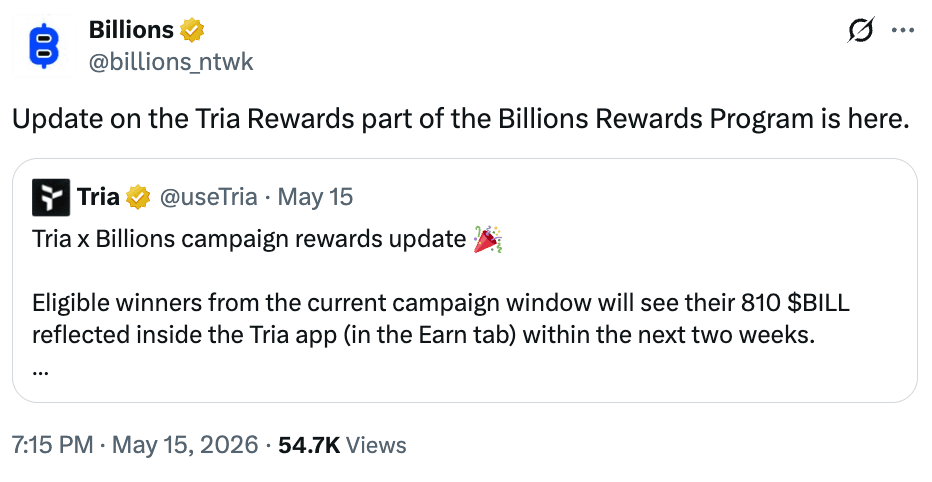
Decentralized consumer networks and Web3 financial applications are deepening community engagement through structured incentive campaigns and card payment partnerships. Billions Network is seeing a significant rise in market attention following a major strategic campaign update with Tria, a Web3 onboarding and digital payment application. Under the verified rewards distribution framework, eligible campaign participants will see their 810 BILL token rewards reflected in the Earn tab of the Tria app within the next two weeks. The tokens will then follow a six-month unlock and distribution protocol. Given the strong level of active user participation and the large volume of card transaction verification, the project foundation has officially extended the campaign window by another five months until the end of October. To qualify for the digital asset distribution, users must keep their accounts active and meet a specific spending threshold of USD 50 or more through the integrated payment framework. As retail users and institutional analysts continue to monitor the expansion metrics of this real-world reward distribution framework, the token is showing strong development momentum.
Disclaimer: The information provided in this section is for informational purposes only and doesn't represent any investment advice or FameEX's official view.