FameEX Crypto Market Trend | May 12, 2026
2026-05-12 06:19:58
Trump announced an Iran ceasefire as the U.S. secured Hormuz shipping. Markets expect a Bitcoin reserve plan, while Powell staying may slow future Fed rate cuts.
I. Core Market Overview
1. BTC Spot Performance
Price Range: 75,285 USD - 82,798.6 USD
Weekly Volatility: 9.98%
Key Driving Factors:
Primary Factors: On April 21, U.S. President Donald Trump announced an indefinite ceasefire in the latest Iran conflict. On May 4, the U.S. military launched “Operation Freedom,” guiding vessels through the Strait of Hormuz, signaling improving conditions in the Iran war situation and strengthening expectations for an eventual peace agreement. In addition, the United States may announce new policies regarding a strategic Bitcoin reserve in May or June.
Secondary Factor: Recent dovish policy remarks by incoming Federal Reserve Chair nominee Kevin Warsh; Russian President Vladimir Putin stated that the Russia-Ukraine war may come to an end, while Trump has also expressed interest in facilitating peace talks. The brief market pullback beginning on April 27 can be interpreted as a reaction to Jerome Powell remaining on the Federal Reserve Board, which could increase resistance to future rate cuts once Kevin Warsh takes office.
2. Central Bank Policy Updates
Policy Impact Assessment:
An increasing number of key Federal Reserve officials have adopted a more hawkish stance, signaling a rising probability of future rate hikes.
The European Central Bank remains focused on financial stability, with the likelihood of further rate hikes also increasing, while regulatory scrutiny over crypto assets continues to tighten.
3. Other Key Updates
Kevin Warsh, personally selected by U.S. President Donald Trump as the preferred successor to Jerome Powell, is reportedly preparing a sweeping agenda of reforms: institutional restructuring, lower policy rates, a new framework for addressing inflation, a sharply reduced balance sheet, a more independent Federal Reserve, a narrower mandate, closer coordination with the U.S. Treasury, and fewer “noisy voices” from the Fed’s 19 policymakers.
At an April 22 hearing before the Senate Banking Committee, Warsh outlined his core policy vision of pursuing balance sheet reduction and rate cuts simultaneously. He explicitly opposed the normalization of quantitative easing and advocated for a gradual downsizing of the Federal Reserve’s balance sheet. Although he stopped short of making a firm commitment, his remarks revealed a clear inclination toward rate cuts. This shift could signal a reassessment of the narrative surrounding persistently excessive U.S. dollar liquidity.
Coinbase’s “Independent Advisory Committee on Quantum Computing and Blockchain” released its first position paper. The paper’s central conclusion is that Bitcoin’s core infrastructure remains fundamentally secure. Quantum computing is not expected to pose a material threat to Bitcoin mining, hash functions, or blockchain historical records. The primary vulnerability lies at the wallet layer. Ethereum has already established a clear roadmap aimed at addressing this issue in the near future.
Web3 security firm CertiK released its report, *2026 Digital Asset Regulation Landscape*, providing a systematic overview of global regulatory trends. According to the report, by 2026, regulatory frameworks across major jurisdictions will have largely taken shape, pushing the industry into a full compliance era.
The report highlights that anti-money laundering enforcement has overtaken securities classification disputes as the primary regulatory risk. In the first half of 2025 alone, global AML-related fines exceeded $900 million, making transaction monitoring capabilities a core compliance requirement. At the same time, smart contract security audits are evolving from industry best practices into mandatory entry requirements, becoming essential for licensing approvals and token listings.
In addition, global stablecoin regulatory frameworks are increasingly converging around principles such as full reserve backing and licensed issuance, although cross-jurisdictional differences continue to create compliance challenges. The report concludes that, as regulatory convergence and enforcement intensify, the industry has entered an era of “strong compliance.” According to CertiK, the key challenge facing companies is shifting from “whether they are compliant” to “whether they can rapidly build and operationalize compliance capabilities.” Multi-jurisdiction licensing, AML investment, and continuous security auditing are becoming foundational thresholds for institutional growth.
II. Market Health Index Analysis (Source: CoinMarketCap)
Source: https://coinmarketcap.com/charts/
Conclusion:
The total crypto market capitalization continues to rise, while declining trading volume suggests the market is increasingly driven by competition among existing liquidity rather than fresh inflows.
The Altcoin Season Index remains within the [25–55] range, indicating capital rotation toward mid- and small-cap tokens. Meanwhile, net inflows into ETFs, combined with the Fear & Greed Index staying in relatively neutral territory, suggest that overall market confidence has changed little.
III. Derivatives Monitor (Source: CoinAnk)
1. Funding Rate
30-Day Avg Funding Rate of Bitcoin Across the Top Six CEXs: 0.4071% (Positive)
30-Day Avg Funding Rate of ETH Across the Top Six CEXs: 0.5798% (Positive)

Source: https://coinank.com/fundingRate/current
Interpretation:
Positive funding rates indicate that bullish positions remain dominant in the market, reinforcing expectations of a continued bull market.
2. Open Interest Changes
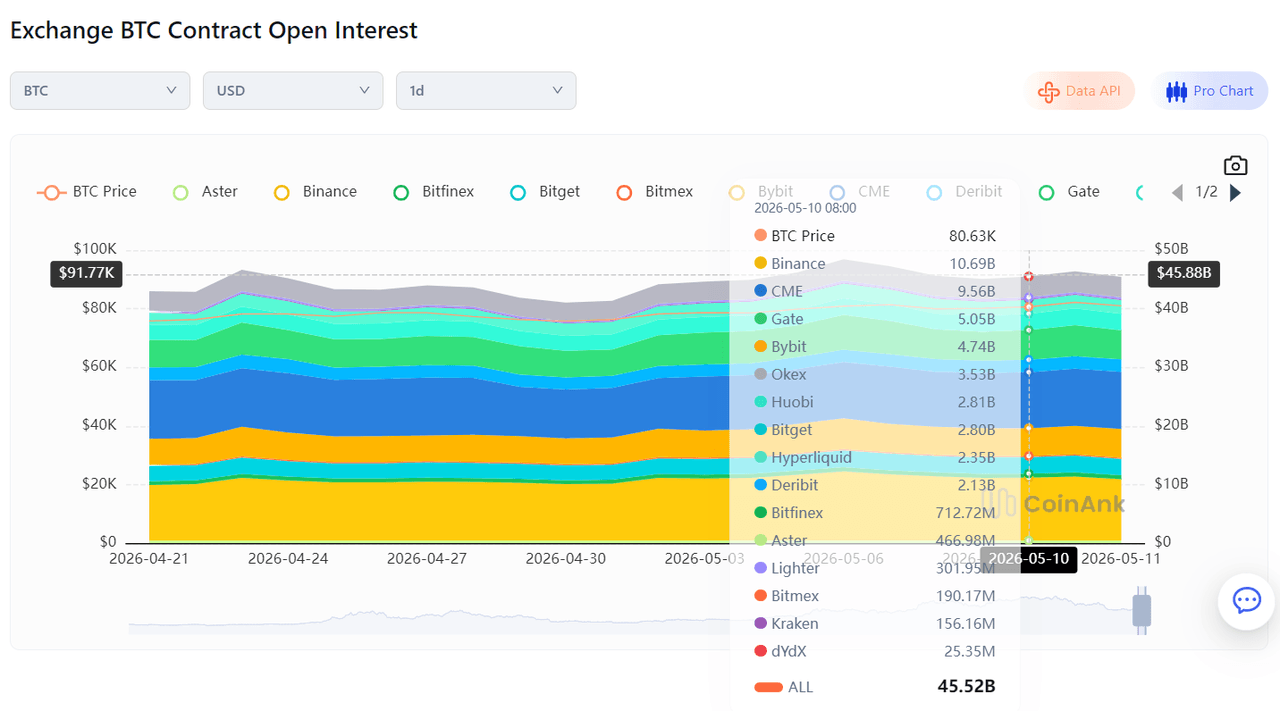
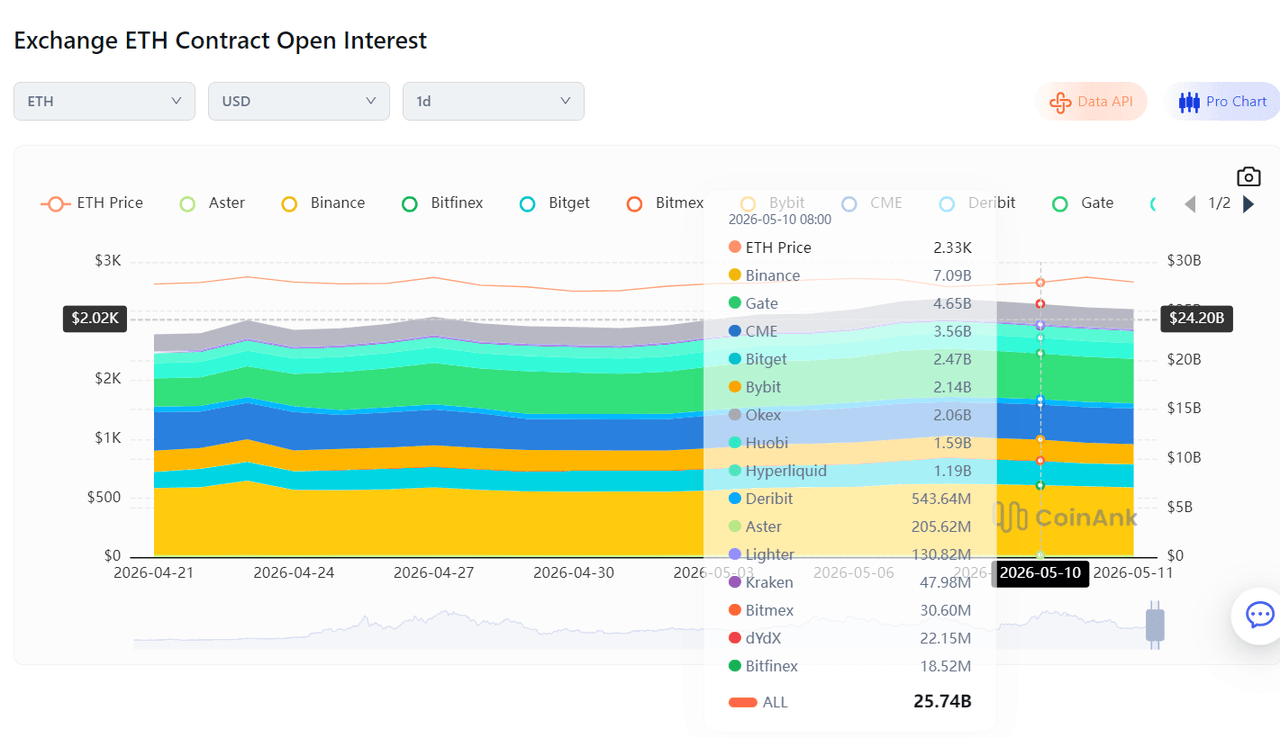
Source: https://coinank.com/indexdata/oivol/exOiHist
IV. Global Economic and Crypto Sector Developments
1. Global Macroeconomy
- April 20: The Federal Reserve kept the benchmark interest rate unchanged at 3.50%–3.75% → Outcome: [In line with market expectations]
- April 21: Donald Trump announced an indefinite ceasefire with Iran → Impact: [The NASDAQ Composite and Bitcoin rose in tandem / The U.S. Dollar Index fluctuated lower]
- April 30: The European Central Bank kept all three key interest rates unchanged → Outcome: [In line with market expectations]
1) April 25: Iran granted exemptions from Strait of Hormuz transit fees to “friendly” countries such as Russia, while banning the passage of all vessels linked to Israel.
2) April 26: Israel’s two major opposition parties announced a merger to challenge Benjamin Netanyahu. Meanwhile, Israel’s president postponed a decision on granting Netanyahu a pardon.
3) April 27: The Iranian delegation did not attend the second round of formal U.S.-Iran talks, instead submitting a three-stage proposal: first, a ceasefire between Israel and Lebanon; second, the gradual reopening of the Strait of Hormuz; and finally, the launch of nuclear negotiations.
4) April 28: Kazuo Ueda stated that if upside inflation risks emerge or downside economic risks remain limited, the Bank of Japan may raise interest rates. A decision could even be made before price data fully confirms upward inflationary pressure.
5) April 29: As of last week, nearly 40% of Democratic members in the U.S. House of Representatives (84 lawmakers) had co-sponsored the Raskin bill, which seeks to strengthen the 25th Amendment by establishing a special committee to assess presidential fitness for office. The amendment provides a mechanism independent of impeachment for removing presidential powers.
6) April 30: Kevin Warsh’s nomination for Federal Reserve Chair was approved by the Senate Banking Committee.
7) April 30: The Bank of England kept its benchmark interest rate unchanged at 3.75% for a third consecutive meeting, in line with market expectations.
8) April 30: The eurozone’s European Central Bank deposit facility rate stood at 2.00%, matching both expectations and the previous reading.
9) May 1: United States Central Command stated that the military would begin supporting “Operation Freedom” on May 4 to restore freedom of navigation for commercial vessels passing through the Strait of Hormuz.
10) May 3: Internal discussions within the Federal Reserve reportedly shifted from “when to cut rates” to “when to resume raising rates.”
11) May 5: The U.S. ISM Non-Manufacturing PMI for April came in at 53.6, versus expectations of 53.7 and a previous reading of 54, viewed as supportive for gold, silver, and cryptocurrencies.
12) May 5: After receiving public criticism from the German Chancellor over decisions related to the Iran conflict, Donald Trump abruptly withdrew 5,000 U.S. troops from Germany.
13) May 6: U.S. ADP employment for April increased by 109,000, above expectations of 99,000 and the prior reading of 62,000, viewed as bearish for gold, silver, and cryptocurrencies.
14) May 7: France deployed the aircraft carrier French aircraft carrier Charles de Gaulle to the Red Sea, signaling support for escort operations in the Strait of Hormuz region.
15) May 7: Initial U.S. jobless claims for the week ending May 2 came in at 200,000, below expectations of 205,000, while the prior figure was revised from 189,000 to 190,000, viewed as bearish for gold, silver, and cryptocurrencies.
16) May 8: The U.S. Department of Justice launched an investigation into $2.6 billion in alleged insider oil trading.
17) May 9: U.S. April nonfarm payrolls exceeded expectations, while the unemployment rate remained stable. However, payroll gains for the previous two months were revised down by a combined 16,000 jobs, and May consumer confidence fell to a record low, viewed as bearish for gold, silver, and cryptocurrencies.
18) May 10: Vladimir Putin stated that he believes the conflict in Ukraine is nearing its end and hinted that a final agreement with Ukraine could soon be signed.
2. Industry Update
- Institutional Developments: On May 4, Rain advanced its on-chain settlement integration with support from Mastercard, reaching a valuation close to $2 billion. On May 10, USDT0 disclosed details of its security architecture, adopting a 3/3 validation mechanism and launching a $6 million bug bounty program.
- Technological Progress: On May 8, Vitalik Buterin stated that Ethereum’s four-year roadmap will focus on scalability expansion and quantum security.
- Industry Trends: On May 9, Binance reported that users from emerging markets accounted for 77% of its user base in 2026, highlighting how crypto trading platforms are increasingly being used as “shadow banks.”
1) April 26: Executives at JPMorgan Chase stated that tokenization will reshape ETFs and the broader fund industry, although meaningful real-world use cases may still be years away.
2) April 27: Authorities in Hubei, China, cracked the country’s first major virtual currency theft case involving over RMB 100 million. The group allegedly developed fake crypto wallet apps to trick users into downloading them and stealing digital assets, with total downloads exceeding 10,000.
3) April 27: Japanese crypto exchange Bitbank launched a crypto-linked credit card supporting direct bill payments in Bitcoin.
4) April 28: Porvenir, Colombia’s largest pension management institution, launched a crypto investment portfolio.
5) April 28: Crypto mining company MARA Holdings established the MARA Foundation, focusing on long-term Bitcoin adoption as well as quantum-resistance and security risks.
6) April 29: Forbes criticized Eric Trump for allegedly profiting heavily through Bitcoin-related ventures at the expense of MAGA investors.
7) April 29: Prediction market platform Polymarket was reportedly hit by a suspected data leak involving more than 300,000 records and an exploit toolkit.
8) April 29: The Ethereum Foundation released its Q1 grant list, continuing support for zero-knowledge technology, cryptography, and protocol infrastructure.
9) April 30: South Korea’s Personal Information Protection Commission launched an investigation into order book sharing between crypto exchanges Upbit and Bithumb. Meanwhile, Bithumb announced plans to introduce post-quantum cryptography technology.
10) May 1: The Trump family reportedly became involved in mining projects in Kazakhstan, some of which previously received $1.6 billion in support from the U.S. government.
11) May 1: North Korean hackers have stolen more than $6 billion worth of cryptocurrencies since 2017. Ripple announced it would share intelligence on North Korean cyber threats with the crypto industry to counter long-term social engineering attacks.
12) May 2: BlackRock submitted a comment letter to the U.S. Office of the Comptroller of the Currency opposing a proposed 20% cap on tokenized reserves.
13) May 3: According to Reuters, the founder of Iran’s largest crypto exchange, Nobitex, is allegedly linked to the family of Iran’s Supreme Leader.
14) May 5: Sam Bankman-Fried’s venture investing abilities have reportedly been reassessed, with some analysts suggesting his investment returns could have reached hundreds of billions of dollars had he not been imprisoned.
15) May 7: BNY Mellon expanded its crypto custody services to Abu Dhabi, initially supporting Bitcoin and Ethereum.
16) May 8: The Moscow Exchange announced that it will launch new settlement futures products for Solana, XRP, and TRON on May 14.
17) May 9: CertiK reported a sharp rise in crypto-related “wrench attacks” in 2026, with Europe becoming the hardest-hit region, particularly France.
18) May 10: South Korea’s crypto asset holdings reportedly halved within a year as investor capital shifted toward equities. A growing trend of “selling crypto to buy homes” also emerged, with people in their 30s accounting for over 70% of participants.
3. Regulatory Policy Update
- April 28: The White House’s chief cryptocurrency adviser stated that a major announcement regarding the “Strategic Bitcoin Reserve” plan would be released in the coming weeks.
- May 1: The Financial Conduct Authority issued new rules for tokenized funds, allowing public investment funds to issue shares on public blockchains.
- May 8: South Korea’s National Assembly passed amendments to the Foreign Exchange Transactions Act, bringing cross-border crypto asset transfers into the foreign exchange regulatory framework.
- May 8: Russia’s Government Legislative Commission approved a proposal from the Ministry of Finance to regulate cryptocurrency taxation and define tax exemption scopes.
1) April 25: U.S. law enforcement agencies offered a $4 million reward for information leading to the arrest of Daren Li, who is accused of involvement in cryptocurrency-related money laundering activities.
2) April 26: The U.S. state of Tennessee imposed a comprehensive ban on cryptocurrency ATMs, with violations carrying penalties of up to one year in prison.
3) April 27: Progress on the U.S. crypto market structure bill stalled, with May 25 potentially becoming the “final deadline” for advancement.
4) April 29: South Korea’s National Tax Service launched preparations for virtual asset taxation, planned for implementation next year. Non-custodial wallets linked to crypto tax evasion will also fall under monitoring.
5) May 1: The Central Bank of Brazil prohibited regulated eFX cross-border payment channels from using virtual assets for settlement.
6) May 2: A revised draft of the U.S. “Clarity Act” would allow crypto companies to offer stablecoin-related rewards while preserving banks’ deposit interest businesses.
7) May 3: The U.S. Office of Foreign Assets Control warned that making “Strait of Hormuz transit fee” payments to Iran through digital assets or similar methods could trigger sanctions risks.
8) May 4: The U.S. Securities and Exchange Commission delayed review of the first batch of prediction market ETFs tied to real-world events such as election outcomes and economic recessions.
9) May 5: A U.S. technology policy initiative organization recruited professionals with crypto industry backgrounds to strengthen congressional digital asset legislative capabilities.
10) May 6: Singapore announced plans to optimize crypto capital regulations, with public blockchain assets potentially no longer being uniformly classified as high-risk assets.
11) May 7: China concluded public consultations on the draft Financial Law, with limited attention given to the legal status of digital currencies and the regulatory boundaries of crypto assets.
12) May 8: Australia’s crypto regulatory reforms officially took effect, while AUSTRAC launched two industry oversight initiatives.
13) May 8: Vietnam announced plans to launch a crypto asset pilot program aimed at shifting unregulated crypto trading into a domestically regulated market framework.
14) May 9: A proposal in Switzerland advocating for the central bank to hold Bitcoin reserves failed after supporters did not gather enough signatures to meet the referendum threshold.
15) May 9: The government of Venezuela reaffirmed its nationwide ban on cryptocurrency mining in response to the ongoing energy crisis.
16) May 10: Rwanda’s parliament passed a virtual asset regulatory bill, with unauthorized operations facing fines of up to 100 million Rwandan francs.
17) May 10: South Korea’s National Tax Service launched its first pilot program, entrusting seized virtual assets to private custodial institutions for management.
V. Market Outlook
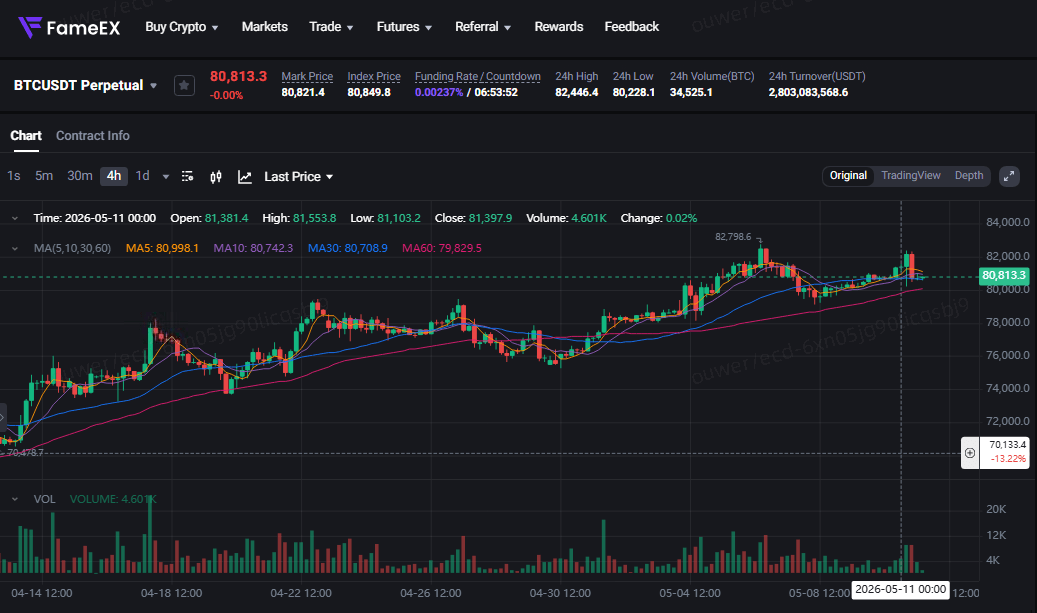
From May 12 to May 31, the medium-term trading strategy will still be applied: for the BTC spot, maintain the sell order at $135,900, positioning for the view that the current crypto bull cycle is not yet over, followed by a major rebound. Place the buy orders at $52,800, $21,300, and $15,450, respectively.
For the ETH spot, place sell orders at $3,485 and $4,885. Set dip-buying spot orders at $1,240 (keep active) and $815.
As of May this year, Democrats in the U.S. House of Representatives trail Republicans by only four or five seats. In other words, if Republicans lose the support of more than two members from within their own party during a party-line vote, a bill could fail to pass. The House also has the authority to challenge or block executive actions by Donald Trump, including those related to military and foreign affairs.
Trump has been widely regarded as the most crypto-friendly president in U.S. history. His election victory, combined with consecutive rate cuts by the Federal Reserve and the European Central Bank, became one of the key drivers behind the previous crypto bull market from November 21, 2022 to October 6, 2025. Reports have claimed that the Trump family earned more than $1.4 billion from the “Trump” token project. Meanwhile, Trump Media & Technology Group is reportedly shifting its strategic focus from social media toward crypto and financial services, while the Trump family has recently expanded investments in cryptocurrency mining.
As the world’s only current superpower, the United States continues to exert decisive influence over global politics and economics. Therefore, the outcome of the November 3 elections this year, covering all 435 House seats, roughly one-third of the Senate seats (35 seats), and 39 gubernatorial races, will play a critical role in determining whether Trump can smoothly implement his agenda during the final two years of his term.
The Democratic Party has historically maintained a more skeptical stance toward cryptocurrencies. If Democrats ultimately secure majorities in both chambers of Congress, the probability of the current crypto bear market ending within this year could become extremely low. Under this view, a confirmed recovery would require Bitcoin to rise back above $126,208.5, measured using Binance USDT-margined perpetual futures with the highest trading volume. In that scenario, the next major Bitcoin bull market peak might not emerge until next year, the year after, or even later. At the same time, Democrats would also be more likely to pursue impeachment efforts against Trump over controversies surrounding the “Trump” token and allegations related to seeking a $400 million aircraft from Qatar as a gift, potentially pressuring him to leave office before the end of his term.
In financial markets, there is a common saying: “You make big money in rising markets, and fast money in falling markets.” With 1x leverage, the theoretical maximum return on a short position is capped below 100%, since an asset cannot fall below zero. By contrast, a 1x leveraged long position entered near the bottom has theoretically unlimited upside. This asymmetry also helps explain why Bitcoin bull markets often take longer to fully develop than Bitcoin bear markets.
VI. Risk Alert
1. Macro Risks: [Federal Reserve policy shifts / escalation of geopolitical conflicts, etc.]
Against the backdrop of limited effectiveness from conventional airstrikes, the United States has reportedly begun discussing high-risk operational options, including the possibility of a ground raid aimed at entering underground tunnels in Isfahan to retrieve stored highly enriched uranium, with the objective of disrupting Iran’s nuclear program at its source.
2. Industry Risks: [Exchange collapses / sudden regulatory crackdowns, etc.]
3. Technical Risks: [Abnormal whale wallet activity / sharp spikes in on-chain gas fees, etc.]
Trading Advice:
Keep spot positions within ≤85% of total capital, and set dynamic take-profit and stop-loss levels to avoid blindly chasing rallies or selling into weakness with high leverage.
On April 22, China’s National Computer Virus Emergency Response Center and the National Engineering Laboratory for Computer Virus Prevention Technology announced that, through the National Computer Virus Collaborative Analysis Platform, they had discovered multiple malicious imitation skill packages within the skill repository of the “OpenClaw” AI agent system. Once installed, these malicious packages could silently download and execute Trojan malware in the background whenever the related skills were invoked, potentially stealing users’ private information and causing sensitive data leaks or financial losses.
According to CoinDesk, quantum computers may not be capable of breaking Bitcoin mining mechanisms or the blockchain ledger itself, but they could theoretically compromise the elliptic curve cryptography protecting wallet ownership through Shor’s algorithm. Approximately 6.9 million BTC, roughly one-third of the total supply, could face potential risk because their public keys are already exposed on-chain. This includes around 1 million BTC believed to belong to Satoshi Nakamoto. Transactions created after the 2021 Taproot upgrade may also be affected due to public key exposure.
Ethereum has maintained a formal post-quantum migration initiative since 2018, involving four full-time teams and more than ten independent development groups, along with a dedicated progress portal (pq.ethereum.org). In contrast, Bitcoin currently lacks a unified response roadmap. Existing proposals such as BIP-360 and detection frameworks from BitMEX Research have not received broad support from core developers. Prominent Bitcoin advocate Nic Carter criticized Bitcoin’s current preparedness as “the worst possible approach,” while Adam Back argued that practical quantum systems remain at the laboratory stage, though he also supported deploying optional upgrade paths in advance.
Analysts noted that Bitcoin’s decentralized governance culture makes coordinating large-scale security upgrades extremely difficult, particularly when dealing with historical holdings such as Satoshi Nakamoto’s wallets. Related research papers from Google warned that by the time quantum attacks become practically viable, the window for mitigation may already have closed.
Quantum security startup Project Eleven recently warned that “Q-Day,” the point at which quantum computers could break modern cryptographic systems, may arrive as early as 2030, with the probability of occurring before 2033 considered “well above 50%.” The report emphasized that advances in quantum computing are unlikely to be linear, but instead may emerge suddenly in a rapid breakthrough pattern. Around 6.9 million BTC, worth more than $560 billion, could potentially be vulnerable under certain conditions. In response to these threats, several mitigation proposals have emerged. Dan Robinson proposed using timestamp proofs to help holders reclaim assets on future quantum-secure versions of the Bitcoin network. Meanwhile, the BIP-361 proposal introduced by Jameson Lopp and others advocates a multi-year migration window, encouraging users to move assets into quantum-resistant addresses. Google has also accelerated its own migration target toward quantum-resistant cryptography to 2029.
On May 9, the “Copy Fail” vulnerability, a recently disclosed Linux kernel local privilege escalation flaw, drew major attention across the crypto industry. The vulnerability affects a large number of mainstream Linux distributions dating back to 2017. Researchers stated that attackers who obtain ordinary user access can escalate privileges to full root access using roughly ten lines of Python code. The U.S. Cybersecurity and Infrastructure Security Agency has already added the flaw to its Known Exploited Vulnerabilities catalog. Because much of the crypto ecosystem depends heavily on Linux infrastructure, including exchanges, validator nodes, mining pools, custodial wallets, and cloud-based trading systems, the vulnerability has triggered widespread concern. Analysts warned that once attackers compromise affected servers, they may be able to steal private keys, seize control of validator nodes, obtain administrator privileges, or launch ransomware attacks. Although the flaw does not directly compromise blockchain protocols themselves, successful attacks against the underlying Linux systems could still create severe operational and financial risks for the crypto industry. Industry experts further cautioned that AI-assisted vulnerability discovery is accelerating the speed at which low-level security flaws can be identified and weaponized, increasing systemic dependence risks tied to server and operating system security across the digital asset ecosystem.
Disclaimer: The data in this report are sourced from publicly available information. FameEX makes no representations on the accuracy or suitability of any official statements made by the exchange regarding the data in this area or any related financial advice.