FameEX Today’s Crypto News Recap | May 14, 2026
2026-05-14 06:40:15
Polymarket volume dips as BTC data signals 77% ATH chance this year and Moody’s forecasts RWA tokenization, while BTC falls below $80K amid extreme market fear. Today’s crypto market showed a broad pullback, while overall sentiment shifted noticeably toward caution. According to the latest market data, Bitcoin fell below the $80,000 level again over the past 24 hours, dragging the general altcoin market lower. This correction triggered large-scale leveraged liquidations across the market, with long liquidations accounting for the overwhelming majority. This reflects that market support near previous highs is being tested. In addition, spot Bitcoin ETFs recorded significant net outflows, breaking the multi-week inflow trend seen earlier. This suggests that institutional investors have adopted a more defensive stance amid macroeconomic uncertainty and ongoing regulatory policy discussions. Although the market is showing some downside pressure from a technical perspective, funding rates remain in a relatively low and positive range. This indicates that the market has not entered a panic-selling phase. Investors are now closely watching the closed-door US congressional meeting on crypto tax reform and the Federal Reserve’s future interest rate path. With risk appetite still constrained, the market is likely to remain in a range-bound structure while sentiment gradually stabilizes.
Crypto Markets Overview
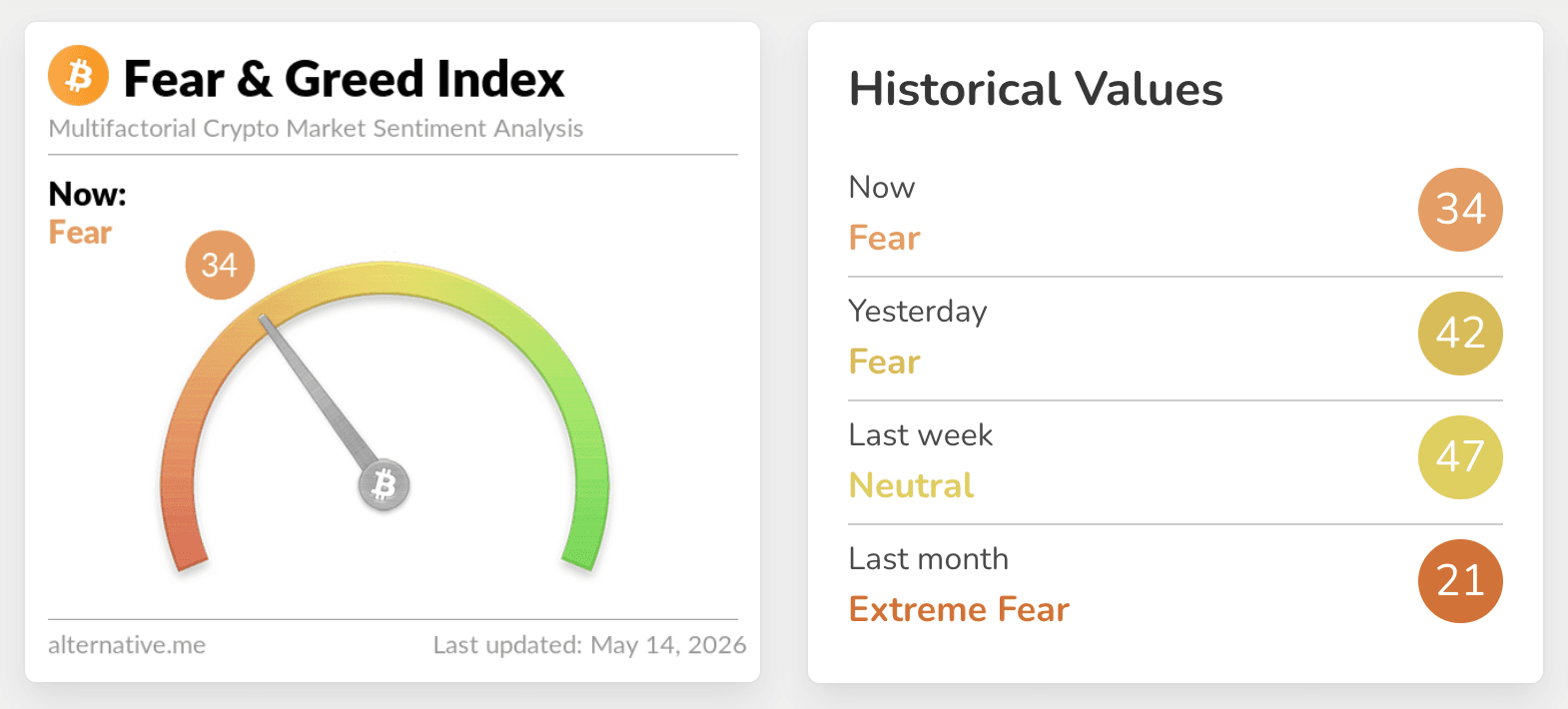
Bitcoin and Ethereum have recently shown clear signs of weak and choppy price action, while short-term volatility has increased across both major assets. According to the data, today’s Crypto Fear & Greed Index fell further from 42 yesterday to 34, placing market sentiment in the Fear zone. This sentiment shift is closely related to the USD 635 million total net outflow recorded by spot Bitcoin ETFs yesterday, including USD 285 million single-day net outflow from a major issuer. From a market structure perspective, if Bitcoin breaks above $82,917 or Ethereum holds above $2,351, cumulative short liquidation intensity across major exchanges could reach USD 1.818 billion and USD 1.345 billion, respectively. These levels could become important drivers of a potential short squeeze. Conversely, if downside pressure continues and key long-side defense levels are breached, the market could face a deeper liquidity pullback.
Source: Alternative
Key News Highlights:
Polymarket’s April Trading Volume Declines For The First Time Recently Amid Regulatory Pressure And Rising Competition
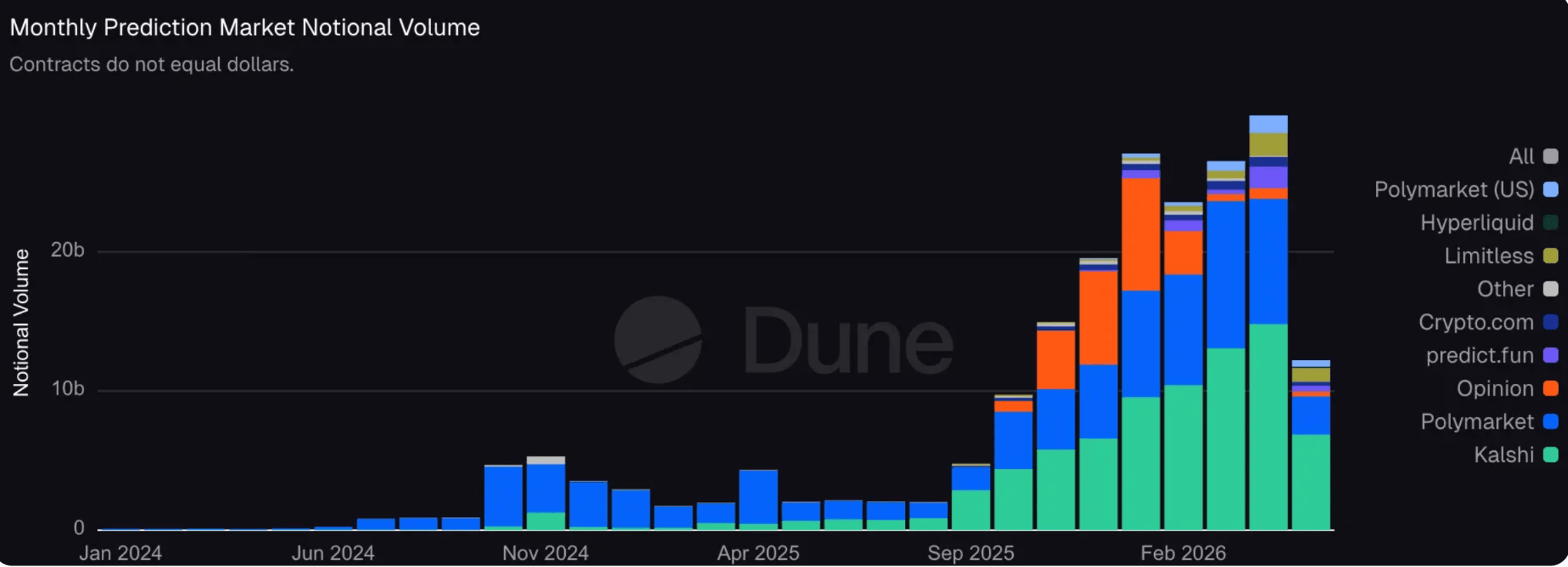
Onchain data shows that monthly trading volume on leading prediction market Polymarket fell by about 8.9% in April. This marked the platform’s first month-over-month decline since last August. During April, Polymarket and its related application generated USD 10.2 billion in trading volume, down from USD 11.2 billion in March. This decline was mainly attributed to intensifying market competition and changes in the regulatory environment. At the same time, rival platform Kalshi saw its trading volume rise by about 13% to USD 14.8 billion, indicating that market share within the prediction market sector is being reshuffled. The total trading volume across the broader prediction market industry still increased, reaching about USD 29.8 billion in April. This shows that user interest in event-based trading remains strong. However, as the US Congress and regulators increase scrutiny over potential insider trading and geopolitically sensitive issues in prediction markets, Polymarket is facing greater compliance pressure. Several lawmakers, including Senator Elizabeth Warren, have urged the Commodity Futures Trading Commission to crack down on behavior that uses prediction markets for improper gains. Some state governments have also filed related lawsuits against these platforms. Against the backdrop of emerging AI-driven prediction tools, the core challenge for traditional prediction markets will be how to meet compliance requirements while maintaining platform liquidity.
Bitcoin Historical Data Suggests A 77% Chance Of Reaching A New All-Time High Within One Year
According to the latest research from network economist Timothy Peterson, Bitcoin has shown a strong historical pattern during recovery phases after major drawdowns. In history, Bitcoin has moved from a 50% maximum drawdown back to a 35% drawdown level nine times. The data shows that in seven of these similar cases, Bitcoin went on to break through and set a new all-time high within the following year. From a statistical perspective, this implies a roughly 77% probability of Bitcoin reaching a new peak within the next 12 months. The current market price is around $81,000, still about 35% below its October 2025 peak. This structure is highly consistent with several previous bullish reversal phases. In addition, digital asset researchers have noted that Bitcoin currently appears relatively inexpensive when assessed through the Buffett Indicator, which compares the total US stock market capitalization with GDP and is used here as a reference for relative valuation. The analysis suggests that if Bitcoin returns to the valuation ratio implied by this indicator, its target price could challenge $160,000. Although macroeconomic uncertainty remains, this historical drawdown-recovery pattern offers an important structural reference for long-term holders. It also suggests that the market may still retain strong growth potential after absorbing selling pressure.
Moody’s Report Predicts Traditional Financial Institutions Will Adopt A Slow Then Fast Digitization Strategy
Credit rating agency Moody’s stated in its latest report that major US banks and financial market intermediaries generally believe the financial system’s transition toward digitization will follow a slow-then-fast development path. The report shows that current RWA tokenization activity is still mainly concentrated in crypto trading, cross-border retail payments, and a limited number of institutional use cases. Even so, most industry leaders have reached a consensus that asset tokenization is an irreversible trend. As technology matures and more market participants enter the space, tokenized transaction volume is expected to accelerate sharply after reaching a tipping point. The tokenized real-world asset market has grown by more than 420% since the beginning of 2025, with total value reaching USD 31.6 billion. This reflects that traditional financial institutions are actively positioning themselves to avoid missing opportunities when demand rises quickly. Nearly all large banks have established dedicated digital asset teams or innovation units. They are also participating in industry pilots to test new infrastructure. Moody’s outlined three possible paths for the financial system, with the most likely scenario being steady growth. Under this scenario, tokenization scales across selected assets such as stablecoins and tokenized deposits, while traditional financial institutions retain their core roles. This digitization process, which begins at the infrastructure level, is laying the foundation for broader Onchain settlement and automated financial services in the future. Its market potential could reach USD 28 trillion over the coming years.
Trending Tokens:
- $DBT (Dabba Network)
Dabba Network is currently gaining significant attention in the DePIN sector as it expands decentralized WiFi infrastructure across India. The project recently reached a major operating milestone, providing connectivity services to 500,000 daily users and processing more than 1,400 TB of data consumption per day. This operational traction is supported by strong financial performance, with the network generating more than $600,000 in recurring monthly revenue. The upcoming $DBT token launch on April 15 has become a key catalyst, as it is designed to accelerate the expansion of a hardware network that has already demonstrated practical demand. By leveraging the Solana blockchain, the project provides ultra-fast and low-cost internet services to underserved regions and positions itself as a leading real-world infrastructure application. Investors are closely tracking the project, as its growth index rose by 1,380% over the past week. The combination of an existing revenue stream and a physical deployment footprint has made $DBT one of the standout participants in the current DePIN narrative.
- $INK (Ink)
Ink is emerging as a key Ethereum Layer 2 solution developed by the major cryptocurrency exchange Kraken, with a focus on bridging traditional finance and decentralized protocols. The project recently sparked market discussion by challenging the definition of "real-world assets" and advocating for a more professional vocabulary around tokenized institutional assets. This narrative highlights four core capabilities that blockchain brings to finance: programmability, composability, around-the-clock settlement, and verifiable collateral. By moving away from the outsider framing of RWA, Ink aims to appeal to professional allocators and fund managers that oversee trillions of dollars in global capital. The ecosystem simplifies user experience through aggregation and automation, making onchain interactions smoother for both retail users and institutional participants. As an exchange-backed Layer 2, ink holds a distinct advantage in supporting the next wave of institutional adoption through standardized asset clearing and settlement.
- $UP (Superform)
Superform is attracting broad attention as an omnichain yield marketplace designed to simplify the complexity of cross-chain decentralized finance. The protocol serves as an advanced distribution platform for ERC-4626 vaults, allowing users to deposit any liquid asset into various yield strategies across multiple EVM networks. Market interest increased sharply after the project completed a $15.1 million financing round backed by major institutions, including Polychain and VanEck. By aggregating vaults from established protocols such as Yearn and Maple, Superform provides a unified interface that removes the need for manual bridging or multi-step transactions. This technical abstraction addresses liquidity fragmentation across different blockchains, which remains a major pain point for yield-seeking users in the current market. The project’s growth index recorded a surge of more than 37,327%, showing strong speculative and functional demand for its services. As the industry moves toward a future defined by chain abstraction, Superform stands out as a key infrastructure layer for automated and efficient capital allocation.
Disclaimer: The information provided in this section is for informational purposes only and doesn't represent any investment advice or FameEX's official view.