FameEX Today’s Crypto News Recap | May 18, 2026
2026-05-18 06:52:01

Japan brokerages plan crypto trusts and MicroStrategy signals BTC buy as the Senate bill faces midterm risks; BTC and ETH lose key levels as the Fear & Greed Index drops to 28. The cryptocurrency market saw a broad decline today as rising geopolitical risks and macroeconomic concerns placed significant downward pressure on global risk assets. After U.S. President Donald Trump issued a military threat against Iran on his official social media platform, tensions in the Middle East intensified again, raising concerns over potential disruptions to strait transit and crude oil supply. This development pushed both Brent crude and WTI crude futures higher, which in turn triggered stronger market concerns over renewed inflationary pressure and the possibility that the Federal Reserve could resume rate hikes. Against this backdrop, major assets led by Bitcoin and Ethereum faced notable risk-off selling pressure. Bitcoin fell to around $76,593 at its intraday low, while Ethereum also lost the important psychological level of $2,200. At the same time, institutional fund flows showed a clear structural reversal last week. Global spot Bitcoin ETFs recorded net outflows of USD 1.039 billion, ending the previous six-week streak of net inflows in one move. Spot Ethereum ETFs also faced USD 255 million in weekly net outflows, with BlackRock’s ETHA posting the largest net outflow among the products. This reflected the risk-avoidance behavior of institutional investors under macro uncertainty. Although overall market sentiment fell back into the Fear zone under pressure from multiple negative factors, spot SOL ETFs still recorded net inflows of USD 58.1181 million against the broader trend, making them the only bright spot among major assets.
Crypto Markets Overview
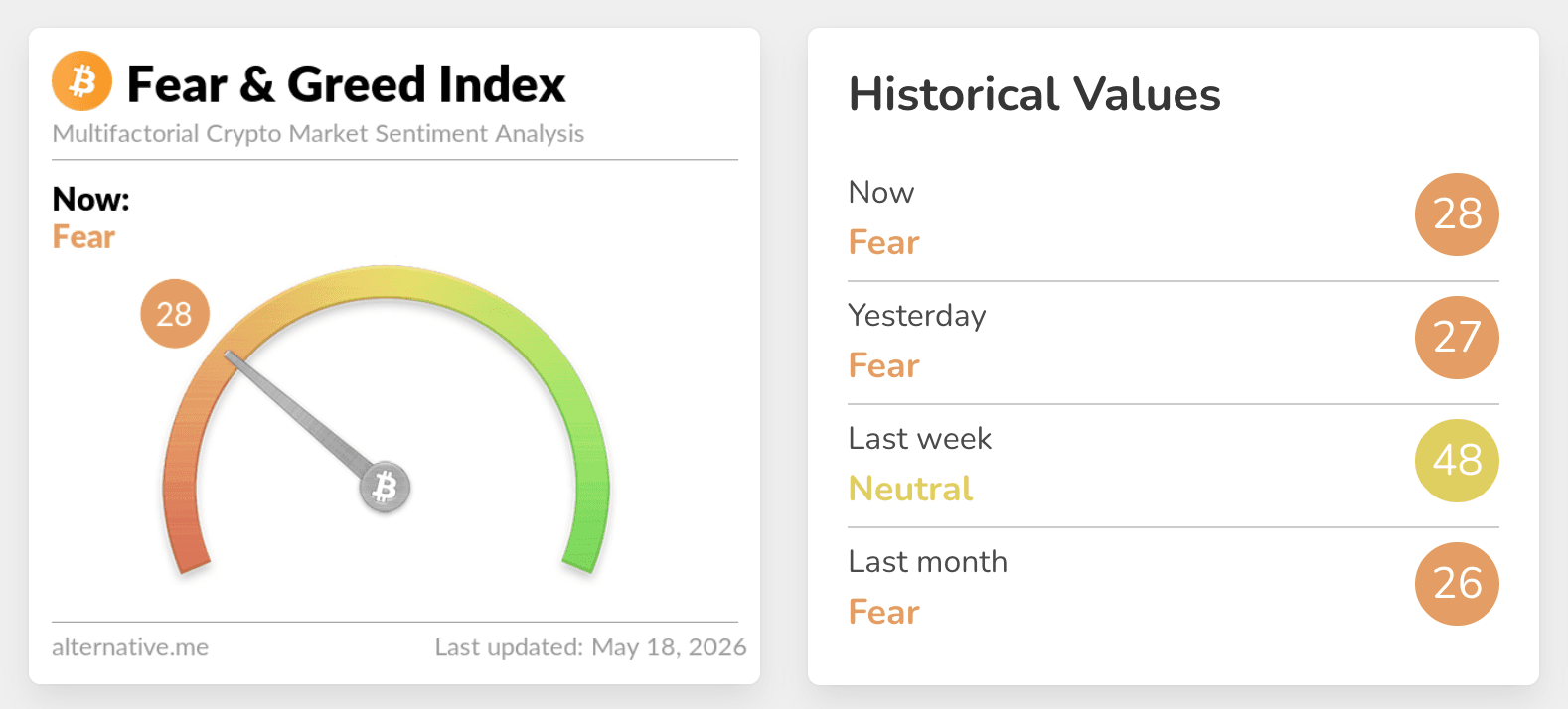
The overall crypto market remained weak today, as macroeconomic indicators and geopolitical headwinds jointly pressured risk appetite. Market sentiment also stayed cautious. According to the latest data, today’s Crypto Fear & Greed Index stood at 28. This was slightly higher than yesterday’s 27, but it remained firmly in the Fear zone, reflecting continued uncertainty among both retail and institutional investors toward the current market structure. From the perspective of derivatives liquidation dynamics, Coinglass data showed that long-short positioning on major CEXs remained highly intense. If Bitcoin breaks above $80,614, cumulative short liquidation intensity could reach USD 1.437 billion. Conversely, if Bitcoin falls below $73,648, long liquidation intensity could reach USD 764 million. At the same time, if Ethereum breaks above $2,223, it could trigger USD 947 million in short liquidation intensity, while a move below $2,022 would put USD 372 million in long liquidation exposure at risk. In terms of fund flows, spot Bitcoin ETFs recorded substantial net outflows of USD 1.039 billion last trading week, with Ark & 21Shares’ ARKB seeing USD 324 million in net outflows and BlackRock’s IBIT recording USD 317 million in net outflows. Although the broader market weakened and the AI sector dropped sharply by 7.91%, decentralized finance and social finance sectors showed mild intraday gains. Block Street rose 42.25%, the major platform token BNB fell 1.07%, while Toncoin moved against the broader market with a 4.12% gain. Industry analysts noted that Bitcoin has remained above the “1-3 month short-term holder cost basis” since its breakout in April, suggesting that the current price correction may have characteristics of a shakeout-driven bear trap. In the short term, the broader market is likely to remain highly linked to macroeconomic and geopolitical developments, while market participants continue to monitor new Federal Reserve Chair Warsh’s policy signals and the key $74,000 support level.
Source: Alternative
Key News Highlights:
Japan’s Major Brokerages Race To Launch Crypto Investment Trusts
According to a Nikkei report, Japan’s leading securities brokerages are accelerating plans to introduce crypto investment trusts to the retail investment market, as regulators move toward formally allowing funds to hold crypto assets by 2028. SBI Securities plans to sell funds developed by group company SBI Global Asset Management. These products will cover spot ETFs and investment trusts focused on highly liquid assets such as Bitcoin and Ethereum, with the group handling all stages from product development to distribution in-house. Rakuten Securities is taking a similar approach and is working with Rakuten Investment Management to develop crypto investment products that can be traded directly through smartphone apps. Nomura Securities and Daiwa Securities have also announced plans to develop crypto investment trusts within their respective groups. SMBC Group has formed a cross-group task force to assess viable options, while Asset Management One under Mizuho Financial Group has begun preliminary exploration. This collective move marks a major shift in how ordinary Japanese investors may participate in the crypto market. At present, buying digital assets still requires investors to open dedicated exchange accounts or set up crypto wallets. Through investment trusts, investors would be able to gain crypto exposure directly through existing securities accounts, removing a major barrier for retail participation. The policy backdrop is that Japan’s Financial Services Agency is working to revise the enforcement order of the Investment Trust Act, with crypto assets expected to be formally added to the list of specified assets that investment trusts may hold by 2028. In addition, Japan passed an amendment to the Financial Instruments and Exchange Act last month, formally reclassifying crypto assets as financial instruments with a regulatory status comparable to stocks and bonds. If the bill is approved in the current parliamentary session, it is expected to take effect in fiscal 2027. Japan is also reportedly considering allowing spot crypto ETFs as early as 2028, with Nomura Holdings and SBI Holdings expected to be among the first institutions to develop such products. SBI Holdings has already outlined plans to launch a Bitcoin-XRP dual ETF and a gold-crypto hybrid ETF, subject to regulatory approval.
Strategy Founder Signals Bitcoin Accumulation And Urges Retail Shareholders To Vote On Dividend Proposal
Michael Saylor, chairman of U.S.-listed company Strategy, again signaled on Sunday that the company may continue increasing its Bitcoin holdings in the coming week. He also strongly urged retail shareholders to vote on a proxy proposal designed to enable semi-monthly dividend payouts. Saylor posted “Big Dot Energy” on X, along with a bubble chart tracking the company’s Bitcoin purchase history over the past nearly six years. Based on past patterns, Saylor has often posted such charts in the days before the company executed large corporate purchases. If the company proceeds with additional buying this week, it would further expand its treasury reserve, which currently stands at 818,869 Bitcoin. In addition to the accumulation signal, Saylor and Strategy’s official social media accounts have posted frequently to encourage retail shareholders, who hold as much as 80% of the company’s STRC perpetual preferred stock, to participate in the proxy vote. The proposal seeks to change the dividend payment schedule from monthly payouts to semi-monthly payouts. Strategy said that if the amendment is approved and adopted, it could reduce reinvestment lag for investors, improve asset liquidity and market efficiency, and further support stock price stability. As the June 8 proxy voting deadline approaches, Saylor emphasized in his post that uniting the strength of retail shareholders could help establish a new standard for digital credit. He also called on holders to make their votes count. However, historical data shows that retail investors generally show limited willingness to participate in proxy voting. A research report from the Harvard Law School Forum on Corporate Governance late last year showed that retail shareholders voted only about 29% of their shares on average over the past five voting seasons, far below the 77% participation rate among institutional shareholders. To help ensure the proposal’s approval, Strategy has rescheduled a livestreamed Q&A session for retail investors at 5 p.m. ET on May 20. Saylor and CEO Phong Le will attend the session, which will be moderated by podcast host Natalie Brunell. All shareholders are invited to submit related questions before the meeting.
NYDIG Warns Senate Crypto Bill Could Face Midterm Risk If It Fails To Pass Before August
Greg Cipolaro, head of research at crypto financial services firm NYDIG, said in a recent report that the crypto market structure bill under review in the U.S. Senate may not reach a floor vote until August. He also warned that if lawmakers fail to pass the bill before the midterm elections, it could face a major risk of stalling completely. Although White House senior crypto adviser Patrick Witt said earlier this month that the target was to pass the Senate crypto bill before July 4, and that there was enough time for Senate markup, a floor vote, and a House vote, Cipolaro viewed that timeline more as an encouraging benchmark than a fixed legislative deadline. The market structure bill aims to define how major U.S. regulators should oversee the crypto industry, and it is widely seen as one of the most important pieces of crypto legislation this year. However, the process has faced repeated delays as lawmakers and lobbying groups continue to propose amendments around stablecoin rules, government officials’ use of crypto, and other issues. Although the bill passed its long-delayed markup in the Senate Banking Committee last Thursday and was advanced to the Senate floor largely along party lines, it will still need at least 60 votes in the full Senate to avoid prolonged debate and pass smoothly. Republicans currently hold a 53-seat majority in the Senate, which means they need support from at least seven Democrats to move the bill forward quickly. However, some Democrats remain strongly concerned that the bill does not go far enough in combating financial crime. Cipolaro further noted that Congress is scheduled to enter recess from late July to early September, followed by the critical period before the November midterm elections. During that period, Senate leadership is highly unlikely to schedule a contested floor debate that requires a 60-vote threshold. If the bill misses this key window, the most likely remaining path would shift to a post-election lame-duck session. That outcome would still depend on Republicans continuing to control the Senate and Majority Leader John Thune prioritizing the bill ahead of government funding deadlines. Current polls and forecasts show an unusually tight race for Senate control. If Democrats regain control of the Senate after the midterms, this Republican-backed crypto market structure bill would be unlikely to advance in the next Congress, which begins in January. Congressional negotiators therefore face a difficult choice between accepting an imperfect bipartisan framework in 2026 and taking the risk of a substantially changed legislative environment after the midterms.
Trending Tokens:
- $M (MemeCore)
The memecoin narrative is continuing to shift toward specialized infrastructure-layer solutions, as reflected by MemeCore’s surging market momentum within the blockchain sector. As a dedicated Layer 1 ecosystem designed to connect creators and communities through tailored applications, the project has established a solid foundation with backing from Waterdrip Capital, CatcherVC, and K300 Ventures. The core catalyst behind the asset’s current performance is the officially announced MemeMax buyback program, which introduces a direct value accrual mechanism for the ecosystem. Under this initiative, 80% of all trading fee profits generated by the platform will be systematically allocated to buy back the native token from the open market. Therefor, the combination of dedicated infrastructure performance and programmatic supply reduction has pushed the project to the forefront of the current market cycle.
- $YOM (YOM)
The intersection of decentralized physical infrastructure networks and modern cloud gaming is undergoing a notable expansion in market valuation, with YOM leading this narrative through its distinctive resource-sharing architecture. As a decentralized cloud gaming protocol that uses a distributed network of consumer-grade machines, the project has successfully enabled global low-latency and near-zero-cost streaming services across multiple devices. The platform incentivizes global node operators to join the network by allowing them to monetize idle hardware cycles, with annualized yields on specific licenses reaching up to 480%. Market attention strengthened further after the official operational update for Season 2 quests, which clearly emphasized consistency over short-term bursts as the key to maintaining leaderboard rankings. This structural approach supports sustained user retention and continuous engagement with the network application while reducing the risk of inflated vanity metrics across the distributed platform. Backed by core strategic investors including Avalanche Foundation, Outlier Ventures, and Borderless Capital, the network is validating the commercial viability of peer-to-peer hardware networks.
- $TAKE (OVERTAKE)
The vast secondary market for virtual gaming assets has found a technical anchor through the accelerated implementation of the OVERTAKE trading protocol on the Sui blockchain. The platform is designed to capture a meaningful share of the multibillion-dollar Web2 gaming asset market by facilitating direct peer-to-peer trading of in-game items, accounts, and virtual currencies. Its infrastructure relies heavily on multisignature smart contract escrow mechanisms to ensure instant trade settlement while maintaining an extremely low fee structure. Investor confidence is fundamentally supported by major strategic institutions including Sui, Immutable, and Green Whale Ventures, giving the asset a distinctive position at the intersection of gaming and finance. Current market momentum is being strongly driven by an algorithmic data narrative that uses advanced institutional models to maximize trading accuracy and protocol optimization. The market is actively pricing in the platform’s potential to remove intermediary layers from traditional gaming marketplaces while providing strong security guarantees for high-value digital asset transfers.
Disclaimer: The information provided in this section is for informational purposes only and doesn't represent any investment advice or FameEX's official view.