FameEX Today’s Crypto News Recap | May 27, 2026
2026-05-27 07:31:56
Base launches AI agent tools, Trump supports CFTC's jurisdiction over prediction markets, and BTC faces selling pressure at $77K and subsequently declining. Under the current traditional financial market backdrop, Goldman Sachs has raised its year-end 2026 target for the S&P 500 Index to 8,000 points, showing that Wall Street remains optimistic about long-term economic expansion. This adjustment is supported by market expectations for corporate earnings growth and business resilience. However, this optimism has not fully carried over into the crypto market. The current crypto market remains under the shadow of macro policy uncertainty. Mizuho CEO Kihara warned that the Bank of Japan may raise interest rates in June or July this year to address persistent inflation pressure. This potential policy shift could trigger sharp changes in global carry trade flows and affect liquidity-sensitive asset classes. Digital assets, including Bitcoin, have faced stronger selling pressure in recent sessions. Market capital is showing a clear preference for risk avoidance. Investors are watching not only the direction of monetary policy but also institutional fund flow signals from spot ETFs. They are trying to find direction through the interaction between traditional finance and digital asset markets.
Crypto Markets Overview
The Crypto Fear & Greed Index currently stands at 25, placing market sentiment in the “Extreme Fear” range. This reflects strong concern over short-term volatility and a cautious stance among investors. In the crypto spot market, Bitcoin has fallen below the key $76K support level. Monitoring data shows that if BTC breaks above $79,337, cumulative short liquidation intensity on major CEXs could reach USD 1.833 billion. Conversely, if BTC falls below $72,543, it could trigger around USD 1.294 billion in long liquidation pressure. Ethereum has also weakened and lost the $2,100 level. Data shows that if ETH breaks above $2,172, around USD 1.303 billion in short positions could face forced liquidation. If ETH falls below $1,974, around USD 822 million in long positions could be liquidated. On the institutional fund flow side, the spot ETF market remains weak. Bitcoin spot ETFs recorded USD 334 million in net outflows yesterday, marking the seventh consecutive day of net outflows. Meanwhile, Ethereum spot ETFs saw USD 35.0383 million in net outflows, extending their outflow streak to 11 days. This reflects conservative positioning and risk-hedging behavior from institutions at the current price range. Total crypto liquidations across the network reached USD 306 million over the past 24 hours, showing that the cost of the long-short battle has risen significantly.
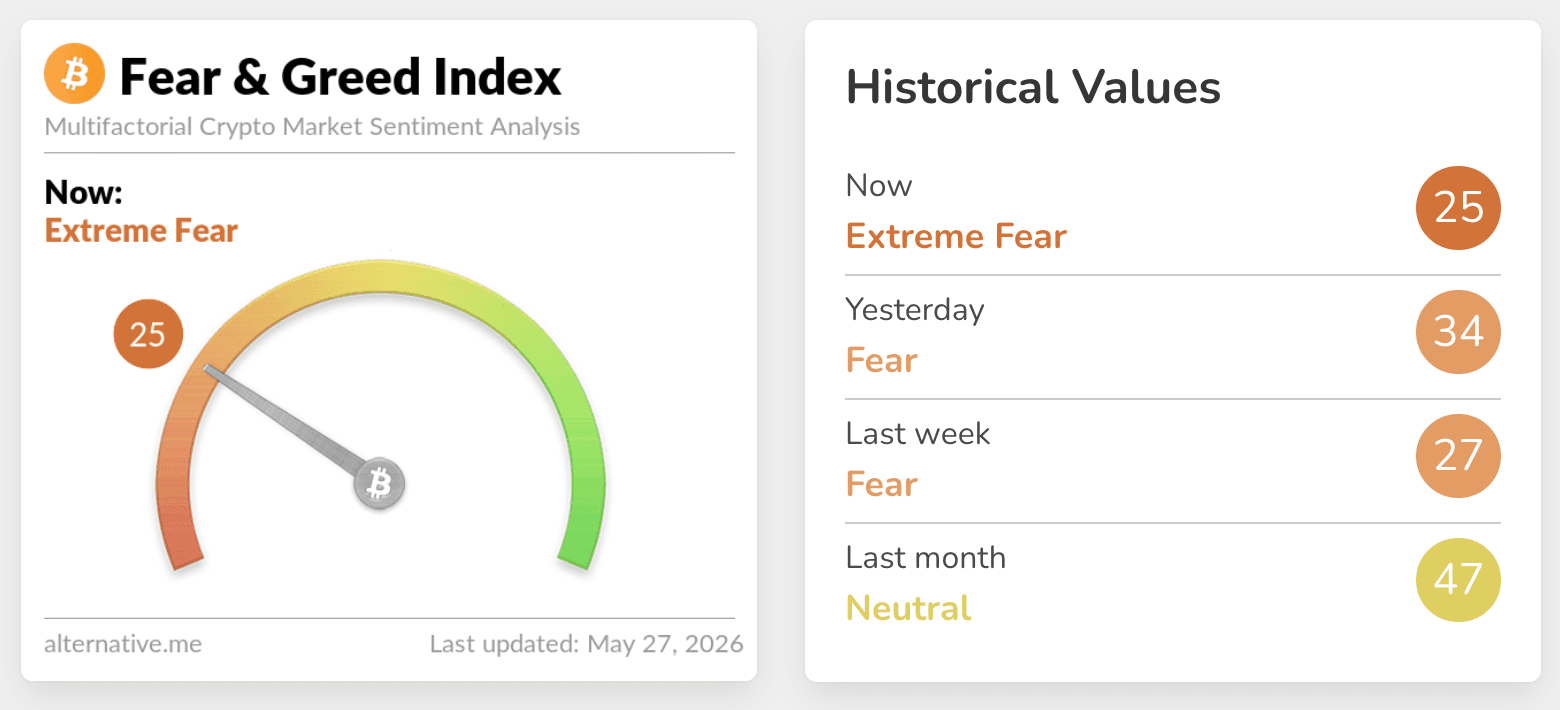
Source: Alternative
Key News Highlights:
Base To Launch New Tool Connecting Crypto Wallets With AI Agents
Base is a Layer-2 blockchain developed by a major US crypto exchange Coinbase and they have officially introduced a new Model Context Protocol tool designed to enable seamless interaction between crypto wallets and advanced AI agents. Through this technology, users will be able to issue commands directly during interactions with AI models. AI agents can then assist with complex on-chain operations such as fund transfers, token swaps, balance checks, and transaction history reviews. The development team emphasized that the feature supports a wide range of decentralized applications within the ecosystem. It also includes strict security design. AI-driven operations do not access user private keys. Every transaction proposed by an AI agent must be reviewed and confirmed by the user before execution. The system also simulates asset changes in advance to ensure transparency. Industry observers view agentic payments as a key application area for the next stage of crypto adoption. This is especially relevant because AI models may face difficulty integrating directly with the traditional banking system. Digital assets provide a more direct and efficient settlement path. Although the related microtransaction economy remains in its early stage and processing capacity is still growing, the expansion of such protocol standards may allow AI agents to participate in on-chain financial activity with greater flexibility. This marks an important step in the evolution of blockchain applications toward greater intelligence and automation. The market is closely watching how this innovation may drive on-chain activity.
Trump Publicly Supports CFTC Jurisdiction Over Prediction Markets
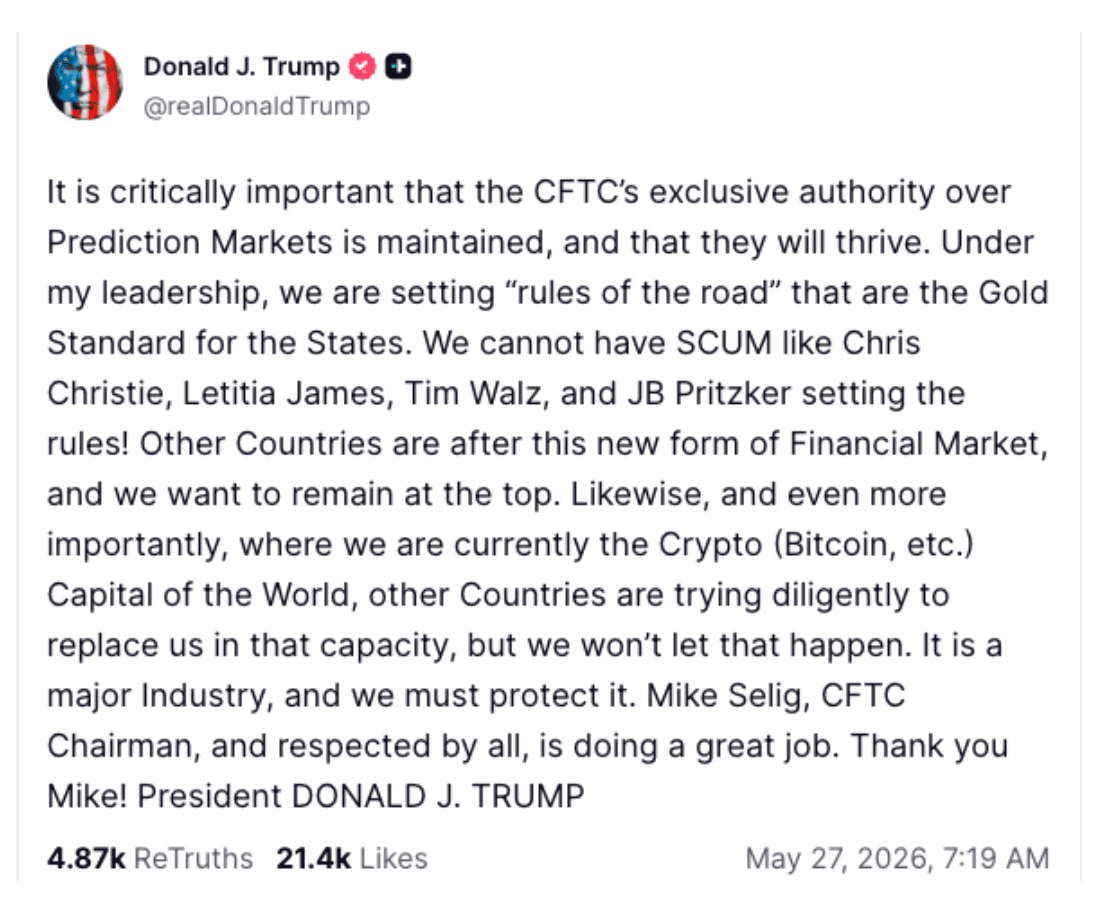
US President Donald Trump recently stated on a public social media platform that he supports the Commodity Futures Trading Commission having “exclusive jurisdiction” over prediction markets. This position quickly became a major topic across financial and regulatory circles. Trump emphasized that maintaining the commission’s exclusive authority over prediction markets is critical for the healthy development of the industry. He also strongly criticized recent legal actions taken by several state-level officials against prediction market platforms. At present, platforms such as Kalshi and Polymarket are facing regulatory pressure from multiple state governments. These platforms have been accused of offering gambling services without licenses. The platforms argue that their operations comply with federal law and should be regulated under a unified CFTC framework. Trump stressed that the US government should establish a high-quality set of standard rules rather than allow local officials to interfere with market development. He argued that this could affect the competitive position of the United States in global financial markets. At the same time, CFTC Chair Mike Selig has taken a similar position. He argues that the commission has sole supervisory authority over prediction markets and has taken action to defend its jurisdiction under the existing regulatory framework. This event shows that prediction markets, as an emerging financial tool, are entering a critical stage of legal classification. As federal regulators strengthen oversight of event contracts and market integrity, the industry may operate under a clearer legal framework in the future. This carries broader symbolic significance for digital finance innovation in the United States.
Analysts Said Bitcoin Faces Heavy Supply Pressure At $77,000
As Bitcoin attempts to find support amid recent market volatility, analysts have pointed out that the $77,000 price level is becoming an important supply resistance zone that may limit upside momentum. According to the latest data analysis from Galaxy Digital’s research team, the market structure has changed significantly since the flash crash in October 2025. Long-term holders with cost bases above $103,000 have continued to release selling pressure during recent rebounds. The analysis noted that although Bitcoin has shown resilience by moving away from its yearly lows, a large amount of token supply has moved since October 2025. Much of this supply is concentrated near $77,000, forming a dense selling pressure barrier that increases the difficulty of a short-term breakout. Data shows that around half of the activated supply came from previous-cycle holders. Many of these holders chose to take profits or reduce loss-making positions as prices recovered. This ongoing supply absorption process is one of the main reasons behind the market’s weak upside momentum. In addition, spot Bitcoin ETF flows also reflect a cautious stance among institutional investors. Recent large block trades further confirm profit-taking and risk-hedging behavior under the current valuation environment for blockchain assets. Analysts concluded that before the market fully absorbs this wave of historical supply pressure, Bitcoin’s price rebound may continue to face resistance. In the near term, the market is likely to keep testing support and resistance levels through volatile trading until liquidity reaches a new balance.
Trending Tokens:
- $SPACE (Spacecoin)
Spacecoin has emerged as a strong decentralized physical infrastructure network powered by a low Earth orbit nanosatellite constellation, with a clear focus on delivering global internet connectivity. The protocol operates as a decentralized infrastructure layer and uses blockchain technology to secure and manage data transmission. Built on Creditcoin, the platform supports trustless network access and allows users to pay internet fees with multiple cryptocurrencies. Recent discussion around the project has emphasized a shift toward real infrastructure development rather than reliance on short lived market narratives. Supporters, referred to as Space Cadets, are helping advance a global and decentralized internet standard that is independent from traditional centralized providers. This strategic focus on long term scalability and core utility positions the protocol as an important component within the expanding DePIN sector. As the network matures, Spacecoin aims to establish a standard open protocol that can connect users and devices across different regions worldwide.

- $GENSYN (Gensyn)
Gensyn stands at the forefront of decentralized artificial intelligence by providing a distributed compute network purpose built for model training. The protocol uses cryptographic verification to ensure that deep learning tasks are executed correctly, creating a trustless framework for high-performance computing. Market attention has increased following the release of the Delphi SDK and Agentic Trading Toolkit, which significantly expands the platform's practical utility. These tools are designed to enable seamless interaction between autonomous agents and markets, allowing users to conduct complex portfolio management and data analysis without extensive programming knowledge. By integrating natural language processing for agent communication, the project lowers the barrier to advanced trading operations. This development highlights the growing convergence between artificial intelligence and blockchain technology, while improving efficiency across automated financial systems. The expansion of these functions reinforces the team's commitment to building scalable infrastructure for the next generation of intelligent compute applications.
- $BLOCK (Blockstreet)
Blockstreet is positioning itself as a key ecosystem platform focused on expanding the use of the USD1 digital currency across decentralized finance applications. The project operates as a launchpad that connects elite resources with builders to accelerate innovation across payments, gaming and real-world assets. Market activity around the project increased significantly after it announced an acquisition by an entity formerly known as Alt5 Sigma. This corporate integration is intended to strengthen the underlying infrastructure and provide a more robust technical foundation for the maturation of global financial networks. The integration is also expected to support the convergence of decentralized finance and traditional financial systems, marking an important milestone for institutional adoption. By using the LayerZero protocol for multichain expansion, the project aims to establish itself as the connective layer of a broader ecosystem. As the platform enters a new phase of development, native token holders are expected to gain broader liquidity exposure and more participation opportunities.
Disclaimer: The information provided in this section is for informational purposes only and doesn't represent any investment advice or FameEX's official view.