ARC (AI Rig Complex) Token Price & Latest Live Chart
2026-03-06 10:57:44
What is ARC (AI Rig Complex)?
ARC is an open-source development framework and ecosystem that connects AI agents with blockchain infrastructure. The project does not attempt to create a new AI model. Its main objective is to provide an engineering environment that allows developers to build, deploy, and coordinate AI agents more easily. ARC was initiated by Playgrounds Analytics Inc. The core technology is a Rust-based framework called Rig that enables scalable and high-performance agent systems. ARC is better understood as an AI infrastructure platform rather than a standalone application. It provides a reusable toolset and collaborative architecture that multiple applications can build upon. Developers can use this framework to create agents that interpret natural language, analyze data, and execute complex tasks. The project addresses the gap between AI systems that understand instructions and systems that can actually perform real actions. Many AI tools generate answers or content, yet they struggle to interact with external services. ARC introduces a composable architecture that allows AI agents to connect to digital services and complete operational tasks. This positioning places ARC within the broader movement of integrating automation with decentralized infrastructure across AI and Web3.
Within the ARC design, an AI agent is treated as a persistent software entity that performs tasks over time rather than responding to a single prompt. This concept is commonly referred to as Agentic AI. It describes AI systems that can plan actions and carry out multi-step workflows. ARC enables developers to combine models, data sources, and service modules into a unified agent architecture. These agents interpret user intent and interact with external tools to perform tasks such as reading blockchain data, managing assets, or executing automated workflows. The result is a shift from AI as a recommendation engine to AI as an execution layer. The open-source nature of ARC also means that developers can build services directly on top of the framework. As new modules and tools enter the ecosystem, the composability of the platform increases. Over time the framework becomes more powerful as additional capabilities accumulate. This structure makes ARC resemble a developer platform for AI agents. Its long-term vision is an environment where agents behave like software services that can be deployed, invoked, and coordinated across digital systems.
The ARC ecosystem also includes a service marketplace called Ryzome. The goal of Ryzome is to help AI agents discover and interact with external services. The platform is often described as an “Agentic App Store.” It lists tools and APIs that AI agents can call during task execution. Developers can publish their services to the marketplace and make them accessible to other agents. This approach allows AI capabilities to be shared and composed like software modules. When an agent needs to complete a complex workflow, it can call several services sequentially. Examples include analytics engines, payment systems, and blockchain operations. Ryzome transforms the ecosystem into a collaborative service network rather than a collection of isolated AI applications.
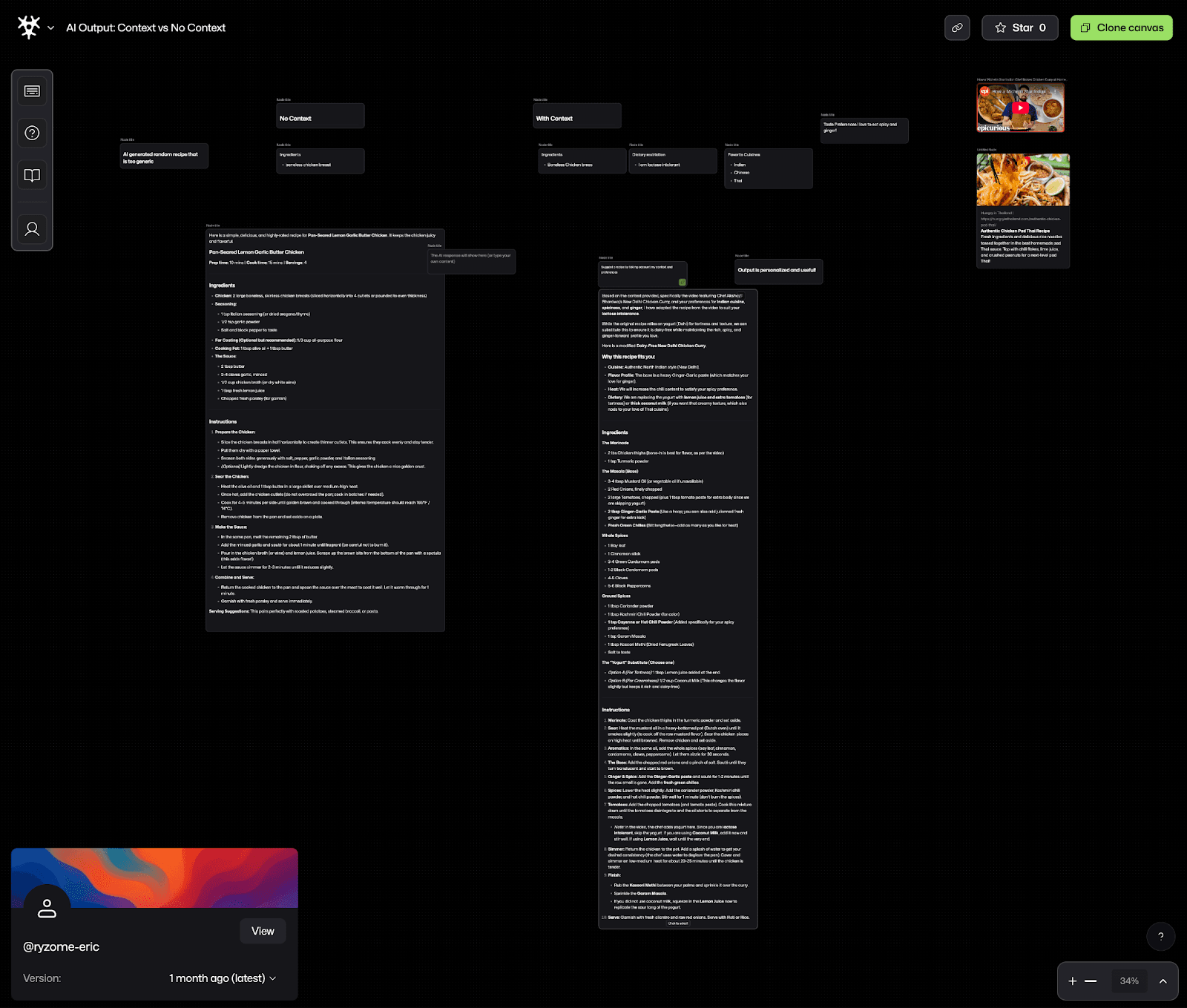
Ryzome integration database example, source: https://ryzome.ai/?utm_source=arc-website&utm_medium=navbar
How does ARC (AI Rig Complex) work?
The ARC architecture consists of three primary components. These include the Rig framework, the Ryzome service marketplace, and a standardized protocol layer for service connectivity. Rig is the technical backbone of the entire system. It is a Rust-based development framework designed for building AI agents. Rust was selected because of its performance and memory safety. These qualities make it well suited for long-running service environments. Rig provides a unified development interface that allows developers to integrate multiple large language models and data sources. AI agents built with this framework can perform advanced tasks such as data analysis, workflow automation, and blockchain interactions. The framework is designed around modular architecture. Each capability can be separated into reusable components. This structure allows developers to assemble new agents quickly without rebuilding every feature from scratch. When new modules are introduced to the framework, the overall capabilities of the ecosystem expand.
Ryzome functions as the discovery and coordination layer for services used by AI agents. The platform resembles an application store, though its primary users are autonomous agents rather than humans. Developers can publish APIs or specialized AI tools to the Ryzome marketplace. Other agents can then access these services when executing workflows. This design enables AI systems to complete tasks through service composition. A single workflow might involve multiple service calls. An agent could retrieve analytics data from one service and then execute a payment operation through another. The objective is to move beyond single-purpose AI applications and create networks of cooperating agents. As the number of services grows, agents gain access to more capabilities. The ecosystem gradually resembles a modular plugin environment for AI automation. ARC aims to build a network where agents and service providers operate together within a shared infrastructure.
ARC also introduces standardized communication protocols that allow services to connect seamlessly. These protocols enable AI agents to interact with external platforms through a consistent interface. Developers do not need to create custom integrations for every service. Standardization reduces engineering complexity and allows agents to adopt new services quickly. The architecture also allows AI agents to interact with both Web2 and Web3 platforms. For example an agent could read data from cloud services while interacting with blockchain smart contracts. It could also perform DeFi transactions or retrieve on-chain analytics. This cross-platform integration is one of the primary design goals of ARC. The unified communication model ensures that workflows remain consistent across different environments. As a result AI systems can expand from isolated applications into multi-platform service orchestration.
ARC (AI Rig Complex) market price & tokenomics
The ARC token is the native cryptocurrency that powers the ARC ecosystem. Its main purpose is to support the economic activity of agent-based services. The total supply of ARC is approximately one billion tokens. A large portion of this supply was distributed to the public during launch. Public information indicates that about 90% of the total supply entered circulation through a fair launch model. This design encourages broad community ownership. Roughly 5.5% of the supply is allocated to a reward pool. The pool is used to incentivize developers and contributors who build services within the ecosystem. The remaining 4.5% is allocated to the development team. These tokens are usually locked and released gradually through a vesting schedule. The structure is intended to align long-term development incentives and reduce market disruption.
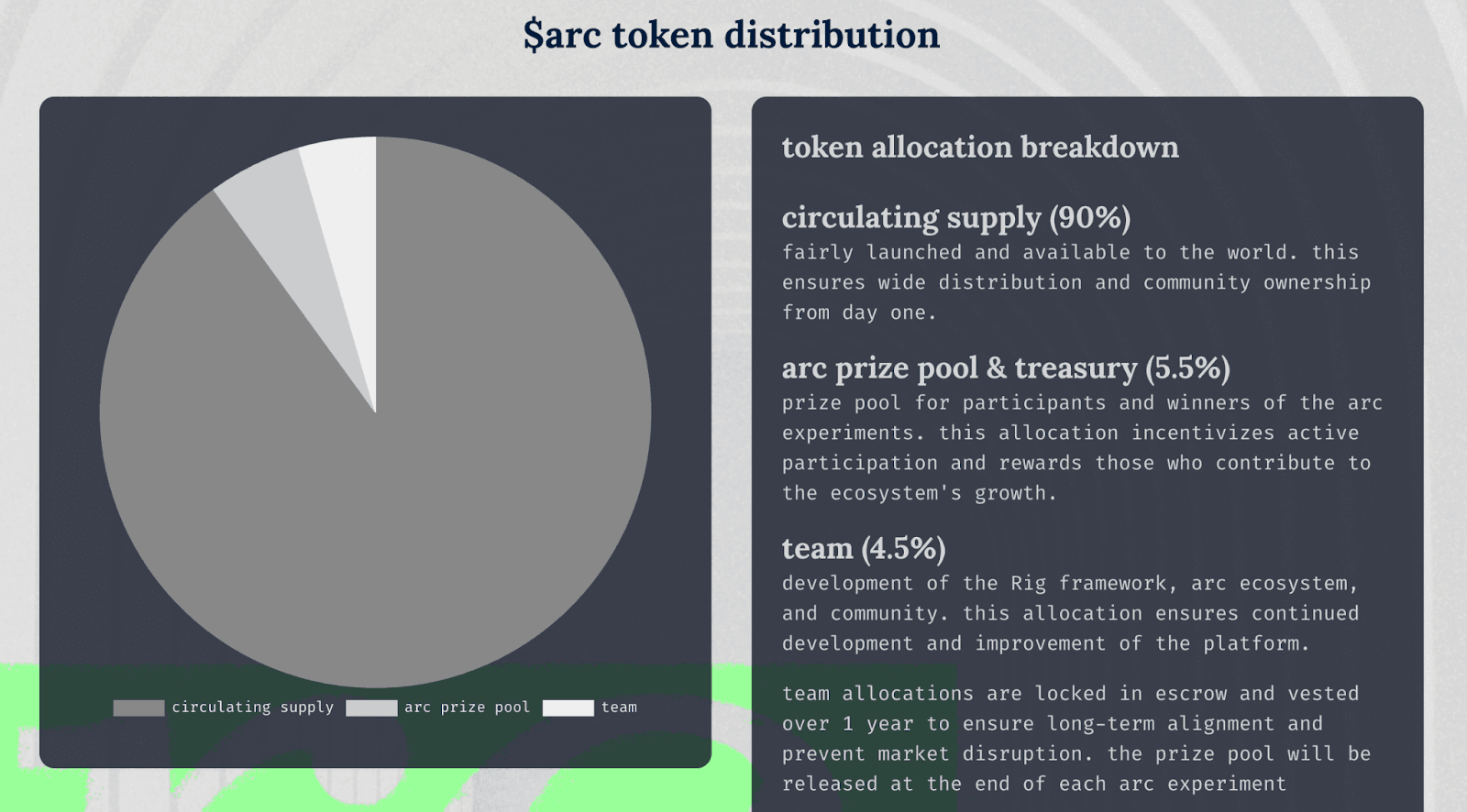
$ARC token allocation, source: https://www.arc.fun/tokenomics
ARC tokens function primarily as the payment mechanism inside the service marketplace. When an AI agent calls a service through Ryzome, the associated fee can be settled using ARC tokens. Service fees are distributed according to a predefined model. Most of the revenue flows to the service provider. A smaller portion is directed to ecosystem funds. These funds support developer grants and community initiatives. This structure attempts to create a feedback loop between service supply and platform usage. When more services enter the marketplace and agents call them frequently, the demand for ARC tokens may increase. In this model the token is closely tied to ecosystem activity. ARC therefore operates less like a governance token and more like a transactional medium within the network.
ARC tokens also function as incentives for participation and development. Developers who create new modules or services that gain adoption may receive ARC rewards. This approach encourages builders to experiment and expand the ecosystem. As new tools become available, the functionality of the platform increases. Incentive systems like this are common in open-source communities. Token rewards help coordinate collaboration across distributed contributors. ARC aims to build a continuously growing network of developers through this mechanism. As more builders participate the value of the ecosystem may accumulate over time. In this way the token economy remains closely linked to developer activity.
Why do you invest in ARC (AI Rig Complex)?
One of the primary reasons ARC attracts attention is its role as infrastructure for AI agents operating in blockchain environments. Artificial intelligence is gradually shifting from content generation to task execution. Developers are searching for frameworks that support autonomous software agents. ARC offers a toolkit designed specifically for building these systems. The framework allows developers to create operational agents with relatively low engineering overhead. This capability becomes particularly relevant in Web3 environments. AI agents can analyze blockchain data and automate financial interactions. Such applications require reliable execution frameworks and secure environments. ARC attempts to provide both. As agent-based automation expands, infrastructure platforms like ARC may receive increased attention. This positioning makes ARC part of the emerging AI infrastructure sector.
The open-source nature of the framework is another factor that attracts developers. Open source allows builders to inspect and modify the underlying codebase. Transparency often increases trust within technical communities. The modular design of ARC also allows developers to specialize in a specific function. Once a module is built it can be reused by other applications. This reusability reduces development costs and accelerates innovation. As the number of modules grows the overall functionality of the ecosystem expands rapidly. Platforms with strong modular ecosystems often develop network effects. As more developers contribute tools the value of the platform increases. ARC attempts to create this type of collaborative development environment.
The service marketplace also differentiates ARC from many traditional AI frameworks. Ryzome allows AI agents to access services provided by other developers. This creates a plugin-style ecosystem where functionality can be assembled dynamically. When an agent needs to perform a complex task it can call several services in sequence. Each service can specialize in a particular capability. Developers can focus on building high-quality tools rather than entire applications. Agents then select services according to task requirements. This model supports the emergence of specialized service markets for AI automation. Such specialization can accelerate the development of advanced AI workflows.
Is ARC (AI Rig Complex) a good investment?
The long-term value of ARC depends heavily on developer adoption and ecosystem growth. As an infrastructure platform the project relies on builders who create applications and services within the framework. If more teams adopt the Rig framework the overall usage of the ecosystem will increase. The number of services available in the marketplace becomes an important indicator. The frequency of service calls also reflects the level of platform activity. When agents interact with services frequently, token demand may increase. If the ecosystem lacks real applications the token may have limited functional demand. Infrastructure platforms often require significant time to mature. Their value usually grows alongside the expansion of the ecosystem.
ARC’s future also depends on the broader evolution of AI and Web3 technology. AI agent development remains an emerging field. Multiple frameworks and platforms are competing for developer adoption. Large technology companies and open-source communities are building alternative solutions. ARC must maintain strong developer engagement and technological relevance to remain competitive. A stable and active developer community could strengthen the platform over time. If competing frameworks provide more mature tooling, market share may shift elsewhere. These dynamics influence the long-term outlook of the project.
Market performance also reflects the volatility of the broader cryptocurrency sector. Digital assets often experience significant price fluctuations regardless of technological progress. Even projects with strong infrastructure narratives may be affected by market sentiment. Understanding ARC requires examining both its technology and its ecosystem strategy. For researchers interested in the intersection of AI and Web3 the project provides a useful case study. ARC represents an attempt to build infrastructure for autonomous software agents within decentralized systems. Its long-term impact will depend on how widely AI agents are adopted across the digital economy.
Explore the latest ARC (AI Rig Complex) price and live chart, trade ARC on FameEX, and access real-time market data! Get started now with a seamless trading experience!
Disclaimer: The information provided in this article is intended only for educational and reference purposes and should not be considered investment advice. Conduct your own research and seek advice from a professional financial advisor before making any investment decisions. FameEX is not liable for any direct or indirect losses incurred from the use of or reliance on the information in this article.