NATGAS (Natural Gas) Token Price & Latest Live Chart
2026-05-18 02:48:03
What is NATGAS (Natural Gas)?
In early May 2026, the natural gas market was experiencing one of the most severe disruptions in the history of fossil fuels. The crisis originated from the outbreak of the U.S.-Iran War on February 28, 2026, which then triggered a chain reaction across global energy markets. European TTF and Asian JKM natural gas benchmarks surged by 80% to 100% within only two months, reflecting an extreme war premium. However, natural gas is constrained by its physical characteristics. It must be cooled to -162°C and converted into liquefied natural gas, or LNG, before it can be transported across oceans. At the same time, U.S. liquefaction and export terminals were already operating at full capacity. This created a severe physical disconnect between the world’s largest natural gas producer and the international markets that urgently needed additional energy supply. The infrastructure disconnection caused a rare market split:
- International Market Scarcity: Global supply contracted by 20% due to the Strait of Hormuz blockade and damage to Qatar’s facilities. This pushed international natural gas prices into a period of extraordinary premium pricing.
- U.S. Domestic Market Oversupply: U.S. production reached a new high of 110 Bcf per day, but surplus gas remained trapped inside domestic pipeline systems. Therefore, Henry Hub futures consolidated near a 17-month low between $2.52 and $2.78. In West Texas, producers even faced negative pricing conditions, effectively paying others to take natural gas away.
As a methane-rich hydrocarbon, natural gas played an irreplaceable role as a bridge fuel in the global energy transition in May 2026. Its use was mainly driven by three high-demand sectors. Electric power accounted for more than 40% of total U.S. consumption, while industrial feedstock demand was concentrated in ammonia-based fertilizer production. The rapidly expanding AI data center market further reinforced natural gas demand because these facilities require stable, dispatchable power around the clock. Unlike crude oil, natural gas is expensive and technically difficult to transport across oceans. It must first be cooled to -162°C and converted into LNG before maritime shipment becomes possible. The 2026 market showed a clear physical disconnect. Although U.S. output reached a record 110 Bcf per day, the closure of the Strait of Hormuz and damage to Qatar’s Ras Laffan facility reduced global supply by 20%. This divided the market into two isolated pricing systems. North America faced a supply glut due to pipeline and export constraints, keeping the Henry Hub benchmark near $2.70 per MMBtu. Seaborne LNG, by contrast, surged above $20 per MMBtu in European and Asian markets due to the war premium.
How does NATGAS (Natural Gas) work?
NATGAS is an RWA tokenized energy asset that operates within the crypto trading ecosystem. At its core, it is a financial derivative benchmarked to one of the most important reference prices in global energy markets, the U.S. Henry Hub natural gas price. The product reflects a deeper convergence between commodity markets and blockchain-based financial infrastructure. Each standardized NATGAS contract represents 1 MMBtu of natural gas value, which turns natural gas pricing into an index-based digital trading instrument. NATGAS does not represent ownership of physical gas, storage rights, or delivery claims. It is a highly liquid USDT-margined perpetual contract product. Through blockchain infrastructure and real-time oracle feeds, this product converts energy price movements shaped by weather, production levels, and geopolitical events into a directly tradable instrument for crypto market participants.
The asset anchoring stability of NATGAS perpetual contracts depends on high-precision oracle systems. These oracles are designed to capture movements in Henry Hub pricing and transmit them into the blockchain pricing infrastructure with extremely low latency. NATGAS contracts use a weighted average price index to filter out abnormal volatility that may appear on a single venue. This helps maintain fair and authoritative settlement prices. The underlying technical design creates a transparent and tamper-resistant value transmission path between digital assets and physical commodities. It allows profit and loss calculations to be executed based on real and trusted market data. The core significance of NATGAS lies in reducing the barrier between traditional commodity futures and decentralized finance. It allows global users to hedge risk or gain exposure to sharp energy price movements without leaving the blockchain ecosystem. For the Web3 industry, NATGAS is an early implementation of physical commodities inside the RWA perpetual contract sector. It also provides a financial engineering and technical foundation for the future digitization of more real-world resources.
NATGAS has also evolved into a highly composable DeFi component. It no longer exists only inside centralized exchange order books. It is beginning to extend into cross-chain protocols, synthetic asset platforms, and broader on-chain derivatives infrastructure. This RWA perpetual contract design avoids many intermediaries and high transaction costs found in traditional energy trading. Settlement and liquidation can be executed automatically through smart contracts, which improves capital efficiency and transparency. The product structure also allows natural gas exposure to become more compatible with crypto-native collateral systems, automated trading strategies, and portfolio construction tools. This makes NATGAS different from a simple commodity quotation. It is a digital financial instrument that translates real-world energy volatility into a form that can circulate inside Web3 infrastructure.
NATGAS (Natural Gas) market price & tokenomics
From the tokenomics perspective, NATGAS is not a token with a fixed supply. It is a perpetual contract asset built on an RWA tokenization framework. Its core operating mechanism is the funding rate. This mechanism uses periodic payments between long and short positions every four hours to keep the contract price closely anchored to the physical market price of natural gas during continuous 24/7 trading. NATGAS uses high capital efficiency and USDT settlement to lower the barriers of traditional futures markets. This allows institutions and market participants that need to hedge electricity costs, including AI data centers and energy-sensitive businesses, to allocate capital through a digitized form of energy exposure. Unlike typical crypto tokens, NATGAS does not rely on token emissions, staking rewards, burn mechanisms, or governance utility to support its value logic. Its market structure is driven by commodity pricing, liquidity, funding rate dynamics, and derivatives demand.
In 2026, NATGAS pricing entered an extremely divided binary market structure. The geopolitical shock triggered by the U.S.-Iran War reduced global LNG supply by 20% after the Strait of Hormuz blockade. This drove European TTF and Asian JKM benchmarks above $20 per MMBtu, an extraordinary level for international gas markets. However, the U.S. Henry Hub benchmark, mainly tracked by the perpetual contract, remained trapped in a domestic oversupply regime because export facilities were already full. In early May 2026, Henry Hub moved sideways between $2.52 and $2.78. This pricing structure means that NATGAS contracts in 2026 reflected more than energy fundamentals. They also became an instrument for capturing regional physical disconnects and war premiums. This is fundamentally different from traditional crypto pricing models based on consensus, issuance schedules, or token supply adjustments. Because NATGAS is priced through the physical attributes of a real-world commodity, it became one of the few digital asset products in 2026 with a clear fundamental analysis framework.
According to the U.S. Energy Information Administration’s May 2026 Short-Term Energy Outlook, U.S. natural gas price forecasts were revised lower because stronger crude oil prices supported higher associated gas production from the Permian Basin. The EIA lowered its 2026 Henry Hub spot price forecast by 5% to $3.50 per MMBtu. Its 2027 forecast was cut more sharply by 11% to $3.18 per MMBtu. The main driver was stronger supply growth in West Texas. Permian Basin output was expected to rise by 10% in 2027 as new pipeline capacity came online and eased the negative pricing conditions that had persisted for months. Waha Hub spot prices had averaged negative $2.505 a year to date. Although the U.S.-Iran War in February caused the Strait of Hormuz blockade and tightened global supply, U.S. domestic prices remained constrained by export capacity limitations, delayed Golden Pass expansion progress, and storage levels that stayed 7% above the five-year average. This strong storage cushion helped suppress U.S. price volatility. Henry Hub was expected to average only $2.83 in the second quarter of 2026, far below the $7.72 high recorded during the January cold snap. This reflected a market environment where U.S. oversupply and global scarcity existed at the same time.
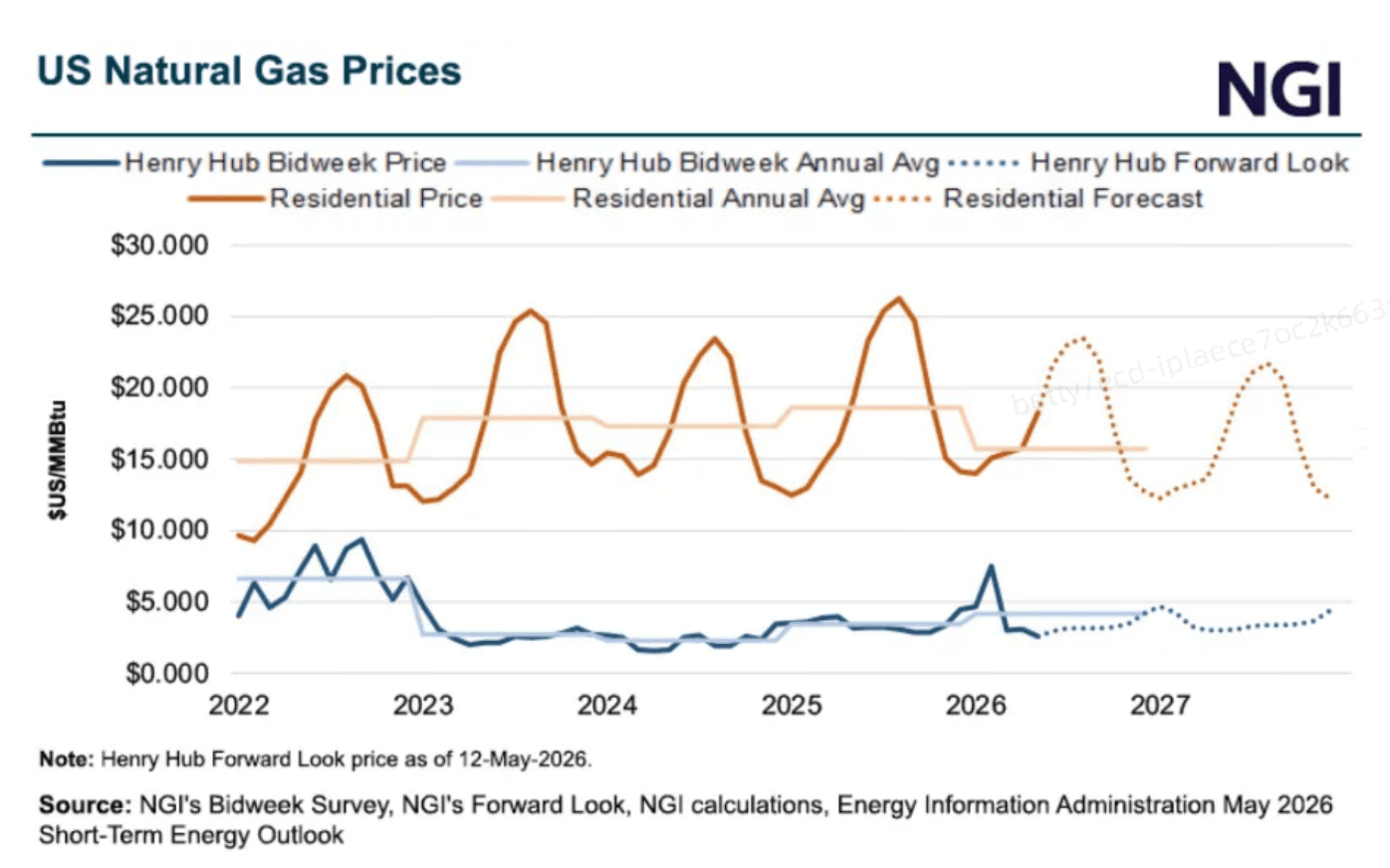
US Natural Gas Price, source: https://naturalgasintel.com/news/eia-cuts-2027-natural-gas-price-forecast-11-on-permian-associated-gas-growth/
Why do you invest in NATGAS (Natural Gas)?
In the volatile market of May 2026, natural gas traders needed to monitor five core factors shaping both global and U.S. domestic pricing. The first was the Strait of Hormuz blockade caused by the U.S and Iran conflict, which disrupted 20% of global LNG supply. Qatar’s Ras Laffan facility was also expected to require three to five years of repairs, creating a long-term structural shortage. The second factor was the U.S. export bottleneck. Although U.S. LNG exports reached a new high of 18.8 Bcf per day in April, existing export facilities were already fully utilized and new projects had not yet entered service. This kept U.S. and global prices disconnected. The third factor was the Permian Basin pipeline bottleneck, which pushed Waha Hub spot prices into negative territory for a record 69 consecutive days in 2026. This trapped gas continued to pressure the Henry Hub benchmark. The fourth factor was the Super El Niño scenario, with Pacific temperatures expected to rise by 2.5°C in the autumn. A warmer winter could suppress domestic heating demand and add more pressure to storage. The final factor was whether strategic curtailments led by producers such as EQT could push Henry Hub back above $3.00. That outcome would depend on how long producers could keep gas underground. These variables together created a high-risk and high-volatility trading landscape for 2026.
In the crypto market of May 2026, the value of NATGAS was its ability to provide a hedging channel with lower correlation to traditional cryptocurrencies. For Bitcoin miners facing electricity cost pressure in 2026, long NATGAS exposure became a practical tool for hedging the risk of rising power costs and stabilizing long-term mining margins. NATGAS was also supported by the expansion of the AI industry. The global compute race in 2026 pushed data center demand for 24/7 power to record levels. Since natural gas is one of the most reliable dispatchable energy sources, its tokenized contract can be understood as indirect exposure to the operating efficiency of AI infrastructure. Participation in NATGAS trading is not only about capturing geopolitical spreads. It also reflects the deeper pricing of global energy transition and digital infrastructure growth. This macro relevance made NATGAS one of the more strategically important assets in the 2026 RWA sector.
Is NATGAS (Natural Gas) a good investment?
From a long-term outlook, 2026 to 2030 could be a key transition period for NATGAS as an RWA product moving from a niche trading instrument into broader portfolio allocation. As more jurisdictions improve regulatory frameworks for tokenized derivatives after May 2026, the legitimacy and market acceptance of NATGAS may strengthen further. This could attract more risk-tolerant institutional capital into the sector. NATGAS perpetual contracts may also integrate more specialized market indices, including products linked to green natural gas or hydrogen-blended fuels. That would expand portfolio breadth in a way that traditional commodity access has not previously offered. However, this development also creates higher requirements for oracle manipulation resistance and smart contract security. Technical risk management will become one of the most important priorities for the sector in the coming years.
The broader market environment also suggests that NATGAS could interact more deeply with decentralized finance protocols. Automated yield strategies and insurance products based on natural gas volatility may begin to emerge. This ecosystem expansion could provide NATGAS with richer liquidity and more use cases. It would allow the asset to function not only as a hedging tool in digital asset portfolios but also as a core instrument for diversified yield exposure. Even so, market participants must remain cautious about asset bubbles caused by excessive financialization. The long-term evaluation of NATGAS should be based on its real contribution to physical energy market efficiency, not short-term speculative demand. Only RWA products grounded in solid fundamentals can secure a meaningful position in the future financial system.
Explore the latest NATGAS (Natural Gas) price and live chart, trade NATGAS on FameEX, and access real-time market data! Get started now with a seamless trading experience!
Disclaimer: The information provided in this article is intended only for educational and reference purposes and should not be considered investment advice. Conduct your own research and seek advice from a professional financial advisor before making any investment decisions. FameEX is not liable for any direct or indirect losses incurred from the use of or reliance on the information in this article.