KITE (Kite AI) Token Price & Latest Live Chart
2026-03-02 11:16:53

What is KITE (Kite AI)?
Kite AI is a blockchain infrastructure project designed with autonomous AI agents as its default users. KITE is the native token that powers the network. The project does not primarily target traditional public chain metrics such as raw transaction throughput or DeFi ecosystem expansion. Instead, it focuses on a structural contradiction in today’s digital economy. AI agents are increasingly capable of executing multi-step tasks across different services. However, identity systems, authorization models, and payment rails were built for human operators. This mismatch makes it difficult for AI agents to carry out accountable economic activity without constant human supervision.
The conflict becomes especially visible in enterprise deployment. When an organization allows an AI agent to move capital or allocate resources, it must choose between two imperfect options. Broad authorization increases systemic risk. Strict manual approval reduces the efficiency gains of automation. Both choices weaken the economic value of the agent. Kite AI positions itself as a protocol layer that treats AI agents as first-class economic actors. Agents operate under verifiable identity, bounded delegation, and programmable payment constraints. Their autonomy exists inside mathematically enforced rules rather than informal trust assumptions about platforms or internal code behavior.
Kite frames this challenge as an infrastructure bottleneck rather than a limitation of model intelligence. Multi-step reasoning, tool calling, and adaptive workflows are already production-ready. The friction appears when agents interact with human-centered systems. Long-lived API keys introduce operational risk and credential management overhead. Cross-border settlements introduce latency and reconciliation complexity. Fixed transaction fees make micropayments inefficient. One-time authorization provides no ongoing behavioral control. These constraints slow down agents that can reason in milliseconds but must navigate financial processes that operate in days.
To address this gap, Kite AI treats stablecoins as machine-native value primitives. Stablecoins enable programmable settlement and global interoperability. The protocol is designed to support low-cost and per-request payments rather than prepaid subscription models. Authorization constraints and audit trails are embedded at the protocol layer. Risk management is enforced cryptographically rather than administratively. Compliance and accountability become engineered properties of the system. Through immutable audit records and selectively disclosed cryptographic proofs, agents can demonstrate that their actions remained within defined authorization boundaries. In this framework, agents are not simply capable of acting. They are capable of acting with verifiable responsibility and bounded risk.
Kite AI also emphasizes compatibility with standards such as x402, A2A, MCP, and OAuth 2.1. Agent economies require interoperability across platforms. They cannot scale inside isolated ecosystems. If every service requires custom payment integration and custom delegation logic, the integration burden compounds rapidly. Kite standardizes payment intent messaging and authorization verification. Services can issue payment requests in a uniform format. Agents can respond using consistent settlement logic. This approach positions Kite closer to a universal execution and settlement layer for agent-native commerce rather than a closed application environment.
How does KITE (Kite AI) work?
The operational foundation of Kite begins with identity and permission architecture. Most risks in autonomous systems arise from unclear boundaries and overly persistent credentials. Kite introduces a three-tier identity structure composed of user, agent, and session layers. Each layer carries a distinct scope and lifespan. The user layer acts as the root authority and retains ultimate asset control. The agent layer represents a delegated long-term actor with defined behavioral rights. The session layer represents short-lived task authorization with narrow scope and automatic expiration.
This layered design transforms unlimited credential exposure into bounded risk. If a session credential is compromised, its authority is confined to predefined limits such as spending caps, time windows, or specific services. Revocation can occur quickly. The model does not merely assign multiple addresses. It establishes a verifiable delegation chain. When a service receives a request, it can validate the cryptographic linkage between the session, the agent, and the originating user. This eliminates identity ambiguity. It replaces platform-level trust in API keys with mathematically verifiable delegation.
Kite extends this structure into programmable governance. Users can encode spending ceilings, frequency limits, conditional triggers, and hierarchical approval requirements directly into smart contracts. These rules apply across services. They are not isolated within each platform’s local permission system. An agent cannot bypass global constraints by splitting payments or distributing transactions across multiple providers. Enforcement occurs at the protocol layer. Organizations can define differentiated budgets for separate agent categories. High-value or high-risk operations can require secondary authorization. This design allows autonomy and control to coexist within a single ruleset.
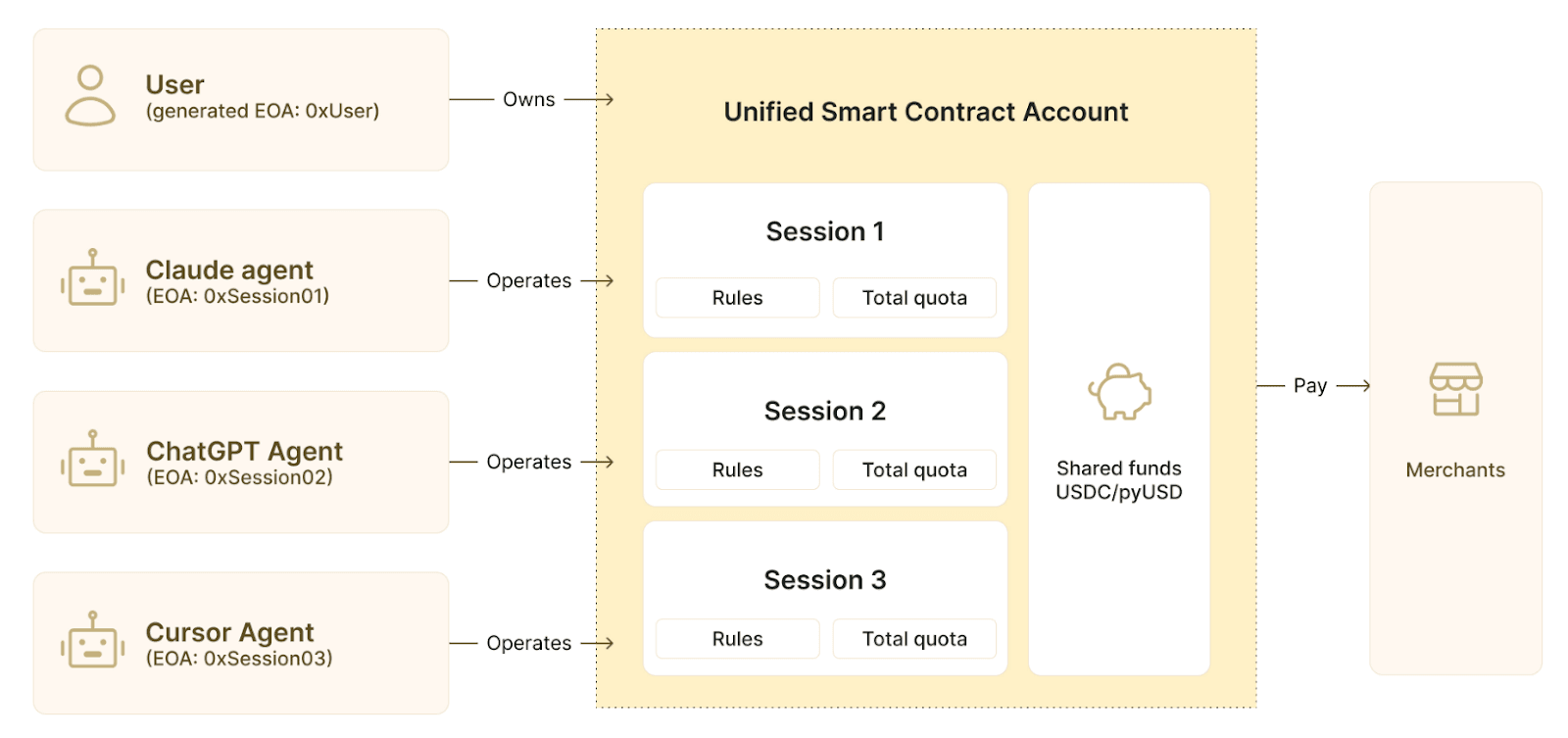
On the payment side, Kite uses stablecoins as the native settlement asset for AI agents. Stablecoins combine programmability with predictable value and global reach. To support high-frequency interactions, Kite implements a state channel architecture. A small number of on-chain transactions open and close channels. Within the channel, numerous off-chain signed updates handle microtransactions and state changes. This dramatically reduces latency and cost. Per-request API pricing becomes economically feasible. Payment can occur at near machine speed.
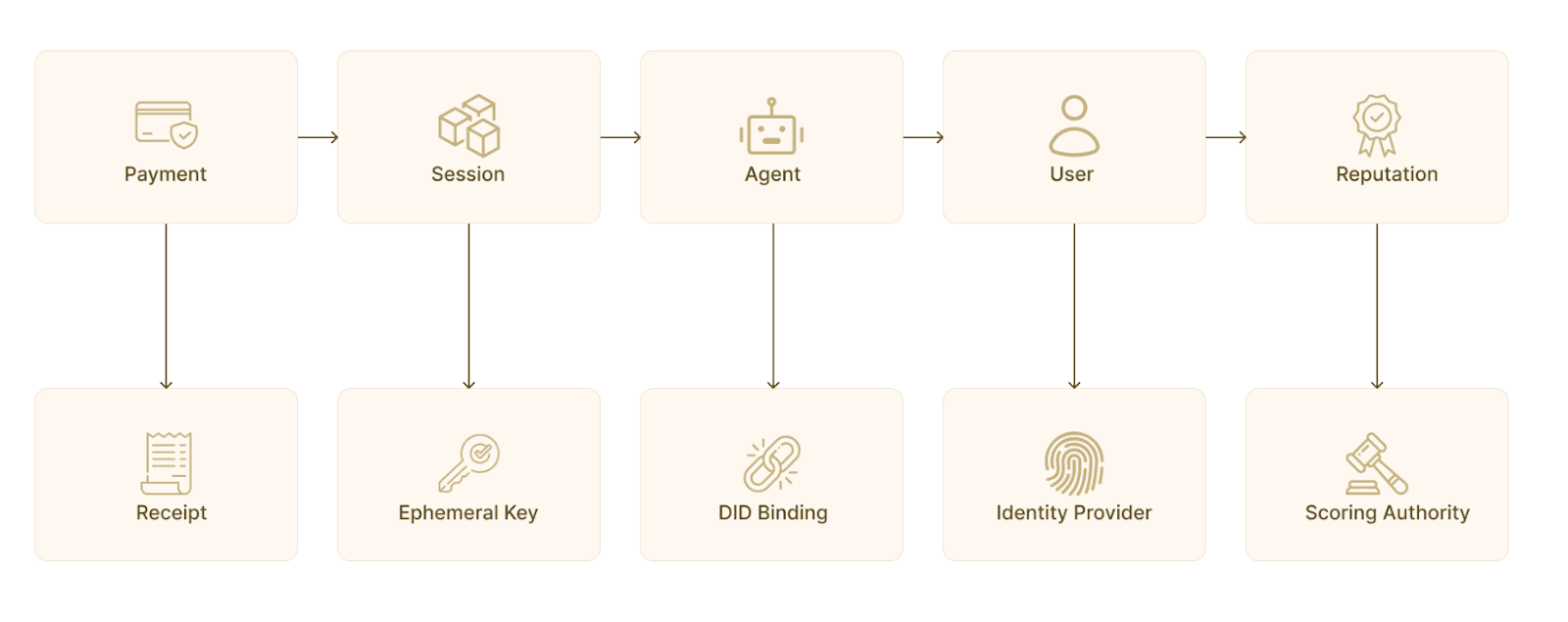
The x402 standard plays a critical role in integrating payment into the communication layer itself. A service can respond to an agent request with a standardized payment requirement. The agent verifies its authorization boundary and completes settlement before receiving the service output. The process does not require external redirection or manual reconciliation. Payment becomes an intrinsic part of the request-response cycle. This standardization reduces integration complexity for service providers and enables agents to compose multi-service workflows without rebuilding payment logic for each endpoint.
Kite also introduces auditable proof trails and structured revocation mechanisms. Errors in agent systems can arise from malicious interference, non-deterministic model behavior, or cascading coordination failures among multiple agents. Each authorization event, payment action, and execution outcome can generate a tamper-resistant record. When anomalies occur, stakeholders can identify which delegation layer was responsible. The objective is not to eliminate all risk. The objective is to constrain the blast radius and provide verifiable accountability. Autonomy does not require opacity. It requires enforceable boundaries and transparent auditability.
KITE (Kite AI) market price & tokenomics
KITE is the native token of the Kite network. Its short-term market price fluctuates across exchanges and liquidity conditions. Long-term analysis focuses on its structural role within network security and value circulation. KITE functions as a staking asset for validators and delegators. Incentives are aligned with specific modules and network performance. Security participation is therefore connected to service reliability rather than abstract chain maintenance.
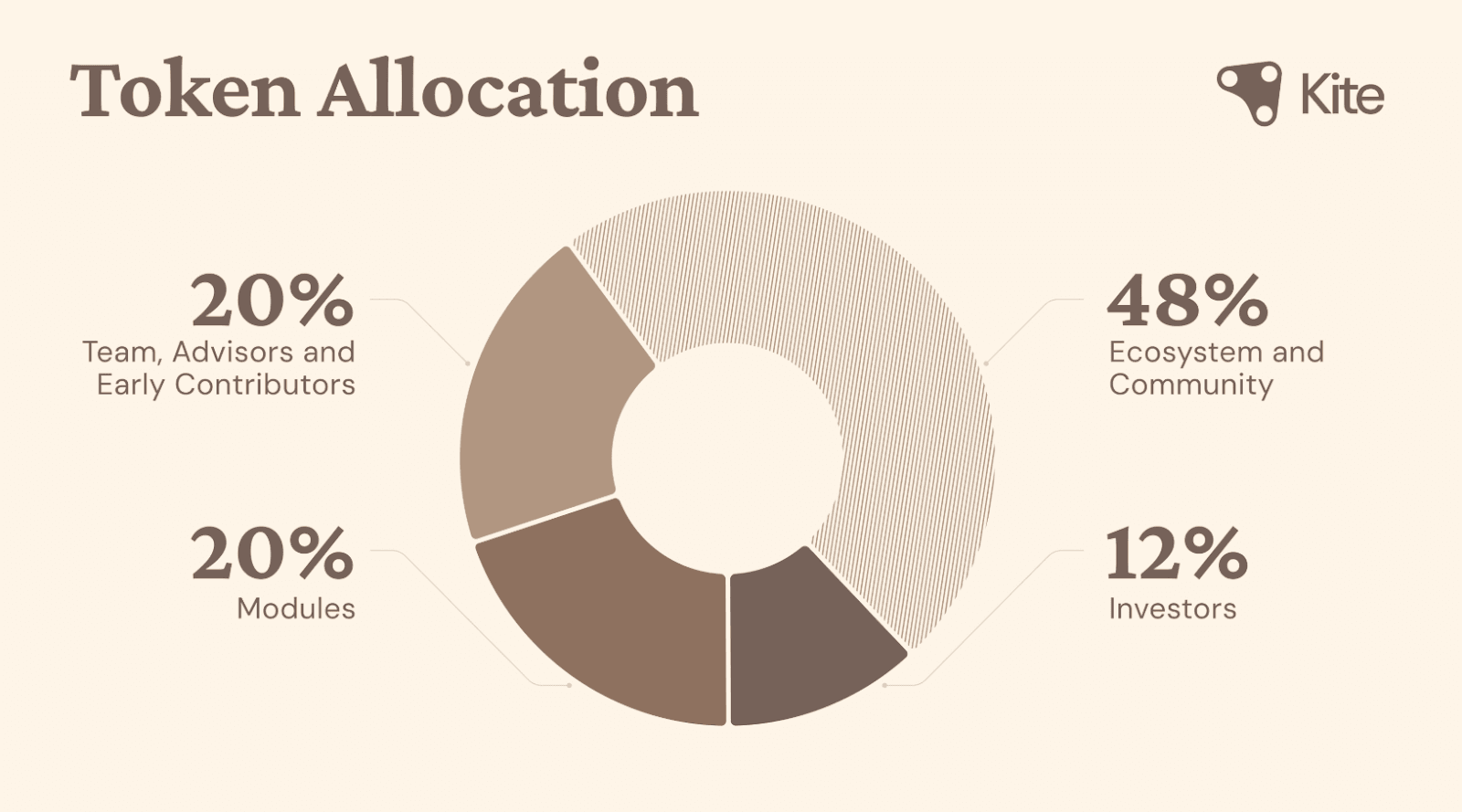
The total supply of KITE is capped at 10 billion tokens. Initial allocation consists of 48% for ecosystem and community development, 12% for investors, 20% for modules, and 20% for team and early contributors. Nearly half of the supply supports ecosystem expansion and adoption incentives. Module allocation encourages development of high-quality AI services. The design recognizes that an agent economy requires not only a settlement layer but also active service supply.
Kite introduces a continuous reward mechanism known as the Piggy Bank model. Participants accumulate emissions over time. If they claim and sell tokens, future emissions to that address are permanently forfeited. This creates a structural trade-off between immediate liquidity and long-term alignment. The mechanism discourages short-term extraction and favors sustained participation.
The protocol also plans to derive revenue from AI service transactions. A portion of service fees flows to modules and the network. The design intends to transition from emission-driven incentives to revenue-driven rewards. In this model, token value aligns with observable service usage. As transaction volume grows, protocol income grows. Token demand is linked to real economic activity rather than solely to inflationary issuance. The sustainability of this model ultimately depends on ecosystem adoption and active service markets.
Why do you invest in KITE (Kite AI)?
Kite attracts attention because it decomposes the structural barriers of autonomous agents into protocol-level solutions. As AI agents enter enterprise operations, finance, logistics, and data procurement, the primary risk is not reasoning capability. The risk lies in controllability and accountability. Traditional authorization grants one-time consent without continuous enforcement. If credentials are abused, losses can escalate rapidly. Kite embeds spending boundaries and conditional logic into smart contracts. Risk becomes enforceable rather than advisory.
Another focus area is whether payment economics can support per-request service markets. Agents may call thousands of APIs in short time windows. Traditional fee structures make such behavior uneconomical. Kite reduces per-transaction cost through channel-based micropayments and stablecoin settlement. Pricing granularity increases. Service providers can align cost with actual usage. Consumers pay precisely for consumed resources. This model supports data markets, compute leasing, and API-based AI services.
Interoperability is also critical. Agent economies require shared payment and authorization semantics across platforms. Custom integration for every service limits scalability. Kite’s compatibility with x402 and major agent standards reduces friction. Services can extend existing authentication flows with agent-native payment capabilities. Gradual adoption becomes possible. Network effects require this type of low-friction expansion path.
Is KITE (Kite AI) a good investment?
Investment decisions are personal financial choices. Project analysis instead provides structural evaluation criteria. The first criterion is whether the problem truly requires a protocol-level solution. If future agent commerce remains centralized, programmable constraints at the blockchain layer may be less necessary. If regulatory and enterprise environments demand verifiable authorization and auditability, protocol enforcement becomes more valuable. The second criterion is sustainable transaction flow. Token value capture depends on actual service usage. If agents actively pay per request and service markets grow, token demand can align with network activity. If adoption remains limited, value may depend primarily on market sentiment. A third factor is engineering usability. Identity layers, governance rules, and payment channels must be practical for developers. Security models only matter if they are widely implemented.
Kite completed an 18 million USD Series A in September 2025 led by General Catalyst and PayPal Ventures. Total funding reached 33 million USD. Capital support enables infrastructure development and ecosystem expansion. Funding does not guarantee adoption. It influences execution speed. For investors, the key consideration is whether agent-native commerce becomes a durable economic layer and whether Kite can position itself as that layer.
Explore the latest KITE (Kite AI) price and live chart, trade KITE on FameEX, and access real-time market data! Get started now with a seamless trading experience!
Disclaimer: The information provided in this article is intended only for educational and reference purposes and should not be considered investment advice. Conduct your own research and seek advice from a professional financial advisor before making any investment decisions. FameEX is not liable for any direct or indirect losses incurred from the use of or reliance on the information in this article.