FameEX Today’s Crypto News Recap | June 15, 2026
2026-06-15 07:11:09

The easing of US-Iran tensions, a sharp drop in Bitcoin mining difficulty, and prediction market legal battles headline today's news; meanwhile, Bitcoin rebounded 1.53% past $65K, and Ethereum climbed back above $1,700. According to the latest on-chain and market data, the cryptocurrency market showed a broad recovery over the past 24 hours. Bitcoin and Ethereum both rebounded during the session. Bitcoin (BTC) rose 1.53% and reclaimed the $65,000 level, while Ethereum (ETH) gained 1.95% and moved back above $1,700. As prices recovered, contract open interest and liquidation data both showed sharp fluctuations. Data shows that ETH total contract open interest rose significantly by 6.35% over the past 24 hours, bringing current total open interest to USD 24.401 billion. This reflects a strong increase in trading activity across the derivatives market. On the liquidation side, total crypto market liquidations reached USD 326 million over the past 24 hours. Due to the short-term upside breakout, short liquidations reached USD 233 million and accounted for most of the total liquidations, while long liquidations stood at USD 93.1306 million. By asset, Bitcoin short liquidations reached USD 112 million, while Ethereum short liquidations reached USD 42.5688 million. This indicates that short positions faced heavy liquidation pressure in the short term. It is also worth noting that liquidation intensity remains high on both sides of the market. If Bitcoin falls below $62,564, cumulative long liquidation intensity across major CEXs will reach USD 1.469 billion. Conversely, if Bitcoin breaks above $68,584, short liquidation intensity will reach USD 885 million. For Ethereum, a drop below $1,634 would bring long liquidation intensity to USD 889 million, while a breakout above $1,798 would trigger USD 441 million in short liquidation intensity. In terms of funding rates, BTC’s current 8-hour average funding rate across the market is 0.0007%, while ETH’s is 0.0027%. Both remain relatively neutral. From a broader sentiment perspective, the current Crypto Fear and Greed Index stands at 20, compared with 18 yesterday. Although sentiment has slightly recovered from yesterday’s Extreme Fear reading, the overall macro mood among investors remains deeply pressured by fear. This shows that while prices rebounded today, the market is still focused on consolidation and risk control.
On the macroeconomic front, CME FedWatch data shows that the probability of the Federal Reserve keeping interest rates unchanged in June has reached 98.5%. Market uncertainty over the future direction of monetary policy remains elevated. At the same time, potential policy shifts are also emerging across the Asia-Pacific region. Market economists noted that several central banks may be entering a synchronized rate-hiking cycle. The Bank of Japan may raise rates toward the key psychological level of 1%, while the Federal Reserve could also shift to a more hawkish stance by the end of this week. This has further increased macro pressure on global risk assets. In terms of sector performance, the DeFi sector posted the strongest performance today, rising 3.34% over the past 24 hours. LAB gained 17.39%, Genius rose 8.29%, and Hyperliquid advanced 4.86%. In addition, the DePIN sector rose 2.64%, the AI sector gained 2%, and both the Layer1 and Layer2 sectors recorded gains close to 2%. In contrast, the NFT sector, which had previously seen strong gains, fell sharply by 15.58% over the past 24 hours. Audiera dropped 26.56% within the sector. This shows that sector rotation and profit-taking remain highly visible across the market.
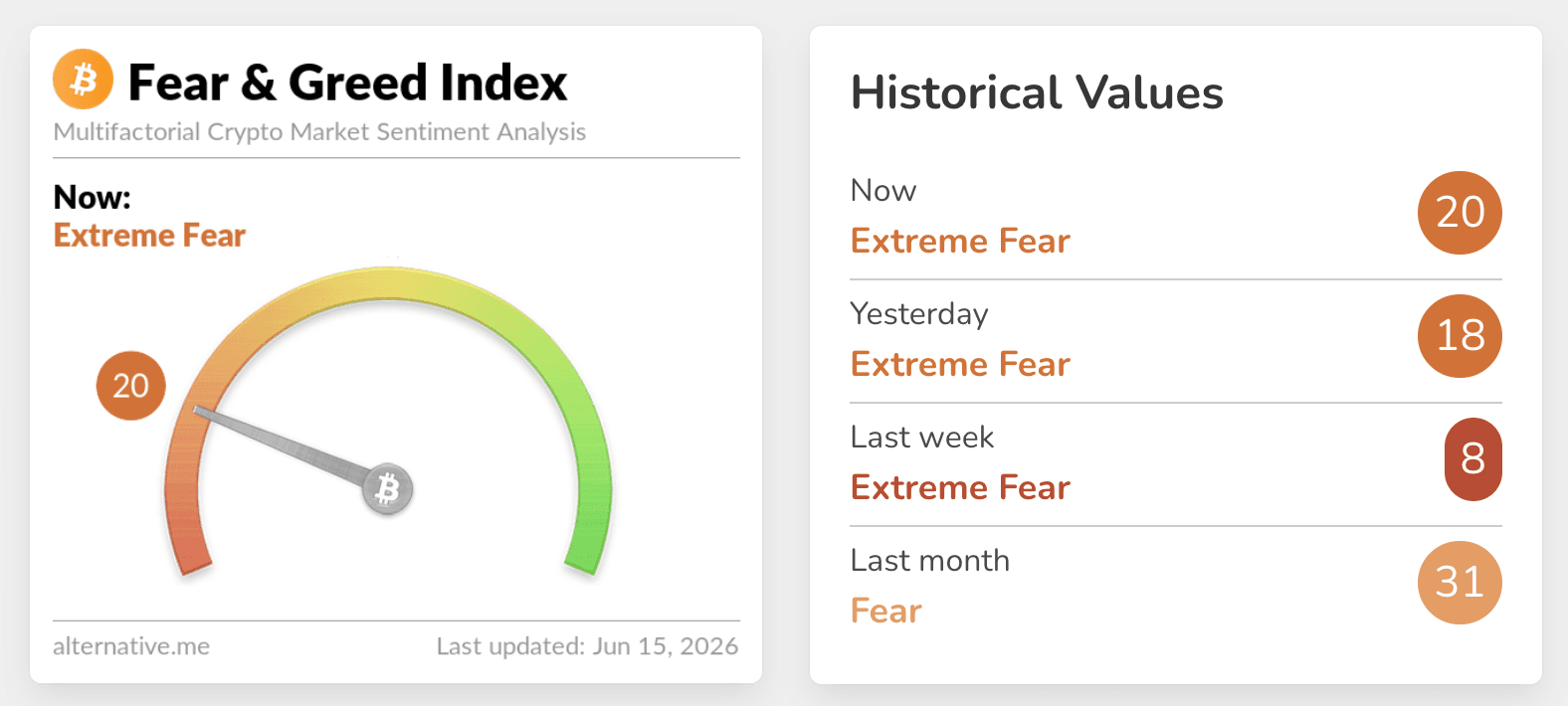
Source: Alternative
Key News Highlights:
US-Iran Geopolitical Tensions Show Signs of a Peace Breakthrough, While Analysts Expect Risk Asset Liquidity to Benefit From Easing Geopolitical Pressure
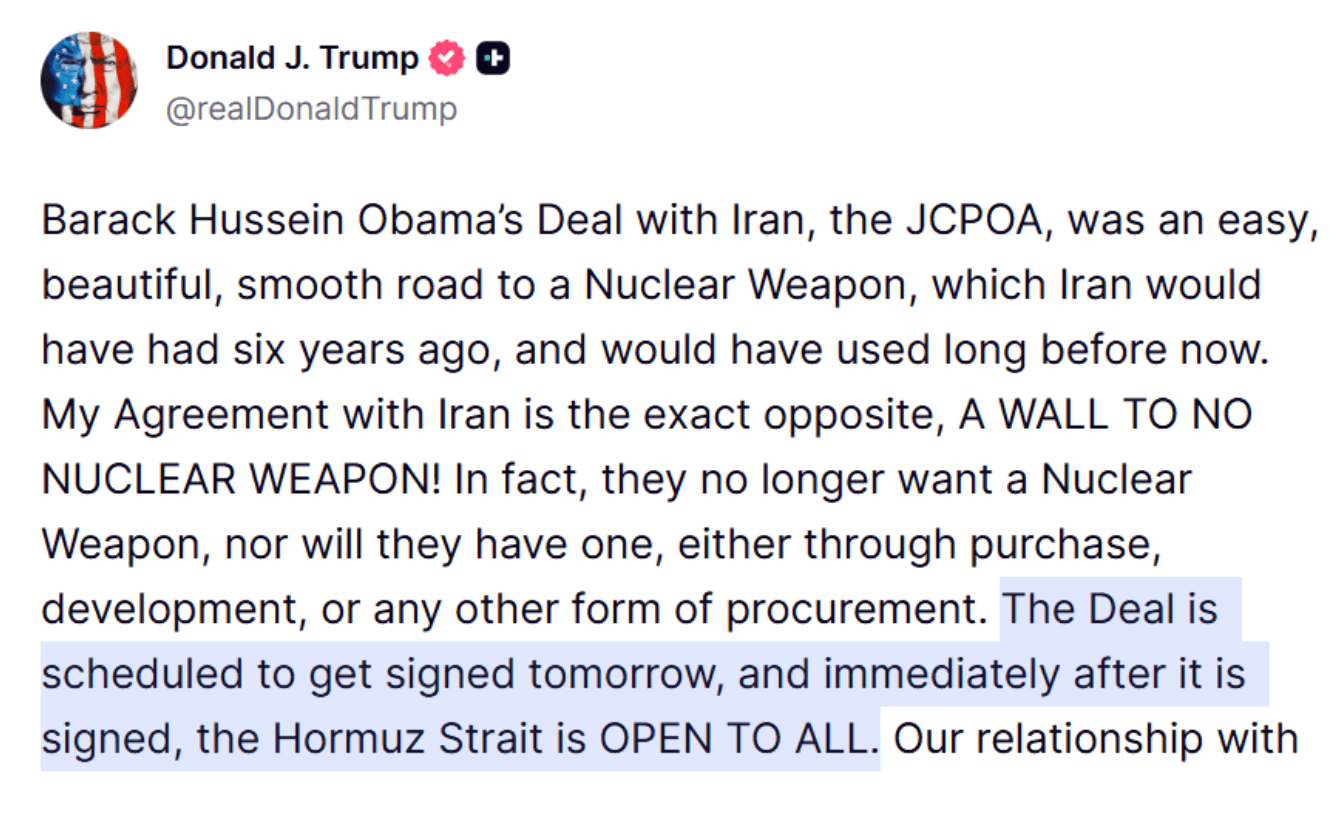
The US-Iran situation may be approaching a major turning point. US President Donald Trump claimed on social media that a memorandum of understanding aimed at ending the conflict between the United States and Iran is scheduled to be signed on Sunday. He also emphasized that once the agreement is signed, the previously blockaded Strait of Hormuz will immediately reopen to all countries. Pakistan, which has acted as a mediator in the US-Iran talks, also confirmed through Prime Minister Shehbaz Sharif that both sides are closer than ever to reaching a peace agreement. The finalization process is expected to be completed within 24 hours, and Pakistan has already prepared for the subsequent electronic signing and technical-level talks next week. However, Iranian officials have not fully confirmed whether the agreement can be signed on Sunday. Iranian Foreign Ministry spokesperson Esmaeil Baghaei told state media that the memorandum could be signed in the coming days, but the exact date still needs to be confirmed. He also made clear that it would not be completed on Sunday. Although the specific timeline remains uncertain, global markets are closely watching the development. Analysts noted that months of naval blockade have disrupted one-fifth of the world’s oil and liquefied natural gas supply. This has pushed up global asset prices and caused a severe shock to market sentiment. It was also one of the key factors pressuring the crypto market earlier. Crypto market analysts said that if the United States and Iran successfully reach a peace agreement and reopen the Strait of Hormuz, global macro sentiment may see a major release. Liquidity is expected to flow back into risk assets, including cryptocurrencies. Research institutions also added that recent outflows from digital asset investment products were mainly driven by geopolitical uncertainty. As geopolitical risks potentially ease, Bitcoin prices and spot ETF inflows could receive stronger positive support.
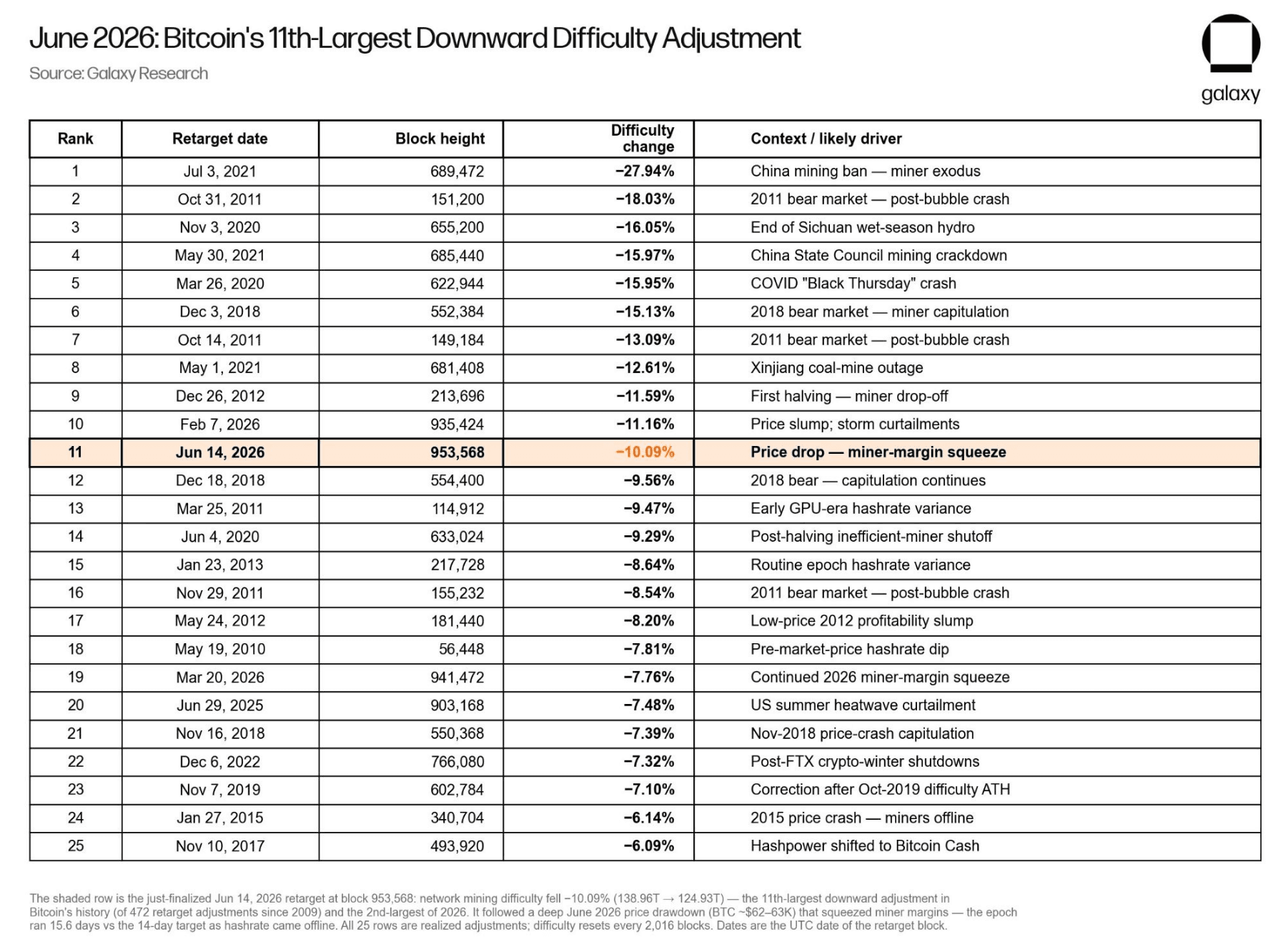
Bitcoin Mining Difficulty Posts the 11th Largest Historical Downward Adjustment While Falling Hashrate Eases Pressure on Miner Margins
The Bitcoin network recorded its second-largest mining difficulty drop of the year, giving cost-pressured miners some room to recover. According to the latest research data from Galaxy Research, the Bitcoin network completed its latest difficulty adjustment on Sunday at block height 953,568. Mining difficulty fell 10.09% from 138.96 trillion to 124.93 trillion. This double-digit drop was not only the second-largest decline of 2026, but also the 11th largest downward difficulty adjustment in Bitcoin’s history. Compared with the all-time high reached last November, current mining difficulty has now fallen by a cumulative 20%. The research team noted that Bitcoin has fallen by around 15% so far in June, which has heavily compressed miner profit margins. This has forced many less efficient or high-cost mining machines offline. As a result, the actual duration of this difficulty adjustment epoch stretched to 15.6 days, which is notably longer than the usual 14-day interval. With a large amount of hashrate exiting the network, Bitcoin’s total network hashrate has fallen to 886 EH/s. It is down 12% so far this month and 23% below last October’s peak. However, the decline in network hashrate also means that miners still operating on the network now face lower competition. A senior market trader noted that after this major difficulty drop, the average revenue per active mining machine has increased by around 9%. Meanwhile, Hashprice, a core metric used to measure expected miner revenue, has also rebounded by 13% and is now back to $33 per Petahash per day. Industry media noted that this level is a critical breakeven threshold. It could allow more mining firms using efficient machines to return to gross breakeven, while older-generation machines with high electricity costs may remain shut down.
CFTC Sues New Mexico as the Legal Battle Over Prediction Market Jurisdiction Continues to Escalate
The regulatory battle over jurisdiction in decentralized prediction markets has expanded again, with New Mexico becoming the latest US state drawn into legal proceedings. The Commodity Futures Trading Commission (CFTC) recently filed a lawsuit in federal court against New Mexico Governor Michelle Lujan Grisham, state Attorney General Raúl Torrez, and members of the New Mexico Gaming Control Board. The lawsuit aims to block the state from using state-level gaming laws to regulate or restrict CFTC-registered contract markets. The case stems from a lawsuit filed by New Mexico authorities against prediction market platform Kalshi on June 4. The state accused the company of offering illegal sports betting services to residents without a gaming license. It also argued that the platform’s sports event contracts are functionally equivalent to traditional sports betting. In addition, the state accused the platform of allowing users aged 18 to 20 to trade, which would violate New Mexico’s minimum gambling age of 21. In response, the CFTC strongly rejected the state’s position in its complaint. It insisted that such event contracts qualify as swaps under federal commodity law, and that Kalshi, as a Designated Contract Market (DCM), should be protected under the CFTC’s exclusive jurisdiction granted by federal law. CFTC Chairman Mike Selig said in a statement that New Mexico’s attempt to impose local gaming laws on a federally regulated derivatives exchange seriously intrudes on the exclusive federal framework designed by Congress to oversee US commodity derivatives markets. However, there are also differing views within the federal regulatory landscape. Former SEC and CFTC Chair Gary Gensler questioned the CFTC’s argument in an amicus brief filed with the Sixth Circuit. Gensler said in a media interview that the Dodd-Frank Act, passed in 2010 to respond to the financial crisis and regulate swaps used to hedge economic risks, did not include sports betting contracts within its statutory definition. He also argued that sports betting rarely involves hedging economic risk. In his view, Congress never intended to strip states of authority over such activities.
Silicon Valley VC Giant a16z Opens Seoul Office as Part of Its Strategic Expansion Into the Asia-Pacific Crypto Market
Global venture capital firm Andreessen Horowitz (a16z), which manages around USD 100 billion in assets, announced today that its Seoul office in South Korea has officially opened. This marks a major physical expansion completed roughly six months after the firm announced its Asia-Pacific expansion strategy last December. a16z said the core purpose of establishing the Seoul office is to provide comprehensive support for its portfolio companies as they enter South Korea and the broader Asian market. As a VC firm that has backed and helped grow global technology leaders such as SpaceX, Instagram, Facebook, and Airbnb at early stages, a16z emphasized that it will go beyond the traditional capital investment model. The firm plans to rely on its deep global network to support portfolio companies. When explaining why it chose South Korea as its strategic hub in the Asia-Pacific region, the a16z team pointed to the country’s strong global competitiveness across artificial intelligence (AI), advanced manufacturing, defense, cryptocurrency, digital content, and consumer goods. It also highlighted South Korea’s high-quality technical talent pool and strong market acceptance of new technologies. Notably, the Seoul office will initially focus its core strategy on cryptocurrency and Web3, before gradually expanding its activities into other technology sectors. The office will be led by SungMo Park, who was appointed late last year as a16z’s Asia-Pacific go-to-market (GTM) lead. He previously built deep industry experience at South Korean internet giant Naver and the Monad Foundation, a well-known blockchain project. Park said the Seoul office will serve as a bridge, using a16z’s rich ecosystem resources to actively promote and accelerate the growth of global Web3 portfolio companies in South Korea and across the Asia-Pacific market.
Disclaimer: The information provided in this section is for informational purposes only and doesn't represent any investment advice or FameEX's official view.