FameEX Today’s Crypto News Recap | June 18, 2026
2026-06-18 07:09:03

Tether winds down aUSDT stablecoin as macro fears grow over Fed policy and Trump comments, while Kentucky sues prediction markets amid massive altcoin spot outflows. The global crypto market remained weak under the dual pressure of macroeconomic uncertainty and hawkish signals from the Federal Reserve. The Fear and Greed Index has fallen to 22, placing the market back in the Extreme Fear zone and showing that overall sentiment remains deeply depressed. According to the latest derivatives market data, total liquidations across the crypto market reached USD 439 million over the past 24 hours. Long liquidations dominated the market at USD 307 million, while short liquidations stood at USD 132 million. By asset, BTC long and short liquidations reached USD 97.4075 million and USD 44.5226 million. ETH long and short liquidations reached USD 81.6489 million and USD 34.5801 million. A total of 106,743 traders were liquidated across the market. The largest single liquidation occurred on a major CEX and was valued at USD 4.9661 million. From the current funding rate structure, BTC’s average 8-hour funding rate across the market stood at 0.0017%. Funding rates on major CEXs ranged between -0.0004% and 0.0037%. ETH’s average funding rate stood at 0.0024%, reflecting a tense balance between long and short positions at current price levels. Market analysts noted that if BTC breaks above $67,738, cumulative short liquidation intensity on major CEXs could reach USD 1.241 billion. If BTC falls below $61,414, cumulative long liquidation intensity could reach USD 713 million. For ETH, a breakout above $1,841 could trigger USD 879 million in short liquidation intensity. A drop below $1,668 could bring USD 451 million in long liquidation intensity. On the macro front, Citi has pushed back its Fed rate cut forecast to October 2026, December 2026 and January 2027. Analysts from Goldman Sachs and other institutions have warned that if inflation remains elevated, the Federal Reserve could restart rate hikes as early as September. New Fed officials have also suggested that the case for rate hikes is building. This has pushed market expectations in a more hawkish direction. Short-term Treasuries came under selling pressure, while risk assets broadly weakened. In addition, European Central Bank President Christine Lagarde was reportedly said to have directly ordered Greece to reject the MiCA license application of a major CEX. The platform was then forced to turn to France for authorization. This move reflects broader regulatory pressure on major crypto firms and adds more uncertainty to the market structure and future compliance outlook.
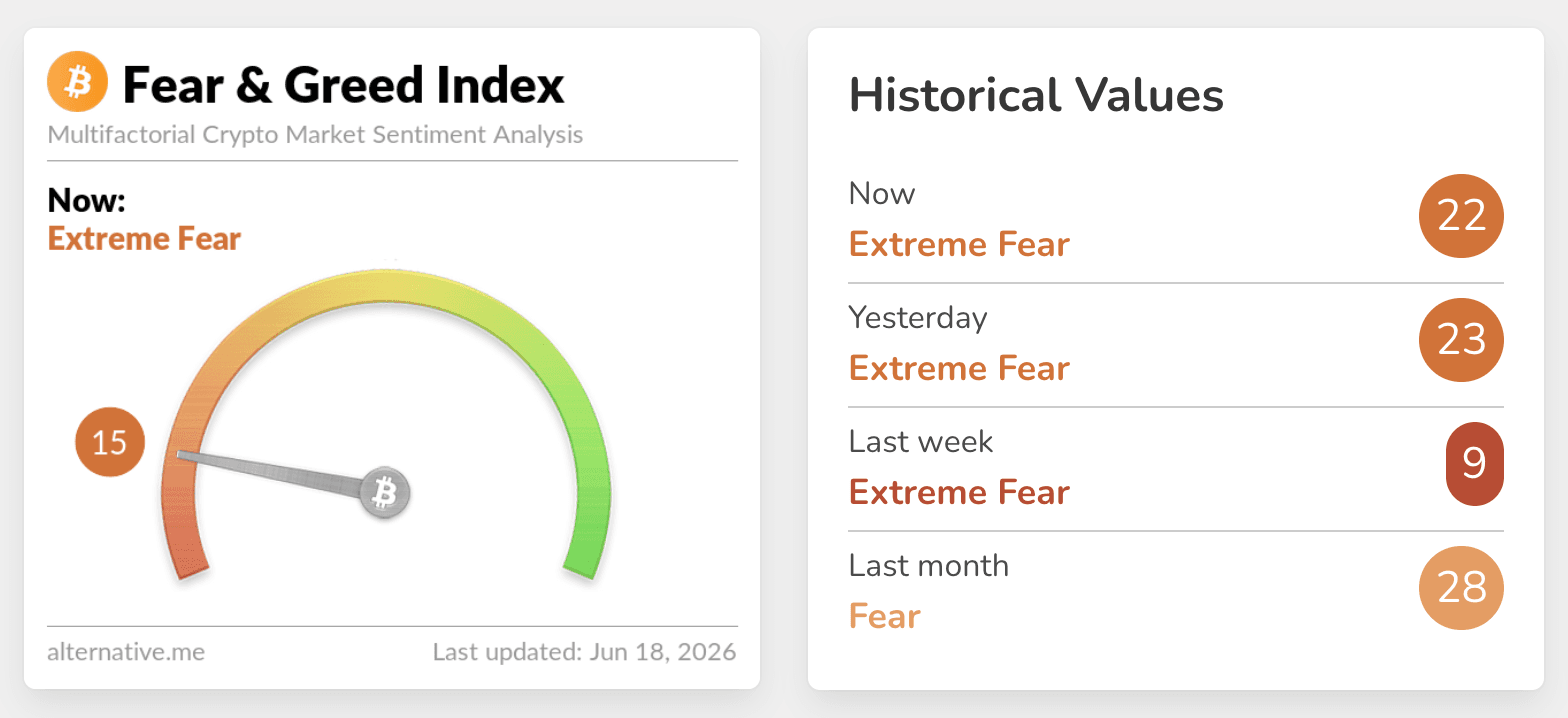
Source: Alternative
Key News Highlights:
Tether Winds Down Gold-Backed Derivative Stablecoin aUSDT
Stablecoin issuer Tether has officially announced that it will gradually wind down Alloy by Tether and its gold-backed, overcollateralized derivative stablecoin aUSDT over the coming months. The decision follows a strategic review of user activity, market demand and broader business priorities. Tether said it will focus its resources on core products with stronger user demand, deeper liquidity and greater long-term market potential. This includes XAUT, its gold-backed digital asset with a market capitalization of USD 3 billion. Alloy by Tether was launched in June 2024. The platform allowed users to deposit XAUT as collateral to mint aUSDT. At present, aUSDT has a market capitalization of USD 1.2 million and is backed by 14.73 kilograms of physical gold worth around USD 2.2 million. According to the official announcement, users will have three months to return their aUSDT and redeem the corresponding XAUT digital assets. The deadline is September 17. Although aUSDT is being phased out, XAUT remains well-received by the market. It is currently backed by 22,169 kilograms of physical gold. Its market capitalization has pulled back by 19% after gold prices hit an all-time high of more than $5,300 per ounce earlier this year. Even so, the company acquired a 12% stake in precious metals platform Gold.com for USD 150 million in February and plans to further integrate XAUT into the platform. Besides aUSDT, Tether has also discontinued its Chinese yuan stablecoin CNHT this year due to changing market conditions and limited community demand. It also wound down its euro stablecoin EURT in response to European regulatory issues. These moves show that Tether is shifting its strategic focus toward the Hadron asset tokenization platform and technology areas beyond stablecoins. The company has also continued to expand into Bitcoin mining infrastructure, artificial intelligence, cloud computing and robotics. Most recently, it led a USD 1 billion funding round for German technology company NEURA.
Kentucky Sues Kalshi and Polymarket Prediction Market Platforms
Kentucky Attorney General Russell Coleman has filed lawsuits in state court against Polymarket, Kalshi and Kalshi’s partners, including a major CEX, Robinhood and Webull. The lawsuit accuses these platforms of operating unauthorized and illegal sports event betting and gambling businesses within the state. Kentucky officials argue that the sports event contracts offered by these prediction market platforms fall squarely under the state’s definition of sports wagering. They also claim that the platforms operated without local gaming licenses and failed to comply with state-level regulations. The state further alleged that the platforms did not provide users with sufficient resources to identify or seek help for gambling addiction, as required under state law. This legal action makes Kentucky the latest US state to join the growing legal battle against prediction markets. At least 17 states have already taken legal action against similar operators, drawing involvement from the US Commodity Futures Trading Commission and the White House. In response, a Polymarket spokesperson said Kentucky’s action conflicts with the regulatory framework established by the CFTC for prediction markets and that the company looks forward to resolving the dispute through the proper legal process. A Kalshi spokesperson emphasized that Kalshi is a federally regulated exchange and that its direct regulator is the CFTC, not state governments. Legal outcomes across the US have so far been mixed. A federal judge in Michigan recently ruled against Polymarket and found that its sports event contracts are not swaps under the CFTC’s authority. In contrast, the Third Circuit Court of Appeals ruled in April in favor of Kalshi and blocked New Jersey regulators from preventing the platform from offering sports contracts in the state. As Kalshi and Polymarket recorded a monthly trading volume of USD 25 billion in May, lawsuits from multiple states could limit their access to some of the largest regional markets in the US. US officials have previously stated that maintaining the CFTC’s exclusive authority over prediction markets is critically important.
Crypto Market Treads Thin Ice Under Hawkish Fed Signals And Trump’s Iran Comments
The US stock market and crypto market both saw broad volatility on Wednesday after US officials issued mixed comments on the Iran peace agreement and stated that the memorandum of understanding was not final. Investors grew concerned that oil flows through the Strait of Hormuz may not recover quickly, which could keep inflation pressure elevated. Although Brent crude fell to its lowest level in 100 days, traders remained skeptical that lower energy prices would be enough to suppress inflation for long. The US 5-year Treasury yield stayed at 4.16%, showing that investors still lack confidence in near-term Fed rate cuts and continue to demand higher returns on government bonds. In parallel, a new Federal Reserve official chaired the first Federal Open Market Committee meeting under his leadership. The decision to keep interest rates unchanged was widely expected, but his hawkish focus on fighting inflation made market sentiment more cautious. Nasdaq 100 futures, which are heavily weighted toward technology stocks, have traded 2% below their all-time high. Bitcoin has also failed to hold firmly above $80,000 since mid-May. Part of this weakness comes from a lack of institutional demand. Data shows that US-listed spot Bitcoin ETFs have recorded USD 2.1 billion in net outflows so far in June, further confirming the retreat of institutional capital. In addition, recent weakness in Strategy’s high-yield preferred perpetual stock Stretch has added to negative market sentiment. The stock offers holders an 11.5% yield, but new share issuance is limited by the fixed issuance price. This increases pressure on the company as it needs to pay USD 142 million in monthly cash dividends. It faces a difficult choice between diluting existing shareholders and reducing its current USD 1.1 billion cash reserves. These financial leverage concerns have weakened confidence in its total preferred share base of USD 15.5 billion and have added pressure to the broader crypto recovery process.
Altcoin Selling Tops USD 266 Billion As Market Watches Capital Rotation
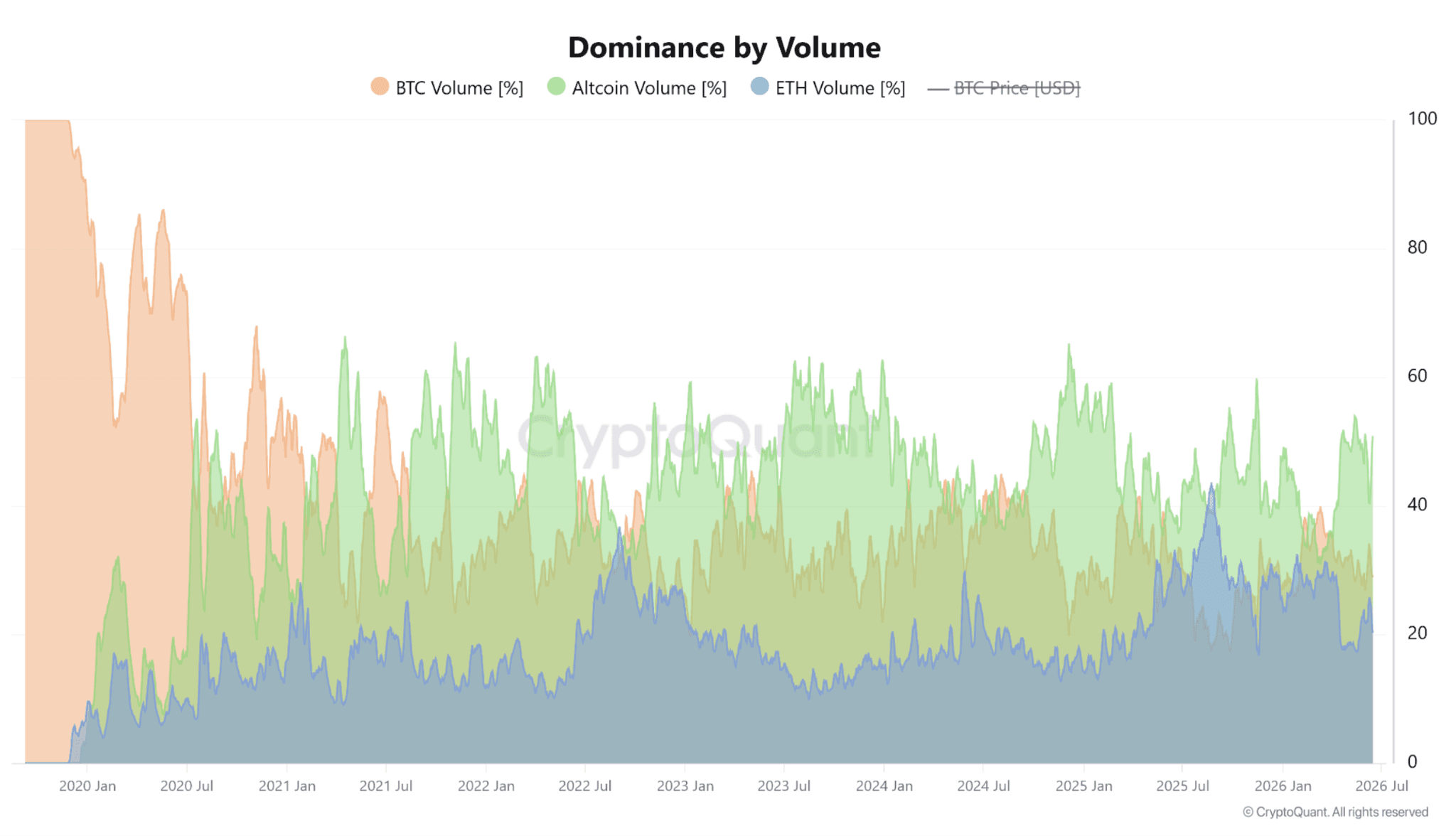
According to on-chain data providers, spot demand for altcoins excluding Ethereum has fallen to its weakest level in six years. The one-year cumulative buy-sell difference for altcoins on centralized exchanges dropped to negative USD 266 billion on June 16. This marks the lowest level since the metric began tracking spot demand in 2020. Despite heavy pressure in the spot market, derivatives trading in altcoins remains highly active. Data shows that altcoins accounted for 51% of daily futures trading volume on a major CEX on June 16. This was far above Bitcoin’s 28.85% and Ethereum’s 20.20%. The divergence between elevated futures activity and extremely weak spot demand suggests that capital is mainly circulating within the altcoin derivatives market rather than entering through new spot inflows. At the same time, exchange-held stablecoin balances have barely changed since December 2024. The exchange supply ratio for ERC-20 stablecoins has stayed between 0.40 and 0.46 for an extended period. This means that around 40% to 46% of circulating stablecoins have remained on exchanges for more than one year. The major CEX also holds 25% to 30% of total stablecoin supply. This shows that market liquidity remains available, but capital allocation has become highly cautious. Some capital that once belonged to the crypto market is now moving into traditional asset derivatives. Data shows that metals futures trading volume on the exchange reached nearly USD 500 billion in March 2026 as gold and silver prices hit record highs. Trading volume in pre-IPO perpetuals surged from USD 2 million in March to USD 715 million in May and USD 2 billion in June. The major CEX processed USD 10.3 billion in pre-IPO perpetual trading volume in June. This was about 20 times higher than the entire month of May and accounted for around 83% of the segment. The growth of metals, oil, equities and pre-IPO contracts clearly shows that exchange users are increasingly allocating liquidity across different asset classes. At the same time, the traditional altcoin spot market is facing a major challenge from capital diversion.
Disclaimer: The information provided in this section is for informational purposes only and doesn't represent any investment advice or FameEX's official view.