FameEX Today’s Crypto News Recap | July 29, 2026
2026-07-29 07:28:08
South Korea advances crypto rules as Tether explores tokenized securities in Nairobi and Visa expands stablecoin payments; today’s BTC price fluctuated around $63.9K. Bitcoin and Ethereum remained range-bound as volatility increased across global risk assets. BTC is currently trading at around $63.9K. It briefly fell to $62,772 during the day before recovering to around $64K. Its overall performance continues to be shaped by changes in market liquidity and risk appetite. Asian stock markets declined sharply today as investors reassessed the valuations of AI-related stocks, corporate capital spending, and earnings prospects. South Korea’s major stock indexes extended their losses. Shares of several large semiconductor companies also fell sharply, triggering concentrated liquidations among retail investors. Volatility in the equity market prompted crypto market participants to reduce short-term risk exposure. Many investors are now waiting for further signals from the Federal Reserve and upcoming earnings reports from major technology companies. U.S. spot Bitcoin ETFs have recorded net outflows for four consecutive trading days. Total net outflows reached approximately USD 49.7544 million in the previous session, which suggests that some institutional investors are still adjusting their positions. The Crypto Fear and Greed Index currently stands at 29 and remains in the Fear range. It is unchanged from yesterday but below last week’s 33. Overall, BTC and ETH remain within their recent consolidation ranges. Trading activity continues to focus on controlling leverage, reducing concentrated exposure, and waiting for greater clarity on the macroeconomic outlook.
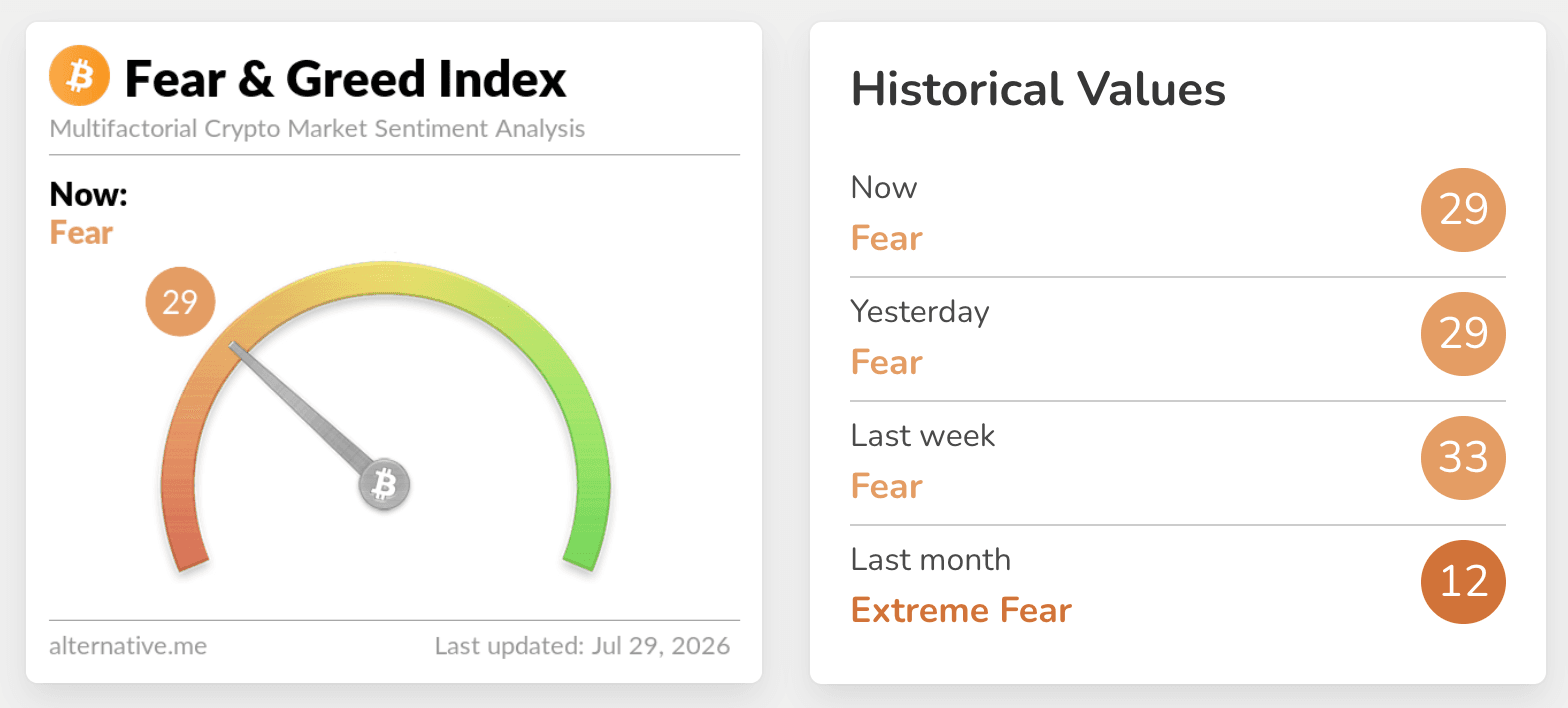
Source: Alternative
Key News Highlights:
South Korea Plans Unified Digital Asset Rules as Opposition Pushes to Repeal Crypto Tax
South Korea’s Financial Services Commission plans to work with the ruling party on a consolidated Digital Asset Basic Act. The proposed framework would establish unified rules for stablecoins and other cryptocurrency businesses. The draft is expected to cover the issuance and circulation of stablecoins. It would also set operating requirements for digital asset businesses and market entry standards for trading platforms. Additional provisions are expected to address disclosures, internal controls, asset management, and system resilience. Ten digital asset and stablecoin bills are currently pending in South Korea’s National Assembly. However, lawmakers have yet to reach an agreement on several core regulatory issues. One major point of dispute is whether issuers of won-denominated stablecoins should be majority-owned by banks. Another issue is whether ownership limits should apply to major digital asset trading platforms. At the same time, South Korea’s opposition party is seeking to repeal the crypto income tax scheduled to take effect on January 1, 2027. Under the current framework, annual income above 2.5 million won from the transfer or lending of digital assets would be subject to a 20% income tax and a 2% local income tax. The repeal bill and a related petition supported by more than 50,000 people still need to be reviewed by a National Assembly subcommittee. No formal review date has been announced.
Tether and Nairobi Securities Exchange Explore Tokenized Securities
Tether has signed a memorandum of understanding with the Nairobi Securities Exchange. The two parties will study how blockchain technology could be applied to Kenya’s capital markets. The cooperation will cover tokenized securities, blockchain-based market infrastructure, and digital asset education. They will also assess whether a tokenization platform could be used to issue and trade securities. This could allow traditional financial assets to be recorded and transferred through blockchain networks. The memorandum also covers instant settlement mechanisms. These systems could reduce the time required to complete the settlement of traditional securities transactions. Subject to Kenyan regulations, the two parties will also explore the potential use of USDT as a digital settlement infrastructure layer. The agreement remains exploratory and does not mean that any related product has officially launched. Industry data shows that the total on-chain value of real-world assets, excluding stablecoins, is approximately USD 36.8 billion. The market would be significantly larger if stablecoins were included. This reflects the growing interest of traditional financial institutions in asset tokenization. The cooperation will primarily assess whether technology, regulation, and market infrastructure can jointly support the issuance, trading, and settlement of tokenized securities.
Visa Outlines Stablecoin Platform and Payment Infrastructure Strategy
Visa provided further details about its stablecoin strategy during its fiscal third-quarter earnings call. The company said it is participating across several layers of the stablecoin ecosystem. Its strategy covers blockchain networks, stablecoin issuance, wallet services, market infrastructure, transaction orchestration, and payment applications. Visa has joined the OpenStandard consortium. The group plans to launch a stablecoin called OpenUSD to support global money movement. Visa’s stablecoin platform will allow partners to settle transactions with the company using stablecoins. The platform is also expected to provide on-chain wallet infrastructure. It will support the movement of funds between fiat currencies and stablecoins. Visa also plans to integrate the platform with Pismo to help financial institutions offer tokenized deposit services. The company may connect with third-party tokenized deposit infrastructure providers in the future. Visa views stablecoins as part of the future backend infrastructure for commercial payments. It also believes AI agents could change how consumers initiate transactions and complete payments through front-end applications. Visa reported fiscal third-quarter revenue of USD 11.6 billion, up 14% from the same period last year. Cross-border payment volume and processed transactions both recorded double-digit growth.
Ten European Financial Institutions Launch RL1 Cooperative Blockchain Network
Ten European financial institutions have jointly established Regulated Layer One, also known as RL1. The network is designed as a blockchain cooperative for regulated financial markets. RL1 has been established in Luxembourg as a European Cooperative Society and has officially begun operations. Its founding members include several European banks, investment firms, and financial technology companies. The organization uses a member-owned governance model. Each member has equal decision-making rights over the network’s development and governance. RL1 is a private and permissioned blockchain. Only authorized institutions that meet regulatory requirements can participate. Its underlying infrastructure was developed by a German fintech company. Ownership of the network was later transferred to the cooperative. The platform has processed more than 50 transactions during the past three years of production use. Their combined value exceeded EUR 700 million. The network is expected to support institutional use cases such as digital money, tokenized bonds, on-chain collateral, and blockchain-based settlement. Members aim to use the shared network to reduce technological fragmentation, duplicated investment, and interoperability barriers. These issues often arise when financial institutions build separate distributed ledger systems. RL1 is also discussing potential membership with additional financial institutions. Its membership base may continue to expand.
Disclaimer: The information provided in this section is for informational purposes only and doesn't represent any investment advice or FameEX's official view.